
CARE's efforts to provide aid to Gaza, Sudan, and more
Clip: 9/26/2026 | 14m 26sVideo has Closed Captions
CARE's efforts to provide aid to Gaza, Sudan, and more
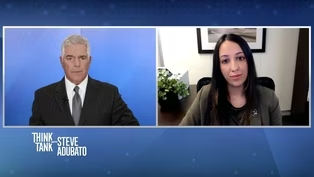
President and CEO of CARE, Michelle Nunn, talks with Steve Adubato about the organization’s efforts to provide humanitarian aid, critical advocacy, and hope to people impacted by conflict in Gaza, Sudan, and throughout the world.
Problems playing video? | Closed Captioning Feedback
Problems playing video? | Closed Captioning Feedback
Think Tank with Steve Adubato is a local public television program presented by NJ PBS
CARE's efforts to provide aid to Gaza, Sudan, and more
Clip: 9/26/2026 | 14m 26sVideo has Closed Captions
President and CEO of CARE, Michelle Nunn, talks with Steve Adubato about the organization’s efforts to provide humanitarian aid, critical advocacy, and hope to people impacted by conflict in Gaza, Sudan, and throughout the world.
Problems playing video? | Closed Captioning Feedback
Where to Watch Think Tank with Steve Adubato
Think Tank with Steve Adubato is available to stream on pbs.org and the PBS app.
Providing Support for PBS.org
Learn Moreabout PBS online sponsorship- We are honored to be joined by Michelle Nunn, who is the President and CEO of a terrific organization called CARE.
As their website is up, Michelle's gonna tell us a little bit about the organization.
Michelle, welcome to the program.
- Thank you so much for the opportunity.
- CARE was established back in 1946.
- That's right, that's right, it was just- - Right after World War II.
- Just after World War II, a couple of Americans who said, "We're not gonna stand by and watch people starve in Europe, and we're gonna do something about it."
And they actually invented the world's first care packages, which stood for something like cooperative assistance and relief in Europe.
And they figured out how to get 15,000 care packages from Philly to Le Havre, France.
And that became a part of a movement where over 100 million care packages were delivered.
And we now serve, you know, the continued legacy of that work is reaching 60 million people last year in 100 plus countries.
- How'd you get into this?
- You know, I have always been an admirer of CARE, but I've spent most of my career in the civic sector.
And over 10 years ago, the opportunity to save lives, defeat poverty, be a part of this extraordinary mission that centers women and girls and families around the world came up.
And I can't think of anything that's more important.
- So CARE does its work in a variety of countries, correct?
- That's right, over 100.
- Let's focus on Gaza.
Describe for us the suffering going on in Gaza.
- Yeah, it is hard to put words to the threshold of suffering that has happened over these last few years in Gaza and that continues.
And so if you think about two million people in the most concentrated and dense place on earth, and then you reduce that to a third of that land size, and that's where all of the population, those two million people are now existing.
And then you compound that with over, you know, 70,000 people killed, hundreds of thousands that have been injured, a system that is still heavily reliant upon food that comes in very limited and constrained environment, a food security situation that labels insecure almost 2/3 of the population.
And then you think about, you know, what does that look like for one family?
As an example, one of the women that CARE serves there, Diana, was telling us that she and so many women can no longer breastfeed because they themselves have faced such a threshold of hunger that their children can no longer get the nutrients that they need.
And not to mention school, shelter, and just basic capacity for people to have access to health, as an example.
Tens of thousands of people that are waiting for evacuations.
So it's a very, very complex and also challenging humanitarian situation.
- At the same time, there've been significant humanitarian aid cuts.
- That's right.
- Describe those cuts.
Where the cuts come from and what has been the impact of those cuts?
- Yeah, well, the US government itself has cut an extraordinary amount of its funding.
Now, America has always been a generous nation over these last 80 years of, for instance, CARE's history post-World War II, and the US was supporting almost 40% of the broader humanitarian infrastructure.
Now, if you think about that from a percentage perspective from a GDP, that was not outsized from, and many other countries actually were giving more at a ratio, but it's been an important player and that was dramatically cut, you know, in the early days of the administration, has been gradually, there have been some restoration of that, but still significant cuts.
And those have now been continued and extended by other countries throughout Europe and around the world.
So what we're seeing is the greatest sort of percentage cut in humanitarian aid in the last 80 years.
And at the same time, as you well know and as you've articulated, you have needs that are increasing and growing.
So it's a great disconnect between needs and resources.
- So CARE does not get involved in politics?
- That's right, we're nonpartisan, yep.
- However, CARE has a need to communicate to the federal administration, the Trump administration, what the impact of these cuts is on innocent women, children, others in places like Gaza, correct?
- Yeah, we think it's our duty to bear witness to the impact that cuts around the world are having, you know, both from the US government and other governments.
And to also say that, you know, we believe that with the restoration of investment and resources, not only will we meet our human obligations, our humanitarian obligations, but it also supports our security, economic, national health security.
We see this in an Ebola crisis so vividly.
And so, you know, that is our opportunity to speak.
And we believe that there is bipartisan support.
And we also believe that we need to rebuild that constituency and have the American people, you know, to really tell their policymakers that we believe that an investment of less than a penny on a dollar to ensure that we, you know, again, show global solidarity, invest in meaningful solutions, impact and save lives, millions of lives on an annual basis is a worthy investment.
- The website's up again.
People want to be helpful.
They go on the website.
The obvious one is contributing money.
Anything else they can do?
- Absolutely, I mean, obviously even, you know, $10 makes a difference and I think we don't want people to lose sight- - Michelle, explain to folks what 10, sorry for interrupting.
Someone says, oh yeah, Michelle said $10 makes a difference.
Explain to folks the difference it makes.
- I mean, look, $10 and over a period of months can feed literally dozens of families in places like Sudan and places like Gaza and can make a meaningful difference.
You know, hundreds of dollars can ensure that someone receives a secondary education.
Imagine the extension of that and the change that that means in their lives and trajectory or provide basic water and food and nutrition to someone and health services.
So, you know, every dollar counts.
But I also, as you said, it's also about people lifting up their voices.
And, you know, quite simply, if you go on our website, you can also learn, how can I tell my policy leader, whoever that might be, a legislator in Congress, the administration, that, you know, we believe in America's generosity, we believe in America's leadership in the world, and we believe that, you know, an investment, a right-sized investment in strategic ways around our economic international security and our humanitarian mandate is really one that we stand behind.
- You know, so you mentioned water.
First, help us understand the water situation in Gaza and then the lack of homes.
Homes have been destroyed.
- Yeah.
- Where are people living?
- You know, I was in Gaza, you know, almost five years ago, and I will tell you then that there were issues with water.
I mean, just people having the access to just clean their hands, their bodies without getting a rash because the water was so problematic.
And now imagine that, you know, so much of that is now they're dependent upon, you know, bottles from outside.
What we need to do and what CARE is helping to do is to replace and support the capacity for Gaza to support itself.
And that means that there's desalination plants, there's water, that water basically facilities that CARE and others are helping to support.
But that is, I mean, again, the most basic possible human need is the capacity for people to have water.
And then you extend that as you said- - What about homes?
Sorry for interrupting, Michelle.
If the homes are destroyed and thousands of homes have been destroyed, where are they living?
- Most everybody in Gaza has been displaced more than once and many, multiple, multiple, multiple times.
And that means now that many of them continue to live in, you know, tarps, under tarps.
And you know, as one of our partners, one of the people that's receiving service from CARE said, you know, our family wants to have a place to have privacy so that my wife is not going to the bathroom in the open, you know, that our family have the most basic things that most people take for granted.
And so shelter is a huge issue, food is a huge issue, water is a huge issue.
And not to mention, for instance, that there's been disrupted education for several years now for, you know, Gaza's children.
- Meaning they're not in school.
- Meaning they have not been able to attend school.
And so again, these are the things that we need to find some way of enabling the people of Gaza to be restored to the basic human dignity and the basic capacity to live lives that so many of us have the good fortune of taking for granted.
- A couple minutes left.
You mentioned Sudan.
I don't, and I'm embarrassed and I'm remiss.
I don't understand enough about the situation in Sudan.
I also know I'm not alone.
- You're not alone.
Yeah.
- Where is the Sudan?
What is the crisis in the Sudan and what is CARE's connection to trying to be helpful?
- Yeah.
Well, you're definitely not alone.
And it is the world's largest humanitarian crisis, yet it is one that receives only a modest level of attention.
So grateful to you for asking the question.
There are almost 34 million people that need assistance in Sudan, so it's hard to get your mind around that.
There are over 11 million people in Sudan that are displaced.
This is the result of a internal conflict, but with a multiple set of external actors as well, very complex.
But what I can say is that it is funded at a very low threshold in terms of the humanitarian need versus the resources that are being made available.
- Funded by whom, Michelle?
- Well, you know, I mean, there are a series of institutional donors and the US continues to play some role here.
Other European governments as well.
CARE has over the last couple of years, you asked about CARE's role.
We've been there for decades and we have reached over three million people over the last two years.
And so, you know, we run 80 health clinics, and there's a whole network of local.
I mean, these are people that are supporting their neighbors and supporting one another in the most difficult circumstances.
We're helping to just help them run the kinds of kitchens that will enable them to feed people.
But it's also a moment of great danger for many people.
You will continue to hear the threshold of violence that exists for so many women, especially gender-based violence, but civilians that are in the crosshairs here.
And so, I mean, what CARE is advocating for is- - Crosshairs of a war going on between rival factions.
- That's right, that's right.
And so what CARE is calling for is more attention from the global community that would manifest in more resources and investment for humanitarian assistance to actually ensure that the warring parties allow for humanitarian access and that needs to be enabled by, you know, global leadership and presence.
And then ultimately, I think the arbitration of a diplomatic solution that would bring peace to the people of Sudan.
- Michelle Nunn is the President and CEO of a terrific organization called CARE, making a huge difference with the need even greater than what they can provide.
Question is, what will the rest of us do?
Which is why the website has been up of CARE to try to find a way to be helpful in our own way.
Hey, Michelle, thank you, let's continue.
Let's make sure we have a conversation in the future and we appreciate everything you and your colleagues do.
- Steve, thanks so much for the opportunity.
- Yep, I'm Steve Adubato.
We thank you so much for watching and we'll see you next time.
- [Narrator] Think Tank with Steve Adubato is a production of the Caucus Educational Corporation.
Funding has been provided by New Jersey Sharing Network.
The New Jersey Education Association.
PSE&G.
Atlantic Health System.
The Turrell Fund, a foundation serving children.
Robert Wood Johnson Foundation.
The Fund for New Jersey.
EJI, Excellence in Medicine Awards.
A New Jersey health foundation program.
And by Adler Aphasia Center.
Promotional support provided by BestofNJ.com.
And by The Chamber of Commerce Southern New Jersey.
- To watch more Think Tank with Steve Adubato, find us online and follow us on social media.
- At the Turrell Fund, we know that all New Jersey families deserve access to affordable, high quality childcare.
Early childhood education supports healthy brain development and provides essential support to power the economy, enabling parents to work, businesses to operate, and communities to thrive.
The Turrell Fund is proud to be part of Start Strong NJ, a statewide initiative to put affordable, high quality childcare within reach of all New Jersey families.
Learn more at TurrellFund.org and StartStrongNJ.org.
 New
NewAlyssa Maurice analyzes elections, data centers, & more
Video has Closed Captions
Alyssa Maurice analyzes elections, data centers, & more (12m 11s)
Providing Support for PBS.org
Learn Moreabout PBS online sponsorship New Episode
- News and Public Affairs

Top journalists deliver compelling original analysis of the hour's headlines.
 New Episode
- News and Public Affairs

Today's top journalists discuss Washington's current political events and public affairs.
 New Episode
 New Episode
 New Episode
 New Episode
 New Episode
 New Episode

 New Episode
 New Episode
Support for PBS provided by:
Think Tank with Steve Adubato is a local public television program presented by NJ PBS