One-on-One
Carin Hep; Patricia Morgan; Patrick McVerry
Season 2021 Episode 2437 | 26m 59sVideo has Closed Captions
Carin Hep; Patricia Morgan; Patrick McVerry
Carin Hep shares the impact of the pandemic on small businesses and the need to attract new employees to businesses; Patricia Morgan discusses learning loss during the pandemic and the role of the government in assisting school districts during COVID; Patrick McVerry talks about the legacy of Steve Kalafer and Sparky Lyle and the ways the Somerset Patriots were impacted by the COVID-19 pandemic.
Problems playing video? | Closed Captioning Feedback
Problems playing video? | Closed Captioning Feedback
One-on-One is a local public television program presented by NJ PBS
One-on-One
Carin Hep; Patricia Morgan; Patrick McVerry
Season 2021 Episode 2437 | 26m 59sVideo has Closed Captions
Carin Hep shares the impact of the pandemic on small businesses and the need to attract new employees to businesses; Patricia Morgan discusses learning loss during the pandemic and the role of the government in assisting school districts during COVID; Patrick McVerry talks about the legacy of Steve Kalafer and Sparky Lyle and the ways the Somerset Patriots were impacted by the COVID-19 pandemic.
Problems playing video? | Closed Captioning Feedback
How to Watch One-on-One
One-on-One is available to stream on pbs.org and the free PBS App, available on iPhone, Apple TV, Android TV, Android smartphones, Amazon Fire TV, Amazon Fire Tablet, Roku, Samsung Smart TV, and Vizio.
Providing Support for PBS.org
Learn Moreabout PBS online sponsorship- [Narrator] Funding for this edition of One-On-One with Steve Adubato has been provided by TD Bank.
RWJBarnabas Health.
NJM Insurance Group.
Serving New Jersey'’s drivers, homeowners and business owners for more than 100 years.
The New Jersey Education Association.
Summit Health a provider of primary, specialty, and urgent care.
New Jersey Sharing Network.
The Turrell Fund, supporting Reimagine Childcare.
United Airlines.
And by Suez North America.
Promotional support provided by The New Jersey Business & Industry Association.
And by ROI-NJ, informing and connecting businesses in New Jersey.
- This is One-On-One.
- I'm an equal American just like you are.
- The jobs of tomorrow are not the jobs of yesterday.
- Look at this.
You get this?
- Life without dance is boring.
- I don't care how good you are or how good you think you are, there is always something to learn.
- Do you enjoy talking politics?
- No.
- People call me 'cause they feel nobody's paying attention.
- Our culture, I don't think has ever been tested in the way it's being tested right now.
- That's a good question, high five.
(upbeat music) - Hi, I'm Steve Adubato.
Back by popular demand, we have Carin Hep, who's Sales Director in Small Group and Individual Programs, of Small Group and Individual Programs, at Delta Dental, New Jersey.
Good to see you, Carin.
- Great to see you, Steve.
Thanks for having me back.
- You got it, listen, a while back, we talked about small business, your organization we know well, very committed to small business, an underwriter of what we do at Delta Dental.
Let me ask you on May 20th, 2021, be seen later, one third of businesses in New Jersey have closed down.
Are most of them small businesses?
- One third of businesses have closed down, yes.
And a lot of those are small businesses, unfortunately.
Unfortunately they are.
- Do you expect more?
- Yes, yes, we do expect more.
We've seen a downturn in a lot of our business over the last eight months, and I feel that going into the second half of 2021, this recovery is gonna drag out, it's gonna be long and we're gonna still be dealing with this into 2022.
- What are some of the most important tools, if you will, that small businesses need to, forget about being successful, just survive?
We're a small business, we're hanging in the game, but we're making all kinds of adjustments and pivoting and we thought it would be this and then it's that.
Is that pretty much what everyone's doing and crossing their fingers?
- Yeah, re-invention is the word I like to use.
Everyone's had to find a way to pivot, to find a new way of doing business, whether how to get their goods and services in front of the client or the customer and deliver that to them.
And what comes with that is technology, right?
So a lot of this is virtual.
Everyone's moved to a virtual platform if they're able to.
And so, you have to be able to understand the technology in order to optimize it.
And then with that comes education, not just for the small employer but for their employees.
- Let's talk about capital, access to capital.
- Yeah, yeah.
- So the federal government's doing what they say they can.
The state government is doing what they say they can.
Are those the sources of capital?
- Those really are the sources of capital right now.
I mean, we've got the ARPA Act that was just signed into legislation, the recovery act by the federal government.
- How dare you not remember every acronym?
(both laughing) - I can't believe I can't remember that acronym.
- That's okay.
And what does that do?
- And then we have the state level.
So that's at the federal level.
And part of that involves funding for small businesses.
And one specifically is the Restaurant Revitalization Fund, right?
So restaurants were amongst the industry that was hit the hardest in small business.
So there's funds allocated there.
But then we have support at the state level.
Governor Murphy signed five bills in April for a total of $100 million.
And they were all geared towards small business.
Specifically, 25 million of that 100 million is geared towards micro-businesses, micro-business meaning employers with five or fewer employees.
So there is a focus.
It is good to see that our legislators are realizing the impact that small business has on the New Jersey economy overall.
- Let me ask you this.
Other than access to capital, other than the unpredictability of where we're going to be and what government policies are going to be as we tape at the end of May 2021, the whole question the Help Wanted signs, who's willing to work, who wants to work, who is incented to work, who is not incented or incentivized to work, the unemployment benefits, it's complicated stuff, childcare issues.
Put that all together.
Getting qualified people to work in a small business is how big a problem at this point midway into the year?
- It's a problem.
It's a problem.
And it's probably going to continue because we have those unemployment enhancements that are going to continue out through the summer, into the fall.
I think part of the solution for that and what we've seen over, let's say, the past month or so at an increase in requests for proposals for dental plans is ways that employers need to get creative to incent employees to join their organizations.
- For example, Carin.
- Yeah.
- For example.
- Oh, so one of those ways is to offer a more robust benefits package, right?
So dental benefits.
That's an offering that an employer would look to add to their portfolio to entice an employee to join their organization.
You have a more robust package of benefits, not only does it benefit the employee and their family, but it benefits the employer because of the tie-in for oral health on your overall health.
It's just a win-win for the employee and the employer.
So I expect to see that, I see that now, but I expect to see more of that as time goes on, for ways to employers to attract talent.
- Let me ask you this.
Our business has largely gone virtual.
We're in a studio.
It looks like our studio at N.J. PBS or at WNET in New York, but we're not at that studio.
And everyone is producing and directing and handling audio issues and camera issues remotely.
Everyone's all over the place, but not every small business, which we are, not-for-profit but highly entrepreneurial small business, long-winded question, but not every business can function that way.
You can't do a virtual restaurant.
Yes, you could do takeout.
You could do a lot of things, but in the end, a lot of small businesses, you have to be there.
- Exactly, yeah.
I think not all small businesses face the same challenges, right?
The businesses that were able to pivot, were able to change, they not only survived, some of them were able to thrive because they were able to do that quickly.
Brick and mortar, if that's where you need to be, those were some of the businesses that we lost, unfortunately.
And we can hope with the new funding, the new opportunities that the state and the federal government are offering, this will bring those businesses back, because small business is 97% of the business that's in New Jersey, and it's really important.
It's key to our economy.
If we are going to have a vibrant recovery, small business has to thrive.
- That's a lot of jobs.
Carin Hep, I wanna thank you so much for joining us.
It's about a year ago you joined us and thanks for keeping us updated.
- Yeah, great.
Thanks, and I'll mention, this is apropos because this month is small business month, so great to be here.
- By the way, every month should be small business month.
- Every month should be small business month.
It is for me.
- Same here.
Thank you, Carin.
- Thanks, Steve.
- Stay with us, we'll be right back.
- [Narrator] To watch more One on One with Steve Adubato find us online and follow us on Social media.
- We're honored to be joined by Patricia Morgan, who is Executive Director of JerseyCAN Good to see you Patricia.
- You too Steve - Tell everyone what JerseyCAN is all about and why it matters.
- JerseyCAN is an advocacy organization.
We engage in research and policy to be able to help improve educational outcomes for all of New Jersey's students.
- So Patricia, there are several reports, a couple of reports that your organization has done that deals with quote unquote, learning loss in our schools with children, students in school, particularly related to COVID.
Talk about it and its disproportionate impact on communities of color.
- Absolutely.
So JerseyCAN together with the New Jersey Children's Foundation, commissioned a report to look at the impact of COVID-19 on student learning throughout the pandemic.
We focused in on the first half of this school year and we use real student test scores, using real New Jersey students in grades three through eight.
And what we found is that in the first half of the school year, students did not meet their expected growth targets.
And so on average, we had students experiencing 30% of learning loss in English language arts and 36% of learning loss in math.
But what we found is that this learning loss was not the same for all of our students.
So our black students lost 43% of learning in ELA and nearly 50% in... - ELA is English?
- Correct, correct, English language arts.
- And the second statistics, 50% of black students had a learning loss in math.
- So they lost 50% of their learning.
So if we look at the first half of the school year, 50% of their learning was not math.
So this is particularly troubling, Steve, because we know that as a state, we have longstanding persistent achievement gaps, which means that we already have certain student groups that traditionally are further behind than other students.
And generally our black students are already further behind their peers.
And so this means that we are pushing them even further back than their peers.
- Patricia, we had a group of really top educators on and most of them believe there was not this degree of learning loss.
Is it a matter of perception?
- We know that there has been very deep learning loss across the state.
The question is what we're going to do about it?
- That is the question.
Are we going to keep using data and the resources we have to identify where each student is?
And to think critically about what the solutions are.
For some students, they may just be off grade level by a little bit, and they may benefit from something like high dosage tutoring.
But then for other students who are further behind, we may need to think about other options that we haven't thought about before.
- Such as?
- Parents may think about retention.
They may also think about summer learning.
- Hold on Patricia, go back.
The term retention means different things to different people.
What do you mean?
- What I mean is that for a parent who decide that maybe their student needs some additional time with either grade level content or may need some additional time to readjust to the school building, perhaps they stay in the same grade that they've been in throughout this last academic year.
- Really?
First, by the way, we're taping the middle of may.
This will be seen after...
I'm curious about this, what are the potential implications of parents, making decisions for their children to have their child repeat a certain grade?
There are implications socially, emotionally, academically, et cetera.
Talk about that.
- We think that parents really have been in their students' classrooms throughout the entire year and each home life is different, right?
So parents know best where they think their child should be over the next year.
And so they should actively have a conversation with their school to see, okay, where is my student and what is the solution for getting my student back on track?
So like I said, there may be students where something like high dosage tutoring is really successful.
And then there may be other students who need additional supports and more intensive services, perhaps some summer learning over the summer to help get them back up to speed or to jumpstart the school year, next year.
- By the way, what's a Lighthouse District.
- A Lighthouse District is a district that has previously used data from statewide assessments to close achievement gaps for their students.
And so Lighthouse Districts, are really beacons that we should be looking to as a state.
These are districts who previously have closed gaps.
And so, we should be looking to them saying, what have you done in the past?
In addition to the Lighthouse Districts, we know that charter schools have been doing incredible work over the last two decades to help close achievement gaps for students.
We should be learning from them and seeing if there are some of their best practices that we could be utilizing as well, - By the way, Patricia, I'm glad you mentioned that there two things.
Number one, I wanna ask you about student navigators in a second, but as it relates to charter schools, there's a major... there are two cases going before the state Supreme court, as it relates to charter schools and their expansion or not, we're going to be doing extensive segments on the policy, educational, physical, social, emotional.
And by the way, those cases are being brought around segregation of students around race it's complicated stuff.
But you mentioned charter schools that triggered for me.
Real quick, what are student navigators?
- Student navigators are individuals in a school building who are assigned to a student and family to help support that student and family socially and emotionally.
And with any services that the family might need.
What's unique about navigators is that these are individuals who are other than the classroom teacher.
And the idea here is to let the classroom teacher really focus on the academics with students and let this other individual focus on the social and emotional health of students and families and identifying the supports that the family might need for their student to be successful.
- Patricia I have a little less than a minute left.
Role of state and federal government here.
- Federal government has, um, they have really pushed out three significant spending plans.
The most recent spending plan.
We're gonna see $2.8 billion come to New Jersey.
And so now it's really up to our state officials, as well as our local school districts.
Almost 90% of those dollars are going to our local school districts.
So it's up to our local school boards and parents and families and community members to have a real robust conversation about how those dollars should be spent.
- Patricia make sure that we continue this conversation because this student a gap around learning is a massive issue for every parent, for every child, for the state of New Jersey and for the nation.
Patricia Morgan is Executive Director of JerseyCAN.
I wanna thank you so much for joining us, Patricia.
- Thank you.
- I'm Steve Adubato stay with us.
We'll be right back.
- [Narrator] To watch more One on One with Steve Adubato find us online and follow us on Social media.
- All right, folks.
Everyone who loves minor league baseball is going to love this segment.
Patrick McVerry is President and General Manager of the Somerset Patriots.
Good to see you, Patrick.
- Hey, thank you for having me.
A pleasure to be here.
- All right, let me get this straight.
The Somerset Patriots based where?
- We're in Bridgewater, New Jersey, Somerset County.
- And the stadium is called?
- It's TD Bank Ballpark.
We're right off 287, exit 13, which is a really great location.
It's kind of a throughway throughout New Jersey.
Do you happen to be connected to my favorite major league baseball team based in the Bronx, New York?
- Yes, in fact we are!
As of this past November, they made a big announcement that the Yank... - They being?
- The Yankees.
- Just checking.
- They made an announcement that they chose the Somerset Patriots, right here in Bridgewater, as their double A affiliate for the next 10 years.
At least for the next 10 years, so.
- Tell everyone what that means, Patr--, sorry to interrupt.
Tell everyone why that's such a big deal.
- Yeah, so we, you know, our team organization started in 1998 as an independent team, the Atlantic League, a league that Steve Kalafer and Frank Boulton founded.
So we had a really good track record with six championships and were wildly successful, but the Yankees came a callin' here.
They wanted to kind of look at a new facility for their prospects.
They asked us to do some upgrades and it is a, they call a PDL, a player development license, with the Patriots for 10 years and we look to renew that for many more years after.
- Yeah.
By the way, you mentioned Steve Kalafer and it's so interesting, way back, I don't know the year, but Steve, the late Steve Kalafer who we lost recently, just an amazing guy, he connected us to the Patriots back in the day, and the one of the first interviews I did, believe it or not, was in a locker room there with Sparky Lyle.
(McVerry laughter) First let's talk about Steve and then we'll talk about Sparky.
Talk about Steve Kalafer and his legacy.
- Yeah.
I had the pleasure of working for him since 1998, other than Sparky Lyle, I'm the longest tenured employee, but it was an absolute pleasure working for him.
He was the smartest person I've ever met.
He was always two steps ahead of everybody, but he was kind, giving, and obviously a very ultra successful businessman.
I think you would encapsulate all those things and that's why he's successful, but he didn't take that for granted.
And he loved people.
I think that's one of the things that you would find, talking to anybody in this community or outside the community, is how much they considered Steve a friend.
And I also considered him a very dear friend.
- Special guy.
On so many levels.
Hey, Sparky Lyle, formerly a great relief pitcher for the New York Yankees comes over to the Patriots as a manager, right?
Now what role does he have with the Patriots?
- Yeah, so Sparky was hired back in '98 and the story's been told many a times, but he went to buy a car from Steve, a truck, Ford 150 and, an F150, and Steve offered a him job for a team that didn't exist.
So that tells you what kind of salesperson Steve was.
So he sold Sparky, the manager position for a team that didn't exist yet and a league that didn't exist yet.
So, he was the greatest hire that the Patriots ever had because right off the bat, he was a name that people knew in this area being this is Yankee country.
And he really was the perfect manager to have because he was a people person, he signed autographs and he knew what he was doin' as he had retired from being a manager.
He had five championships.
He moved into a role, what we call a manager emeritus, which he's still at every game.
Here to take pictures and sign autographs and talk to fans and something that he was born to do.
And also of course, closing games for Yankees.
- A real character too.
Hey listen, can we talk about community involvement, particularly on the education side, economic development as well?
There's an educational component to the, to the Patriots.
Talk about it.
- Yeah.
And listen, we're very involved with the community.
To back to Steve, that's one of the things that he always wanted us to make community come first in what we did and I can remember way back in the early years, he wanted to make sure we had as many people on the field before every game as possible.
So one of the programs we've actually had for a long time is honoring our teachers, the teachers of the year here at the ballpark.
And we would team up with the New Jersey Education Association and our local Somerset County Education Association and a few other counties locally.
And we honored the teachers on the field with a certificate, tickets for the game, a meal.
And it's a great night.
Unfortunately, with COVID this year, it kind of got pushed to a more online virtual, but nevertheless, it will be, still be very special.
- Yeah.
Patrick, let me ask you, as we tape this program on the 20th of March, baseball, man, I don't miss a Yankee game.
I haven't been there in person, but I don't miss it on the air.
And with you guys, being there is so much of it, the experience of minor league baseball game, how challenging has COVID been to staying in the game?
I'm sorry for the corny expression, but literally staying in the game.
Surviving it.
- Well, yeah, I, listen, it's something that every business has been dealing with.
Obviously, you know, we're no different.
We're a 6,000 seat venue.
Last year we didn't have a season.
Well, we did have a season, I should say.
We played 13 games, We created... - No fans?
- We had 500 fans, 'cause that was the gathering limit.
And you know, so we had about actually had about 81 events, but like Steve said at the time, we pretty much lost money on each of those events because it just cost that much money to run the facility and pay people and all that stuff.
But he was happy to do that, to go back to the community 'cause he wanted to be there for the community.
But to answer your question on minor league baseball and baseball in general, yeah, COVID took a beating to us because most teams didn't even have an opportunity to open ballpark at all.
So we're regrouping right now.
I think there's light at the end of the tunnel.
Ballparks are startin' to fill up and I foresee this being a very successful summer.
- Let me ask you this question.
Minor league baseball has a huge, there's a history to it.
Actually, goin' all the way back, back in the day before any one of the producers who are on our team right now and the great production operation we have, back back back in the day, I did a, a special on the Newark Bears, the 1937 Newark Bears, talk about connected to the Yankees, right?
- Yeah.
- And the role of minor league baseball.
Minor league baseball is a huge part of American culture.
Is it not?
- Huge.
I mean, it is America's pastime.
You hear that over and over.
But there's nothin' like it.
It is by far my favorite sport, for a lot of reasons.
It is a true spectator sport because you come out here and the game is not a fast paced game as maybe as opposed to some of these other sports where they're slammin' game.
The game's action's constant where baseball is a traditional laid back, kind of, I always look at it, every game is like a book.
You know, it's gonna change.
There's gonna be a storyline at the end of the day.
You know, it's just, it's just an amazing sport.
And we can get local communities, these kids involved with baseball, they think these guys they're, you know, they're heroes and they treat 'em as such.
So it is, it's such a vital part of each of these communities throughout the country.
- That is Patrick McVerry, President and General Manager of the Somerset Patriots.
They are very much affiliated with the Bronx Bombers, New York Yankees and many of the players who are with the Patriots over time, they wind up with the Yankees playing in the Bronx.
Hey, listen Patrick, we wish you and your team and the family of the Patriots all the best.
And once again, Steve Kalafer.
He's missed.
Made a huge difference.
Thank you, Patrick.
- Thank you, Steve.
It's a pleasure.
Thank you so much.
- You got it.
I'm Steve Adubato.
That's Patrick McVerry and go Patriots and go Yankees.
We'll see you next time.
- [Narrator] One-On-One with Steve Adubato has been a production of the Caucus Educational Corporation.
Funding has been provided by TD Bank.
RWJBarnabas Health.
NJM Insurance Group.
The New Jersey Education Association.
Summit Health New Jersey Sharing Network.
The Turrell Fund, supporting Reimagine Childcare.
United Airlines.
And by Suez North America.
Promotional support provided by The New Jersey Business & Industry Association.
And by ROI-NJ.
(Music playing) NJM Insurance Company has been serving New Jersey policy holders for more than 100 years.
But just who are NJM'’s policy holders?
They'’re the men and women who teach our children.
The public sector employees who maintain our infrastructure.
The workers who craft our manufactured goods.
And New Jersey'’s next generation of leaders.
The people who make our state a great place to call home.
NJM, we'’ve got New Jersey covered.
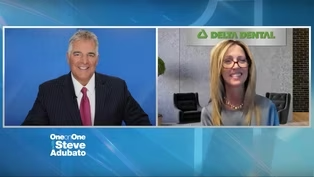
The Challenges Small Business Has Faced During the Pandemic
Video has Closed Captions
Clip: S2021 Ep2437 | 8m 41s | The Challenges Small Business Has Faced During the Pandemic (8m 41s)
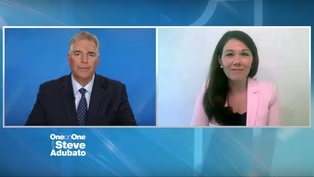
Examining Learning Loss During the COVID Health Crisis
Video has Closed Captions
Clip: S2021 Ep2437 | 9m 8s | Examining Learning Loss During the COVID Health Crisis (9m 8s)
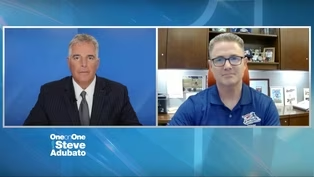
The Impact of COVID on the Somerset Patriots
Video has Closed Captions
Clip: S2021 Ep2437 | 10m 2s | The Impact of COVID on the Somerset Patriots (10m 2s)
Providing Support for PBS.org
Learn Moreabout PBS online sponsorship
- News and Public Affairs

Top journalists deliver compelling original analysis of the hour's headlines.

- News and Public Affairs

FRONTLINE is investigative journalism that questions, explains and changes our world.












Support for PBS provided by:
One-on-One is a local public television program presented by NJ PBS