
Carlos Lejnieks; Catherine Goss/Colleen Bol; Bonnie Coleman
10/15/2022 | 27m 46sVideo has Closed Captions
Carlos Lejnieks; Catherine Goss/Colleen Bol; Bonnie Coleman
Carlos Lejnieks, Big Brothers, Big Sisters of Essex, Hudson & Union Counties, discusses mentoring children; One-on-One's, Jacqui Tricarico, speaks to sisters Catherine Goss and Colleen Bol, as they recount their experiences giving and receiving the gift of life at the NJ Sharing Network’s 5K Celebration of Life! to; U.S. Rep. Bonnie W. Coleman discusses pressing issues in our urban communities.
Problems playing video? | Closed Captioning Feedback
Problems playing video? | Closed Captioning Feedback
Think Tank with Steve Adubato is a local public television program presented by NJ PBS
Carlos Lejnieks; Catherine Goss/Colleen Bol; Bonnie Coleman
10/15/2022 | 27m 46sVideo has Closed Captions
Carlos Lejnieks, Big Brothers, Big Sisters of Essex, Hudson & Union Counties, discusses mentoring children; One-on-One's, Jacqui Tricarico, speaks to sisters Catherine Goss and Colleen Bol, as they recount their experiences giving and receiving the gift of life at the NJ Sharing Network’s 5K Celebration of Life! to; U.S. Rep. Bonnie W. Coleman discusses pressing issues in our urban communities.
Problems playing video? | Closed Captioning Feedback
How to Watch Think Tank with Steve Adubato
Think Tank with Steve Adubato is available to stream on pbs.org and the free PBS App, available on iPhone, Apple TV, Android TV, Android smartphones, Amazon Fire TV, Amazon Fire Tablet, Roku, Samsung Smart TV, and Vizio.
Providing Support for PBS.org
Learn Moreabout PBS online sponsorship- [Narrator] Funding for this edition of Think Tank with Steve Adubato has been provided by Kean University.
Where Cougars climb higher.
The Turrell Fund, supporting Reimagine Childcare.
Delta Dental of New Jersey.
Everyone deserves a healthy smile.
Valley Bank.
NJM Insurance Group.
Serving New Jersey'’s drivers, homeowners and business owners for more than 100 years.
The Fidelco Group.
New Jersey Sharing Network.
Johnson & Johnson.
And by Prudential Financial.
Promotional support provided by BestofNJ.com.
All New Jersey in one place.
And by Insider NJ.
[MOTIVATIONAL MUSIC] - Hi, everyone.
I'm Steve Adubato.
We are honored to, once again, be joined by our friend, Carlos Lejnieks, who is President and CEO of Big Brothers Big Sisters of Essex, Hudson, and Union Counties.
Good to see you, Carlos.
- Good see you Steve.
Thanks for having me.
Let everybody know the Big Brothers Big Sisters work as we put up the website.
It's so important.
Go ahead.
- I appreciate that.
I've been the CEO of Big Brothers Big Sisters for about 14 years.
We pair up one-to-one mentors for young people in our community in Essex, Hudson, and Union Counties.
And through a evidence based mentoring program that's been around for over a century, we, based on common interests and commonalities, have caring adults in the lives of our kids.
During the pandemic if we learned anything else, the power of human connection is definitely needed amongst us all, but particularly for our young people that come to our doors.
About a third of our kids come to us referred by the state social work system.
They face challenges, but with the power of a one-to-one mentor, we see positive things increase, like school attendance, school grades, and then high school graduation rates and also college matriculation rates.
We see negative things decrease as well.
So we know that the secret sauce of mentoring works and I have been doing this for 14 years and looking to be strong coming out of the pandemic to recruit more mentors.
- Yeah, you mentioned the pandemic, Carlos, let's get into that.
And we'll come back to the healthcare issues in just a moment.
So the greatest impact of the pandemic as we're taping this program toward the back end of the Summer 2022, the greatest impact that COVID has had on the work of your organization is?
- Twofold.
Academic loss, as well as a depression.
We saw during the pandemic that our young people when they were isolated, they faced traumas, especially because of the families from once they come, who were essential workers.
Online learning was not what it was cracked up to be.
- No.
It's not a disparaging comment on the teachers, they were trying to do what they could.
However, everyone saw what was playing out and our young people needed that additional support.
Unfortunately, not all of them were able to get it.
So we saw an academic loss that has yet to be fully quantified.
But McKinsey recently put together a study that talked about something like nine to 15 months of academic loss for young people, especially in under-resourced communities.
And so how do we come out of this catching them up and having them get the skills necessary and the desire to graduate from high school, go off to college so they become competitive in a world economy?
And then lastly, the social and emotional development of our kids was really challenging during the pandemic.
And we still see the trauma of that ripple into today.
We had our referrals for supports around therapeutic supports, and behavioral health supports, and depressive elements of our young people be more than doubled during the pandemic.
So we're very in tune with the social and emotional needs of our kids.
And we think that a caring, stable adult mentor in the life of our kids helps mitigate and buffer against that.
- But real quick though, on this, Carlos.
But a lot of the mentoring was going on remotely.
- Yeah, so the blessing of our work was that we had strength of relationship before.
Many of our relationships had been years in the making, so they had each other to lean on.
- They had history.
They had history.
- Conversation, absolutely.
So they were known to each other.
And then of course, we all had to pivot to virtual.
But we know coming out of this, there's nothing that replicates in person human connection.
- Yeah, and those new relationships are hard to establish remotely out of the box.
But listen, the work is important.
And that's why we put up the website for those who are interested in volunteering, making a difference with the young people that Carlos is talking about.
Follow up there, follow up on the website.
Over at Jersey City Medical Center, you are the first person of Latinx heritage to serve as chairperson of the board.
It's a big deal.
First of all, congratulations.
- Thank you, sir.
Thank you, sir.
It's a real (indistinct) responsibility.
- Talk about what needs to be done there.
- Well, about a decade ago, I joined on as a board member just as a community leader.
Given my role at Big Brothers Big Sisters, we were actively involved in respecting what Jersey City Medical Center was doing every single day.
We hire from our community.
We see what our families and students are like.
And so there was this incredible respect.
And when they asked me to join the board, I of course, took on that responsibility, and seeing what the impact is of our community.
But having a diverse set of eyes at the board level, as well as at the C-suite, as well as at the staffing level, is essential I think, to make sure that we're aligned with culturally competent care, our alignment with how we view the assets of our community, and how better to address the call to action for some of our needs in our community.
And so, you know, throughout the years they had pulled me in the hospital, had pulled me into various community engagement opportunities, as well as committee work.
And in the committee work, you really see where all the work is done, with the frontline workers, talking about nursing, talking about the docs, talk about our complete staff, about 2,500 staff members, a majority of whom come from our community.
But I'm particularly proud about our nurses and what they were able to do during the pandemic.
- Absolutely.
- You know, the board asked me to be on a committee two times in a row where we presented to an independent body that evaluates quality of nursing.
And it's a high level status called the Magnet Award status.
We've won this four times.
- Magnet Award.
- We won it four times in a row.
And for the six hundred nurses that we have in our hospitals, it's a real validation of the hard work that they took on.
But especially the case that we just got the distinction for the fourth time about a month ago.
And coming out of the pandemic, this was such a shot in the arm for the culture of our team.
What they were doing during the pandemic was just God's work.
And weathering the storm and doing it committed to purpose, and committed to our people was just incredible.
So I'm really grateful to be a small part in that conversation.
- It's so interesting.
First of all, Jersey City Medical Center, part of the larger RWJBarnabas healthcare system, significant supporters of public broadcasting.
But the really interesting thing for me is this.
Carlos is talking about the nurses and other clinicians on the frontline, whether it's at Jersey City Medical Center or any other healthcare organization hospital system.
Heroes, that first.
Now, what the heck?
- We can't forget.
What is that, go ahead, Carlos.
What is that about?
- We can't forget them.
We can't forget the issue.
I remember two years ago when we were banging pots and pans in celebration of our nurses.
We were trying to do that to show support in the way we can.
- Now there targets for people who are peeved at whatever, and frustrated, and COVID restrictions, and policies of the government, and what medicine is appropriate or not, or are cleared by the CDC.
Now, it's like their targets?
How does that happen?
- Unreal.
Politics is the devil's work.
And we are here to lift up what they are, which are our heroes, and will continue to be so.
They've always been the case.
When you walk through the, some people ask me why Jersey City Medical Center?
What is of quality of them?
And we could talk about all the accolades, but I will tell you it's highly personal.
I moved my mom from Montclair where she lived to Hudson County, to Jersey city.
My mom has personal needs that she leans on healthcare system pretty regularly.
I will tell you nothing more precious than my mother to walk through the doors and the people that greet her, the nurses on the front end, as well as the docs, and the clinicians, and everyone else, takes no one better care than to my mother than those out of our institution.
So it's a highly personal one.
We can list all the accolades, but this is where the rubber hits the road.
And for those who vilify those in the front line, you know, I think there's a special place-- - There's a special place.
Let's just leave it at that.
- That's right.
- And Carlos's point, not only at that particular institution, but to all the hospitals, hospital systems, and to all the frontline workers, you continue to be heroes, regardless of how some folks may want to take out their frustration.
Carlos, thank you so much, my friend.
Best to you and all the folks at the organization.
Take care.
- Thank you so much, Steve.
Thank you.
- You got it.
Stay with us.
We'll be right back.
To watch more Think Tank with Steve Adubato, find us online and follow us on social media.
- Folks recently, my colleague Jacqui Tricarico and I, who is the executive producer of Think Tank and also of our series Remember Them, we were out there at the New Jersey Sharing Network 5K, it's over in New Providence, New Jersey.
Jacqui had a chance to sit down-- Now, she wasn't sitting down, she was standing up and talking to a whole range of people who have powerful, compelling stories about organ and tissue donation, about the gift of life at the 5K, the Sharing Network.
Here's Jacqui.
- Joining me now is Catherine Gross and her sister Colleen Bol.
Catherine actually received a liver transplant just back in February - [Catherine Gross] February.
And half of the liver came from your sister.
- Yes.
Yep.
- Yep.
- I need to hear more about this story.
So tell me about what happened and why you needed to receive a liver transplant.
- Sure.
So I've had some autoimmune diseases pretty much my entire adult life.
One of which is called Primary Sclerosing Cholangitis, which I know is a mouthful.
It goes by PSC, which is the abbreviation for it.
And as part of that disease, you are at a greater likelihood for a lot of complications, including something called Cholangiocarcinoma, which is bile duct cancer.
And I had bile duct cancer.
So I first got bile duct cancer in 2019, and I was able to have a, what they call a liver resection, where they removed part of my liver.
But when I was diagnosed again this past fall, that wasn't an option for me.
So I got the formal diagnosis in December and found out that my only chance really for survival was a living donor.
So we started that process, - [Jacqui Tricarico] Okay.
and we were able to identify my sister, - Well how do, when you know that you need a living donor, because this is the first time we're talking to somebody who's had a living donor - [Catherine Gross] Yeah.
transplant.
How does that process start?
Well how does the reach out start?
Is the New Jersey Sharing Network involved right away?
- Actually, we weren't involved with the New Jersey Sharing Network because it was a living donor situation.
The hospital network that I was with and my doctor suggested that I start with people I knew.
So, and I started with what I call the big ask.
So they said, you know, go to your friends and family and see if you can get somebody who you know.
When it comes to living donors, the preference is for somebody that does know you.
Obviously, there are many cases where people do the altruistic gift and they give to somebody, a complete stranger, but ideally, if they can find somebody that knows you and has a personal connection to you, that is preferred.
- And it needs to be a perfect match too.
It just can't be anybody.
And I'm sure that perfect match can most likely come from somebody in your family.
So Colleen, tell me when you knew that she needed a transplant, what was your first thought?
- Well my first thought, honestly, was that it was me.
I knew, - [Jacqui Tricarico] You knew.
Yeah, I knew all along it was gonna be me.
I would be the right person for it and the most appropriate person to do it.
And I knew that my blood type was compatible.
I knew that, I mean, obviously the relationships there, you know, were sisters.
it just, I never doubted that it would be me.
- And you never had a second thought?
Was it a scary decision for you?
- Oh well, I mean it's certainly scary.
It's a big undertaking.
It's a major surgery, so you know there's gonna be some recovery, and there's some risk involved, but I was very confident in it the whole time.
I really had no doubts at all.
What does it mean to both of you to be here today to witness what this is really all about and help things unfold here at the 5K every year?
- Well, it's great.
- Yeah.
It's great, right?
It's great.
It's, I mean, back when this was all happening, it felt very, you know, obviously emotional and scary and not really sure what to expect over the next few months.
And I think it's been surprising.
Our recovery has been surprisingly good.
Our support from our family and friends have been wonderful.
Being part of this is is even more amazing, right?
Being able to walk this on this beautiful day, I think it's great.
- And for anybody like who is questioning like, okay being a living donor is a whole 'nother thing, right?
So if anybody's questioning being a living donor or you know, checking that mark off on their driver's license, or doing it online to become - [Catherine Gross] Yeah.
a donor in general, what would you be your message as being someone who just-- - I would say explore it.
Certainly, you know, keep an open mind and do it.
You know, if you have that personal connection I think it's an easy decision to make.
if you maybe don't and it's somebody who's not a sister, or a loved one, a friend or whatever, maybe it feels like a bigger decision to make, but you'll be surprised.
I mean, it's mostly the unknown, right?
The unknown is scary, but if you educate yourself beforehand and you're prepared, and you trust the process, like I trust it very much that they would only do what was right for me, and that they wouldn't even pursue it with me if I wasn't healthy enough to come out successful from it.
So I felt really, I felt completely confident going into it.
- And one thing I'd like to just add to that is that the hospital really underscored that the living donor is the priority.
And I think that's important for people to know.
You know they are put first, as they should be, because they are doing something, you know, incredibly generous, and so they should be.
So her health as my living donor, was prioritized.
And that may help people get over some of that fear and trepidation of pursuing it.
- And for you, with your sister.
- [Catherine Gross] Yeah.
- I'm sure there's probably no words that you can ever say to her, to say thank you for doing this.
How has that been for you to try to show her or tell her how important this was for you?
- Impossible?
Let's just say it's impossible - But unnecessary, because it, I mean it was just gonna happen regardless.
So yeah.
So it's all good.
There's no need for that.
- I've tried.
I've tried.
(Catherine and Jacqui laugh) And I will always try.
I continue to try for the rest of my life.
If I could say, you know, I also, as part of my surgery received an artery from a deceased donor.
So, you know we are here supporting, obviously living donors.
We're celebrating my life, our success.
But we're also really in support of the whole initiative, and the message of the Sharing Network.
We couldn't be more thankful.
- Well, thank you.
And we're thankful that you're sharing your story and this helps educate people about organ donation, how important it is, tissue donation, and you know, your own story is incredible.
So thank you for sharing.
- Thank you so much Jacqui.
- Thank you so much.
- Thank you.
To watch more Think Tank with Steve Adubato, find us online and follow us on social media.
- We are honored to, once again, be joined by United States Congresswoman Bonnie Watson Coleman.
Congresswoman, thank you so much for joining us.
- Thank you for having me.
It's good to see you.
- Good to see you.
Congresswoman, we have a series we're doing in cooperation with Kean University, you know, their institute the John S. Watson, Urban Research and Policy, Policy and Research Institute, Urban Matters, it's called.
You'll see the graphic up there.
The most pressing urban issue or issues that we should be focused on, not just in New Jersey, but the nation include - Disparities, disparities on all levels whether it's the income gap, the accessibility, the health gap, the safety and security in your communities, the mental health issues, the wealth gap, all of those things.
That's what's driving, I believe, the work that I want to do.
And that certainly drives the John S. Watson Institute.
And so I'm so delighted that that Institute is located and under this amazing president up at Kean University because he gets it.
He gets about the interconnectability of all those sort of social dynamics, and economic dynamics, and a healthy economy in general.
And so that's what I think.
- Yeah, you're talking about Dr. Lamont Repollet, the former head of the Department of Education in the state, and now the president of Kean University.
We'll be talking to him about these issues, as well.
But Congresswoman, let me be more precise, and specific with you, in terms of some urban matters.
Let's talk about environmental justice.
What does it mean, first of all, and what is the role of the United States Congress, in terms of dealing with addressing this environmental injustice?
- So let me just say that I'm so glad that Joe Biden is the President right now, because he kind of gets the whole environmental existential threat to all of us.
Whether or not we're in the rich communities, or the poor communities, but in the poor or lower income communities, it's extremely important that we recognize what's happening with climate change.
The heat index has been so high, the health reaction to that health to those heat indexes that made people really sick.
We've had unnecessary deaths because of them.
So we need to look at what does it mean to create a safer and healthier environment, free of so much pollution, free of all of the sort of heat that comes from the lack of freeze and things of that nature.
The water issue, just being able to have a cooling center in the summer, and a heating capacity in the winter, looking at what is happening among the poorest of us, and trying to remediate, and eliminate those barriers.
Because if we, from a policy perspective, look low so that we can go broad, and go high, then we will end up making things better, for everybody.
You and I both know, if you deal with the least among us, you're doing the right work.
- Doing the right work, and speaking the right work.
We're, if you listen to us on the audio side, we're speaking with the United States representative, Bonnie Watson Coleman.
But, real quick Congresswoman, could you tell us exactly what committees you're serving on right now so people can have perspective?
We'll put up your website as well, so people can find out more.
- I'm on Homeland Security, and I'm on the Appropriations Committee, and I'm the only New Jerseyian in both the Senate and the House of Representatives on the Appropriations Committee.
And I am on the subcommittees... Labor, Health, and then other agencies, and transportation, housing and urban development and the interior that's on the appropriations committee.
- You think that's enough?
(laughs) - Sometimes, I think it's too much because I'm also a subcommittee chair under Homeland Security on maritime security issues, so.
- Yeah, you forgot to add that.
By the way, the congresswoman will be joining us.
We're doing a special on our other series, "Remember Them", that is dedicated to her father, John S. Watson, who I was honored to serve in the state legislature with.
He was a leader in the legislature, a leader in our state, and our nation.
That is on "Remember Them", check out the congresswoman there.
Representative Bonnie Watson Coleman, I wanna follow up on a childcare issue, because we have another series.
We have a lot of mini-series, and this one is about reinventing, uh re-imagining, excuse me, re-imagining childcare.
What needs to be re-imagined regarding childcare, and what is the role of the federal government, in that regard?
- Number one is the child tax credit, which, you know took 43% of the children out of poverty immediately.
Very modest investment on a monthly basis so the families could use it in order to take care of their children.
Something we're still fighting for.
It was in the American Rescue Plan, we weren't able to get it.
Republicans have not been very helpful with us on the issues of this nature.
Secondly, it is making sure that there's early childcare.
That the childcare is both substantive, and safe, and secure, and affordable.
So supplementing that, from a resource perspective, wherever we can.
And then making sure that mothers have access to good jobs, so that they can, and fathers as well, so they can take care of their families, and making sure that the education system is safe, and secure, and delivers the kind of education that takes care of our children, and prepares them to be our future.
Because, you know, as vibrant as we might be right now, Steve it ain't gonna be that way forever.
And so we need to recognize that it's resource based.
And when we found that we placed these resources in the hands of families, they use that money for good things, for taking care of their children, for getting their children, school, preschool care, for making sure that they had the clothing, the food, et cetera.
And so, I also support this issue of a guaranteed income which elevates the family, and makes sure that no family is allowed to fall below a certain floor level in this very wealthy country.
And it's all about preparing, and protecting and preserving our, the future of our society.
There are some listening right now, watching right now, that are gonna say, "Wait a minute, isn't that" I'll use the S word, "socialism?"
Yeah, go address that because, go ahead.
- So I don't know, I don't wanna put a label on it.
I think it is a fair realization of the way you eliminate poverty in this country, is to make sure that people have the financial resources they need, to be able to purchase the things, whether it's shelter, food, transportation, education, whatever.
It's as simple as that.
- Childcare.
- So childcare, absolutely.
So when we think of giving to the very, very poor, and the social and economically vulnerable, you know, we had a lot to say about it.
When we think about the tax credits, and the tax loopholes, that go to the very, very, very wealthy, we think that's, you know, good policy.
So why does that sort of a grace evolve to the very, very wealthy, and is looked at as healthy policy.
But when it comes to the very, very poor who need those specific resources, and has been demonstrated that they use those resources to support and protect their families, and educate and care for their children, why are we having, why are we having to label these things as things that sort of foment a divisiveness in our country?
- Congresswoman, we have about a minute left.
I wanna ask you this, you joined us right after January 6th.
You were directly impacted, affected by that.
You shared your experience with us, and with many others, and the media across the state, across this region, and nation.
This isn't a political program.
We don't cover elections per se, but we're taping on the 20th of September.
What does at stake in this election?
A and B, what does that have to do with the future of democracy, and your view?
Got a minute left.
Sorry to load you up like that with that question.
- That's all right.
Democracy is in peril here.
We see what's happening on the other side.
I know this is not, you know, Republicans versus Democrats.
But Donald Trump et al.
have made this an issue of a a contrast that says, do you support democracy?
Do you support equality of opportunity?
Do you support the rule of law, or do you support autocracy, and greed, and corruption?
So I am telling you that what's on the ballot is what you can teach your children at school, whether or not libraries are gonna have the books that they need, whether or not women are gonna have access to the freedom of their healthcare decisions, whether or not there's gonna be environmental justice, investments into communities, whether or not there's gonna be serious climate change recognition and investments for the whole country, and the whole world.
And whether or not we are going to lower the cost for healthcare, whether or not we're gonna make sure people who need insulin get that at a price that they can afford, and making sure that seniors are capped at a certain level at $2,000.
We're trying to lower cost, we're trying to lower costs, expand opportunities, expand protections, and make sure that everybody has a stake in this great nation.
And that is on the ballot.
- This will be seen before, and potentially after that November election, but the stakes are still the same, as the Congresswoman described it.
Also, to make sure everyone understands that we on "Think Tank", and our other programs, will make sure we have different perspectives, different points of view who may frame the issue differently than the congresswoman just did.
Congresswoman Bonnie Watson Coleman, I cannot thank you enough for joining us.
We appreciate it.
All the best to you and and your family.
- Thank you.
- You got it, I'm Steve Adubato, that is the Congresswoman.
We'll see you next time.
- [Narrator] Think Tank with Steve Adubato has been a production of the Caucus Educational Corporation.
Funding has been provided by Kean University.
The Turrell Fund, supporting Reimagine Childcare.
Delta Dental of New Jersey.
Valley Bank.
NJM Insurance Group.
The Fidelco Group.
New Jersey Sharing Network.
Johnson & Johnson.
And by Prudential Financial.
Promotional support provided by BestofNJ.com.
And by Insider NJ.
(Music playing) NJM Insurance Company has been serving New Jersey policy holders for more than 100 years.
But just who are NJM'’s policy holders?
They'’re the men and women who teach our children.
The public sector employees who maintain our infrastructure.
The workers who craft our manufactured goods.
And New Jersey'’s next generation of leaders.
The people who make our state a great place to call home.
NJM, we'’ve got New Jersey covered.
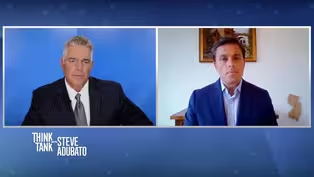
Helping Children Overcome Mental Health Challenges
Video has Closed Captions
Clip: 10/15/2022 | 9m 37s | Helping Children Overcome Mental Health Challenges (9m 37s)
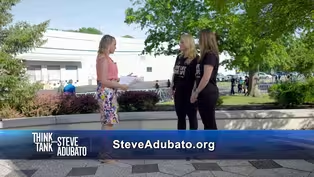
Transplant Recipient and Donor Disucss the Gift of Life
Video has Closed Captions
Clip: 10/15/2022 | 7m 20s | Transplant Recipient and Donor Disucss the Gift of Life (7m 20s)
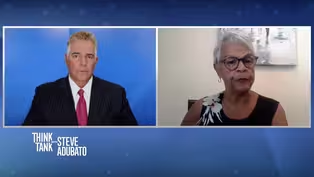
U.S. Rep. Discusses Pressing Issues in our Urban Communities
Video has Closed Captions
Clip: 10/15/2022 | 11m 39s | U.S. Rep. Discusses Pressing Issues in our Urban Communities (11m 39s)
Providing Support for PBS.org
Learn Moreabout PBS online sponsorship
- News and Public Affairs

Top journalists deliver compelling original analysis of the hour's headlines.

- News and Public Affairs

FRONTLINE is investigative journalism that questions, explains and changes our world.












Support for PBS provided by:
Think Tank with Steve Adubato is a local public television program presented by NJ PBS