One-on-One
Carlos Rodriguez; Bob Ley; Deborah Aschendorf
Season 2022 Episode 2552 | 26m 45sVideo has Closed Captions
Carlos Rodriguez; Bob Ley; Deborah Aschendorf
Steve Adubato and Carlos Rodriguez, President & CEO, Community Foodbank of NJ, examine the causes of food insecurity; Bob Ley, Award-winning ESPN Sports Anchor & Executive Founder of the Center for Sports Media at Seton Hall University, discusses his career at ESPN & sports in our culture; Deborah Aschendorf, nurse and cancer survivor, recounts her cancer diagnosis during pregnancy.
Problems playing video? | Closed Captioning Feedback
Problems playing video? | Closed Captioning Feedback
One-on-One is a local public television program presented by NJ PBS
One-on-One
Carlos Rodriguez; Bob Ley; Deborah Aschendorf
Season 2022 Episode 2552 | 26m 45sVideo has Closed Captions
Steve Adubato and Carlos Rodriguez, President & CEO, Community Foodbank of NJ, examine the causes of food insecurity; Bob Ley, Award-winning ESPN Sports Anchor & Executive Founder of the Center for Sports Media at Seton Hall University, discusses his career at ESPN & sports in our culture; Deborah Aschendorf, nurse and cancer survivor, recounts her cancer diagnosis during pregnancy.
Problems playing video? | Closed Captioning Feedback
How to Watch One-on-One
One-on-One is available to stream on pbs.org and the free PBS App, available on iPhone, Apple TV, Android TV, Android smartphones, Amazon Fire TV, Amazon Fire Tablet, Roku, Samsung Smart TV, and Vizio.
Providing Support for PBS.org
Learn Moreabout PBS online sponsorship- [Narrator] Funding for this edition of One-On-One with Steve Adubato has been provided by Bank of America.
Veolia, resourcing the world.
The Port Authority of New York and New Jersey.
Moving the region through air, land, rail, and sea.
MD Advantage Insurance Company.
Choose New Jersey.
The Robert Wood Johnson Foundation.
Summit Health a provider of primary, specialty, and urgent care.
The Healthcare Foundation of New Jersey.
And by Delta Dental of New Jersey.
Everyone deserves a healthy smile.
Promotional support provided by The New Jersey Business & Industry Association.
And by BestofNJ.com, all New Jersey in one place.
- This is One-On-One.
- I'm an equal American just like you are.
- The way we change presidents in this country is by voting.
- I'’m hopeful that this is the beginning to accountability.
- Life without dance is boring.
- I don't care how good you are or how good you think you are, there is always something to learn.
- I did do the finale, and guess where my trailer was?
A block away from my apartment, it couldn'’t have been better!
- People call me 'cause they feel nobody's paying attention.
-_ It'’s not all about memorizing and getting information, it'’s what you do with that information.
- (slowly) Start talking right now.
- That's a good question, high five.
(upbeat music) - Hi everyone, I'm Steve Adubato.
We have him back.
He's Carlos Rodriguez, President, CEO of Community FoodBank of New Jersey.
Good to see you.
- Good to see you, Steve.
- So again, we'll put up the website of Community FoodBank.
We've been doing a whole range of programming, trying to create greater public awareness around food insecurity, hunger related issues.
But the first thing I wanna talk about is, there's a study that Community FoodBank was involved in, together with the Robert Wood Johnson Foundation, around hunger.
Talk about it.
- So, it's a study to really look at as we emerge from this pandemic and put our arms around this new reality, what is it gonna take to really end hunger in New Jersey?
And what does it look like?
And the study does a great job of first of all, bringing amazing thought partners around the table to bring this together.
That was in and of itself an amazing effort.
And I think second, really identifies some unique aspects of how the problem exists of food insecurity and some ways to really coordinate and solve for it.
Because as you've heard me say, Steve, hunger is something that has a solution.
And I just think we have to figure out and commit to how to get there.
The baby formula shortage, tie it to the initiative of the efforts of your organization and why it's tied to the larger hunger food insecurity issue.
- So, baby formula shortage or any food shortage really has a disproportionate impact on folks that are already struggling to put food on on the table.
And in this case, to feed infants.
And baby formula is not something that we see a lot of as a food bank.
It's not something that's actively donated in any large quantities, or at least in any quantities that are needed.
So you could imagine what a shortage does, where now everyone is scrambling to get their hands on something so important.
Important especially if your child, your baby has special dietary needs that literally if they don't get what they need, they can die.
And then of course, to just be able to feed and nourish a child out of infancy, it's so important.
And it just begs the question, how much more choice are we gonna take away from moms and women by not allowing them to have product that they need to allow them to not just feed their child, but allow them to go to work and allow them to be a part of the society as they choose to be.
So just very complicated problem.
But as you could imagine, disproportionate impact on those that already have limited means and limited abilities to manage crisis.
- Shift gears, we follow the work of the community excuse me, the Casino Redevelopment Authority and our long time friend Mo Butler down there.
Community FoodBank and the CRDA, the Casino Redevelopment Authority is involved.
And I heard about this from a few different people.
You selected 15 organizations to receive grants of up to $500,000 total, right?
They go to not-for-profits dealing with food insecurity issues in AC, in Atlantic City?
- That's correct.
I mean, let's talk about a success story, and an example.
- It'd be nice to have one of those.
Go ahead.
- It's a great success story.
It's really collaboration at its best.
And so CRDA and Community FoodBank of New Jersey partnered to first respond to the pandemic taking over Bader Field with many partners to distribute food at the height of the crisis.
- Is Bader Field the airport there?
- Bader Field, the old airport, that's correct.
And I mean, just really put in perspective what we were all going through, when you see cars, lines of cars up and down the runways lining up for food.
Well, we knew that that wasn't gonna go away overnight and that we also needed to transition that back into our network of pantries and soup kitchens for everyone that needed.
And we're talking about 20% of the food in Atlantic City at one point was going out through large distributions.
So the focus was, how do we make our and help our pantries and our network feeding programs become more resilient and be able to absorb whatever's left of that tremendous growth?
And that's what this investment did, gave them the opportunity to expand their operations and also convert their operations so that they're not just giving out bags of food or boxes of food, but there's a greater focus on doing that than what we call a healthy client choice style.
- Say again, a healthy client- - Healthy client choice.
And that means you walk in and you get to pick for the foods that are right for your family with nutritional nudges, built into the selection process of that food.
And it's just a great model.
None of it could have happened without the support and partnership of CRDA, and of course the tremendous network that we partner with to distribute food every day in Atlantic City and throughout the state.
- Go from Atlantic City all the way up north to Garfield.
Important things happening there, Carlos, talk about it.
- And in Garfield, another amazing example of collaboration, there was a community that's again, long lines, a small feeding program had to sunset, and there was a need to address the high numbers of food insecure that were there before the pandemic and became exacerbated since.
And so we looked for food distribution partners, and on the way to that, we developed a collaboration called the Unity Initiative, along with Bergen CAP and a couple of other organizations, where the end of it is we want to have all the services that family needs to address their health issues, their mental health issues, and their food needs.
And again, the idea is to develop and deploy a healthy client choice type pantry that immediately connects families to and from some of the other services that will be available in that campus.
And it really is a springboard to what the report says should be happening.
- The reports, you're talking about the Robert Wood Johnson?
- The Robert Wood Johnson.
Yes, sir, the Robert Wood Johnson report.
These are examples of collaborating and leveraging resources and really helping them land with the neighbor, the client, how they are, where they are, because here's the point of the report in part.
You need multiple services and multiple solutions to come together to make the person whole.
You can't address the health issue without food.
You can't address food needs without health issues, if they both exist.
And you need to be able to provide economic assistance where families are eligible for, and help them navigate through the process to get it.
When you wrap three solutions together like that, for example, then you can see a climb out of food insecurity.
There has been a real impact on food pantries, the ban on plastic bags.
And also, I believe there's a caveat in the law that allows for, I believe six months until, when does it take effect?
- So six months from the time that the law was enacted.
So we're talking about in the fall is when it will hit pantries and other feeding programs.
- Okay.
Real quickly, 30 seconds left.
What does it mean?
- It means that we have an opportunity to innovate in partnership with food industry who are giving us some bags and cycling some bags, maybe adopt some of this healthy client choice model for many pantries.
Some of them have already done that.
And we're in the process of getting some of the best practices of pantries who already solved for this, and helping others figure out how to get there.
Of course, we're securing bags for many of our network pantries and actually, New Jersey actually set aside for purchasing some bags and giving them to them as well.
- You know, Carlos, you know I'm a student of leadership, and I've always, this isn't me who says, it's anyone who understands leadership.
Every problem and challenge is ultimately for great leaders an opportunity to pivot and adapt.
And that's exactly what you're doing at the food bank.
Thank you, Carlos.
- Thank you, Steve.
- We appreciate it.
Stay with us, we'll be right back.
- [Narrator] To watch more One on One with Steve Adubato find us online and follow us on Social media.
- We are honored to be joined by Bob Ley.
It's his award-winning, you can see the awards 'cause he has like really good Emmys.
They told me that I can't have mine.
He has a lot more.
He's the Emmy award-winning ESPN anchor.
He stepped down in 2019 after an extraordinary, extraordinary career as a broadcaster.
Now, executive founder of the Center for Sports Media at Seton Hall University.
Good to see you, my friend.
- It's great to see you, Steve, it's been far too long.
- Now, here's the thing, you're retired from ESPN, but you not only head up this Center for Sports Media, you brought A-Rod, we'll show some video in just a moment, to the students at Seton Hall, but you also gave a significant lead donation to get things moving.
Why the commitment to the university, one of our, actually, Seton Hall University, one of our higher ed partners?
- It's pretty simple.
Here's a scary number for, at least scary to me, it's been 50 years this fall since I first entered Seton Hall.
And I've been saying this for years, I wouldn't have been able to have achieved professionally when I did without the grounding and the values, the education I received at Seton Hall.
And I've always tried to stay connected over the years, but especially, in the last four or five years, doing events with professional and residents there, BJ Schecter, classes, events, mentoring.
And basically building towards what we always felt, I think could be formalizing a center for sports media, which we're now able to do.
Because this entire, I have to tell you, and I'm sure your viewers are quite aware, it's changing by the week, the month.
And to educate our students, provide them the tools and the values to go out there and thrive, I think it's very important.
- Let me jump right into this thing, it's been thinking about this, we're taping at the end of May, be seen later.
So, NBA playoffs going on right now, but in the middle of the playoffs, this horrific shooting, this murder, this mass murder in Texas happens.
And then, Steve Kerr, and you saw the video, and people have...
It's not gonna get old, because the issue and the problem exists, persists.
He does a press conference.
It didn't matter whether Golden State won or lost.
That's all he wanted to talk about, and he talked about it in a certain way.
He also lost his dad to gun violence.
For those who say "Shut up and dribble, shut up and play, Shut up and don't get involved in politics or social issues."
You say what for athletes?
What do you say to those folks?
Including the issue of race.
- Yeah.
Race, guns, social justice, that phrase, which strikes different people differently.
Sports has been a prism through which we have looked at these issues for the last 50, 60 years, going back to the 1960s.
Yes, when you turn on a basketball game, you wanna watch a basketball game.
And when something like what happened in Uvalde, Texas occurs and as you mentioned, Steve's dad, Malcolm, who was killed back in the 1980s in Beirut, it hits everybody like a hammer blow.
And there are responsibilities in the media.
He had to tell the story of that game that they played that night, and and his team did lose the game.
But to put it through that prism of sports and understand why it is important, it is a fine line.
What people, you know, wanted just... Jason Gay, the day after that tragedy, wrote a beautiful piece in the Wall Street Journal, I'm gonna drop a note about it, about how he almost felt guilty.
He and the other parents in their Little League, watching their kids play Little League in the wake of this event.
Having a nice moment of respite and understanding there are families in Central Texas who will never have that moment again.
So I think we have a responsibility.
And that gets down to the values, and to the philosophies you want to inculcate in young professionals in the field.
How to tell a story, to tell it fairly, and to tell it with imports, so that when you look back at it in a few years you say, "At that moment, I got it right."
What is in your view the place for the quote, distraction of sports, the entertainment of sports, in light of the horrific things we're talking about.
Including mental health issues for athletes for whom their mental health issues are supposed to somehow, listen, that's not our business.
We only care about how Osaka, Naomi Osaka plays tennis, or there's a whole range of other people.
Go ahead, I'm sorry, Bob.
I'll get off my soapbox.
- No, but it's not a soapbox because Steve, I think you in the last 18 months, 24 months, we have seen a greater ability and a propensity.
Go back two, three years actually for athletes to talk about this entire field and for, I think the general public, to embrace them.
We all, in the dark of the night, we all have questions, and fears, and things that keep us awake.
And athletes are no different.
And when it gets to the point of meeting professional assistance, I think we have seen people embrace that.
Look, I lived for 40 years in Connecticut, and lived 45 minutes from Newtown.
- Oh.
- And we'll all feel that day forever.
And I was, I don't wanna say the word privileged but I was through circumstances able to be part of the first town wide event in Newtown after that shooting early in 2013.
And what it was was an event organized by Chris Canetti of Major League Soccer who grew up also in Connecticut, we're a small state.
Of bringing soccer people from around the country, flew in on their own dime, Mia Hamm, Landon Donovan, and Alexi Lalas to do a little soccer get together for all the kids and no media.
But I was privileged to be part of the group that helped facilitate a Q&A.
You could feel in that town, just four weeks afterwards, the burden of this.
And I have a good friend who does business in that town.
I had lunch with him last summer.
And to this day, it persists.
I mean these are generational scars that will live certainly with these families and these towns and these regions.
And we need to do something as a people here to understand what we're doing to ourselves.
- Just remember Muhammad Ali steps down, he loses his title in the '60s as the heavyweight champion in the world.
Not because someone beat him, but because he refused to fight in the Vietnam War as a conscientious objector, and gave up the best three years of his professional life.
So for those who say, "Yeah, they're just talking," they act as well.
Let me ask you.
We're gonna show some video of A-Rod coming to Seton hall.
Describe that.
- Well, Bob, through the good offices of a fellow alum Bardia Shah-Rais, class of '95, and a very good friend of mine, a fellow I've known since he was in high school.
And works closely with Alex, Alex agreed to come in.
And it was our first event as the Center for Sports Media at Seton hall, since the official establishment of it.
And Alex came in on his own dime.
God bless him.
So generous with this time insisted on doing numerous small sessions with students, athletes, communication students.
And made sure there were business and entrepreneurial students in a small setting, Q&A.
And then a larger session with four to 500 people at Bethany Hall, he spent four to five hours on campus.
And then when he, when it was time to go he ended up spending another hour just walking around the baseball diamond, and through Walsh Gym he enjoyed being on campus.
And it was a remarkable day, because I think he got a lot from it.
I know we did.
And our students, I think, got a window onto a world class athlete who was very honest about all the issues that he has been through.
- Real issues.
- Someone, yeah.
And someone who has become quite the entrepreneur has purchased an MBA team.
And in fact, six weeks before he and Mark Lowrey, his partner, went out and struck a deal for their club president.
We got a good window onto their thinking about why that he would spend that kind of money.
I think it was a great example of some of the things we hoped to achieve in the future at the Center for Sports Media.
And exposing our students to the to the leaders in the field and the people who are setting the trends.
- And as someone who is, I continue to teach at the Buccino Leadership Institute at Seton Hall there is nothing like, and Bob I know you feel the same way.
There is nothing like interacting with teaching and learning from really young students with great, very bright futures whether it's at Seton Hall or any other- - It's the best.
It's the best.
When I go to campus, Steve, I mean, I'm sure you feel the same way.
That's the best part of it.
- No, I was on campus early this year that as part of the search committee, we've hired an exceptional executive director.
Jane McManus, a great journalist, a former colleague of mine who was working in this endeavor at Marist College.
And now she's at Seton Hall.
And I was on campus, we were doing some interviews for the hiring process.
And one of the search committee members invited me to address his class and it's in person class.
And I had missed that so much because of the pandemic.
That energy, that Q&A it makes you, it energizes.
So you hope the students get as much as you get from having a dialogue.
- That's Bob Ley.
He is a giant in our industry, not just because he broadcast about sports for 40 years, but he talked about bigger issues as well.
And now at Seton Hall.
Hey, thank you, my friend, all the best, Bob.
- It is always great to see you, Steve.
Thank you.
- You got it.
Stay with us.
We'll be right back right after this.
- [Narrator] To watch more One on One with Steve Adubato find us online and follow us on Social media.
- We're now joined by Deborah Aschendorf.
Was previously a patient, at one of the hospitals in Hackensack Meridian Health.
First of all, Deborah, thank you for joining us.
- Thank you.
- Deborah... you were a nurse in Brooklyn and you were diagnosed with lymphoma.
Describe exactly what you were dealing with.
- I had primary mediastinal diffuse B cell lymphoma.
It's a type of a Non-Hodgkin's lymphoma, which is typically in, like, the chest region.
- How did that impact you, this is within a week Okay, I wanna be really clear you had your fourth child after this?
- I was diagnosed while I was pregnant.
Yeah, and I started treatment the day we had a C-section.
So I had the C-section first and then I started treatment later on that day.
- And you go through several rounds of chemo as this is happening and there are a whole range of people that have impacted by cancer, different forms of cancer, whether a family member or they themselves are patients.
Describe that experience.
- It was definitely challenging.
Especially the type of regimen I had was four days, 96 hours, inpatient of chemo.
So continuous chemo.
And then I was home for two weeks.
So, just in general, I had a newborn which I wasn't even able to be with for those, you know, few days of the week that I was inpatient and then coming home exhausted and just trying to be able to take care of my other kids, a newborn, and just manage life.
It was impossible.
- So you're a nurse, but then you get introduced to and let me disclose that HMA, Hackensack Meridian Health is a healthcare underwriter of our programming.
You get introduced to CAR T treatment, a new treatment at the time back in 2017, if I'm not mistaken.
- Yes.
- What is CAR T-cell treatment?
- Basically they, in like the shortest form I could think of they take your cells, your T-cells.
They reprogram them to attack the cancer and then they reinfuse it.
So basically your, your T-cells, your immune system looks for the cancer and it kills it directly.
- How did it play out for you?
- This treatment was used because I had relapsed from my initial course of treatment.
So this was, and then a second line also did not work.
So this was my third, third line of treatment.
And I had a full remission from it.
It was great.
- You had full remission?
- Yes.
- Did, did you go back to work?
- I did go back to work.
I took probably six months after the treatment but I've been back to work.
I have been working, you know, since COVID I've been working remotely, which has been a blessing but it's yeah, I've been back to work, taking care of you know, my family and life in general's great.
- Let me ask you this.
Do you have a, I know it sounds like such, such a cliche but you have a message for anyone watching who's dealing with a significant serious form of ca- any cancer is serious, but you, you this was a really serious form of cancer.
What message do you have for them, other than getting the best clinical treatment medical treatment they can, what message did you have for them?
- My takeaway was I really just appreciated the little things.
You know, being able to care for my family be there for my kids when they come home from school being able to live a normal life.
And we just, we always take for granted everything.
You know, we're always hustling and bustling to do everything.
We just, we don't take time to appreciate, you know everything that we have until, you know there's a possibility that it won't be there.
So you just have to just take a step back and appreciate life.
- How old are your children?
- My eldest is 14.
Then I have an 11 year old, a seven year old, And my little one just turned five.
- How's your health now?
- Great.
- You feel good?
- Yeah, feeling good.
It's starting to work out.
I started bootcamp.
It's it's been good.
- Whoa, whoa, whoa, whoa, wait, wait.
You just can't say you started boot camp.
(laughs) What boot camp did you start?
- My friend recommended me to a gym that does boot camp.
6:00 AM.
So it's, I've already done 10 sessions.
It's been fun.
- Wow.
I was on my Peloton bike for 20 minutes.
I'm exhausted.
- Oh, I'm exhausted.
And I can't move, but, but it's great - Real quick.
Before I let you go.
The impact of the pandemic on you and your colleagues great nursing colleagues that they were all heroes heroines.
They were.
And then afterwards, after a year or so, it was like really?
No, they're always heroes.
What would you say about the impact of COVID on you and your colleagues in nursing?
- So I'm more now in the office so it doesn't impact me as much, but I know the field nurses in our office, it's, it's been tough.
A lot of burnout, you know, it's and they're still, you know they're trudging long day in, day out, you know, still with their full PPP because they have to and, you know, we're dedicated to our patients.
- I love when people say "it's over, right?"
"We're past that."
Well, some people can't be so cavalier.
Deborah, we wish you all the best, you and your four children, your family, all the best and continued good health.
Deborah, thank you so much.
- Thank you.
- I'm Steve Adubato.
That is Deborah Aschendorf.
Thank you so much.
We'll see you next time.
- [Narrator] One-On-One with Steve Adubato has been a production of the Caucus Educational Corporation.
Funding has been provided by Bank of America.
Veolia.
The Port Authority of New York and New Jersey.
MD Advantage Insurance Company.
Choose New Jersey.
The Robert Wood Johnson Foundation.
Summit Health The Healthcare Foundation of New Jersey.
And by Delta Dental of New Jersey.
Promotional support provided by The New Jersey Business & Industry Association.
And by BestofNJ.com.
- Choosing a new family doctor can be confusing.
Check with your health insurer to see which physicians near you participate with your plan.
Find out which hospitals the doctor uses, and who covers when the doctor is away.
And remember to schedule an appointment with your new doctor in advance, to fill out any paperwork without the added stress of being sick.
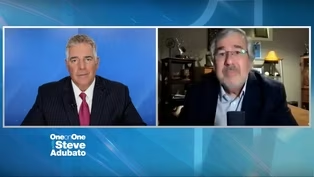
Award-winning ESPN Anchor Discusses his Extensive Career
Video has Closed Captions
Clip: S2022 Ep2552 | 10m 44s | Award-winning ESPN Anchor Discusses his Extensive Career (10m 44s)

Food Insecurity and What Can be Done to Fix it
Video has Closed Captions
Clip: S2022 Ep2552 | 9m 17s | Food Insecurity and What Can be Done to Fix it (9m 17s)

A Message to Those Battling a Cancer Diagnosis
Video has Closed Captions
Clip: S2022 Ep2552 | 7m 5s | A Message to Those Battling a Cancer Diagnosis (7m 5s)
Providing Support for PBS.org
Learn Moreabout PBS online sponsorship
- News and Public Affairs

Top journalists deliver compelling original analysis of the hour's headlines.

- News and Public Affairs

FRONTLINE is investigative journalism that questions, explains and changes our world.












Support for PBS provided by:
One-on-One is a local public television program presented by NJ PBS