
Carolina Impact: April 13, 2021
Season 8 Episode 21 | 26m 59sVideo has Closed Captions
Carolina Impact: April 13, 2021
Carolina Impact: April 13, 2021
Problems playing video? | Closed Captioning Feedback
Problems playing video? | Closed Captioning Feedback
Carolina Impact is a local public television program presented by PBS Charlotte
Carolina Impact: April 13, 2021
Season 8 Episode 21 | 26m 59sVideo has Closed Captions
Carolina Impact: April 13, 2021
Problems playing video? | Closed Captioning Feedback
How to Watch Carolina Impact
Carolina Impact is available to stream on pbs.org and the free PBS App, available on iPhone, Apple TV, Android TV, Android smartphones, Amazon Fire TV, Amazon Fire Tablet, Roku, Samsung Smart TV, and Vizio.

Introducing PBS Charlotte Passport
Now you can stream more of your favorite PBS shows including Masterpiece, NOVA, Nature, Great British Baking Show and many more — online and in the PBS Video app.Providing Support for PBS.org
Learn Moreabout PBS online sponsorship- [Narrator] This is a production of PBS Charlotte.
- Just out on Carolina Impact.
- While Charlotte looks at the future of light rail, the town's North of Charlotte, asking questions about the past.
I'm Jeff Sonier, stick around.
We'll talk about the arguments for and against a new mobility tax.
Coming up.
- Plus, we'll tell you about the purchase of a hotel for the homeless.
And we meet an amazingly talented young musician shining in a new movie series shot right here in Charlotte.
Carolina Impact starts right now.
- [Narrator] Carolina Impact covering the issues, people and places that impact you.
This is Carolina Impact.
- Good evening, thanks so much for joining us, I'm Amy Burkett.
The only way to keep Charlotte moving forward is to keep Charlotte actually moving.
That's the reasoning behind city Hall's plan for a new Mecklenburg mobility tax.
It would add an extra penny to our sales tax for more rail and bus service.
Plus new sidewalks, greenways and bike paths.
It all sounds like a good idea, unless you live in one of those areas that was left behind the last time they raised taxes.
Never getting the promised projects.
Carolina impacts Jeff Sonier joins us now from the South end with more, Jeff.
- Yeah, I actually covered Charlotte City Council.
Last time they proposed a mobility tax, back in the late '90's That's when they called it a transit tax.
A half penny on the Mecklenburg sales tax.
That's still around today.
That's the money they use to launch our light rail system and to pay, to expand our bus system for decades here in Charlotte.
In fact, we even dug up the PowerPoint presentation that City Hall produced back in 1998 to support that original transit tax.
(upbeat music) In fact, some of what they've promised from the transit tax, more than 20 years ago actually happened.
CATS light rail service in what they called the South corridor from Uptown to Pineville turned out to be a huge success.
Maybe not so much with transit riders, but definitely with the leave besiegers.
The light rail blue line itself, now surrounded by new apartments office buildings, restaurants, shopping.
But what about the commuter rail red line in the so-called North corridor to Huntersville, Cornelius and Davidson.
The old transit plan set from 2000 to 2005, the transit tax would pay to build these high quality North Meck bus stations.
That could ultimately be converted to red line rail stations.
- [Jeff] You never got the rail you were promised.
- Never got the rail.
- [Jeff] Never got the bus and train stations you were promised.
- Never got that, we have some park and rides but that's really, it's not changed.
We're talking with mayor John Aneralla at Huntersville Town Hall.
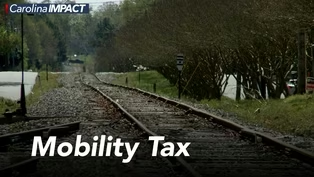
Not far from these rusty rails that run through the center of his town.
They're the old Norfolk Southern freight train tracks that CATS never got permission to use, for commuter trains.
Despite all those taxes collected for transit that taxpayers expected.
These old red line maps and timelines show actual rail service to Huntersville, Cornelius and Davidson were supposed to start soon after 2010.
The old CATS transit plan promising commuter trains between North Meck and Uptown, every 15 minutes in peak periods.
- You know, it was a great plan on paper, but the only thing that's really been done over the last 20 or so years in terms of the red line has been studying it.
I think we've had at least three, if not four studies.
- [Jeff] And while CATS tries and fails to put trains on these North Meck rails.
Well, they keep spending the old transit tax for tracks to other parts of town.
Like the light rail line from Uptown to UNC Charlotte, the original transit plan proposed building Bus Rapid Transit to serve the University Corridor instead because rail ridership there was considered too low and the cost of rail to high.
But CATS wound up building the blue line extension anyway.
Locally funded by that original transit tax money.
The old transit tax also helped to build these brand new tracks.
Now connecting the Johnson C. Smith area by sctreetcar to Plaza Midwood.
Even though that Gold Line sctreetcar from the West side to the East side is never even mentioned in the original transit tax plan.
- So when you see a headline in the Charlotte observer that says red line is a priority, we've seen this story before and it doesn't end well for North Mecklenburg.
- But I also believe that one thing that will be different this time, is that we're not just talking about your red line or transit.
- [Jeff] Charlotte assistant city manager.
Taiwo Jaiyeoba is on the Charlotte moves taskforce.
- We wanna make sure everybody is getting very familiar with what it is that's being proposed.
- [Jeff] That's Jaiyeoba sitting next to former mayor Harvey Grantt, chairman of the task force.
Which is recommending that new mobility tax to voters.
- What are the benefits to you in your town in Cornelius in Davidson and Huntersville?
Not just about Charlotte, but in your town.
It could just be streets or bikeways or Greenways.
- [Jeff] Mobility tax supporters also suggest that those far away new light rail projects located only in Charlotte actually benefit everybody especially after COVID, by bringing new growth and new jobs that we all share.
- For every mile of track you lay, there is a job number that's associated with that.
It's the best way to, you know to galvanize the economy and begin to generate jobs again.
This is not just about Charlotte.
This is about Mecklenburg County and this is about the adjoining towns.
- And we've been told this will be coming for 15 years.
If you build it, they will come, right?
- [Jeff] That was before Ray Steimel built his brewery here in Huntersville, near the rail line.
The track just beyond the back of Primal Breweries, Beer Garden.
- It had potential inside, had room for brewing outside and it had the railroad tracks.
And to know that it was going to be running down this corridor, you know it would be a whole revitalization.
We're gonna have the light rail, when the light rail opens this is gonna happen to our business.
So we're still waiting.
- [Jeff] Ray adds the red line is the reason he supported the transit tax the first time around, but not this time.
- That tax increase was the only tax increase I ever voted for.
I bet most people don't even know they're still paying it.
I mean, it's all in the same county.
It would be nice if it was all treated the same.
So when they say they're gonna do something they really ought to think about sticking to it.
- Yeah, I think it's great to be regional, if you're on the long end of the stick but if you're on the short end, it's a little hard to take.
- In fact, we talked with may around Aneralla the day after his Huntersville town board voted unanimously against the mobility tax.
Other North Meck mayors also voicing their opposition and the Lake Norman Chamber-Commerce saying no to any future sales tax increase for transit improvements they haven't seen yet and may not see for decades, Amy.
- Thanks so much Jeff.
You'll find a link to more information about Charlotte's new transit plan and the mobility tax to pay for that plan on our website at pbscharlotte.org.
Well, as Jeff just mentioned in his story, CATS is launching expanded East side, West side sctreetcar service.
The cross town sctreetcar from Elizabeth Avenue on the East side to Beresford road corridor on the West side has garnered its share of controversy from questions about gentrification to changing community dynamics.
As Beatrice Thompson tells us, its development has sparked a lot of interest, from not only developers, but long term residents.
- This is a community has been historically underutilized, historically neglected.
Now the city is making the investment.
Now everybody wants to come.
- This is the opportunity to unite all the businesses in the corridor and show them that something positive is happening.
And we can all grow and build together.
- We're not in necessarily in the long range planning conversation.
So, 2021, there are a lot more people at the table.
- [Bea] Meet the volunteers, the developer and the entrepreneur, all key players in the Beresford road corridor facelift.
Spearheaded by that long awaited city links Gold Line.
Bonds overwhelmingly supported by black voters, allowed phase one of the old trolley to start in 2015.
But it's taken longer to get on track to the West outside of the city.
- Unfortunately, however, we've always been on the last in the receiving the benefits of those bonds and so certainly there is a legitimate concern.
- [Bea] Now the city's multimillion dollar investment in the West side has attracted the attention of investors and new residents to a corridor that has been historically black.
Is that shift in economics and demographics that has many concerned that the history and the culture of the West side will be lost.
- When I saw what was happening, I said how do I be in part, I'm already in the housing side and I'm pushing hard to change and provide affordable housing.
- [Bea] Chris Dennis sees the West side corridor as a major part of this city's image as well as the heart of his black community.
He bought commercial properties at LaSalle and Beresford road.
Charlotte natives will recognize one as the original location of McDonald's cafe.
- That was the reason why this developed became so important to me and to try and bring history and to try do something iconic in this corridor.
- [Bea] Mr. McDonald would have been proud.
The anchor tenant in his old space, Chase Bank.
Currently, there is no date on when the sctreetcar will reach this last major intersection, which could be frustrating for business owners.
- But the challenge that Beresford road had it has been disenfranchised for a long time.
There hasn't been adequate funding I think putting this area and we have to ask that question of why.
The improvements start at the I-77 overpass with wider sidewalks, a pocket park with a splash pad and an amphitheater are on two corners of the Five Points intersection.
There are several West side streetcar stops, including in front of Johnson C. Smith University dormitories and art at the streetcar shelters.
Councilman Graham points out the 150 year old university should play a key role in these changes.
- We can't have a strong corridor without a strong Johnson C. Smith University.
So, I really want to begin to work with the institution so that they can be the protector of the corridor.
- We have been left out of so much that when things happen we feel helpless and we sound helpless.
We are powerful and we need to use that power to make change.
- [Bea] Diana Ward saw her opportunity to be part of the change.
The former owner of a bike rideshare business, now owns this group of buildings at the Five Points intersection.
- I've always wanted double in development.
I would say this is a leap for a novice.
- [Bea] Her a development includes businesses that will engage the community, a pizza place, an ice cream shop and a pharmacy and more.
She points out, African-Americans concerned about gentrification in black communities have an obligation to be part of the solution.
- You can't sit in Ballantyne talking about gentrification.
It's like, bring your banking dollars back instead of buying one of those cookie cutter houses in the suburbs, bring your money here or just get out of the conversation because we are also part of the problem.
- [Bea] It's a balance the community and its residents will have to strike.
Welcoming progress to the West side, while trying not to lose its identity.
And just how to do the politician, the entrepreneur and the developer think all of that can be done?
- What the city is trying to do, what I'm trying to do is to make sure that citizens are part of the change and not victims of it.
- We've got bazillion dollar athletes.
We have bazillion dollar bankers and they have to find out what is the conversation happening now that's gonna impact the city 20 to 30 years down the road.
- Now that opportunity is coming around, we're seeing the city looking at this corridor in a different way.
We're seeing the community that saying we need this.
- For Carolina Impact, I'm Bea Thompson.
- Thanks so much Bea.
There's still more to come for the West end streetcar.
The plans call for an extension past LaSalle Street.
Now, test trials have already been done and the streetcars should be operating later this spring.
Well, next up hope for the homeless.
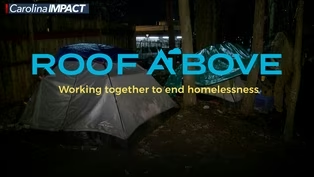
The non-profit Roof Above has purchased an 88 room hotel in Southwest Charlotte that will become home to the chronically homeless.
Carolina impacts Sarah Colon-Harris shares more on the initiative and introduces us to residents at a similar complex, who've already walked in their shoes.
- It was February 1st, 2012, and they checked me to my apartment and they were like, okay, here you go.
They open up the door and it was mine.
- [Sarah] Nine years later, and the joy of being in her own home still hasn't gotten old for Tabby Burns.
- I was like a little kid in a candy store.
- [Sarah] It's a far cry from the years she spent lost in the streets.
I've lived in tents, I've lived in camps, tents city.
I've lived in Port of Johns, I've lived in hard... - [Sarah] Homeless and addicted.
Tabby says she struggled to get clean.
- I was addicted to do crack, cocaine and I was basically a crack addict.
- [Sarah] Today she's sober and stable.
Her apartment at Moore Place, a saving grace.
Do you feel safe in here?
- Yes I do.
Yeah, I feel okay.
And to be honest with you, for me the only person that can make me safe is God.
So, I'm comfortable with him, knowing that he's here with me.
- And how does it feel being sober?
- Good, it feels good because being sober is something that you don't get a chance to do unless you're determined to do.
(soft music) - [Sarah] Gina Robinson is the director of Moore Place, a permanent supportive housing complex in North Charlotte built in 2012 to house the chronically homeless.
It's funded by private donors and owned by the non-profit Roof Above, which works to end homelessness.
- The goal I like to say is improve your quality of life.
So that may look like anything.
It may be reducing your substances, it may be maybe you wanna be connected with a psychiatrist and improve your mental health.
Maybe it's you wanna learn how to cook.
You wanna learn how to take care of your home.
- This is one of 120 units here at Moore Place.
Each one comes with a standard kitchen, a sofa, a desk and even a bedroom set.
And for many people who have been formerly homeless it's also a place of new beginnings.
And now there's more reason to be excited.
In 2020, Roof Above announced the five and a half million dollar purchase of a quality in hotel off Clanton road in Southwest Charlotte.
Modeled after Moore Place, the hotel will be converted into 88 apartments for the chronically homeless, social workers and support staff will also be on site.
- How will you go about selecting who gets housing and who doesn't?
- We target folks who have been homeless a long time and have disabling conditions.
So people who really need some robust supports to be successful in housing.
We have a core belief that by virtue of being human, everyone's ready to be, have the safety, stability and dignity of home.
But some people need some additional supports to be you know, successful and keeping whole.
- [Sarah] She says, renovating the hotel is more cost effective than building from the ground up.
Right now Charlotte's affordable housing crisis at an all time high.
According to Roof Above CEO, a person working 40 hours a week must make at least $17 an hour to afford the average apartment.
Those with no financial safety net or family support are the most vulnerable to homelessness.
- The individual stories are all unique.
And so, but in general people have some sort of crisis in their life.
And it's often a combination of two.
Maybe you're going through a divorce and you lose your job.
You have a healthcare crisis and you know, you're struggling with depression.
- [Sarah] For Walter Thomas homelessness was the price of childhood trauma and addiction.
- I've been addicted since I was nine.
- [Sarah] To what?
- Everything that makes me feel good.
- [Sarah] And while Tabby has remained sober and embraced her home at Moore Place, Walter admits his journey to stability still feels almost too good to be true.
- I still have a tent out there right now.
I still go outside once a week and sleep outside of my tent.
- [Sarah] Why do you do that?
- Because it's what I'm known to.
See, it's a mental thing for me.
- [Sarah] Psychological trap he says.
An internal war between feeling inadequate and a longing to feel safe.
- Everybody expect you to change just like that.
But if I've been doing something for a long period of time, what do you expect?
Hey, you put me in this place for 30 days and I've been on the street for 37.
So I've been doing everything I need to do for being on the street and all of a sudden I get into this great place.
You think things are gon' change just like that.
- [Sarah] Still, he's grateful for the staff and housing support he's received at Moore Place.
His dream to go back to school.
But the journey to recovery continues.
- I'm learning how not to be insecure.
I'm learning how my main goal is to stay humble.
You know what I'm saying?
'Cause this place was given to me for a reason.
- [Sarah] A reason to have hope with a roof above.
For Carolina Impact, I'm Sarah Colon-Harris.
- Thank you so much, Sarah.
There really is no place like home.
Well, Roof Above currently uses the hotel as an emergency shelter, but officials planned to begin renovations this spring and begin moving residents in by the end of 2021.
Well finally tonight, you hear the stories all the time.
Young wannabe actors and actresses making their way to Hollywood to try and make it big.
But more often than not, those Hollywood dreams go unfulfilled.
But thanks to a few doors opening at just the right time.
One local teenager who never even wanted to act, landed a coveted role on the Oprah Winfrey Network.
Carolina Impact's Jason Terzis and producer Doug Stacker shows us it was all because of her musical talent and being in the right place at the right time.
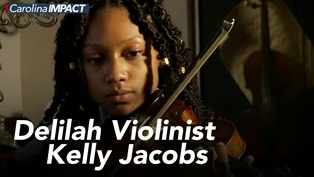
(orchestral music) - [Jason] For Kelly Jacobs today's violin lesson has a little added significance.
She's not practicing for a recital or a school show.
The stakes are just a little bit higher.
- I used to be scared to go to lessons.
- The E is out though.
When you hear Kelly play there's something a little bit different.
I think it just kinda speaks to people.
(orchestral music) - [Jason] Kelly May only be 17 years old but she's been playing the violin for 13 of those years.
- My sister played piano.
She still plays piano.
And I was like, I just wanna be like her.
I went to maybe two lessons and after I was just like, this is not for me.
♪ Can you tell me how ♪ ♪ To get to Sesame Street ♪ (orchestral music) - [Jason] But while watching the PBS classic Sesame Street, Kelly saw young kids playing the violin and she was hooked.
- And I was like, this is amazing.
This is exactly what I wanna do.
I just had that aha moment.
There are like little light bulb, that just came on.
- [Jason] So at the age of four, Kelly got her own violin and soon began taking lessons.
- Playing it then and being like, this is exactly what I thought it was going to be.
- She really liked the violin in a way that most kids aren't disciplined enough to.
- By age eight, Kelly was doing her own recitals.
Teaming up with teacher Tiffany Preston.
- Kelly was always mature in her work ethic.
So when she came to me, you know we would try things and she would immediately go home and work on it.
Classical.
It just put my mind in a bigger perspective.
(orchestral music) - [Jason] 2020 was a difficult year for just about everybody, including Kelly.
But it ended up bringing unexpected opportunity.
- We got a phone call last year and they were trying to find a set to film for a new series coming into Charlotte.
- [Jason] The, they were producers from the Oprah Winfrey Network.
- They were looking for locations.
- [Jason] Locations for a new show called Delilah.
(upbeat music) A drama series about an attorney fighting for the disenfranchised.
Who's also a single mother, raising two kids, her nephew and also dealing with her ex.
- So they came in and they were just like, this is exactly what we're looking for.
- [Jason] The violin shop housed in a 100 year old Victorian home in the Elizabeth neighborhood of Charlotte made for a perfect shooting location.
Shop co-owners Glen Alexander and David McGuirt were thrilled.
- They were taking pictures in every room and drawing those sketches.
We could tell immediately that it was what they were looking for.
- [Jason] The shows producers though had just one more request.
- And he said, well, I've got every part that I need, except I need someone to play Delilah's daughter.
And I'm looking for, an African-American who can play a sixteen year old that also can play violin really, really well.
- [Jason] Glen and David knew just the right person.
- My mom got a call.
- Do you think Kelly would have any interests in being in a TV show?
- We thought, oh this is a really cool thing for you to, you know, try to do.
- [Jason] Aside from appearing in a fourth grade musical, Kelly had no acting experience.
She went to the audition thinking it was for a secondary role.
- Couple of days later, we get the script and I was like, oh there's a script?
And he was like, yeah, like you're, auditioning for a role.
- [Jason] The role was for Maya, Delilah's smart, feisty and talented teenage daughter.
Kelly landed the role.
- I was just so giddy, I was so excited.
- Try this one.
- I don't wanna break it.
- Maya.
- [Jason] That giddiness quickly turned into nervousness as the reality of what was ahead set in.
- The show has definitely changed how I practice that's for sure.
Some of the pieces in these shows are things that I have not played at all.
- Doing all of the new stuff.
You know, scripts, learning her lines, being on set all of those kinds of things, going to school and then making sure that you find enough time to practice the things that you have to.
- How much is it?
- [Jason] Shooting for the show's first season lasted from October through January.
There's similarities between Kelly and her role in the show are everywhere.
- Me, I play Maya.
And just like in real life, I play the violin.
Maya is an aspiring musician as well.
She wants this as a career.
She wants to be a famous soloist.
It's her dream.
- [Jason] Her love affair with the violin has led to a lot of work.
It's also led to the opportunity of a lifetime.
Something Kelly wouldn't trade in for anything.
For Carolina Impact, I'm Jason Terzis reporting.
- Thanks so much, Jason.
What a talented young woman.
Well, Delilah is currently wrapping up its eight episode first season on the Oprah Winfrey Network.
The show's executive producer is York, South Carolina native Charles Randolph-Wright No word yet, if the show is being picked up for a second season.
Well that's all the time we have this evening.
We always appreciate your time.
And look forward to seeing you back here again next time on Carolina Impact.
Good night, my friends.
(upbeat music) - [Narrator] A production of PBS, Charlotte.
Carolina Impact: April 13, 2021 Preview
Preview: S8 Ep21 | 30s | Carolina Impact: April 13, 2021 Preview (30s)
Delilah Violinist Kelly Jacobs
Video has Closed Captions
Clip: S8 Ep21 | 5m 42s | Feature on 17-year old violinist Kelly Jacobs (5m 42s)
Mobility Tax: What Happened to the Red Line?
Video has Closed Captions
Clip: S8 Ep21 | 6m 30s | Red Line trains from Uptown to North Meck were supposed to start service in 2010 (6m 30s)
Video has Closed Captions
Clip: S8 Ep21 | 5m 37s | Inside Moore Place and how Roof Above provides permanent housing for the homeless (5m 37s)
Video has Closed Captions
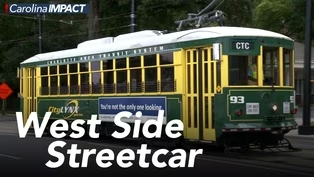
Clip: S8 Ep21 | 4m 59s | Development is growing along the Beatties Ford Road corridor (4m 59s)
Providing Support for PBS.org
Learn Moreabout PBS online sponsorship
- News and Public Affairs

Top journalists deliver compelling original analysis of the hour's headlines.

- News and Public Affairs

FRONTLINE is investigative journalism that questions, explains and changes our world.












Support for PBS provided by:
Carolina Impact is a local public television program presented by PBS Charlotte