
Carolina Impact: April 16th, 2024
Season 11 Episode 1121 | 26m 34sVideo has Closed Captions
Programs Meet the Demand, Autobell, The Raptor Center, & Montgomery Store Bluegrass Jam.
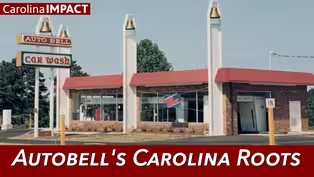
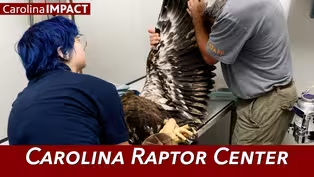
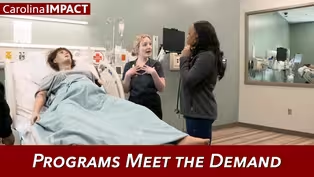
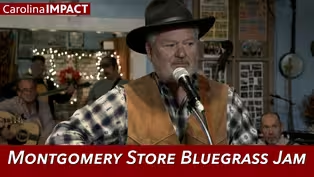
A local college is expanding programs to meet the demand for healthcare professionals; A look at the family history of local business Autobell, founded in 1969; A local center serves as a sanctuary for recovering birds from around the world; & A 20 year tradition at the Montgomery Store Bluegrass Jam in Gold Hill.
Problems playing video? | Closed Captioning Feedback
Problems playing video? | Closed Captioning Feedback
Carolina Impact is a local public television program presented by PBS Charlotte
Carolina Impact: April 16th, 2024
Season 11 Episode 1121 | 26m 34sVideo has Closed Captions
A local college is expanding programs to meet the demand for healthcare professionals; A look at the family history of local business Autobell, founded in 1969; A local center serves as a sanctuary for recovering birds from around the world; & A 20 year tradition at the Montgomery Store Bluegrass Jam in Gold Hill.
Problems playing video? | Closed Captioning Feedback
How to Watch Carolina Impact
Carolina Impact is available to stream on pbs.org and the free PBS App, available on iPhone, Apple TV, Android TV, Android smartphones, Amazon Fire TV, Amazon Fire Tablet, Roku, Samsung Smart TV, and Vizio.

Introducing PBS Charlotte Passport
Now you can stream more of your favorite PBS shows including Masterpiece, NOVA, Nature, Great British Baking Show and many more — online and in the PBS Video app.Providing Support for PBS.org
Learn Moreabout PBS online sponsorship- [Announcer] This is a production of PBS Charlotte.
- Just ahead on Carolina Impact, we'll learn how Central Piedmont Community College, plans to expand programs to help meet the demand for registered nurses and other healthcare professionals.
Plus how a popular Charlotte-founded car wash, became a national empire, and we traveled to Gold Hill to experience a 20-year bluegrass tradition.
Carolina Impact starts now.
(upbeat music) Good evening.
Thanks so much for joining us.
I'm Amy Burkett.
According to the American Hospital Association, about 100,000 registered nurses left the workforce, during the past two years due to stress, burnout, and retirements.
And more than 600,000 report they plan to leave by 2027.
Carolina Impact's Dara Khaalid and Marcellus Jones, show us how Central Piedmont Community College, plans to help meet the demand for healthcare professionals.
(gentle music) (door knocks) - Good morning, Ms. Jocelyn.
How are you?
- [Dara] It's another day in simulation for nursing students, Christian Wilson and Alexandria Gerard.
- Okay, very good.
And are you feeling short of breath right now?
- [Dara] Speaking to and caring for a mannequin, they act out a hospital scenario that's designed to prepare them for the real world.
- There are adverse events that happen because it can happen like that.
And this is without putting us in the direct line of fire.
This is the best experience that we can have.
- [Dara] Hands-on Experience like this is a crucial part of Central Piedmont's Associate nursing degree program.
- We make sure that they know how to do certain skills before they go into the hospital facilities, and then they actually get to take care of patients from first semester all the way through fourth semester.
- [Dara] Department chair.
Melanie Colson, tells me, "This is important because after graduation, students are walking into an industry that's still facing a nationwide nursing shortage."
- It has a lot to do with a lot of our older population of nurses retiring.
It has a lot to do with COVID, and the impact that COVID had on nurses, a lot of nurse burnout.
- [Dara] One of the ways Central Piedmont is trying to help meet the demand for nurses is by adding an accelerated 15-month nursing program that launches this summer.
- It's providing them the same education.
It's just compressed to a shorter period of time.
So, you know, we look for certain specifics of those that are more academically capable to do that fast-paced program.
- [Dara] They're also starting, a 12-month licensed practical nurse to registered nurse bridge program next year.
- It makes me kind of feel more comfortable, entering the workforce because I know there's such a tremendous need for nurses.
I think that that eases my concerns about being able to find a job because it's so needed right now.
- [Dara] Inside the same building on Central Campus, you'll find students dressed in full personal protective equipment gear, working diligently, the new sterile processing program.
(water sloshing) - The main goal of the department is to get the instruments for surgery clean and sterile for the patient.
So it's an extremely important job.
They're all infection preventionists, so to speak.
- [Dara] Instructor Lana Haecherl says, "Their inaugural class has learned a lot about their field in a short time."
- We're starting out with the classroom didactics, an eight to nine week program.
Once they get done with the classroom didactics, they'll have a module where there'll be 200 hours of clinical, and then another module with 200 more hours of clinical.
- [Dara] Similar to nursing, there's a shortage in this industry too.
- There are significant vacancies in this field, not only in the Charlotte market, but across the United States.
and trying to get students through a program that's comprehensive, that includes clinical experience is very difficult.
- [Dara] Haecherl tells me, "The nature of the job is contributing to shortages."
- Sterile processing is a hard job.
It's very physical job.
Up until recently, it wasn't really considered a profession, it was a job.
Most sterile processing departments, if you go into a hospital today, they're in the basement.
They don't have beautiful windows to look out.
It's not a job where you get a lot of accolades.
- [Dara] Research from the US Bureau of Labor Statistics, shows that the average salary for registered nurses in North Carolina is over $77,000 a year, for medical equipment preparers, it's under 40,000.
For student, Lori Bagley, the reality of the job hasn't deterred her.
- I really like how it's a hands-on thing.
I like working with my hands.
I like being able to manipulate and understand just how something works.
- [Dara] Central Piedmont has another hands-on program.
- You can just leave her foot on the table, and then dorsiflex up from the pad.
- [Dara] The massage therapy program gives students a chance to work one-on-one with each other.
Although it looks like pure relaxation, they're learning vital techniques.
- So our students do spend plenty of time in our anatomy and kinesiology classes, learning all about the body, the bones and the muscles.
And then the art of massage would be working hands-on, and learning different modalities of massage therapy, starting with Swedish and working their way into neuromuscular therapy.
- [Dara] The nine-month certificate program, prepares them for the next step.
- We have aligned our curriculum with the North Carolina Board of Massage and Body Work Therapy requirements, so our students are fully ready upon graduation to obtain their license.
- [Dara] Once graduates get their license, they can enter the workforce, one that desperately needs them.
- In the Charlotte area, this would be a high-demand career.
We are absolutely seeing a lot of employers looking for therapists every day.
So this is something that would be an easy-to-fill job for the Charlotte market.
- [Dara] The average salary in North Carolina is just over $63,000 a year.
The students we spoke with tell us they feel more than ready to conquer the workforce after graduation.
For Carolina Impact, I'm Dara Khaalid.
- Thank you, Dara.
Central Piedmont also has other high-demand programs, like dental hygiene, advanced manufacturing, and carpentry for students looking for a technical career that allows them to get into the workforce quickly.
Well, it's that time of year again, however, we're not talking about the Masters Golf Tournament, which just wrapped up this past weekend, or baseball's new season, which just got underway.
No, we're talking about pollen season.
Carolina Impact's Jason Terzis joins us now with more.
- Well, we all love spring, right?
The warmer days, the greening of the grass, the blooming of the flowers, and the budding of the trees.
We love it except for those of us with seasonal allergies, and that pesky yellow dusk that gets on everything.
It's a good time of year though to be in the car wash game.
♪ You might not ever get rich ♪ Those of a certain age, might remember the 1976 hit movie "Car Wash," the disco-infused comedy about a day in the life at the Dee-Luxe Car Wash, its employees and its eclectic mix of visitors.
♪ Working at the car wash ♪ ♪ Working at the car wash, yeah ♪ It's a throwback to a different era, music and fashion.
Same can be said for what it was, a full service car wash with the outside and inside getting cleaned.
- There's not many of us left in this business.
- [Jason] Here in Charlotte and around the Carolinas, we have one, and its roots go all the way back to even before the "Car Wash" movie was released.
- I was there when it started.
- [Jason] The Autobell story begins in 1969.
At the time, Charlie Howard was working for a local industrial company, but when that company was bought out, Charlie found himself out of a job.
- So he had to find something else to do.
- [Jason] He partnered with a friend to sell truck-washing equipment.
♪ Car wash, yeah ♪ - In order to have a show place to showcase their equipment, they built the first Autobell Car Wash right here in Charlotte down on South Boulevard.
- [Jason] As for the Autobell name, the auto and Autobell has two meanings, auto for automobile and automation.
The bell part, well, that comes from somewhere else.
- It just so happened at the time, we were doing business with an architectural firm that used Bell Towers as an architectural feature, a focal point if you will.
So he said, "Well, it's kind of natural, Autobell."
- [Jason] Charlie's son, Chuck, was a college sophomore when the first Autobell opened.
Two years later, and with his business degree from UNCC in hand, he joined up with dad.
- 'Cause everything we were doing were things that I'd studied in my business classes.
Little by little, we just slow and steady kept growing and growing the business - [Jason] In 1986, and was still a relatively small company, Autobell founder, Charlie Howard, passed away at just 60 years old.
- A pioneer not only for our company but for the entire industry.
- His character is alive and well in this company.
- It took a while to get my feet on the ground and begin to implement my own plan.
- [Jason] For Carl Howard, joining his dad in the family business, the one that his grandfather had started, only seemed natural.
- From the time I was an early teenager, I worked in the car washes, and then I got my license, and I could actually drive a car out, which was exciting.
- [Jason] Over its five plus decades, Autobell has remained in the Howard family with the fourth generation of Howards now on board.
- We're not big corporate private equity, we just do it the old-fashioned way.
We use our funds and borrow a little bit from the banks, and keep growing the company.
- [Jason] But the term, family, goes well beyond just the Howard name.
- We have employees that I consider family, 'cause you know, they've been with us so long.
- I'm one of many who's part of the family.
So with the family vibe comes the family accountability.
- [Jason] Autobell is known for hiring high school students with many returning during and after college.
Every single one of the company's managers, district managers, regional managers, and operations directors, started out by working as a crew member.
- I think about 75% of our employees are students, and it's a great job for a student.
You know, there's no late night work.
It's physical activity, it's outside, a lot of people like that.
- By the time our people are ready to join our management team, they're already well-indoctrinated in our culture, so they understand what our company is all about.
- [Jason] Over the years, they've implemented multiple programs to better serve the community from recycling used water.
- And it enables us to wash cars with only about eight gallons of new water per car.
- [Jason] To giving back to various organizations, like the $12,000 they recently gave the Red Cross, and the 2 million plus dollars of scholarship money for student employees heading off to college.
- We have parents call us wanting to know how they can get their son or daughter into the scholarship programs.
- [Jason] Slow and steady, that's been Autobell's growth model over the years with now 90 some locations across five states.
- Not every decision make is all about profit dollars, right?
It's about what's best for the whole group, what's best for the growth of our company, what's best for the next five years, the next 10 years.
- [Jason] In a world where companies, get bought out all the time, how has Autobell done it?
Well, look no further than the foundation set by founder Charlie Howard 55 years ago.
- Every company makes mistakes.
So the question is, how quickly can you recognize this is not working, let's change it, and do something else that might work or that will work?
- That's one of the great freedoms we have in this country, is to be able to create a business really from practically nothing and grow it.
- [Jason] From a single location on South Boulevard to closing in on 100, makes you wonder what Charlie would say now, nearly 40 years after his passing.
- He'd probably say, "Why didn't you go faster?"
- "Why aren't we bigger?
Why didn't we grow faster?"
(Carl laughs) - But I think he would be very proud of where it is.
But yeah, he was put the pedal to the floor kinda guy for sure.
- [Jason] Employing roughly 3,000 full and part-time employees, and washing some 5 million cars annually, more than 90 million since 1969.
It's probably fair to say, Autobell has left an enduring mark on the Carolinas.
- Again, I love that I learned something new from your stories every week, Jason, but I wanna know a little something about the company's other organizations.
- Yeah, it's the other company, and this is the part about Autobell that people probably do not know, and that's something that I did learn while putting this story together.
This other company is called Howco, which is short for Howard Company.
It too was founded by Chuck Howard at the same time he started Autobell in 1969.
So keep in mind, all Autobell locations are owned by the Howard family.
They are not individually-owned franchises.
So let's say someone wants to open up a car wash and wants them to be the owners, Howco will supply all the machinery, the parts, the chemicals, even help with the design of the facility, everything that that person would need in order to start up a car wash business.
So basically, that other aspect of the company comes in, helps them get set up, so it's not an Autobell, it's whatever car wash, but they're basically helping them do their business.
- Awesome.
- [Jason] Mm-hmm.
- So much great information.
Thanks so much, Jason.
- Absolutely.
- Up next, it could be called one of the hidden jewels in the Queen City's crown.
For more than four decades, it's been a sanctuary for recovering patients from around the world.
As Carolina Impact's Bea Thompson, and videographer Max Arnold show us, this corner of compassion in Northwest Mecklenburg County, has garnered worldwide attention.
- [Bea] Picture this, you're walking along a wonderful wooded trail near the river in Mecklenburg County.
So peaceful, so calm, and then you hear this, (birds chirping) then you look up and see this.
Welcome to what could be termed a safe space for avians.
For the rest of us, you can just call it the Carolina Raptor Center.
- Hi, okay, we're very excited.
- [Bea] More than 40 years ago, it began as a rehabilitation hospital to aid injured birds.
Today, the work has expanded to include programs for the public on local birds and birds of the world.
- So it's a really cool thing that we can do here at the Raptor Center is have birds from all over the world so that we can showcase what birds all over the world look like.
Because there are people that may not ever have the opportunity to go to Africa or Australia.
So we can show them those birds.
- [Bea] The Raptor Center takes part in international efforts to help save rare bird species.
While here, birds can be observed in natural settings, and because the center provides rehabilitative services for avians from all around the world, the facility tries to mimic their environment while they're in the Carolina woods.
- When you walk on our trail, you might notice that some of our birds have these little lights in the back.
Those are heat lamps.
Birds are really good though at self-regulating, thermoregulating.
They grow in extra feathers in the winter to keep themselves nice and warm.
But if they are naturally from a different place that stays pretty warm, we will give them that supplemental heat.
- [Bea] Moving around the heart of the center, the rehab facility and hospital, you see the staff working to aid the recovery of birds from feeding them to keeping a watchful eye on them.
And for many staff members, the story of getting here is similar.
It starts with a love of animals.
- Rehabilitation is a little bit of medicine, it's a little bit of art, and it's a whole lot of passion.
- [Bea] Meet Sunny Cooper, whose job it is to oversee the operation of the animal hospital.
- We have birds that come in that are injured that we do full exams on when they come here.
We assess whether we think that their injuries are things that would allow us to re-release them back to the wild because here at the Raptor Center, we focus 100% on release back to the wild.
- [Bea] Which for some birds means close observation by those staff members checking on not only their recovery but potential injuries.
Here, birds with injured wings, well, they get x-rays.
- [Sunny] And we do all of our x-rays here in-house.
So we have our x-ray machine downstairs, and we can see here that this bird has a broken wing.
So this bird probably was a bird that got surgery.
He's a good candidate for it.
- [Bea] But you may ask, how do you set a bird's broken leg?
Simple, a pool noodle.
- The same ones that you would float in Lake Norman on, we use on birds.
We use them as boots on their feet.
- [Bea] Staff perform normal care for birds from intake assessments to minor wound care, while two volunteer veterinarians, handle orthopedic surgeries on those birds.
And when your patient load of birds runs from 800 to 1,000 annually, that adds up to a lot of bird feed.
But avians, in particular, Raptor avians, don't simply eat bird feed.
- We do feed quail here, and that's kind of seen as a more exotic food that people may eat.
So we feed quail, we feed chicks and mice.
We try to make sure that their diet is really varied 'cause it would be out in the wild.
You know, raptors not gonna go out and catch mice day after day after day.
- [Bea] You may be surprised to learn Joe's town, many variety varieties of raptors are found in this region.
- Red-shouldered hawks are probably gonna be one of the most common, but we also have barred owls.
We have great horned owls, we have red-tailed hawks, we have black vultures, we have Turkey vultures, and then you go down to the water, we have osprey.
Sometimes we'll even see a bald eagle down there and- - [Bea] And All of those are native to here.
- [Kate] All of those are native to here.
- [Bea] 90% of the birds that come in have some sort of human-based injury, whether it's been hit by a car or it flew into a window, tangled in barbed wire or fishing line.
Yet, what may be the biggest danger for those birds, what you toss from your car.
- Well, what's happening is that you know, things are on the side of the road, litter.
Apple cores, banana peels, you know, sometimes trash, and that's going to attract little rodents to the side of the road, and what eats little rodents?
Raptors.
- [Bea] It's a lot to learn, it's a lot to see, yet the staff want you to know it is a wholly different world to explore.
- You take a step in that front door, and we'll handle the rest.
We'll make sure that you fall in love with birds, and that you leave feeling good about the environment, about our future.
You just get here, and we'll take care of the rest.
- [Bea] It's just a jewel in the woods of Northwest Mecklenburg County.
But if you look closely, you just might see a bit of fluff and magic high in the Carolina Pines.
For Carolina Impact, I'm Bea Thompson.
- Thank you, Bea.
The Raptor Center is getting a facelift in partnership with Mecklenburg County Park and Recreation.
The center will have a new entrance.
That entrance will be part of the county's newly built Quest Center at the Lauder Preserve.
Well, finally tonight, since the 1940s bluegrass musicians, like the late North Carolina native Earl Scruggs, have been making toe tapping music with their banjos, fiddles and guitars, it's a distinctive sound born in the Southern Appalachian Mountains.
Producer John Branscum takes us to the Montgomery Store Bluegrass Jam in Gold Hill, a Friday night tradition, 20 years in the making.
(gentle music) - [Vivian] Bluegrass is a music that everybody can relate to.
It's a toe-tapping happy music.
- It's just old time hillbilly, just down home gospel, anything you wanna throw in it.
- Bluegrass was coined and named by Bill Monroe.
He wanted it to be different than the country music of the day.
He was from Kentucky.
Kentucky's known for bluegrass.
It's a traditional string music.
(gentle music) - All right, we're so glad y'all are here.
We're glad we're here too.
- [Vivian] The jam here at Montgomery General Store, has been going on for almost 20 years.
- It's just the perfect medium to play just an old country store out in the middle of old country, and you know, with banjos and guitars and bass fiddles and pictures and ice cream and stuff, and people can just, you know, can stand around and play, and be very much at ease.
♪ I'm saying longtime, Monroe ♪ - [Vivian] The Bluegrass Jam is a gathering of musicians from all over the region.
Some will drive an hour to two hours to get here to play.
- You know, it's always different.
Some of these jams can go on for two hours, three hours straight.
Sometimes you know, longer than that.
♪ And I don't know ♪ ♪ I'm saying longtime, Monroe ♪ - [Vivian] It brings players together that don't have a chance to get together and pick, just pick and have fun.
- I love coming down here probably as much for the fellowship as I do for the music.
(indistinct) - Sometimes it's really nerve-wracking.
Sometimes it's so fast that you don't have time to think about it, but it's just a lot of fun.
♪ The rhythm of the brass keys ♪ ♪ The function of my mind ♪ - I'm so happy that you're here tonight.
- [Mary] And Vivian knows everybody.
- If this is the building, she's the cornerstone.
- [Mary] She really cares about the players and about the people that come.
- I don't remember a time, when bluegrass wasn't being played in our house.
My father was a musician, a luthier.
He built Fiddles guitars, mandolin.
My dad was a member of the Church Brothers Pioneer Bluegrass Band from back in the day, the late '40s, early '50s, and into the '60s.
I was about six or eight years old, when he was going out there and playing on the Opry.
That was way back when in the original Ryman Auditorium.
One of his most iconic songs was written and recorded in 1948, and Lester Flat and Earl Scruggs had just left Bill Monroe to form the Foggy Mountain Boys and needed original material.
And my dad let them record "Cabin in Caroline."
- We got Luke, we got Jacob, Taylor and Anna, they go by Brothers of Bluegrass, and Paul.
So I'm the Paul part of it, grand Paul.
Luke was the first one, and I knew that I just wanted to pass it down.
(bright upbeat music) - From day one, he started off teaching me just the basics and let me make mistakes and learn from those mistakes.
- There's hardly a day go by that I don't sit and play something.
I've drove my wife crazy forever, try and get the kids to come over two or three times a week if possible.
- When we have young kids like the Whitley children, it makes you feel good that there's still interest, and this music will live on.
I think the music brings people here that wouldn't come to Gold Hill otherwise.
People will walk in just hearing it from the sidewalk, and they'll just say, "Wow, what is going on here?
This is totally awesome."
I really want them to feel good.
I want them to be happy when they leave here.
I want them to take away a family tradition with them.
- You know, you're learning and you're playing, and you fellowship, and that's what's the beauty of this place right here.
(audience applauding) - Thank you, John.
Vivian Hopkins is currently producing an album of her late father's songs with musicians in California, Tennessee, and even Italy.
Bluegrass music has certainly evolved.
Here on Carolina Impact, we love exploring the issues, people and places that make our region so special.
We'd love to hear your story ideas.
Please send us an email with details to stories@wtvi.org.
Thanks so much for joining us.
We always appreciate your time, and we look forward to seeing you back here again next time on Carolina Impact.
Goodnight, my friends.
(bright upbeat music) - [Announcer] This is a production of PBS Charlotte.
Video has Closed Captions
Clip: S11 Ep1121 | 5m 47s | A look at the family history of local business Autobell, founded in 1969. (5m 47s)
Video has Closed Captions
Clip: S11 Ep1121 | 5m 35s | A local center serves as a sanctuary for recovering birds from around the world. (5m 35s)
Video has Closed Captions
Clip: S11 Ep1121 | 5m 38s | A local college is expanding programs to meet the demand for healthcare professionals. (5m 38s)
The Montgomery Store Bluegrass Jam
Video has Closed Captions
Clip: S11 Ep1121 | 4m 44s | Learn about the Montgomery Store Bluegrass Jam in Gold Hill. (4m 44s)
Preview: S11 Ep1121 | 30s | Programs Meet the Demand, Autobell, The Raptor Center, & Montgomery Store Bluegrass Jam. (30s)
Providing Support for PBS.org
Learn Moreabout PBS online sponsorship
- News and Public Affairs

Top journalists deliver compelling original analysis of the hour's headlines.

- News and Public Affairs

FRONTLINE is investigative journalism that questions, explains and changes our world.












Support for PBS provided by:
Carolina Impact is a local public television program presented by PBS Charlotte