
Carolina Impact: April 19, 2022
Season 9 Episode 22 | 24m 16sVideo has Closed Captions
Charlotte Fish Farm, Scratch Jr., Hookshot Charlie, Charlotte Fencing Acadamy
Charlotte Fish Farm, Scratch Jr., Hookshot Charlie, Charlotte Fencing Acadamy
Problems playing video? | Closed Captioning Feedback
Problems playing video? | Closed Captioning Feedback
Carolina Impact is a local public television program presented by PBS Charlotte
Carolina Impact: April 19, 2022
Season 9 Episode 22 | 24m 16sVideo has Closed Captions
Charlotte Fish Farm, Scratch Jr., Hookshot Charlie, Charlotte Fencing Acadamy
Problems playing video? | Closed Captioning Feedback
How to Watch Carolina Impact
Carolina Impact is available to stream on pbs.org and the free PBS App, available on iPhone, Apple TV, Android TV, Android smartphones, Amazon Fire TV, Amazon Fire Tablet, Roku, Samsung Smart TV, and Vizio.

Introducing PBS Charlotte Passport
Now you can stream more of your favorite PBS shows including Masterpiece, NOVA, Nature, Great British Baking Show and many more — online and in the PBS Video app.Providing Support for PBS.org
Learn Moreabout PBS online sponsorship- [Narrator] Wells Fargo is proud to support diversity, equity and inclusion in our employees, our customers and the communities we serve, as well as through content on Carolina Impact.
- [Announcer] This is a production of PBS Charlotte.
- Just ahead on Carolina Impact.
- Come on down to the farm, the fish farm.
I'm Jeff Sonier at North Carolina's largest tilapia farm.
You'll be surprised where it's located.
- Plus, four-year-old's learning how to code.
We'll introduce you to the program making it possible.
And these students know how to take jabs.
How this fencing academy teaches more than sword play.
Carolina Impact starts right now.
- [Announcer] Carolina Impact.
Covering the issues, people and places that impact you.
This is Carolina Impact.
- Good evening.
Thanks so much for joining us.
I'm Amy Burkett.
Charlotte's known as a big business town, a banking town, a tech town, but you won't find much farming here unless you know where to look.
We'll take you to what maybe Charlotte's most unusual farm.
Unusual because of what they grow and where they grow it.
Carolina Impact's Jeff Sonier and photojournalist Doug Stacker join us near Charlotte Douglas International Airport for an inside look.
- Yeah, you can see how close we are to the airport.
There's the air traffic control tower just behind us.
We've got planes landing on either side of us here and we're surrounded by airport business park type buildings.
So where's the farm?
And where are the fish?
(clicking sound) - [Rob Ellis] We're maybe a quarter of a mile from the, the closest runway.
This was actually the original DHL shipping warehouse for the airport facilities.
- But owner Rob Ellis says it's not a shipping warehouse anymore.
- No, I, I have a fish farm.
Yeah.
Oh, are you what in, yeah.
In Charlotte.
Yeah.
In an industrial park.
Yeah, near the airport.
- [Jeff Sonier] That's how most conversations start with Ellis when he talks about converting this giant airport warehouse into Astor Farms, with a dozen swimming pool size tanks inside, each tank holding 30,000 gallons.
And most of the big tanks are also filled with these fresh and fat tilapia.
- [Rob Ellis] Every tank in here, the fish are a different age.
And so, you know, we may be harvesting that tank next month.
- [Jeff Sonier] But until they're harvested, these fish at Astor Farms all swim in perfect 82-degree water, constantly circulating and filtering to keep it clean.
- [Rob Ellis] And remember, there's not fish in every tank right now, but what we're looking at here is the oxygen level in each one of these tanks.
- [Jeff Sonier] It's all controlled by this computer system that Ellis designed for maximum e-fish-ency.
- [Rob Ellis] So we can come in here and change these set points of any of these tanks.
We're also looking at our water temperatures.
- [Jeff Sonier] And Charlotte's only fish farm has an automatic food system too.
- Are we ready?
- Ready.
Here we go.
- [Jeff Sonier] Making sure this feeding frenzy for hundreds of thousands of fish happens not just every day, (water rushing) but every hour.
- [Rob Ellis] So we bring in fish when they are about a centimeter long.
At that point, they're about 30 days old.
We bring 'em in, we grow 'em, we split 'em into more tanks as they get larger.
And then we bring 'em down to these big tanks and they'll stay here for another four or five months.
So in total, the process is 9, 10, 11 months.
- [Jeff Sonier] Ellis walks us down to what he calls the nursery tanks, smaller tanks, where the smaller fish grow into the fresh, full size tilapia that his customers are looking for.
- [Rob Ellis] So these fish now I'd say are about three quarters of a pound.
So we have a couple of months left before they're ready for market.
Our typical market size is around a pound and a half.
- [Jeff Sonier] But Ellis, who's a chemical engineer from NC State, admits that in the beginning, he learned most of what he knows about fish farming from NC State's aquaculture website.
- [Announcer] From mountain trout to coastal oysters, North Carolina has a bountiful selection of fresh aquacultured seafood.
- [Jeff Sonier] Aquaculture is what the state calls fish farming, the oh-fish-al name.
And it's actually a $56 million a year business.
With big open air aqua farms like this 100 acre bass growing operation near the Outer Banks.
Trout, oysters and catfish make up most of north Carolina's fish farming, but nobody grows more tilapia than Astor Farms does here in Charlotte.
- Our annual production is a little less than a half a million pounds a year.
- [Jeff Sonier] Wow.
- [Rob Ellis] Yeah.
- [Jeff Sonier] You're the biggest tilapia producer in the state.
- [Rob Ellis] Yeah, in North Carolina and kind of on the east coast.
We're I think the second largest east of the Mississippi.
- [Jeff Sonier] So you're one of the big fish.
- [Rob Ellis] (laughs) You can say that.
- [Jeff Sonier] And here's what those Astor Farms big fish look like when they're netted and headed out the door to your friendly neighborhood ethnic grocery store.
- [Rob Ellis] Our customers are those grocery stores from Atlanta, Georgia to Toronto, Canada.
And you'll go into these grocery stores and you'll see aquariums with the fish swimming.
If you walk into a store in Charlotte, they're all our fish.
Our fish are a premium product and our fish are sold in these grocery stores as the Sunday dinner, as the special meal or during holiday get-togethers.
We're competing with the other high end fish in the market.
People see these fish and they know that you can't get any fresher.
The way we do it here is just, it's a very environmentally friendly form of agriculture.
- [Jeff Sonier] And at Astor Farms, they don't just grow fish either.
- [Rob Ellis] It'll start rotating and you'll hear a sprayer go off.
- [Jeff Sonier] Not when this system that cleans and filters.
The fish tank water inside also provides purified plant food for this greenhouse outside, growing what some call Charlotte's best lettuce.
- [Rob Ellis] And we're basically just pulling that nitrogen out of the water and using it for these plants.
You see the roots sit right into the water there.
And that's where they get their nutrients.
- [Jeff Sonier] Yep, it turns out that when you're a Charlotte lettuce farmer, well, being a Charlotte fish farmer too, can be, you know, pretty bene-fish-al, making Astor Farms even more self suf-fish-ent.
- [Rob Ellis] Farmers kind of get together outside of the city and talk about farming.
- [Jeff Sonier] Right.
- [Rob Ellis] But yeah, no, we're we're in our own little bubble here in the industrial park.
- [Jeff Sonier] By the way, owner, Rob Ellis says every four to six weeks, they get another load of those finger sized tilapia fish.
So they can start another crop and they don't have to go far to pick up that shipment that comes in right here at the airport.
Amy.
- [Amy Burkett] Thanks so much, Jeff.
at PBScharlotte.org, you'll find more about Astor Farms aquaculture and hydroponic farming.
For years, we've heard about the importance of pre-K education, but not all children have access to quality pre-K programs.
PBS Charlotte teamed up with Smart Start of Mecklenburg County to implement a new initiative teaching four year olds how to code.
Yep.
They can do it.
Wait until you find out.
Carolina Impact's Jason Terzis has the story.
- [Toye Watson] Hi friends.
How are you?
[Children] Good.
[Toye Watson] Hi, it's good to see my creative coders again.
So.
- [Jason Terzis] It looks like a typical pre-kindergarten class, except what these four year olds at Hidden Valley Elementary school are learning about, might be considered anything but typical for their age.
- [Toye Watson] So we're gonna click on the color that we want to personalize her and tap on her face.
- [Jason Terzis] The kids may not even know it, but they're learning the basics of computer programming or coding.
- [Toye Watson] That's the beauty of pre-K learning, right?
You learn through play.
- [Kaz Muhammad] And that's the best way to learn, right?
Where you don't really know that you're actually learning.
- [Toye Watson] Pick the character that you want.
So what do you, who do you want to be your avatar in your code.
- [Jason Terzis] For the kids, it's fun picking characters, colors, and backgrounds.
- [Allyson Armstrong] But they didn't know that they were actually coding.
They were having to put things together to get to the next level.
- [Toye Watson] So they're doing the coding.
They're learning algorithm, they're learning sequences.
They're learning all the foundational concepts of coding, but they're, it feels like they're playing a game.
- [Jason Terzis] PBS Charlotte implemented the program called Scratch Junior, developed at MIT in the early 2000s to help young children keep up with ever-changing technology.
- [Toye Watson] Then they married it to PBS because PBS is synonymous with early childhood education.
I mean it's America's first classroom.
- [Kaz Muhammad] And when she mentioned coding and building and project based learning for pre-K, that's exactly what we need to be doing.
- [Jason Terzis] To fund the program and provide the class with the tablets, PBS Charlotte received an innovation grant from Smart Start of Mecklenburg County.
- [Toye Watson] Can I get some silent claps?.
- Silent claps?
Fantastic.
- [Natacha Duggins] When they grow up, their careers, everything is gonna be technology based.
And so to start it young at this young age where they're familiar with it, it's not just playing games, but it's actually learning the behind the scenes of it.
- [Jason Terzis] The class is taught by PBS Charlotte education and outreach coordinator, Toye Watson.
- [Toye Watson] So now let's find a setting.
A setting is a fancy word for where do the character want to be.
- [Jason Terzis] While the kids are learning how to code, they're also being exposed to STEM, science, technology, engineering, and math.
- [Allyson Armstrong] We actually have been incorporating more STEM activities in our classroom thanks to Ms. Watson.
At first, I didn't realize how much STEM could be incorporated into pre-K. - [Morshed Mahmud] So now, you know, STEM is the future and the world is very competitive.
So the earlier they can start, the better for them.
So we are really happy about that.
And we thank the whole PBS Charlotte team for this initiative.
- Where do you want red to be on the character?
That's all right.
So now he's red.
- In January, Toye began teaching two pre-K classes at Hidden Valley and another at the Sugar Creek Library, serving 56 children in all.
- [Toye Watson] What if we gave kids concepts around vocabulary sequencing, algorithm, and then showing them coding blocks.
This is basically you take the code that we would normally see in the HTML format and bring it down on the level for kids.
- [Jason Terzis] And for Toye, this initiative is personal.
She attended Hidden Valley and spent a dozen years as a middle school English language arts teacher within CMS.
She saw firsthand the struggles some kids have.
So to be able to give back now and help the younger generation means a lot.
- When Mecklenburg County, you know that we have, we have trouble with meeting our reading standards by the time the end of third grade.
By that time, I already could recognize the gaps that were in learning, right?
- [Kaz Muhammad] She was at one of the most challenging schools in CMS, which was ML King, Junior, Middle School.
And she won teacher over of the year over there.
So her reputation precedes her.
- [Toye Watson] Do you see what you guys just did?
You gave him a list of steps in order to follow, to complete a task.
- [Jason Terzis] According to US News and World Report, all of Hidden Valley students are economically disadvantaged and just 17% of students scored at or above the proficient reading levels for their age, putting the school near the bottom of the state rankings.
(applause) Graduation ceremonies were recently held.
The kids awarded certificates of completion for the course.
Everyone from teachers to parents, administrators and Smart Start reps are thrilled with how the program turned out.
- [Toye Watson] When I got there only 2% of the kids could say that this is a character.
This is the setting.
This is how the story, or this is the plot.
Now all of the kids, that's 100% of the kids are able to do that.
- [Allyson Armstrong] Math skills are improving because of the technology skills are improving.
I mean, it's been all around.
- [Jason Terzis] Seeing students growth and development during her coding sessions, Toye shed a few tears during her certificates ceremony.
- [Toye Watson] And they just welcome me with such open arms and in a community where I'm from, because I'm from that community.
And it's a stigma sometimes that comes along with being from Hidden Valley.
And so just being emotional, because I'm a part of a situation where I get to erase that stigma, give them something positive to look out for.
- [Jason Terzis] Although the grant is now complete, the goal is to continue the initiative in future school years, and not just at Hidden Valley, but throughout all CMS pre-K programs.
- Good job, good job.
For Carolina Impact, I'm Jason Terzis reporting.
- [Amy Burkett] Thanks so much, Jason.
I went to the graduation and it was great to see how proud those kids were of what they had accomplished.
Well, the results are in from the PBS playoffs.
We asked you to vote online for your favorite Carolina Impact stories.
Tonight, we're sharing number three.
At 64 years old, he does wonders with a basketball.
Carolina Impact's video journalist Doug Stacker and reporter Jason Terzis introduce us to Hook Shot Charlie.
(commuter train honking and clanging) - [Charlie Currence] It's like breathing to me.
It just has become a part of me.
- ♪ I think about it - I haven't reached perfection.
♪ I can't keep - [Jason Terzis] It's been said that perfection is not attainable, but if you chase perfection, you'll catch excellence.
- My name is Charlie Currence.
They call me Hook Shot Charlie.
- [Jason Terzis] Charlie Currence isn't perfect.
But his hook shot certainly classifies as excellent.
- I haven't reached perfection, but every day I strive to get closer and closer to hitting everything I throw up.
- [Jason Terzis] For more than seven years, Charlie has been getting himself to a gymnasium, to do just this, put a hook shot after hook shot, after hook shot.
- [Charlie Currence] It's something that makes you feel like I want another one and another one.
- [Jason Terzis] Effortless.
That's the way Charlie makes it look even when he is well past the three point line, nearly out to half court.
- [DeJuan Cuthbertson] First time I saw him, I came into the gym and I was like, who is this guy doing hook shots from half court?
He was making them.
- [Damien Goodman] And then I saw him hitting those shots consistently.
And I was like, who is this guy, man?
- [Jason Terzis] Not even injuries can keep him away.
- I've shot with ankle sprains, broken thumbs, pulled muscles, because I want it that bad.
- [Jason Terzis] When people see him, they don't say hi.
They don't have to.
All they do is throw it up.
- [DeJuan Cuthbertson] When they see Charlie, they tend to go hook shot Charlie.
- [Jason Terzis] There was the time when Chick-fil-A asked him to do a promo.
- [Charlie Currence] When they approached me, could I make a hook shot in a cow suit?
Of course I said, yes.
- [Jason Terzis] Cow costume and all, Charlie was still able to make it.
- [Charlie Currence] The hand was a big mitt.
So I couldn't palm or feel the ball.
And I couldn't see out of the head.
I knew where I was on the floor.
I didn't get to see it go in.
I heard the people yelling.
- [Jason Terzis] Charlie fell in love with basketball when he was just eight.
- [Charlie Currence] Started playing basketball as a kid.
And I always loved the game.
That was one of my passions.
I always wanted to play basketball.
I just fell in love with the game and I haven't stopped.
- [Jason Terzis] He left his job in the banking industry after 23 years, when he was 50.
The next day, he got a new ball and headed to the Y.
- [Charlie Currence] I started out just shooting and working out by myself and the hook shot just sort of come into play.
I stumbled into it.
It wasn't what I started out doing.
That's what it ended up being.
- [Jason Terzis] Alone in the gym, Charlie started shooting the hook.
He was there hours at a time putting up hundreds of shots.
- [Charlie Currence] You know, I didn't started hitting right off.
- [Jason Terzis] Soon he was at the gym seven days a week.
- But I started trying to see how far I could go back.
I challenged myself.
I didn't challenge anybody else.
I challenged me, and next thing you know, I was at half court.
- [Jason Terzis] He started keeping a log of all the shots he was taking.
- [Charlie Currence] I put up well over a million hook shots.
- [Jason Terzis] Now at 61, his love for the game is stronger than ever.
- [Charlie Currence] I love doing it and I love more than anything than in that gym by myself, challenging myself.
Can I hit 10 in a row?
Can I hit 15?
Can I hit 20?
- [Jason Terzis] Yeah, he occasionally misses, but it's not often.
So why the hook shot?
Despite being virtually unblockable, the hook is a lost art form.
Oh sure, there were guys back in the day who did it.
Most notably Kareem Abdul-Jabbar.
- [Charlie Currence] Everybody knows Kareem.
- [Jason Terzis] But today's game is more wide open, slam dunks on the inside.
Three point marksmen on the outside.
- [Announcer] Fires a trade.
Oh, he puts it in.
(crowd cheers) - [Damien Goodman] I think those shot won 'cause the guys are so athletic.
- [DeJuan Cuthbertson] Times are different though.
- [Charlie Currence] That shot is so, as I say, basic and vanilla, it's not a big splash, like a dunk or a through the legs, a crossover.
So I get it.
- [Jason Terzis] But even with his old school shot, Charlie has gained the respect of the younger generation.
- [Chris Thompson] He's a part of the old school, but he fits in with the new school.
- Good shot.
- [Jason Hazell] It inspired me because ever since I met Hook Up Charlie I've been doing it.
I be trying and trying until I made it.
- [Charlie Currence] When their eyes open up with the hook shot and I get 'em in a group while they have that glee in their eyes I say, what do you like though?
What do you love doing?
- [Jason Terzis] Turns out for Charlie it's not really about the hook.
his reasons for doing it go much deeper.
- [Charlie Currence] When I'm shooting basketball, man.
It's almost like it's therapy for my life.
It's therapy for me.
Yeah.
- [Jason Terzis] And even as our interview with him wrapped up, what did Charlie do?
Get up and knock down another one.
- [Charlie Currence] You have it all?
- [Jason Terzis] And that's what he'll keep on doing, knocking them down over and over again.
For Carolina Impact, I'm Jason Terzis reporting.
- [Amy Burkett] Thank you, Jason.
Since our original story aired, Hook Shot Charlie has made quite a name for himself online.
His popularity caught the attention of a few big brands.
He also scored a viral video and I'm honored to call him my Facebook friend.
I love seeing the positive impact he makes everywhere he goes.
Finally tonight, how much do you know about fencing?
The sport requires strategic thinking and quick hand/eye coordination.
It's more than sword play.
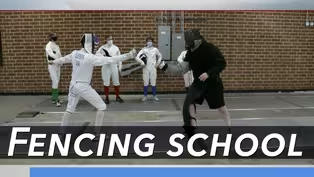
Photojournalist Russ Hunsinger takes us inside the Charlotte Fencing Academy.
- [Brian Toomey] On guard.
Fence.
(dramatic music) - [Brian Toomey] When everyone's a little kid, they wanna play sword fighting with a little stick or they wanna play Star Wars.
They wanna play Pirates of the Caribbean out there.
- Very good.
- [Brian Toomey] When they come into here, they find things are a little bit different than that.
Back and forth.
- [Eliana Spector] I'm third grade, I started as foil and I was progressively started liking it more.
And it's a really interesting sport.
It's a lot like physical chess.
- [Graham Lewis] Fun is really the only word I can think of, but there's so many other smaller things.
It's constant action, exciting and fast.
- [Emily Dong] I think I like part of like the adrenaline.
You can just find your own way and style and not everyone fences the same way.
So it's really interesting to kind of meet new fencers as well.
- [Matthew Joseph ] A lot of this sport is about strategy and trying to get your opponent to do things that you want them to do before they get you to do things that they want you to do.
- Anyone can do this.
We have fences from seven all the way up to 70.
If you're any type of disabilities, we can work with those disabilities as well.
There's Paralympic fencing is available.
There's not really a whole lot of limitations to prevent someone from coming in and fencing for the first time.
- Ready?
Fence.
- [Eliana Spector] I am on the shorter side.
I'm five feet tall and no matter how tall you are, boy, girl, or whatever you choose.
Fencing is a sport that allows everybody to do that.
- [Brian Toomey] Here we teach foil and epee.
In foil points are scored by hitting the torso.
In epee, you're also attacking with a point, but the entire body is target.
- What got me into this was my son.
And he hadn't really been one who really loved sports and someone suggested fencing and he said, sure, I'll try it, and he was kind of hooked.
Where I came into it is I started taking him to different tournaments.
Every time I'm there at the tournaments I'm like, well, that looks like that could be fun.
And he finally talked me into actually going and taking a lesson.
And you know, a lot of the things that he liked about it, you know, I liked about it as well.
And it felt like something that we could, we could do together a little bit.
- [Graham Lewis] You can look around here.
You know, a lot of the kids, a lot younger than me, you know, kind of out here, I'm kind of the old guy here, but I can do some things they can do.
they can do some things I can't do.
But you know, this sport in particular with epee, it's about who can make the first touch.
And so I feel like I can come out and I can compete and have a lot of fun too.
[Brian Toomey]There are lots of benefits to the sport.
You'll develop a lot of quick thinking because when you're having defense back and forth, sometimes you gotta come up with plans on the fly.
You also develop a lot of self-reliance because when you're out there on the strip, you're out there on your own, you've gotta depend on your skills and your knowledge in order to defend yourself against an opponent who's trying to do the same back.
Fencing is one of the safest sports.
There's a study that's out there that says it's safer than badminton.
We wear thick jackets and we wear a glove that protects your hand from being hurt.
And you wear a very thick mask.
- [Eliana Spector] But if you hadn't ever had a sport click, definitely try fencing.
It's really fun and an interesting sport to learn about.
And when you tell people they're like, oh really interesting.
Tell me more.
- [Matthew Joseph] There's so much moving going on.
And it's just so exciting and fun to be a part of it.
Seeing all the other people who are better than me, it's really fun to watch them and see how much better I would be able to get.
- [Emily Dong] It can kind of just lift up your mood when you're upset and you get to meet a lot of cool people as well.
A lot of my close friends are in fencing too.
- [Graham Lewis] Just try it.
I mean, it, it looks a little daunting at first, right?
You got the whole uniform, you got the, you got the mask you got, you know, got, got the weapons.
What's great here is they have a great introductory course that kind of got you up to speed with all that you needed to know.
And pretty soon you gotta get out there and you can be fencing.
(dramatic music) - [Amy Burkett] Thank you, Russ.
I have always been intrigued by fencing, but I've never tried it.
So before we go this evening, we'd love your feedback on our stories tonight, or send us your story idea.
You can do both by sending an email to feedback@wtvi.org.
Well, that's all the time we have for you this evening.
Thanks so much for joining us.
We always appreciate your time and look forward to seeing you back here again next time on Carolina Impact.
Goodnight, my friends.
(happy music) - [Announcer] A production of PBS Charlotte.
- [Narrator] Wells Fargo is proud to support diversity, equity and inclusion in our employees, our customers and the communities we serve, as well as through content on Carolina Impact.
Carolina Impact: April 19, 2022 Preview
Preview: S9 Ep22 | 30s | An fish farm unexpected, the art of Fencing, pre-k students are coding, & Hookshot Charlie (30s)
Video has Closed Captions
Clip: S9 Ep22 | 3m 59s | People are taking a stab at learning an unique sport in Charlotte (3m 59s)
Video has Closed Captions
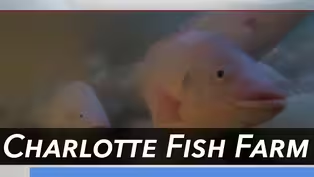
Clip: S9 Ep22 | 6m 4s | The fish are always biting at North Carolina's biggest tilapia farm in Charlotte (6m 4s)

Video has Closed Captions
Clip: S9 Ep22 | 5m 4s | At 64 years old, he does wonders with a basketball. Meet Hook-shot Charlie. (5m 4s)

Video has Closed Captions
Clip: S9 Ep22 | 5m 6s | A new initiative teaching four year olds how to code (5m 6s)
Providing Support for PBS.org
Learn Moreabout PBS online sponsorship
- News and Public Affairs

Top journalists deliver compelling original analysis of the hour's headlines.

- News and Public Affairs

FRONTLINE is investigative journalism that questions, explains and changes our world.












Support for PBS provided by:
Carolina Impact is a local public television program presented by PBS Charlotte