Carolina Impact: April 2, 2024
Season 11 Episode 1119 | 26m 17sVideo has Closed Captions
Recycled Water into Beer, Moonshine & Whiskey, AnderBerry Bracelets, & Violin Miniatures.
Charlotte Water and Town Brewing are producing beer made with recycled waste water, The craft of making moonshine and whiskey is alive in Wilkes County, Find out how a Charlotte teen used bracelets to financially help his family, & Meet Charlotte miniature artist Amy Wright who recreates the living world on a much smaller scale.
Problems playing video? | Closed Captioning Feedback
Problems playing video? | Closed Captioning Feedback
Carolina Impact is a local public television program presented by PBS Charlotte
Carolina Impact: April 2, 2024
Season 11 Episode 1119 | 26m 17sVideo has Closed Captions
Charlotte Water and Town Brewing are producing beer made with recycled waste water, The craft of making moonshine and whiskey is alive in Wilkes County, Find out how a Charlotte teen used bracelets to financially help his family, & Meet Charlotte miniature artist Amy Wright who recreates the living world on a much smaller scale.
Problems playing video? | Closed Captioning Feedback
How to Watch Carolina Impact
Carolina Impact is available to stream on pbs.org and the free PBS App, available on iPhone, Apple TV, Android TV, Android smartphones, Amazon Fire TV, Amazon Fire Tablet, Roku, Samsung Smart TV, and Vizio.

Introducing PBS Charlotte Passport
Now you can stream more of your favorite PBS shows including Masterpiece, NOVA, Nature, Great British Baking Show and many more — online and in the PBS Video app.Providing Support for PBS.org
Learn Moreabout PBS online sponsorship- [Announcer] This is a production of PBS Charlotte, (gentle music) - Just ahead on "Carolina Impact," you'll likely be surprised what they're making with recycled wastewater these days.
Plus how a Charlotte teen used bracelets to financially help his family.
And it truly is a small world after all, we take a peek inside a local miniature artist's tiny creations.
"Carolina Impact" starts right now.
(upbeat music) Good evening, thanks so much for joining us, I'm Amy Burkett.
Over the last few years, much of the Western United States has been dealing with a drought.
According to the National Centers for Environmental Information, abnormal dryness and drought are currently affecting over 55 million people across the US, that's about 18% of the population.
While the Carolinas aren't currently impacted, a couple local organizations are being proactive.
"Carolina Impact's" Jason Terzis joins us now with more.
- The impacts of a drought can reverberate throughout the local, regional, and national economies.
Droughts can reduce the food supply, farm income, and ultimately, the price that we all pay at the grocery store.
Changing climate and growing global populations mean water authorities worldwide are looking at wastewater treatment options to supplement declining freshwater supplies and achieve water security and sustainability.
- Despite a rainy and snowy winter out west, Lake Powell and Lake Mead, the reservoirs that provide water for 40 million Americans, are at record low levels due to the ongoing mega drought.
- [Jason] It's a commodity most of us take for granted, but maybe we shouldn't.
- There is a water shortage that is very evident.
- [Jason] The issue hasn't yet reached the Carolinas, but it has out west, where droughts have become more and more common.
- Arizona is set to lose over 20% of its Colorado River Water allotment this year alone.
- And so utilities out there are really looking for innovative ways to use and reuse water.
- [Jason] Charlotte Water director Angela Charles has been working with the city for over 35 years.
You might think someone with that kind of experience would be set in their ways of doing things, not Angela, she's looking ahead.
- We are all thinking as employees of Charlotte Water, what if?
- [Jason] What Angela spearheaded is an idea, something that's been done out west.
- The whole goal from the beginning was to plant the seed in the minds of people in our community about how to use and reuse wastewater.
- [Jason] What Charlotte Water is doing is using recycled wastewater in the production of a local beer.
If a strange expression just came over your face at the idea of it, you're not alone.
- You get the face of misunderstanding.
- Public perception and the court of public opinion is a real thing that we have to be aware of and have to navigate.
- It takes a certain type of brewery and company to get over that yuck.
- [Jason] So how is something like this even possible?
Well, it's through an advanced cleaning process the water goes through.
- Charlotte Water reached out to folks that they knew in our company and said, "Hey, we've got this really cool project, we wanna transform wastewater into beer, and we'd really love your help in providing us the technology and the manpower to do that."
- [Jason] The first company Charlotte Water teamed up with was Xylem, a global technology company that specializes in providing expertise to utilities and industrial customers, primarily in the water industry.
- Whether that's moving water, treating water, analyzing water, we have a presence in over 150 countries and a good presence here in the Carolinas.
So we were really, really excited for this project.
- [Jason] Typically, wastewater goes through a multi-step process of decontamination and cleaning before being released back into our streams and rivers.
- So it's high quality water at that point.
- [Jason] But in order for it to be used in beer production, it had to go through several additional steps.
- So we provide really three levels of filtration, two carbon filtration steps, and then a really powerful filter we call reverse osmosis treatment.
So the three filtration steps and then two additional disinfection steps, one is ozone, which is a very, very powerful disinfectant, so we're zapping and killing any viruses or bacteria that might be in the water, and then we provide an ultraviolet light, UV, disinfection step as well.
- [Jason] What Xylem helps Charlotte water produce is what they've branded as QC water.
So clean they say it's actually cleaner than tap water.
- QC water exceeds drinking water standards.
- Charlotte Water tested the water for 150 different contaminants, actually more than that, so we went through a full battery of drinking water tests and it came out with flying colors.
- When we toured the wastewater treatment plant and we really saw what was going on and the microbes that they put in to clean the water and all the processes that it goes through, I think we really started to understand water that we work with on a daily basis.
- We got the final report back and the water actually was a lot cleaner than the actual city water that we drink from our taps.
For Renew Brew, all the water came in those two IBC totes right behind you, 275 gallons a piece.
- [Jason] The other major partner in the project, Town Brewing, which is located in an old service garage on Charlotte's West side.
- Because we are a smaller brewery, we want to be able to cater to that craft beer drinker that's always looking for what's new, what's next?
- Everything you taste in beer is a combination of malt flavor and primarily the flavor compounds that you get from the yeast.
- [Jason] Town was approached by the Charlotte Beer Collective to produce what would become known as Renew Brew.
- The first thing, we really wanted to hear more nuts and bolts because we didn't know, even as producers, exactly what all recycled water entailed, right?
And so that's something that we had to find out to make that our product would be safe, that we could package that and what all that water, how it was gonna be treated and how it would get to us.
- [Jason] Filtering with QC Water began in January, with the first beer produced in February.
- After we boil the wort, we run it through this heat exchanger, and from the heat exchanger we cool it down to fermentation temperatures and then we send it out into one of our fermentation vessels.
It's just a good old classic American pale ale.
- I'm a big beer fan, so I love it, they did a great job.
- And I'm not a beer drinker, but it's a great pale ale, it is really good.
- [Jason] And to further prove that it's not what you may have thought, at February's Queen City Brewers Festival, Renew Brew won Best in Show during a blind taste testing competition.
- That's amazing.
- Fantastic, it's very humbling for us to realize that we're such a small part of what needs to be such a larger effort right now going on with water in America.
But it's so cool to have something in proof of concept to not only have this beer, but immediately have this beer win an award and then to have this beer be talked about by so many people about how interested they are, not how turned off they are by the product.
- And then to just think of the possibilities, we are just starting here.
Think about the possibilities and what we can do with that in the future, it is mind boggling.
- I always say you never know what they're gonna come up with next.
What's new for Renew Brew?
- Well, for now, this is still what they're calling a demonstration project only.
So what that basically means is they're just trying to see if they could pull it off, which they did.
So Renew Brew is not available for public sale, but is available at various tasting events.
They're talking about doing something around Earth Day, which is April 22nd, perhaps at the US National Whitewater Center.
But plans for that have not been finalized.
But they really just want to see, can we do this?
Is this feasible?
Can we actually create this and do it in a safe way and in a good way where beer drinkers will be like, this is good and they have pulled it off.
So they're now kind of, okay, where do we go from here?
And that's what they're gonna try to figure out next.
- I never ceased to be amazed, Jason, thanks so much for sharing that story with us.
- Absolutely.
- Well, sticking with our adult beverage theme, whether you call it White Lightning, corn liquor, or moonshine, it's all American.
For some North Carolina families, making the distilled spirit is a multi-generational family tradition.
Carolina Impact's Jason Terzis and producer John Branscum take us to Call Family Distillers in Wilkes County.
(upbeat music) - [Jason] Downtown Wilkesboro, tucked away in the foothills of the Blue Ridge Mountains.
The town draws you in with its historic charm, murals and classic Main Street buildings.
But at one time, Wilkesboro, and all of Wilkes County for that matter, were known for something else.
- [Brian] This is the moonshine capital of the world in a certain time period.
- Just a few miles from downtown.
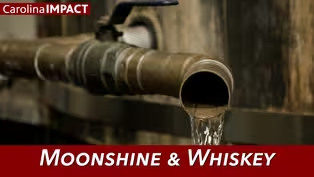
- Over here in the stainless barrel, you see the mash fermentation.
- [Jason] What Brian Call and his son Austin are doing today is perfectly legal.
- This process, it starts out real sweet, when we cook the cornmeal and grain in and towards the end of fermentation, it ends up kind of a sour taste to it.
All that activities, when you pitch the yeast, that's the yeast eating up the sugar molecules and converting it into alcohol.
- [Jason] They're following an age old family recipe.
- I always ask Dad, why we do sour mash whiskey?
And he said, well, that's the way we've been doing it for generations, and three to four days fermenting in your fermentation tanks.
Then you'll pump it over into still.
Around 172 degrees, your alcohol vapor starts coming off.
- [Jason] Once condensed, then depending on the mash recipe, the flowing crystal clear alcohol ends up as moonshine or whiskey.
- Every still is different, but our still in about two hours, we can make around 180 gallons of whiskey or moonshine.
You can put fruit in it like this, make apple pie or sell it clear - [Jason] Everything at the distillery centers around family.
- My son will be eight generations.
Kind of started with a Lutheran minister over in Tennessee and he ended up having a legal distillery.
It is called the Daniel and Call Distillery, District four, number seven.
He is a Luther Minister and the temperance movement come through and there's a lady, Angelica, the story goes, preaching at his church.
And she looked right at him, said, you're gonna go to hell if you keep making this whiskey.
So he ended up selling out to Jack Daniels and choosing the Lord's work and some of the family members kept on in the whiskey business on the illegal side.
Here we are today in full circle, making legal moonshine and whiskey again.
- [Jason] During the era of prohibition, a few members of the Call family found themselves on the other side of the law.
- Grandpa, he was in the liquor business in a big way.
Him and Junior Johnson, they made shine together and grandpa ended up going to prison - With his grandfather away in prison, Brian's father, Clay, stepped up at a young age to help provide for the family.
- [Jason] His Uncle Howard was hauling whiskey and he started riding with him, helping him unload the product at around 13-year-old.
And the story goes, my dad, he started hauling around 14 and 15-year-old.
(gentle music) - [Jason] Now for the more romanticized part of illegal moonshine, the cars, built for speed, like this black '66 Dodge Coronet.
Brian's late father once used it for transporting his valuable but illegal cargo.
But Brian says his father's favorite car.
- So the '61 New Yorker was his favorite car.
It's a baby blue, looks more like a business coupe.
But my dad, he'd put a sports coat on and a Stetson hat and they thought he was somebody of importance like a judge or lawyer, but he'd have a trunk load of hooch in the back.
- [Announcer] With so many souped up cars running around, it was inevitable, bravado would kick in.
- When they weren't racing the police, a lot of times like you know how men are, they want to prove that theirs is the fastest or whatever.
So they would race each other and then that slowly got more organized until they founded NASCAR.
- [Jason] Clay Call was a lifelong friend of racing legend, Junior Johnson.
- Him and Junior Johnson had become best friends of hauling shine.
And I always asked dad, I said, why in the hell didn't you ever get into racing?
He said there wasn't no money in it.
He stuck to the moonshine business and Junior went on racing.
(gentle music) - [Jason] With the popularity of craft moonshine and whiskey on the rise, making sure the Call Family Distillery is ready to meet the demand means a lot of work.
But Austin Call sees it as an opportunity.
- There's more to it that meets the eye, learning the distribution part of it and pushing liquor, learning the alcohol industry in itself, it's a lot to take in.
- [Jason] For the family, the pride in what they've built is as clear as their moonshine.
- I'm just proud to be a part of this and a part of this family and the history that we have when it comes to making moonshine and whiskey.
- [Jason] I just want to get it built up enough where Austin can take over and keep the tradition rolling.
My grandpa and dad and everybody involved in the business is just thankful that I can carry on the tradition the legal way and don't have to be looking over my shoulder and worried about going to prison.
- [Jason] All around the world, you'll find distilled spirits, everything from Irish whiskey to Kentucky bourbon, Mexican tequila, or even Wilkes County moonshine.
Each unique in flavor and cultural identity, an identity the Call family is proud to be a part of.
For "Carolina Impact," I'm Jason Terzis reporting.
- Thanks again, Jason.
Call Family Distillers started production in 2014 and recently added a restaurant and an outdoor stage for live concerts.
Well, up next, one Charlotte Teen never would've imagined that his childhood passion would lead his family out of financial troubles.
"Carolina Impact's" Dara Khaalid and videographer Marcellus Jones, show us how 10 years later that same dream supports their family - [Dara] Together they work, mother and son, in their small craft room, tucked inside their Charlotte home.
- Do you want clear or black string?
- [Dara] With white beads, purple beads, teal beads, and plenty of charms.
- [Amy] The honeycomb.
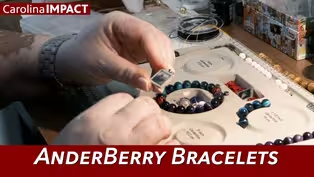
- [Dara] Piece by piece, 17-year-old Aaron Anderson and his mother, Amy, string them onto a clear band.
- [Aaron] Afterwards, what I'll do is I'll knot it up, I'll glue it, and then we'll let that dry out, and then you'll see the end result.
- [Dara] The end result, handmade bracelets that he and his mom poured their time and creativity into.
Some days they make simple orders that only require white lava rocks and a few other colorful beads.
But other days, their orders can be more complex.
- [Aaron] So what I'm doing now is I'm just moving some of the fine bubbles.
- [Dara] Where it requires precision, like mixing ingredients, pouring them into a small clear mold, having exact placement of objects, - [Amy] Put that on like so.
- [Dara] And curing at the perfect temperature.
- So I let it cure, and then once that comes out, I'll take the decal.
- [Dara] Amy Anderson tells me intricate orders like these are special for customers and herself.
- [Amy] This young man, he passed away a few months back, so his brother asked me to do some type of memento.
- [Dara] As she connects with their hardships, it's a reminder of her own.
- It was really outta necessity, it wasn't like we had this complete business plan and we had the capital.
We literally were using what we had in order to start the business.
- [Dara] And they didn't have much back in 2014.
- We had just recently relocated to Charlotte, having to flee from domestic violence from a different state.
And anytime you relocate when you really didn't have a plan to do so, makes things a little bit more difficult.
Financially, we were really strapped.
- [Dara] Amy says times were so hard, she and her two children ended up homeless.
- We stayed at motels, we actually stayed at the Salvation Army Women's Shelter, even stayed in our car at one point.
- [Dara] In the middle of their trials, Amy's 7-year-old son, Aaron, told her he had an idea.
- He mentioned, you know, hey, I've got some bracelets, I know how to make bracelets.
- [Dara] Something Aaron says, came naturally.
- Financial situations were tough and it was a lot of hardships, but just thinking and trying to put a means to an end, I started selling them.
- [Dara] Little did they know those rubber bracelets that began as a hobby will pull them out of their financial challenges and be lucrative enough for Amy to do it full-time, supporting their family.
- It's no telling where we would've been if this bracelet business had not come along when it did.
- [Dara] Thus, Andrew Berry Bracelets was born.
- Respect to you.
Keep it up man, keep it up.
- [Dara] Going all around Charlotte at music festivals, sidewalks and parks, Aaron became the face of the business, even getting a chance to sell bracelets to celebrities.
- I was very fortunate to sell, I think, maybe one or two bracelets to Sinbad and it was at a diner.
My mom and my sister saw him and then told me, hey, go, you gotta sell a bracelet, you gotta introduce yourself, you know, and I'm glad I did.
- [Dara] Just as Aaron grew and evolved as a young man, so did the company and the types of bracelets they sold.
- People were actually recommending the beads, like it was a source of really demand in figuring out what people wanted.
- [Dara] The beaded bracelets were a big hit, especially for a longtime customer, Brian Williams.
- Ooh.
- [Dara] Brian tells me he's bought from the company for years and loves the custom bracelets, but it's more than beads that keep him coming back.
- This is something she did with her son, so I definitely jumped on it.
We got to know each other personally, so I definitely wanted to help her and her son and I'm constantly doing it and I really enjoy it.
- [Dara] So regardless of where they're selling bracelets.
- You did that, you did that.
- [Dara] Or how much their business continues to take off, the Andersons say family and love will remain at the core of everything they do.
For "Carolina Impact," I'm Dara Khaalid.
- Thank you Dara.
The family's hosting build a bracelet workshops across our region.
Well let's move on to meet another creator.
This one is an artist who works with miniatures.
Imagine a cozy room, complete with a library, shrunk down to the size of a shoebox.
A small outdoor cafe that fits inside the space of a wall outlet.
or a peaceful room, complete with an easy chair and warm fireplace, all inside an Altoids tin.
Tonight, producer Russ Hunsinger, gives us a peek inside miniature artist, Amy Wright's Tiny World.
- When I was small, one of my favorite books was called "The Borrowers" and I read it over and over again.
And I loved in my imagination, thinking of teeny tiny people hiding and living in houses and no one knew they were there.
And so I always see little spots where The Borrowers could have been, where they might have made a little room and I like to play with that.
And now my passion is miniatures.
(gentle music) When I'm doing a miniature, I almost always want it to look like someone may have just been there and they've just left the room.
A little cup of tea, a book left open on a bed.
(gentle music) I like to think about the people that I'm making things for and make it fit them.
My daughter's apartment had an outlet for a kitchen phone that was just a hole, and since no one uses phones anymore, so I created a little scene to go in that little hole of the phone outlet.
She is a traveler, she has spent a lot of time in Europe, I bet she spent a lot of time sitting in little cafe tables watching people walk by, and so i included that for her.
(gentle music) My sister is an amazing cook and so I've got an unused electrical outlet and made a little kitchen scene in the electrical outlet with the plug front, connected up front with magnets.
So it looks like a plug, but you can take the front off and it's a little kitchen scene.
(gentle music) I really like the teeny tiny mini-Altoid tins best of all, so I've made several things in those.
My son has one of my Altoid attends.
I have a friend who asked me if I would redo her library in a miniature form.
It's a totally different thing for me in that usually I just make things up and they don't have to match.
I can change it as I go along and if it works, it works.
If it doesn't, I can toss it out.
(gentle music) And so this one, I'm trying to match something that already exists and so it's a different kind of challenge, which I'm enjoying.
I enjoy knowing that a piece of my art was with my loved ones.
You see things now you think, oh, I wonder what that could be little?
A collection of some of the neck ties that I will use for furniture.
Blister packets from medicine is what I use for the can lights, magazines that have a spine that's glued, cut it into pieces and you have a little book.
(gentle music) - I'm David McGuirt, co-owner of the Violin Shop here.
We sell and rent and repair the whole violin family of instruments.
With Amy, our families have been friends for about 30 years and one day she had posted something about the dollhouse and I messaged her and I said, I've always thought it would be really cool for somebody to make a dollhouse in an old cello.
- And I was like, well I could try that, that would be fun.
So he was able to give me a cello and I took the front off of it and decided to turn it into a shop and a workshop and an apartment.
- She kind of developed a story in her head about the scenario of what happens in this space and who lives here.
- [Amy] Whenever I'm making something, I like to make up stories about 'em 'cause it helps me think of how to decorate things and what to make.
And so in the cello, I was thinking that the upstairs apartment belonged to a girl named Melody and her grandfather, who she just called Grandpa, owned the violin shop, and he wanted her to work with him.
And so he told her that if she came to work for him in the violin shop, that she could redecorate the upstairs anyway that she wanted to.
(upbeat music) - And just began to furnish it, and it's multiple floors.
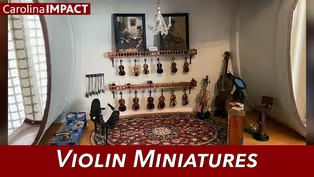
The showroom here you can see how the violins are hanging and she actually duplicated the wooden racks that we have the violins hanging from.
And lord knows how she made these tiny little violins.
- I can't tell you how long it took, but it did not come quickly.
- [David] She asked me to give her any parts and pieces off of broken things and she would repurpose them.
- [Amy] The checkout desk in the store, that's a piece of the wood from the original cello.
- Up here on the top floor of this living quarters, there's a bed and the headboard and the footboard are violin bridges.
We have a lamp that is the thumbscrew off of a cello end pin rod.
- The sink in basement is off a chin rest off of a teeny tiny violin.
- We have a junky old shelf back there in the shop and she copied it down to the horse hair that is hanging from it, that is for rehairing bows.
She cuts some hair off of her dog, Junie, as tail to copy the horse hair.
She has a band saw that, I don't even know how she did it, but it's very detailed and it's a copy of ours.
- From growing up in my dad's shed that had a band saw that I would use, there was sawdust all over the floor, and so I sprinkled sawdust on the floor.
- So many details.
Here, on the checkout counter, she's put the computer monitor and it actually has numbers and writing on it, which I just now noticed.
It's like I'm still discovering things about this piece every day.
We love it, it's a fun conversation piece, parents love showing it to small children.
(gentle music) - Wonder, joy, I hope that people look at the things I make and it strikes their imagination and gives them stories.
(gentle music) - Such amazing artwork, thank you so much Russ for sharing it with us.
The public is also invited to visit the Violin Shop on 7th Street in Charlotte to view her work.
She tells us her true joy comes from creating miniature art for family and friends.
Well, we'd love to learn about the interesting people you know who we should spotlight on "Carolina Impact" in the future.
Please email us your ideas with details to stories@wtvi.org.
Well, before we say goodnight, I wanna say thank you to our friends from the Dallas Senior Club who've been a great studio audience, we're so glad they came to visit us tonight.
Well, that is all the time we have.
Thank you so much that you chose to join us this evening.
We always appreciate your time and we look forward to seeing you back here again next time on "Carolina Impact."
Goodnight my friends.
(upbeat music) - [Announcer] This is a production of PBS Charlotte.
(upbeat music)
Video has Closed Captions
Clip: S11 Ep1119 | 4m 41s | Find out how a Charlotte teen used bracelets to financially help his family. (4m 41s)
Video has Closed Captions
Clip: S11 Ep1119 | 5m 29s | The craft of making moonshine and whiskey is alive in Wilkes County. (5m 29s)

Recycled Waste Water into Beer
Video has Closed Captions
Clip: S11 Ep1119 | 5m 52s | Charlotte Water and Town Brewing are producing beer made with recycled waste water. (5m 52s)
Video has Closed Captions
Clip: S11 Ep1119 | 5m 21s | Meet Charlotte miniature artist Amy Wright who recreates our world on a smaller scale. (5m 21s)
Carolina Impact: April 2nd Preview
Preview: S11 Ep1119 | 30s | Recycled Water into Beer, Moonshine & Whiskey, AnderBerry Bracelets, & Violin Miniatures. (30s)
Providing Support for PBS.org
Learn Moreabout PBS online sponsorship
- News and Public Affairs

Top journalists deliver compelling original analysis of the hour's headlines.

- News and Public Affairs

FRONTLINE is investigative journalism that questions, explains and changes our world.












Support for PBS provided by:
Carolina Impact is a local public television program presented by PBS Charlotte