
Carolina Impact: April 20, 2021
Season 8 Episode 22 | 23m 12sVideo has Closed Captions
Carolina Impact: April 20, 2021
Carolina Impact: April 20, 2021
Problems playing video? | Closed Captioning Feedback
Problems playing video? | Closed Captioning Feedback
Carolina Impact is a local public television program presented by PBS Charlotte
Carolina Impact: April 20, 2021
Season 8 Episode 22 | 23m 12sVideo has Closed Captions
Carolina Impact: April 20, 2021
Problems playing video? | Closed Captioning Feedback
How to Watch Carolina Impact
Carolina Impact is available to stream on pbs.org and the free PBS App, available on iPhone, Apple TV, Android TV, Android smartphones, Amazon Fire TV, Amazon Fire Tablet, Roku, Samsung Smart TV, and Vizio.

Introducing PBS Charlotte Passport
Now you can stream more of your favorite PBS shows including Masterpiece, NOVA, Nature, Great British Baking Show and many more — online and in the PBS Video app.Providing Support for PBS.org
Learn Moreabout PBS online sponsorship- This is a production of PBS Charlotte Just ahead on Carolina Impact - City hall looks into its crystal ball for a few of future Charlotte neighborhoods.
I'm Jeff Sonier, stick around.
We'll tell you what those neighborhoods think about the view on both sides.
- Plus we explore a cutting edge arthritis therapy.
And have you ever heard of a paper taxidermy artist?
We'll meet an accomplished woman in the art form.
Carolina Impact starts right now - Carolina Impact, covering the issues, people and places that impact you.
Yes, this Carolina Impact.
- Good evening, thanks so much for joining us.
I'm Amy Briquette.
Charlotte has a history of planning for the future.
What Uptown looks like today, the stadium the high rises, the apartments, the light rail trains.
They were all first imagined back in the sixties and seventies.
And now city hall is proposing what Charlotte neighborhoods will look like for the next two decades in what they call the 2040 plan, as PBS Charlotte's Jeff Sonier tells us it's a vision.
- Yeah, not everybody agrees with.
- Yeah.
Usually zoning stories don't make headlines maybe a new shopping center here or a new apartment complex there.
But when the city proposes a rezoning that touches nearly every Charlotte neighborhood.
Well that's when it gets political and also personal.
From Ballantyne to Biddleville Myers Park to Commonwealth Park, Eastover to Westover.
Charlotte's a city of single family homes but city hall is trying to change that.
- I believe that building exclusively for single family is not sustainable.
- Assistant City Manager, Taiwo Jaiyeoba, says that's the whole idea behind Charlotte's 2040 plan, that allowing more duplexes in Dilworth or more multifamily in Myers Park will make expensive single family neighborhoods more affordable with the kind of housing they don't have now.
What the city calls The Missing Middle - The Missing Middle is what you have between apartments and single family.
That's what takes care of our police officers of our childcare providers, right, of nurses.
They don't want to live in an apartment.
They don't want to live in a single family home but they want a path to home ownership - Jaiyeoba adds that the 2040 plan is also a path to more diverse neighborhoods, not the mostly white or the mostly minority neighborhoods that many of us live in, or the history of Charlotte zoning that got us there.
- We cannot deny the fact that zoning has contributed to segregation in American cities.
We can't deny it.
We just have to confront it.
- And while many neighborhoods like Myers Park, write letters urging council members to vote no on a plan, they say is big on neighborhood change, but bad on neighborhood planning - They go across town to Myers Park or in Ballantyne.
- Well, many 2040 plan supporters are sounding off about segregation.
- Ain't nobody who doesn't want to support this plan is essentially a segregationist.
They're trying to hide themselves behind racist laws and policies that will only further perpetuate systemic racism.
- Even some city council members are claiming on social media that single family equals segregation but that focus on race in high-income single-family white neighborhoods like Myers Park and Eastover ignores what happens in low income, single family minority neighborhoods where a zoning change could bring other changes.
- Right now in the neighborhood that we stand in almost half of the homes in this neighborhood are owned by outside investment corporations.
And you'll see just like what behind me here, homes are literally being torn down and new ones are built in their place.
- City Council Member, Victoria Watlington lives here in the Westover Hills neighborhood off West Boulevard.
So close to Uptown, you can see the skyline that makes this neighborhood so attractive to developers.
The single family, new homes going up here in Westover are twice the size or more of the older homes, right next door.
Properties selling at prices that current neighbors can't afford, raising their property taxes too - What do you need to get on board?
- Amy Watlington worries that if you take away single family zoning here then developers will try to build even more.
- It's not that everybody's going to come in and tear your house down without your permission.
The issue is that it creates a situation where investors are then incentivized to double their returns by converting their single family rentals into duplexes and triplexes from a purely money standpoint.
That is something that becomes attractive particularly in neighborhoods where land is cheaper.
Again, like our most vulnerable neighborhoods in the Inner Ring - If you take out single family zoning and the developers quote, start moving in.
They're not going to move into Myers park and Eastover, for the most part, they're coming here - Correct.
Well, they're already here.
I mean, this is my husband's father's house - Brianna Hanton says it's nice having her kids grow up in the same home, the same neighborhood her husband grew up in, but from her front porch Brianna can see the neighborhoods changing - Like with that house next door.
It was an empty lot.
And then across those two houses, it was an empty lot too.
When I, you know, came into the family.
- Yeah.
- The the new houses coming in are a lot bigger than the old houses that are already there.
- Yeah.
They're a lot bigger - You know they're talking about maybe letting them build duplexes and triplexes instead of just single family.
And Brianna's reaction is that when the neighborhood changes well, so do the neighbors - We've had about over five renters.
I can honestly say that.
And I'll probably say every year it changes.
We have a new renter next door every year.
- How are we going to protect our neighborhoods?
How are we going to ensure that homes are actually affordable?
And that there are home ownership options.
- Those are the questions Council Member Watlington wants answered before she votes for any city-wide zoning changes.
- Gentrification is happening now, how can we make sure that we provide some language in the plan that will be strong enough to protect vulnerable communities from being displaced?
And I think that's our job - When a discussion of land planning turns into a discussion of race.
That's when it gets harder for people to come together, I suppose - Of course it is, as planners, what we do is political enough, but we try to stay away from politics.
What this comprehensive plan tries to do is to help us to blur the lines, to say you should be able to as a Charlottean live any way you want to live, it's about providing options - And neighborhoods on all sides of town hope one option is not changing.
What makes those neighborhoods great places to live, even as they welcome new neighbors who want to live there - Politics makes strange bedfellows, right?
So it really just depends on the issue.
I think whichever way we go we've got to ensure that Charlotte still feels like home.
- You know, the entire 2040 plan is more than 300 pages long and it's not just focused on neighborhood zoning changes are single family versus duplexes triplexes and quadruplexes, but that is the issue that most are focused on right now on both sides.
Amy - Thanks so much, Jeff.
If you're looking for more information on Charlotte's 2040 plan, we've got a link on our website at pbscharlotte.org, including a calendar of virtual events that you can sign up for online.
Well, you may not have known that arthritis is the leading cause of disability in the United States Impacting 23% of Americans.
That's more than 54 million people.
Regenerative therapy is one of the ways being used to help treat it these days while this relatively new form of treatment has caught the attention of many it's still not widely recognized by the more traditional medical establishments.
Carolina Impact's Jason helps us understand how it works - In the fall of 1995.
A new era dawned in the Carolinas - For some the Carolina Panthers inaugural season of 1995 seems like forever ago.
Well, for others, it feels like only yesterday.
- All right, let's make a play here.
Let's keep them out.
- One of the Panthers first draft choices that inaugural season was Frank Garcia.
I was six years here with the Panthers two at the greatest show on turf.
And then two years with the Arizona Cardinals - Playing center, Frank made his living blocking, but earning a living in the trenches of the NFL was no Sunday picnic.
Every week was a different injury.
You know, playing in the NFL.
I had a broken foot.
And I had a dislocated fingers.
- I had a stinger on my neck one time, so bad that I couldn't lift my arm.
Multiple concussions, probably the most significant injury was an MCL.
I missed 4 weeks - As is the case with many former players the rigors of playing 125 NFL games over the course of a decade took their toll - Father time's undefeated.
And as we get older, we start breaking down and you start feeling that wear and tear you put your body through and you know, like a tire you only have so many miles before it just bursts.
- After retiring from the game, Frank came back to Charlotte, spending 16 years working in local sports talk radio - Sitting behind a desk, being stagnant is probably one of the worst things for an ex athlete that was used to being active.
- But now approaching age 50 arthritis is invading his lower back.
- You can feel that arthritis starting to creep in you can feel your body starting to lock up, but then mentally you start, you know, becoming a little depressed and a little discouraged - With traditional medicine unable to help him, Frank went to NeoGenix in Ballantyne, a clinic specializing in stem cell and regenerative therapies - For the typical low back case we focus on the lower lumbar spine.
And typically these joints called facet joints.
- Dr. James Altizer has been practicing medicine for well over 30 years, spending 11 years as an internist, 17 as a Vein Surgeon, and the last five working with regenerative therapies.
- This is the easiest of the three, I'll say.
It's the most rewarding of the three because just about every patient who comes in gets better.
- Regenerative therapy consists of multiple levels.
Everything from over the counter products to platelet rich plasma, which is where blood is spun in a centrifuge, separating out the platelets which are then injected back into an effected area to promote healing.
Then there's stem cell therapy, which uses a patient's stem cells from either fat deposits and/or bone marrow - Stem cell therapy is the only thing to my knowledge that can actually slow down the progression of arthritis.
- Those regenerative cells need a jumpstart.
And that's what you're doing by injecting your own stem cells into that joint.
- Michael Keck is another NeoGenix patient.
Unlike Frank, he's not a former professional athlete but he did spend his fair amount of time in the gym - Over 40 years of lifting weights.
And I destroyed the cartilage in my shoulders to the point where I was in a lot of pain, constant pain - Having already undergone one shoulder replacement surgery Michael wanted to avoid getting the second one done.
He went to another stem cell clinic but a year later was still in pain.
So he decided to make the drive from his home in Concorde, down to Ballantyne.
- I brought my x-rays in and the doctor took a look at them.
Did an exam, a full exam.
We came to the conclusion that, yes, I think I can help you.
- Over 90% of people that I treat get better.
- What sets NeoGenix apart from other clinics, Michael says, are a couple of main things.
First, a full-time doctor on staff who analyzes every prospective patient.
- And here's the key.
They screen.
They have an excellent success rate because they don't take patients they know they can't help.
- And second, the fact that NeoGenix does live imaging making sure injections are going exactly where they're supposed to go.
Which is something surprisingly, not every clinic does.
- There's an immediate confidence that they know what they're doing - Despite all the advancements in recent years regenerative therapies are still not recognized by mainstream medicine.
And in many cases are not covered by insurance but opinions are slowly starting to change.
- If you go to an orthopedist 10 years from now with a bad knee, he's going to say to you you have to get stem cells first before we can replace your joint because the insurance company says you have to do it that way.
That will happen.
- For now, though, that means people like Frank and Michael will continue paying out of pocket.
But for them, the benefits far outweigh the cost.
- The pain levels have gone down significantly.
- I've had the stem cell injections six weeks ago.
Shoulder feels great - When you can get somebody out of pain and they can get their life back.
And they don't have to take pain pills every single day.
And they can get back to doing the things that they want to do.
It really does change people's lives.
- I don't want to call it the Fountain of Youth, but it almost feels like the Fountain of Youth.
I found the Fountain of Youth with the stem cell therapy.
- It may not be the Fountain of Youth but as long as patients are in less pain and feeling better I doubt you're going to hear anyone complaining.
New man - For Carolina Impact, I'm Jason recording.
- Thanks so much, Jason.
It's important to note that the cost of stem cell therapy varies greatly depending on the type of treatment, location and how many procedures or injections are being done.
According to Scientific America a single platelet rich plasma injection can range from $500 to $2,000.
The most advanced and complex bone marrow stem cell treatments can cost several thousand dollars per treatment with multiple rounds often needed.
And it's not generally covered by insurance.
Well, Charlotte artist, Elisa Sanchez grew up in a family of musicians and one supported herself by teaching piano.
But today she's her own boss working full time as an artist, Caroline Impact Producer John Branscombe introduces us to her.
- My name is Alyssa Sanchez.
I'm an artist based in Charlotte.
The past couple of years has been me supporting myself fully with visual arts.
It's been cool to have my creativity fuel my life.
It's difficult to be your own boss sometimes Or if you're not in the mood to draw You kind of have to meet deadlines, taxes, But it's also it's hard to like separate yourself I think from your art sometimes when this job and just having confidence I think to keep making what you want to do and be yourself through your work Right now, we're in Goodyear arts which is an artist space and collective.
This studio space allows me to kind of expand on some larger projects and not feel like I have to be so confined to a small space.
I've always lived in apartments.
So it lets me kind of arrange things on the walls to see how they might be in a gallery to see like the whole body of work together.
It just allows me to be a working artist.
So I would consider myself a mixed media artist and illustrator.
And right now I'm currently working as a tattooer.
I enjoy wood-burning.
I have ventured into painting.
I've always worked with black ink pen and ink and kind of started breaking out from just a 2D illustration into these like paper sculptures Paper taxidermy was a project that I started because I wanted to break the barrier of 2D work.
I've always been partial to objects in art.
It just is something a little bit more magical kind of that storybook feel again I'm not sure why I chose bugs.
Other than that, I think they're cool.
And there's so many different variations of colors and reference to pull from.
And I had to come up with a name for it for a show.
So Paper Taxidermy seemed like it was cool.
I liked taxidermy.
My two dimensional work I think is definitely more illustrative.
One of my friends describes my work sometimes as like a dark story book.
So I enjoy like these natural imagery but kind of with a twist, just a juxtaposition often of like life and death, having a skull in there or like just a surprise to be seen.
Most of my work is pretty detailed.
So I think it's easy to like bury something inside where you have to kind of really go looking and reward the viewer with something different.
I definitely tend to lean towards the more time consuming subject matter and mediums.
I found a craft burner in my parents' house.
It's like basically a soldering iron with a pointy tip.
And it is the slowest way to draw that you can think of, but it was really difficult.
And for some reason that just sparked something in my brain that it's like, no, I want to master this.
Like, I'm not going to be bad at this But it's pretty permanent, so once you've started, you kind of have to go with the lines that you put down, which I kind of like too because there's just less second guessing yourself.
You kind of have to be sure of your marks and just go for it.
And I like that.
I think it also opens up some creativity for me just rolling with what's on the board Just kind of slowing down and getting into the details.
That's my favorite part.
It's just once the outline's on there just fleshing it out with a million lines.
That's the fun of it, is like the minutiae of just like tweaking and tweaking and eventually trying to just figure out where to stop.
But that's what I've always enjoyed.
I think I just liked the practice and the process of it.
It's something that I would do regardless of it being a job.
I don't think I could not do what I'm doing.
- Thanks so much, John.
I had never heard of paper taxidermy before.
She's incredibly talented.
Elisa told us she does miss teaching and might consider doing it again.
Well, for many of us, summertime means swim time.
A chance to get back in the water especially after those months behind closed doors but not everybody feels comfortable in the water.
That's why a local swim club is offering a program to make you more comfortable and to erase old stereotypes.
- Mahogany Mermaid is a black swim organization under the US Masters Swim.
As far as we know where the first and only majority black swim club We started out catering to women because when you look at most swim clubs you might see one or two black people.
You don't see a lot.
And that can be intimidating.
If you're not a very strong swimmer We range from beginners, people who don't know how to swim to people may have competed in college to folks that are triathletes It's a community I feel like that is growing and that we are really giving back and making sure that every, every black person black woman who wants to learn how to swim in this community type of environment has that opportunity.
- What brought me here is my daughter started a competitive swim team, Queen City Dolphins.
It just motivated me to swim.
I just really enjoy it.
The coaches are excellent.
You got to kick.
They motivate you.
This is a 50 go.
They push you to get better.
And we're not just restricted to black people, this was a black culture, but anybody can come.
Anybody can come they can come and swim with us.
They can take lessons with us, but we do want them to understand, they will be in a black culture and they will learn our history.
It's really about inclusion.
It's also about breaking the stereotype that black people don't swim.
One thing that we do here, in addition to teaching swimming we teach the history of swim.
We look at it from when we were indigenous people before the enslavement started and we were swimming.
We look at during the enslavement period when we were swimming, we look at it up until Jim Crow.
When some of us were still swimming but the story wants to be that we didn't swim.
So this community teaches all that.
It's about empowerment.
It's about engagement.
It's about knowing where you came from.
So you will know where you're going.
And that's important that we let people know black people know that swimming is a part of your history and it's something to be embraced.
It's something to enjoy.
It's also something that's recreational and fun but it's also a life skill.
They're all different levels of skill and abilities but we've worked with where you are because some people are terrified of even putting their face in the water.
So I would approach that differently than someone who was okay with putting their face in the water and just is ready to go.
So it really just depends.
So someone who's afraid to put their face in the water we're going to ease into their comfort even so much as let's put your chin in the water Let's put your lips in the water.
Let's put your nose in the water.
Okay?
Now let's submerge your eyes into the water.
So it's a gradual step again, depending on their comfort level and where they are - The program starts with everyone learning the bare minimum basics of how to stay flat and develop your stroke learn to rotate your head and your hips, learn to breathe.
And then progresses from there - This was just such a welcoming space.
And that's what I love about it.
And, again, it's like no judgment zone and everybody's working hard.
We all encourage each other.
It's just a fantastic place.
I really just want to break that myth.
I want black people to know they can swim.
I want the world to see us as swimmers - Absolutely can save a life regardless of their age.
You are never too old to learn how to swim.
Never.
- Thanks Russ.
To learn more, visit the Mahogany Mermaids Facebook page.
Well, that's all the time we have this evening.
Thanks so much for joining us.
We always appreciate your time and look forward to seeing you back here again.
Next time on Carolina Impact.
Good night, my friends A production of PBS, Charlotte.
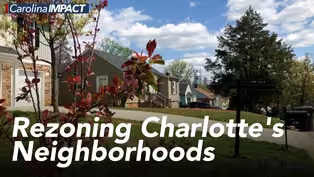
2040 Plan: Rezoning Charlotte's Neighborhoods
Video has Closed Captions
Clip: S8 Ep22 | 6m 30s | How a plan for more neighborhood duplexes turned into an argument over race (6m 30s)
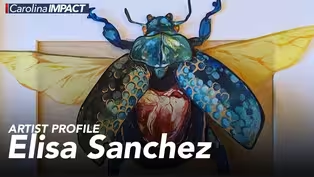
Video has Closed Captions
Clip: S8 Ep22 | 4m 4s | Elisa Sanchez is a Charlotte Artist who loves to take on challenging and detailed methods (4m 4s)

Carolina Impact: April 20, 2021 Preview
Preview: S8 Ep22 | 30s | Carolina Impact: April 20, 2021 Preview (30s)

Video has Closed Captions
Clip: S8 Ep22 | 3m 39s | The Mahogany Mermaids is a Charlotte swimming organization (3m 39s)
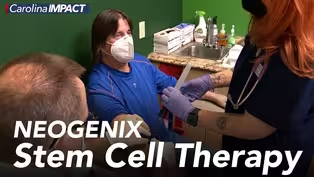
NeoGenix Stem Cell & Regenerative Therapy
Video has Closed Captions
Clip: S8 Ep22 | 5m 14s | Business profile: NeoGenix, a clinic performing Stem cell and regenerative therapies (5m 14s)
Providing Support for PBS.org
Learn Moreabout PBS online sponsorship
- News and Public Affairs

Top journalists deliver compelling original analysis of the hour's headlines.

- News and Public Affairs

FRONTLINE is investigative journalism that questions, explains and changes our world.












Support for PBS provided by:
Carolina Impact is a local public television program presented by PBS Charlotte