Carolina Impact: April 23rd, 2024
Season 11 Episode 1122 | 25m 35sVideo has Closed Captions
Mobile Food Pantry, Park Community Development, Zoos of the Carolinas, Safer Racing Seats
A mobile food pantry in Anson County brings food to people, reaching them where they are; The Park Community Development Corporation works to help those in underserved communities; Visit both the North Carolina Zoo and Riverbanks Zoo & Garden, Former NASCAR driver Randy LaJoie helping to make racing safer.
Problems playing video? | Closed Captioning Feedback
Problems playing video? | Closed Captioning Feedback
Carolina Impact is a local public television program presented by PBS Charlotte
Carolina Impact: April 23rd, 2024
Season 11 Episode 1122 | 25m 35sVideo has Closed Captions
A mobile food pantry in Anson County brings food to people, reaching them where they are; The Park Community Development Corporation works to help those in underserved communities; Visit both the North Carolina Zoo and Riverbanks Zoo & Garden, Former NASCAR driver Randy LaJoie helping to make racing safer.
Problems playing video? | Closed Captioning Feedback
How to Watch Carolina Impact
Carolina Impact is available to stream on pbs.org and the free PBS App, available on iPhone, Apple TV, Android TV, Android smartphones, Amazon Fire TV, Amazon Fire Tablet, Roku, Samsung Smart TV, and Vizio.
Introducing PBS Charlotte Passport
Now you can stream more of your favorite PBS shows including Masterpiece, NOVA, Nature, Great British Baking Show and many more — online and in the PBS Video app.Providing Support for PBS.org
Learn Moreabout PBS online sponsorship(ambient music) - [Announcer] This is a production of PBS Charlotte.
(ambient music) - Just ahead on Carolina Impact, they're bringing food to the people.
How one organization uses a mobile food pantry to reach those in need.
Plus how a West Charlotte nonprofit works to improve lives through healthy environments.
And we take you inside a NASCAR legends company that's keeping racers safe.
Carolina Impact starts right now.
(upbeat music) Good evening, thanks so much for joining us.
I'm Amy Burkett.
Nearly 50 miles from Charlotte, you'll hit Anson County, a rural area where the poverty level is twice as high as it is in Mecklenburg County.
For the past 10 years, a local organization has been helping with their mobile food pantry.
Carolina Impact's Dara Khaalid in John Branscum take us to one of their stops in Peachland, where they mix in a lot of love with their free food.
(upbeat music) - [Person 1] Good morning.
- [Person 2] Good morning.
- [Dara] It's a busy day at Peachland United Methodist Church.
(items shuffling) with volunteers moving quickly.
- Would you mind putting some more blackberries up there too?
- [Dara] Loading food into cars.
- We have dates, we have tomatoes of different kinds.
We have potato, lemons.
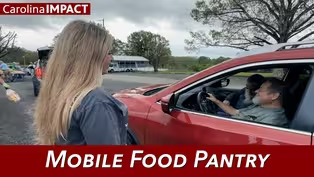
- [Dara] It's all part of Anson Crisis Ministries' mobile food pantry that began in 2014, that travels throughout different areas like Wadesboro, McFarlan, Wingate, and Monroe, providing free food for those in need.
- A lot of people can't afford food and so this helps them out a lot.
(high-pitched rewinding) - [Dara] Their morning begins bright and early.
First, putting out signs directing people where to go.
Next, organizing and bagging items fresh off the truck.
- [Debbie] The heaviest stuff first.
- [Dara] Then they gather for a prayer.
- God, we thank you for the folks that have come today to receive food.
- [Dara] After a resounding: - Amen.
- [Dara] Their work begins.
(upbeat music) Even though it's a chilly, overcast day, it didn't stop these 20 volunteers and over 70 cars from lining up.
And what time did you get here this morning?
- About 7:20 this morning.
- [Dara] George Ingram has been coming to the mobile pantry for about four years and says he always likes to be at the front of the line.
- I don't mind getting up early to make the effort to get here, because like I said, everything helps.
I've yet to get anything that I could not use.
So I really am grateful to everything I get here.
- [Dara] The latest data from the US Census Bureau shows that in Anson County, 22.4% of people live in poverty, compared to neighboring Union County that has 7.1%, and Mecklenburg County sits at 10.3%.
- Some people are flat hungry when they get here.
I mean, they have virtually nothing in their house and they're looking forward to this day.
Others, it's part of what helps them defray the cost of their grocery bill.
- [Dara] People who pull in the parking lot usually first see the smiling face of assistant director Lonnie Grose.
He goes from car to car checking them in, but also checking on them.
- From laughter to tears and everything in between.
Some people come through and they need the food, but they're really not here for the food.
They're here for the engagement, truthfully, the love.
I've had several people that just said, I just want you to pray with me today.
- [Dara] Grose tells me Second Harvest Food Bank donates the food they give away.
On average their mobile pantries serve about 70 families, from children to senior citizens.
- I've had a lot of personal struggles in my life and God has saved me from so much and he's given me a heart to reach out to people who are struggling.
Many of the people struggling with some of the same things I did in my youth, and I just want to give back.
- [Dara] As he and other volunteers continue to give back, the impact is being felt by those like William Price who've fallen on hard times.
- I had a stroke in March and I've been out of work since.
My cupboards were bare, so was my refrigerator, didn't have a thing in there, not even a piece of bread.
- [Dara] Price tells me his friends helped him find the program, and it literally saved him.
- I've never had to ask anybody for nothing, and I don't have to ask now.
It's there, all you've gotta do is walk up.
It don't belittle you.
And that's a big thing, 'cause you can swallow pride, but it don't fill your stomach.
- [Dara] The kindness he's received from volunteers is contagious.
- When things do turn around, I will be helping, because I'm not gonna forget that I got help.
And that's my goal, to help the people that help me and other people that need it.
(ambient music) - We have a lot of good produce and food today, so hopefully we have some full bellies and full hearts when they leave.
- Take these and try these.
- [Dara] A full belly and full heart - Thank you so much.
- You're welcome.
- [Dara] is exactly what 82-year-old Margaret Rogers says she gets every time.
- The big trucks are wonderful.
You either get meats, veggies too.
I love my veggies.
(laughs) - [Dara] For Rogers and her two elderly sisters, the mobile pantry makes a big difference.
- Most of the seniors are on fixed income in this area and when you go to the grocery store, the prices keep going up, and this has really helped.
- [Dara] She's not the only one seeing the financial benefits.
- I'm able to spend my money on gas and pay some bills, and that a big help.
- [Dara] Brenda Watson tells me the money she saves has gone a long way for her household over the years.
- Everybody don't have the money to go to the grocery stores and everybody don't receive food stamps.
So this is a plus for some of us.
- [Dara] For Watson, however, her experience is about more than just food and savings.
It's about the love she receives.
- Our fellowship with the pastor and the workers.
When I go through, they say good morning and I say, good morning.
We all smile and we talk.
- [Dara] And if you ask the volunteers, - Very, very, very fulfilling to your heart.
I mean, it's amazing.
- [Dara] They'll tell you love and serving others is what it's all about.
- It's good to see you sweetie.
- Good to see you.
- [Dara] For Carolina Impact, I'm Dara Khaalid.
- Thank you Dara.
Those with the ministry tell us they feed about 50,000 people a year through their mobile pantry and other food programs.
If you'd like to find out when their next giveaway is, head to our website at WTVI.org.
Well, continuing with our theme of helping others, there are more than 40,000 charitable nonprofits operating in North Carolina.
Religious organizations and educational institutions make up by far the most, however, the list also includes museums, theaters, food banks, senior centers, research facilities, animal shelters, health clinics, housing assistance centers, and transportation providers.
Phew, that's a big list.
Carolina Impact's Jason Terzis joins us with a look at one local organization that's trying to help people on multiple fronts.
- Well, of those 40,000 charitable non-profits in the state, more than 15,000 are located right here in the Greater Charlotte Metro region.
This includes Concord, Gastonia, Fort Mill, and Rock Hill.
Each is trying to do good in the community and each has a unique story to tell.
Tonight we bring you the story of a relatively new organization that's not trying to put a bandaid on one issue but is working to help people truly change their circumstances.
(jazz piano music) The soil gets tilled, weeds picked, and compost mulch added to enhance the native dirt.
- Anybody who gardens in North Carolina knows we have a terrible clay soil.
By adding organic matter to it, you help bring up the quality of the soil.
- [Jason] It's another day at Sunset Farm in Northwest Charlotte, but the people working here at this urban garden aren't farmers, they're volunteers.
- I think the biggest thing for me is just giving back to the community.
- I've been volunteering here since last June.
- And we could not get the work done without them.
- [Jason] The volunteers are donating their time to the Park Community Development Corporation, which was formed by the nearby Park Church.
- So they are one of our biggest partners and biggest supporters, but we are our own separate entity, our own 501(c)(3), and we get to do great work.
We focus on three pillars: affordable housing, healthy living, and economic mobility.
- It is amazing that we have an organization that works on all three major things.
- [Jason] The Park Community Development Corporation.
or CDC for short, formed about seven years ago.
Its mission: create sustainable change within marginalized communities.
- And we have to balance our ambitions, which are huge, with our ability to do good work.
- [Jason] Here at the urban garden, they're growing a little bit of everything, with the eventual harvest going to those in need.
- And this is where we get to do a lot of our work under our healthy living pillar.
We have a raised bed garden, we have an urban garden.
We get to partner with some amazing people in the community to help mitigate food insecurity.
- This food goes to all kinds of organizations for seniors and folks who need fresh food to eat.
- [Jason] Last year, nearly a thousand pounds of vegetables were harvested from the garden.
- So the idea is double the growing space by next year, by 2025, increase the volunteer count, because we can only scale as much as we have resources to do so.
- And when you look at the Park CDC, it's not just gardening.
They have a lot of different functions that they do to give back to the community.
(upbeat music) - [Jason] Just down the street and around the corner sits the new Gilfield Park Apartments on Beatties Ford Road, built specifically as affordable housing for seniors 55 and over.
The 80 Unit complex is the first part of a multi-phase project to add affordable town homes and single family units to the area.
- And if you live anywhere in the great US of A, you know that affordable housing is a big deal.
It's a big problem.
- And I Googled senior housing and found out, and the first thing that came up was about Gilfield Apartments and that they were having an informational meeting the next day, so we went to it and signed up and we ended up getting an apartment at Gilfield.
- [Jason] Tying things together, sitting right next to the complex, raised beds for planting.
The idea is to teach residents how to grow their own vegetables to help create a more sustainable living.
- It's an opportunity at the apartments for us to get to know our neighbors more.
It's a real community there.
We share food with each other.
- [Jason] Park CDC also works with residents on what to look for in food labels and budgeting for meals, especially for those on a fixed income, and assisting them with personal financing and investing.
- We've been fortunate enough to partner with some amazing organizations, financial institutions that have the resources to talk about financial management, financial education, budgeting.
Not only that, but investments and stocks and home ownership.
- [Jason] With a staff of just four people, having volunteers to help achieve the Park CDC's goals is paramount.
- So we're small in number, but big in impact.
- [Jason] Volunteers like Sachie Kutu-Akoi who came to the United States from The Bahamas.
- Coming from a very small island, and it was very like, really condensed and not a lot of people.
There was a big community, and when I came to America, it was just not that much of a community.
So volunteering for me gave me a family that I didn't really have here.
- You get two aspects.
You get to learn about gardening, learn about horticulture, get back to agriculture, get your hands wet.
But there's also like a therapeutic component to it.
- [Jason] The Park CDC isn't trying to put a bandaid on one issue.
They're tackling multiple issues at the same time, hoping to help people truly change their circumstances.
- It really provides this sort of wraparound support for people.
So you get kind of all aspects of the things that you need to improve your life, right?
You get a place to live, you get access to healthy food and mental wellbeing, and then helping you with economic literacy, financial literacy, all those things really give you all the tools, give someone the tools they need to start to thrive.
- I think it's remarkable to find one organization that focuses on various parts of the community.
So providing affordable housing, providing ways to teach people in affordable housing how you can give back to the community.
So like by gardening and teaching them how to garden for themselves.
I think having the workshops, they do workshops on financial literacy, that's an entirely different avenue.
So I think finding an organization that just focuses on more than one specific thing and does a lot of things is just, I can't even describe it.
It's amazing.
- Jason, as I understand, the Park CDC works with a lot of different organizations.
Can you tell us a little about that?
- Yeah, they're trying to pull all the resources together.
So there are a lot of other great organizations in town doing similar work as the Park CDC, but a lot of that work is siloed.
So there might be an organization on the west side of town doing the same thing as another on the east side of town.
So the Park CDC is trying to develop a better system to identify all of the area's resources so that there's not some cross pollinating going on, and then work together to kind of bring all these good services together to people and just kind of get 'em all together so that they're all aligned - And making a positive impact.
Thanks so much Jason.
Well, up next, summertime is just around the corner.
And if you are looking for something to do, why not a day at the zoo?
North Carolina and South Carolina have world-class zoos, each with unique animals and experiences.
In tonight's One Tank Trip, Carolina Impact's Jason Terzis and producer John Branscomb take us to Bogue.
(upbeat music) - [Jason] On most days, just outside Asheboro, you'll find folks making their way through the gates of the North Carolina Zoo in droves.
Once inside they scatter across the zoo on their own personal safaris.
- Oh, I've been coming here probably 50 years.
- [Jason] For Henry Hogan, it's a photo safari.
- It's relaxing, the stress level goes down when you come in here.
Just me, my camera, and just enjoy, like I say, the animals, the wildlife.
- [Jason] The scene repeats itself down in Columbia, South Carolina, as visitors from all over seek unique wildlife interactions at Riverbank Zoo and Gardens.
- I'm from Michigan, this is amazing.
(bird squaking) I am literally like in love right now.
This is so cool.
Hi!
- [Jason] Combined, both zoos annually welcome nearly two million visitors to explore the beauty, behaviors, and personalities of the hundreds of species that call the zoos home.
- My favorite animal is the giraffe.
- My favorite animal would probably have to be the tiger.
- Truthfully, it's probably the gorillas or the chimps and now the baboons.
(upbeat music) - [Tommy] We love to talk to families that have generations upon generations of coming when they were little.
- [Jason] Folks like Riverbank Zoo regular Kristi Adams.
- My husband and I have been bringing our kids here since they were born.
It's a different experience every time.
Sometimes we're feeding the giraffes, sometimes we're watching a bird show.
It's just a unique place to spend family time.
(percussive music) - [Jason] Around the world, the impact of climate change has many zoos rethinking their missions.
- The change in thinking was zoos should become more of the arcs of the future, arcs of hope, being able to establish assurance colonies that would ensure their survival since a lot of 'em are endangered already.
- [Jason] Conservation programs are on full display at both zoos.
Staff at each actively work to protect endangered species from around the world, as well as right here in the Carolinas.
(wolf howling) The North Carolina Zoo participates in the US Fish and Wildlife's Red Wolf Recovery Program.
- We are one of many collaborating partners that are involved in the Red Wolf Recovery Program.
And the primary goals of that program is to help with the success of the recovery effort of red wolves in North Carolina.
- [Jason] At Riverbank Zoo and Gardens, visitors to the newly remodeled Darnall W and Susan F Boyd Aquarium and Reptile Conservation Center enter a world filled with snakes, turtles, fish, and other scaly creatures.
But they also get introduced to several leading conservation projects.
Meet aquarium curator Kendra Bottini.
- This is the coral lab that's part of the AZA Florida Reef Tract Rescue Project.
These corals were in peril because of the devastation that's occurring on the reef tract.
And so we are holding them to keep them healthy and safe for future restoration, reproduction, and hopefully get some of these guys back on the reef when the reef is healthy.
The reefs protect Florida from hurricanes.
They help to act as nurseries for fishes, not just reef fishes, but also sport fishes, which are important.
(upbeat music) - [Jason] Variety in scale, location, animals, and landscaping means both the North Carolina Zoo and Riverbank Zoo, along with their botanical gardens, offer something different to their visitors, factors that make the zoos major economic engines in their respective communities.
- The impact is over $150 million a year in economic impact.
It drives people that are coming into the state to spend money, to also see these magnificent animals.
- [Jason] And at the NC Zoo, - Our impact is about $180 million a year here in the heart of North Carolina.
By the time we open Asia in 2026, we expect that to grow to $300 million.
- [Jason] Beyond the impressive attendance statistics and economic impact, most agree that it's the intangibles that make up a zoo's legacy.
- As we grow, we continue to balance a great place to bring your family, find some fun entertainment, as well as being able to educate and show the community what we do behind the scenes for the care and wellbeing of our animal population.
- [Zoo Patron] It's such a family tradition.
You bring your kids to the zoo.
It's an outdoor family friendly experience.
- [Jason] An outdoor outing is exactly what Jamel Khabeer had in mind for his family on their trip to the NC Zoo.
- I'm here with my family, it's my wife and my two sons.
We love nature, we love getting out to national parks, national museums, national zoos, and just learning and educating our children as well as ourselves.
- [Jason] So the next time you're looking for a bit of family fun mixed with a bit of learning, a day at the North Carolina Zoo or Riverbank Zoo in Columbia just might fit the bill.
For Carolina Impact, I'm Jason Terzis reporting.
- Thank you Jason.
Both zoos offer special interactions with the animals, including behind the scenes tours.
Finally tonight, are you familiar with the phrase, "It takes one to know one"?
When it comes to motor sports and safety, who knows what it takes to protect a driver during those high-speed crashes more than someone who's been in a wreck or two?
That's where a two time NASCAR Busch series champion Randy LaJoie comes in.
His company, The Joie of Seating, manufactures custom race car seats for all levels of the sport, from young go-kart racers to experienced NASCAR drivers.
Producer Russ Hunsinger visited with Randy, took a tour, and shows us what goes into creating one of the most critical parts of a race car safety system.
- [Announcer] And in trouble is 07, LaJoie, Randy LaJoie slamming into the wall.
Randy LaJoie, (indistinct) - 1984, we went to Daytona.
I went for a pretty good ride.
That was my first of probably a handful of pretty good concussions.
(ambient music) See some of the helmets I have here.
The problem with some of these is because I have crashed and I have broken the helmets.
My dad was a racer, then it went to me, and now I'm doing it with my kids.
(ambient music) I tell people racing is dangerous.
(announcers shouting) It always will be.
They give you a helmet and a fire suit, it's because it's dangerous.
My eyes didn't start opening up until I went to three or four funerals and they're like, man, that kid was a good kid.
He's not here no more.
Dang, that kid's a good kid.
He ain't here no more.
Man, that guy was a legend, he's not here no more.
And then the more stuff I started doing with NASCAR and doing sled tests and you're like, oh my goodness, this is serious.
'Cause it's hard to explain to people what your body goes through, when you're 60% fluid.
we're containing jello, so we have to protect that jello.
And the less that jello moves, the better the occupant's gonna be.
(ambient music) (machines whirring) - We're a full custom shop, little bit of steel, but all our products basically are aluminum.
And a big part of the LaJoie seats is the roundness that you have in here that fits a body, because nobody's square, we're all rounded here and we're all a little different shape.
- We do all our own sizings.
You'll see different size seats being made.
(saw whirring) (tools clattering) You'll see on the wall hanging before we get 'em completed, kids stuff.
You'll see stuff from 120 pound person to a 280 pound person.
- I fit all the tubing and weld it in and then do the final check and make sure the dimensions are right for the paperwork that we have for the size of the person.
And I have seen some of the seats that I made in the past with people that were wrecked in 'em.
It's pretty interesting to me to see how the seats hold up in the wrecks.
That's the main crux of the situation is how do they function when you're actually wrecking in one?
'Cause nobody wants to wreck.
If everything is perfect, this thing never gets bent.
- As you can tell, got caught in a fire somehow, I guess the car caught on fire, headrest foam's burnt, the rest of the seat's burnt.
- But it'll end up looking good once we're done with it.
(upbeat music) - Because all the racing technology improves, cars get faster, they build frames differently and all that, we still have to kind of keep up with what everything's going.
The basic people aren't changing, but the applications that we're putting these people in and using these seats with changes.
If it doesn't feel right in the car, then half of what you're trying to get out of the seat is not working for you.
There's the safety factor.
But then there's a comfort factor too.
- If they hit something and the seat bends, I wanna know.
- [Announcer] Photo finish as cars spin.
- Because I don't want the next one to bend.
I want the report from the crash and this way the next person could be better.
Somebody gets hurt in one, I want to know why.
- This is one of our heavyweight seats.
This would be a cup seat.
- You gotta certify our seats every couple years.
NASCAR has had black boxes in these cars now for 25 years maybe.
The information that we get fed back for safety stuff goes into everything we do here.
So we adjust the strength of the tubing, the size of the tubing.
We're talking NASCAR style seats are good for a hundred G hit, which we have seen, to protect the driver.
- [Worker] If I don't do a good job at what I do, somebody may get hurt doing what they do, trying to have fun, trying to make a living.
(engines rumble) - We do a lot of things for people's children also.
We do a lot of little seats.
And you've really gotta take some pride in doing those because you're dealing with something that somebody's child is using.
That's a pretty good incentive to me.
- Everybody grows up racing with speed secrets.
You know what?
There should be no secrets in safety.
And that's what I've done, and we're learning every day.
I mean, safety is a moving target.
I think we've helped the industry be safer.
Before racers, we'd never thought about getting hurt.
It would happen to the other guy.
It would never happen to us, but it could.
(ambient music) (machine whirring) - Thanks so much, Russ.
Over the course of 19 years, Randy competed in 350 races and what's now known as the NASCAR Xfinity Series.
He won 15 of those races.
As part of NASCAR's 75th anniversary in 2023, Randy was named one of NASCAR's 75 greatest drivers.
Congratulations, Randy.
Well, we'd love to learn about the interesting people you know.
Please email us your ideas with details to stories@wtvi.org.
Before we leave this evening, I wanna thank an amazing group of homeschoolers who came to be in our studio audience today.
They had some extraordinary questions and we always love it when the community comes to visit their public television station.
Well, that's all the time we have this evening.
Thanks so much for joining us.
(ambient music) We always appreciate your time and look forward to seeing you back here again next time on Carolina Impact.
Good night, my friends.
(ambient music) (upbeat instrumental music) - [Announcer] This is a production of PBS Charlotte.
Preview: S11 Ep1122 | 30s | Mobile Food Pantry, Park Community Development, Zoos of the Carolinas, Safer Racing Seats (30s)
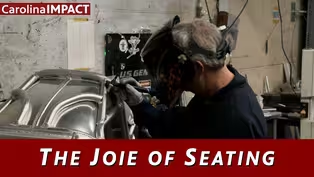
The Joie Of Seating & Racing Safety
Video has Closed Captions
Clip: S11 Ep1122 | 4m 43s | Former NASCAR driver Randy LaJoie is helping to make racing safer. (4m 43s)
Video has Closed Captions
Clip: S11 Ep1122 | 5m 33s | A mobile food pantry in Anson County brings food to people, reaching them where they are. (5m 33s)
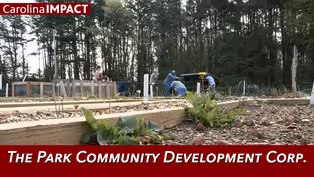
The Park Community Development Corporation
Video has Closed Captions
Clip: S11 Ep1122 | 4m 56s | The Park Community Development Corporation works to help those in underserved communities. (4m 56s)
Video has Closed Captions
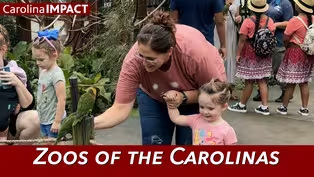
Clip: S11 Ep1122 | 5m 8s | Visit both the North Carolina Zoo and Riverbanks Zoo & Gardens. (5m 8s)
Providing Support for PBS.org
Learn Moreabout PBS online sponsorship
- News and Public Affairs

Top journalists deliver compelling original analysis of the hour's headlines.

- News and Public Affairs

FRONTLINE is investigative journalism that questions, explains and changes our world.












Support for PBS provided by:
Carolina Impact is a local public television program presented by PBS Charlotte