
Carolina Impact: April 25, 2023
Season 10 Episode 22 | 25m 55sVideo has Closed Captions
Charlotte's brewery business, Profound Gentlemen, Landsford Canal, & artist Benny Reeder.
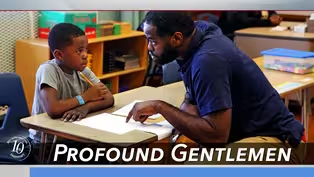
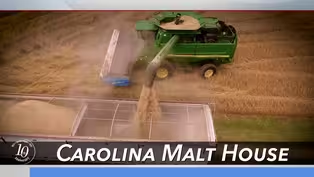
Why so many great craft beers start with Carolina malt and barley from Rowan County. Charlotte based Profound Gentlemen works to keep male educators of color in the classroom. Discover the why behind the construction of Landsford Canal along the Catawba River. And, we visit with self-taught welder and artist Benny Reeder of Benny's Yard Art in Huntersville and view his incredible sculptures.
Problems playing video? | Closed Captioning Feedback
Problems playing video? | Closed Captioning Feedback
Carolina Impact is a local public television program presented by PBS Charlotte
Carolina Impact: April 25, 2023
Season 10 Episode 22 | 25m 55sVideo has Closed Captions
Why so many great craft beers start with Carolina malt and barley from Rowan County. Charlotte based Profound Gentlemen works to keep male educators of color in the classroom. Discover the why behind the construction of Landsford Canal along the Catawba River. And, we visit with self-taught welder and artist Benny Reeder of Benny's Yard Art in Huntersville and view his incredible sculptures.
Problems playing video? | Closed Captioning Feedback
How to Watch Carolina Impact
Carolina Impact is available to stream on pbs.org and the free PBS App, available on iPhone, Apple TV, Android TV, Android smartphones, Amazon Fire TV, Amazon Fire Tablet, Roku, Samsung Smart TV, and Vizio.

Introducing PBS Charlotte Passport
Now you can stream more of your favorite PBS shows including Masterpiece, NOVA, Nature, Great British Baking Show and many more — online and in the PBS Video app.Providing Support for PBS.org
Learn Moreabout PBS online sponsorship- [Announcer] Support for Carolina Impact comes from our viewers and Wells Fargo.
- [Spokesperson] Wells Fargo has donated $390 million.
- Honey, like I said, you get your own room.
- [Spokesperson] To support housing affordability solutions across America.
(uplifting music) - Get it, get it.
- [Spokesperson] Doing gets it done.
Wells Fargo, the Bank of Doing.
(upbeat music) - [Announcer] This is a production of PBS, Charlotte.
- Just ahead on Carolina Impact, we'll explore the issue of teacher retention.
Plus.
- [Sonier] You can't have great craft beer unless you also have great malted barley.
I'm Jeff Sonier.
We'll show you where all that barley comes from, and surprisingly, it's not that far away.
- [Burkett] And we'll show off some amazing yard art by a local welder.
Carolina Impact starts now.
(upbeat music) - [Announcer] Carolina Impact, covering the issues, people and places that impact you.
This is Carolina Impact.
- Good evening.
Thanks so much for joining us.
I'm Amy Burkett.
It's an issue facing school districts across the country.
The recruitment and retention of teachers.
Just some of the many reasons teachers are leaving the profession include increased workloads, constantly changing curriculums, more time dealing with mental health and disciplinary issues, spending more of their own money on supplies, the pandemic, low salaries, and inflation.
Carolina Impact's Jason Terzis has our story.
(screen whooshes) - The National Center for Education Statistics says 44% of public schools will report teaching vacancies at the start of this year.
And more than half of those were from resignations.
- [Terzis] It's an issue the American education system can no longer afford to ignore.
- With thousands of teaching vacancies across the country, the nation appears to be reckoning with an exodus of educators.
- [Terzis] Teachers are leaving the profession in droves.
- So many of us are feeling drained.
So many of us are questioning, why are we still doing this?
Should we still be doing this?
- [Terzis] Long hours and minimal pay are the key factors driving teachers out of the classroom and keeping potential new ones from entering.
- We are all driven by money, right?
Even though we love teaching, we love being educators, we're always driven by our finances.
- More than half of public schools report being understaffed, and bringing diversity into the classroom is a big part of that.
In the 2020-2021 school year, fewer than 2% of teachers were black men, while 61% were white women.
- [Terzis] The United States teaching workforce is far less racially diverse than the student body it teaches, which makes recruiting and keeping teachers of color so very important.
- I came from a school where I was the only male educator of color in my building.
- [Terzis] A Charlotte based nonprofit is doing what it can to change that.
It's name, Profound Gentlemen.
- Our mission is to increase retention for male educators of color.
We want to basically keep black and brown males in education from being a classroom teacher up to policy work.
- Our goal is not necessarily the recruitment part, but really keeping us in the classrooms.
- [Terzis] Jason Terrell and Mario Shaw shared common backgrounds and challenges as Charlotte Mecklenburg educators.
In 2015, they formed Profound Gentlemen as a way of uniting and supporting educators of color.
- And they had their own personal experience, just in the space, feeling isolated, not getting the support that they needed, but also realizing that like boys of color needed more representative images of them because they noticed that the students would come to them and they'll treat them like their dad, or you know, they became their mentor.
And so like, we need more of this.
- [Terzis] Over the last eight years, Profound Gentlemen's footprint has expanded from Charlotte to cities like Atlanta, Chicago, Brooklyn, and Washington, DC, and now has over 700 members.
- It's about having a community of people that you can lean on that can support you in all the endeavors and accomplishments that you want to have in the field.
But above all, it's being able to have that and being able to know that you're not in this work alone.
- There's a power in teaching.
A lot of people don't look at teaching as being a powerful position, but it is.
I'm always reminding myself of the influence that I have as a teacher, how I can change communities, how I can change mindsets.
- [Terzis] PG recently held its annual conference in Charlotte, working to build community and grow professional skills.
- So we have 125 gentlemen here at the Community Impact Assembly representing 18 states.
- [Terzis] The workshop featured everything from full participant forums to breakout rooms where impact leaders presented various questions and scenarios.
- And so here is our problem statement for this session today.
Males of color often navigate a workplace that renders their identity, skills, and contribution to the district invisible, or to the network, for those of you who are at charter schools.
In addition to being, to feeling invisible in the space, stresses related to teaching during the heightened racial climate create toxic environments that push male educators of color out of the profession.
There's a big focus on recruiting teachers of color, but districts and schools need to do the work to address cultures that negatively impact male educators of color and their experiences within the profession.
In other words, new male educators of color are invited to a house that is not clean and has not been prepared for them, so they leave.
Here's the question.
How can we protect the psychological safety and mental wellbeing of male educators of color?
- [Terzis] The education system's inability to retain teachers of color not only harms the profession, but also the students, who lose out on the well-researched benefits of having a diverse set of teachers.
It also makes them less likely to choose the profession themselves.
- [O'Neal] There are systemic and historic influences to this.
So we do know that black and brown boys and girls are treated differently in schools, even especially, like inadvertently.
It's not always like overtly, but they get treated differently.
They get penalized more, more referrals, more expulsions.
And that, I think, has caused a cultural disillusionment.
And so when you think about the suspension rate, when you think about all the things that are negative, when you think about who's failing in education, many times those are our male educators of color.
And so, you are asking me to come back and to be inspired by a space that didn't work for me the first time.
And so many people are not like, oh, I wanna go back there, because I didn't, they didn't have a great experience.
And so that's what I feel is one of the greatest challenges is because if you don't have a great experience of something, why would you come back to it?
- [Terzis] But despite the dwindling numbers and all the challenges they face, the men of Profound Gentlemen are committed, committed to the profession and to the students they teach every day.
- We talk about it all the time.
You know, PG's just different.
It's a space where you feel, you feel safe, you feel, you feel like you have people who you can really lean on and support you.
- So the theme is Reground.
And so we're thinking that we want to reground our educators in their passion, in their professionalism, in their heart for what they do, in the instructional practices that will lift them.
- I love the mission, especially now that I'm a mother who has a four year old son.
- People love coming to PG spaces because it's rejuvenating.
They, it's like love in the room, and that's really a lot of the work.
The sessions and the content is cool, but they love to come and just be around other educators who understand the struggle.
And we talk about it, but we also celebrate it too.
- [Terzis] Profound Gentlemen, regrounding in their roots, in order to keep growing in their profession.
For Carolina Impact, I'm Jason Terzis reporting.
- Thank you so much, Jason.
With CMS opening two new schools and others already under construction, the need for more teachers will only continue to increase.
Business is booming at our region's popular local breweries.
Seems like everybody has a favorite neighborhood tap room where they pour the same hometown craft beers that also share the shelves at grocery stores with the big national brands.
It's not just the local brewers enjoying all the success.
Carolina Impact's Jeff Sonier and videographer, Doug Stacker, take us to Rowan County, where many of the best local brewers start with the best local ingredients.
- Yeah, here in the Carolinas, keeping it local could mean farm to fork restaurants, where the meals come from nearby fields, or maybe dirt to shirt clothing sewn from homegrown cotton.
But how about grass to glass?
Local craft beer, made with barley that you barely have to leave town for.
♪ 'Cause there's a cold calling my name ♪ - There's no telling where they'll end.
They'll just keep growing and growing.
♪ There's a cold beer calling my name ♪ - I thought that micro breweries were just a fad.
Boy, was I wrong.
- [Sonier] Yep, barley farmer, Philip Sloop says the growing brewery business is also good for his brewery growing business.
♪ And there's a cold beer calling my name.
♪ ♪ Yeah ♪ Much of that craft beer getting its malt right here in Rowan County, from fields that used to grow wheat or soybeans or corn.
- Barley was never really viable unless you had cattle to feed it to.
♪ There's a cold bear calling my name.
♪ We have planted this year approximately 190 acres of two-row variety of barley.
- [Sonier] That's a lot of barley.
- It is.
It is.
- [Sonier] Sloop owns C and H Grain, here in the town of Cleveland, growing his barley on a friend's old dairy farm.
Other nearby farmers have barley for the breweries in their fields too.
♪ Yeah, there's a cold bear calling my name ♪ - They met with a bunch of growers and asked us who wanted to give it a try.
And luckily, we said yes.
Skeptical when they approached us but anxious to try something.
Can you be optimistic and skeptical at the same time?
They've sort of provided a safety net for us, you know?
Yeah, during the harvest, if you come to Cleveland, you'll see the trucks rolling by going to the malt house.
(gentle music) - [Goss] So everything comes straight from the field, straight to our grain bins here.
- [Sonier] Carolina Malt House founder, Aaron Goss, grew up here in Rowan County.
He was a lawyer before becoming a maltster.
Goss turning his home brew hobby into a craft beer career.
- Almost all the grain we've ever processed has been grown within 10 miles of where we sit right here.
- Yeah, this malt house is also in Cleveland, North Carolina, because for malt, beer's key ingredient, closer means fresher.
- On these shelves, we usually don't have more than about a six week supply.
Makes for better beer.
- So this is our gravity table.
- [Sonier] Starting with how this local barley is sorted and cleaned.
Also using a century old machine that's made of wood, which is good for the grain itself.
- [Goss] 47,000 pounds of barley.
- [Sonier] Goss shows us the huge tank he calls the barley jacuzzi, where all that Rowan County grain goes to soak, then drain, and then afterward, to these high heat kilning and drying rooms.
- All that barley is actually sitting, it's maybe two and a half feet deep right now, and it's.
- This is where Carolina Malt House develops all their different malty tastes that Carolina craft brewers and craft beer lovers look for.
- [Goss] So this is our milling machine.
- [Sonier] Then some of that malt is milled before all that malt is filled into these 40 and 50 pound Carolina Malt House bags that are stitched up tight.
(machine humming) The malt sacked, then stacked, then sold to breweries by the pallet.
- [Goss] Some breweries will take six pallets at a time.
And within a year of being in business, not even a whole year of being in business, beers made with our malt were winning state awards, national awards, and our malt placed third best in the world.
There is a different flavor that you'll pick up on if you try it.
- [Sonier] Which means when the barley's grown in Carolina and malted by Carolina, the beer tastes like Carolina.
- There's 10 different beers there that all highlight Carolina Malt House's grains and malts they give us.
Almost about 90% of the grain that was used from that came from Carolina, which, you know, again, very proud of that.
- [Sonier] Tripp Moser is head brewer here at Charlotte's Heist Brewery, where all these labels, all these lagers, are all local malts.
And here in the brewing room, Moser skateboards back to some of those same sacks of barley we saw at Carolina Malt House.
- [Moser] It's definitely my job to make sure we're having some of the top quality malt that we can get access to.
Been using malt with Carolina for approximately four years now, and we know it's gonna be the freshest we have available to us.
It's extremely clean, a little bit of sweetness to it.
(gentle music) This beer right here is called Tall Horns.
It's a Heller bock style German with a hundred percent Carolina grown barley from Carolina Malt House.
- Wow.
- And obviously, we love the fact that it's local, so there's a premium that, you know, we're sharing with customers by being, by going local.
(gentle music) - [Goss] Malt is the key ingredient that makes beer, beer.
Just having fresh malt is gonna make a world of difference.
I mean, talk to any cook, and they'll tell you fresh ingredients matter.
- [Sonier] So it's a grass?
- Barley is a grass.
Early in the year, it looks just like grass planted in rows.
- So we can call it grass to glass?
That's fair?
(laughs) - There you go.
That'll work.
That'll work really well.
(gentle music) - By the way, this Rowan County grain that's malted here in Rowan County as well, is used by 120 breweries in more than 500 beers in North and South Carolina, which is why the growers who raise this grass also raise a glass to the brewery industry.
Amy.
- Thank you so much, Jeff.
You can learn more about Carolina Malt House at our website, pbscharlotte.org, including a link to the city by city list of all the breweries in North and South Carolina that use Carolina malts in your favorite craft beers.
There are famous canals around the world from the Panama in Central America to the Suez Canal in Egypt.
But did you know South Carolina once had a system of canals moving cotton to coastal ports?
Carolina Impact's Jason Terzis and producer John Branscomb take us to the Landsford Canal State Park to learn more.
(lighthearted music) - [Terzis] Commerce and trade often go hand in hand with the development of infrastructure.
Along the Catawba River, there's a unique state park known for both its natural beauty and for a 19th century engineering marvel.
- Today we are at Landsford Canal State Park, here in Rock Hill, South Carolina.
- [Terzis] The park encompasses just over 400 acres on either side of the river.
- The most popular thing that people come here for is the Rocky Shoal Spider Lilies.
- [Terzis] The shallow rocky shoals along this section of the Catawba River makes a great habitat for the spider lilies.
But back in the early 1800s, these shoals created a barrier for commerce and trade.
With the industrial revolution in full swing, textile mills in the northern United States and Europe had an almost insatiable appetite for South Carolina's primary cash crop, cotton.
But the Palmetto State needed an efficient transportation network to get this fluffy white stuff to market.
- [Al James] So they surveyed all the river systems in South Carolina and determined that they could get goods down to Charleston from the upstate if you built bypass canals around the shoals.
This canal right here bypassed about two and a half miles of shoals.
- [Terzis] Prior to the canal's construction, this site was the home of William R Davie, who had served in the Revolutionary War and later, as governor of North Carolina.
According to James, Davie chose the land with the intent to build a water-powered mill.
- He built a mill here so that he could grind corn and also had a sawmill on the outside of it.
And as when he built the mill, he designed it with a mile long mill race, which is where, how the water gets from the river through basically a canal or ditch to the mill site so that it can run the wheel to grind the corn or run the sawmill.
- [Terzis] Davie's mill race provided engineers with a head start.
- [James] There was already a mile long canal here, so this became one of the easiest places or choices for them to build one, because they only had to put another mile and a half down below it to get the boats back out into the river on the bottom side of the fall.
- [Terzis] The state of South Carolina paid just over $120,000 to build Landsford Canal, with plans drawn up by American architect, Robert Mills.
He's perhaps best well known for designing the Washington Monument.
The actual construction work took about three years, using both enslaved African Americans and Northern stone masons.
According to James, Landsford Canal opened 200 years ago in 1823 and was considered critical infrastructure with a big economic advantage over other transportation means of the day.
- [James] You basically needed a way to get these goods and services down to a port as efficiently as possible.
If we're about 225 miles from Charleston, you pretty much figure boats probably moved about walking speed.
It's gonna, it's gonna take a long time to get that materials down there.
But when you're doing it with wagons, it's basically the same thing.
There, you're not putting strain on animals, you're basically just going with the flow.
- [Terzis] And going with the flow starts here.
- [James] You have an entrance up here.
It's kind of hard to see, but this is a diversion dam.
There's a basic pile of rocks that they just hand piled out there in the river about three quarters of the way across, and it was designed to get the water level on this side a little bit higher so that the water would go into the canal.
Once you got to the lifting locks, this lifting lock down here is about 200 feet long and drops about 18 feet in two stages.
The assumption on these canals are that they were pretty much one way traffic.
One of the cool little tidbits is when all these boats delivering goods got down to Charleston, they took the boats apart, loaded the wood onto wagons, brought 'em back up here, rebuilt the boats, floated 'em down the water.
This canal operated from about 1823, was its initial opening, to about 1831 to 35.
We've got records that show that the employee that worked here was called a bank ranger, and his last payment was in about 1835, 1836.
- [Terzis] The canal only operated for a little more than a decade.
It and other canals in South Carolina were made obsolete, thanks to railroads.
- When the railroads started coming in South Carolina in 1831, I think the main, the first line was, they called it the Hamburg Line, which would've been from Augusta to Columbia.
And once they started spurring off of that and running down to the coast, they found that that was a lot speedier and a lot more secure way to get the goods down to the coast for shipping.
- [Terzis] For Carolina Impact, I'm Jason Terzis reporting.
- These days, the canal structures and hiking trails are open year round.
If you wanna see the Rocky Shoal Spider Lilies, mid-May through mid-June is the best time to visit.
Finally tonight, if you've driven down Gilead Road in Huntersville, one particular yard might have caught your eye.
When you pass by a landscape of whimsical metal sculptures, that's Benny's yard art.
Benny Reeder is a welder by trade, repairing vehicles and equipment.
When the mood strikes him, he uses his keen eye to see shapes and figures in the bends and turns of scrap metal and old vehicle parts.
He turns them into unique works of art.
We visited Benny to learn more about his passion.
(screen whooshes) (gentle music) - You just take a piece of metal, look at it, and start looking and figuring out what you can do with it.
Well, it depends on what it is.
You can look at it, study it a little while, you will cut it there and cut it there, and I'll make that and you know, it comes into something.
I grew up in Mill Hill.
When I was a kid, I was making stuff up.
Yeah, I ain't never had no experience in welding.
I just had to have something welded one night and couldn't finish the job without getting it welded, you know?
So I had to learn how to either do it or didn't finish the job.
I just had an itch to make something, then started making something up.
(upbeat music) I just get my parts from old scrapyards, junkyards, anywhere I could probably find something, but a lot of times you get people bring stuff up and drop it off.
Well, one time I went off and come back, and there was about four bicycles laying down there.
You can't ever tell when you go off, something might be laying here, and if you throw it away, I'm gonna put it in something, make something out of it, recycle it, make it a whole lot better than going to the dump.
Well, somebody throw this old drink machine away.
So I made a door to my office out of it.
Gears off a bicycle, somebody's gonna throw 'em away.
So I just made something out of it.
I just call it a flower.
Just don't throw nothing away.
I just like to make something up and let 'em look at it.
The fun's making it.
After you get it made, it ain't no good no more.
Well, let's see here.
(welder buzzing) You just get more enjoyment outta making it than you do selling it.
(lighthearted music) Pigs, I made a bunch of pigs up.
Well, you got a couple dinosaurs down there.
Right now, they're shooting fire.
That one's made outta shopping carts.
I think it took 32 shopping carts to make it.
I think that'll be good at a swimming pool.
If you had the fire and water shooting back out at the same time, it'd be different.
And I also thought about putting a grill inside of one of 'em and shooting fire out at the same time.
Sitting there cooking to watch the fire burn.
That'd be kinda weird.
(chuckles) Yeah, I get people coming up quite often, wanting to know if they can go in and look around.
Yep, a lot of people really like it.
Tin man, that stands about five foot high, made out of a road tractor muffler.
That other man there made outta old car bumpers.
Enterprise is made outta haul truck feeders.
Just something different.
That one airplane that I got down there, it's got a washing machine for the engine on it.
Anytime I'm sleeping, I'm thinking about making something.
I guess it gets in your head, you just gotta put it together.
Sometimes I'll just start welding it up and keep on going 'til I get something like I want.
That boat down, that's made out of old license plates, out of North Carolina license plates.
I was at an auction one time.
They had four or five boxes full of license plates, so I bought 'em.
I don't know, I just started.
That's all I know.
It's just, you do it so long, it's just like an everyday thing.
(welder crackling) It looks like a bouquet when you get it done.
You always got a spoon with ya.
Yeah, I made bicycles up.
I took, I got one down here I made, take it and flip the bicycle upside down, and you'd be setting way up here.
Reversed the frame and everything.
It's just a little different, you know.
Just do the best you can with what you got and go on.
Well, I always say it's a throw away society.
Throw it away.
Go by new.
Don't need to throw it away.
Just bring it by here and we'll do something with it.
(lighthearted music) - I love the passion he has for his art.
Well, Benny is an award-winning artist who has had exhibitions and permanent installations all over the place.
He doesn't mind if people stop by for a visit to see what he has on display in his front yard.
Well, what interesting people or places do you know about throughout our region?
They could make great stories on a future Carolina Impact.
Please, email your ideas to stories@wtvi.org.
That's all the time we have this evening.
Thanks so much for joining us.
We always appreciate your time, and I look forward to seeing you back here again next time on Carolina Impact.
Goodnight my friends.
(upbeat music) - [Announcer] A production of PBS Charlotte.
- [Speaker] Support for Carolina Impact comes from our viewers and Wells Fargo.
- [Spokesperson] Wells Fargo has donated $390 million.
- Honey, like I said, you get your own room.
- [Spokesperson] To support housing affordability solutions across America.
(upbeat music) - Get it.
Get it.
- [Spokesperson] Doing gets it done.
Wells Fargo, the Bank of Doing.
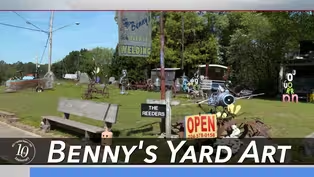
Benny's Backyard Welding & Yard Art
Video has Closed Captions
Clip: S10 Ep22 | 3m 56s | We visit with self-taught welder & artist Benny Reeder of Benny's Yard Art in Huntersville (3m 56s)
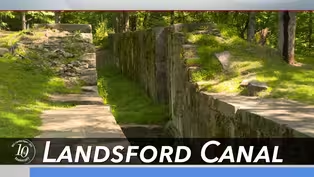
The History of The Landsford Canal
Video has Closed Captions
Clip: S10 Ep22 | 5m | Discover the why behind the construction of Landsford Canal along the Catawba River. (5m)
Video has Closed Captions
Clip: S10 Ep22 | 6m 17s | Charlotte based Profound Gentlemen works to keep male educators of color in the classroom. (6m 17s)
Video has Closed Captions
Clip: S10 Ep22 | 5m 55s | Why so many great craft beers start with Carolina malt and barley from Rowan County. (5m 55s)
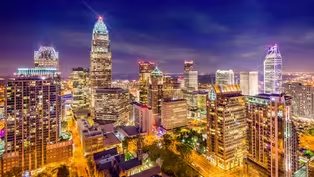
Carolina Impact: April 25th, 2023
Preview: S10 Ep22 | 30s | Charlotte's brewery business, Profound Gentlemen, Landsford Canal, & artist Benny Reeder. (30s)
Providing Support for PBS.org
Learn Moreabout PBS online sponsorship
- News and Public Affairs

Top journalists deliver compelling original analysis of the hour's headlines.

- News and Public Affairs

FRONTLINE is investigative journalism that questions, explains and changes our world.












Support for PBS provided by:
Carolina Impact is a local public television program presented by PBS Charlotte