
Carolina Impact: April 26, 2022
Season 9 Episode 23 | 27m 24sVideo has Closed Captions
The Green Book Exhibit, VAPA, Autism Awareness, Fall Nights in China Grove
The Green Book Exhibit, VAPA, Autism Awareness, Fall Nights in China Grove
Problems playing video? | Closed Captioning Feedback
Problems playing video? | Closed Captioning Feedback
Carolina Impact is a local public television program presented by PBS Charlotte
Carolina Impact: April 26, 2022
Season 9 Episode 23 | 27m 24sVideo has Closed Captions
The Green Book Exhibit, VAPA, Autism Awareness, Fall Nights in China Grove
Problems playing video? | Closed Captioning Feedback
How to Watch Carolina Impact
Carolina Impact is available to stream on pbs.org and the free PBS App, available on iPhone, Apple TV, Android TV, Android smartphones, Amazon Fire TV, Amazon Fire Tablet, Roku, Samsung Smart TV, and Vizio.

Introducing PBS Charlotte Passport
Now you can stream more of your favorite PBS shows including Masterpiece, NOVA, Nature, Great British Baking Show and many more — online and in the PBS Video app.Providing Support for PBS.org
Learn Moreabout PBS online sponsorship- [Narrator] Wells Fargo is proud to support diversity, equity and inclusion in our employees, our customers and the communities we serve, as well as through content on Carolina Impact.
- [Announcer] This is a production of PBS Charlotte.
- Just ahead on "Carolina Impact," this little green book kept African American travelers safe during segregation.
A new exhibit tells the stories of the businesses where they found refuge.
We'll take you to one that's still open.
Plus, how this mother and son shed light on autism with their new dog treats store.
- I'm Sheila Saints.
Artists in Charlotte have a new home.
We'll take you inside VAPA, the visual and performing arts center in uptown Charlotte coming up.
"Carolina Impact" starts right now.
- [Announcer] "Carolina Impact" covering the issues, people and places that impact you.
This is "Carolina Impact."
(energetic music) - Good evening, thanks so much for joining us I'm Amy Burkett.
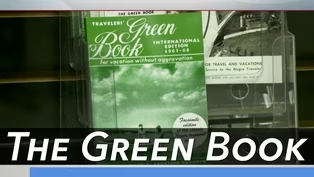
A new exhibit on display at Central Piedmont, highlights the importance of "The Green Book."
For African Americans traveling during segregation the small book listed hotels, restaurants and businesses where African Americans were welcome without harassment.
As "Carolina Impact's" Bea Thompson reports one of those local businesses remains open.
(soft jazz music) - [Bea Thompson] At the start of the 20th Century, Americans were traveling in that new invention, cars.
But for African Americans, the journey was fraught with concerns about safety and traveling while black.
- They wanted to travel They wanted to take their families places and they wanted to not have their families be exposed to any kind of racism.
- That was an amazing thing to be able to find out where you could eat, where you could stay, where, you know, it was okay for black folks to do that.
- [Bea Thompson] For the small child traveling north with his parents and not knowing all the obstacles to his safe arrival at Grandma's house.
- This is history.
This is real.
It's not imaginary that these things happened.
- [Bea Thompson] The librarian who wants to make sure students know this part of America's history.
(machine beeping) And the business family that never gave up.
- We're the only one that's still here, owned by the same family and in the same spot.
- [Bea Thompson] Their lives all intersect with this small book.
A pamphlet compiled in the 1930s by a black man, Victor Green, who worked for the railroad as a mail car carrier.
Green wanted to provide African Americans a guide to safe traveling across the country during a time when doing so for black people could end in tragedy.
Particularly if their travels brought them through so-called sundown towns.
- So these places said that if you were African American, if you were Mexican that you should not be caught after a certain time, after the sun went down.
You would run the risk of losing your life.
(trumpet music) - We were traveling, you know, 4 a.m. is still kind of dark.
Sunlight comes up, we're going through this little small town and my father notices that somebody's following us.
- [Bea Thompson] The international traveler remembers those trips as a child, and how his parents shielded him from the dangers on the road.
- [Gloria Kelly] History was not told as it should have been, and so this is correcting wrongs.
It's letting people know actually how did people live then?
How did they travel?
Everything was not as it is now.
- [Bea Thompson] The current exhibit on "The Green Book," is on display at Central Piedmont's main campus library.
For Gloria Kelly, who brought the exhibit to Charlotte, it was important for student's to learn.
- It affected everybody.
And so we need to know that and now people will understand why people feel a certain way.
- This little green book provided a roadmap for traveling African Americans.
It gave them tips on where to sleep, where to eat and where to stop to get some gas.
It basically was an underground railroad (knocking) in plain sight.
(gentle piano music) At any given time, more than 150,000 copies were in circulation.
And while they were not sold everywhere, one major American company did sell it to their customers.
- And like the Esso Company, now Exxon, was a backer of this.
- Because they would have dealerships for black people.
- Yeah, they did franchises.
- [Bea Thompson] From 1936 until 1966, African American businesses across the country would advertise in the books.
Listed by city, it provided everything from hotels, to entertainment venues and restaurants.
- You can see us right here by Biddleville Luncheon.
You can see the Seltzer Club is on here.
- [Bea Thompson] It's a family affair for Jermaine Blackmon.
His grandfather put his "Chicken 'N' Ribs" business on Charlotte's west side at Oak Lawn and Beatties Ford Road in 1953, and he advertised in "The Green Book."
- Because the Jim Crow era was a hard time and people of color needed somewhere safe to be, and that's what "The Green Book" was all about you know.
Being able to travel and be treated as humans you know.
- Because in losing this history you lose the sense of what African Americans were able to accomplish for themselves.
- [Bea Thompson] Dr. Griffin points out the traveler's pamphlet pulled back the layers that covered up the history of black businesses which thrived during segregation and survived under the separate rules.
- When we talk about African American history we don't talk about African American business owners, and the things that they were able to accomplish.
- [Bea Thompson] It also kept motorists up on changes in civil rights legislation that could impact their travels.
- By the 1960s, you begin to see "The Green Book" advertising all of the new civil rights laws and which states were abiding by these civil rights laws.
They're now telling the people who are reading "The Green Book," who are purchasing "The Green Book" these states now have laws that will protect you.
- [Bea Thompson] By the end of the 60s as the laws became more enforceable, "The Green Book" in many ways became unnecessary because of the way integration began to open up the country.
For third generation business owner Jermaine Blackmon, his family's stake in the community is firmly planted for the next generation, his children.
- We remodeled.
Business picked up it did and now we have more people coming to the community.
So things have picked up.
We're very proud to be in this community and part of African American history.
- [Bea Thompson] And for this business owner and his family the road ahead looks pretty good.
For "Carolina Impact", I'm Bea Thompson.
- Thanks so much Bea.
If you're interested in seeing the exhibit, it's on display at Central Piedmont's central campus until May 6th.
Well National Autism Awareness month takes place each April.
Research shows autism spectrum disorder affects one in 44 children.
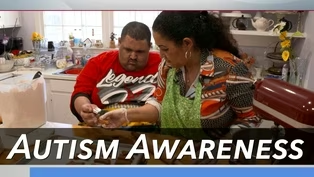
Next, we meet a Charlotte mother who says, baking dog treats brought her closer to her autistic son.
As "Carolina Impact's" Rochelle Metzger reports, the pair recently opened a pet bakery and boutique created to help people with disabilities.
(mixer whirring) - [Rochelle Metzger] The kitchen is a sacred place for Mariame and Zach Boujlil.
The sweet smell of honey and pumpkin fills the air as they mix, and roll mounds of dough.
- [Mariame] Good job.
- [Rochelle Metzger] Mother and son working side-by-side filling trays with homemade bone-shaped dog treats.
- [Mariame] There's nothing more beautiful than to share this moment with Zach.
- [Rochelle Metzger] Boujlil treasures these moments of calm and closeness with her son, who has severe autism and is non-verbal.
For them, baking is a love language they both speak.
- It fills me up with a lot of hope.
- [Rochelle Metzger] Hope for her son's future and a desire to prove people wrong.
- Zacky has autism but he can do.
- [Rochelle Metzger] Building on what Zach does best, making pup pastries, Boujlil started Zack's Barkery and More.
The dog treat business on Sharon Lakes Road benefits a non-profit she founded to support people with autism and other disabilities.
She says the store will offer employment opportunities.
- If someone with high function autism, to teach him like a life skills as far as customer service maybe.
- [Rochelle Metzger] And proceeds will help fund Blue Angels House, a communal living home, for young adults with high functioning autism.
- We passed inspection for building and everything.
- [Rochelle Metzger] The house in south Charlotte still needs approval from the state.
It features a large activity space that can be used for fundraisers, or rented out for events.
The money will help supplement tenants who don't receive government assistance.
- We still need more.
More for our students and our adults with disabilities.
More opportunities, more career paths.
- [Rochelle Metzger] Tracy Falda is Zach's teacher at Metro School, which serves students with cognitive disabilities in Mecklenburg County.
Now 18, Zach is in a transition class for graduates.
Falda says they incorporate lessons that will prepare him for his role as an entrepreneur.
- So we do a lot of skills with him focused on baking, and the other things for the class would be getting his business ready.
So we do the labeling for his packaging, we do the boxes.
(water splashing) - [Rochelle Metzger] There's also a time for play.
For Zach that's tossing a ball and swimming.
He hits the pool daily for a bit of fun and exercise.
Falda says working with non-verbal students like Zach is challenging at times.
But they find other ways to communicate.
- He is able to point and do things like that, so it does help.
As you get to know him, you know his mannerisms which is really fun too.
- [Rochelle Metzger] Autism spectrum disorder affects one in 44 children in the U.S. according to the CDC.
It's four times more common in boys than girls, and an estimated 40% of people with ASD are non-verbal like Zach.
The disorder varies in severity and is often combined with other disabilities.
- Zacky has severe autism.
He has ADHD, OCD.
He has seizures.
Epileptic disorder.
Hyper diabetic, obesity.
- [Rochelle Metzger] Autism is a life long brain disorder that typically appears during the first three years of life.
Boujlil says Zach was a toddler when she noticed drastic changes in his behavior.
- And all of a sudden when he turned about two, he wouldn't respond at all in his name, and that's really like very odd.
- [Rochelle Metzger] Autism affects individuals differently, but there are signs to look for.
- The lack of repeating what other people are doing, lack of eye contact, lack of pointing fingers.
- [Rochelle Metzger] Shagun Gaur is an autism resource specialist with the Autism Society of North Carolina.
The organization estimates that more than 65,000 people in the state are living with autism spectrum disorder.
Gaur remembers the day her eldest son, Ronic, was diagnosed.
- After the word autism everything was blank, everything was dark I just didn't know what they said I was in disbelief.
I was in denial.
- [Rochelle Metzger] Ronic now 23 is considered severe on the spectrum.
- He cannot communicate verbally.
He cannot cross the street.
He cannot go take a shower by himself.
- [Rochelle Metzger] Gaur says early intervention is key.
So the first thing parents should do is get a proper evaluation from a developmental specialist.
Once you have the diagnosis, start therapeutic intervention.
- Give them tools.
Give them strategies how to cope if there's a meltdown.
How do they communicate?
So a good sensitive diet that might be helpful.
- [Rochelle Metzger] Gaur says resource specialists can provide guidance to navigate community services and government assistance programs.
But ultimately, parents need to be their child's best advocate.
- Education is key.
Understanding what autism is.
How to help him?
What should be done?
Talk to people, have a good support system around you.
- [Rochelle Metzger] Mariame Boujlil says she's thankful for her mother and teachers, like Tracy Falda, for supporting her and Zach over the years.
She says the mission of Zach's Barkery and More is to pay it forward.
- God give me long life and health to make sure that I take care of him.
I advocate for him and I do it for all kids with autism.
- [Rochelle Metzger] As long as she's around Boujlil says, those who can't speak will have a voice.
For "Carolina Impact," I'm Rochelle Metzger.
- What a special story, thanks so much Rochelle.
The Autism Society of North Carolina offers guidance on navigating early intervention and finding community services.
Resource specialists are also available for free in every county.
Well a massive effort to upgrade Center City meant losing one of Charlotte's iconic buildings, Spirit Square.
When news spread that Spirit Square was being demolished the creative community joined forces to find a new facility.
As "Carolina Impact's" Sheila Saints reports, now they're transforming a vacant building into something vibrant.
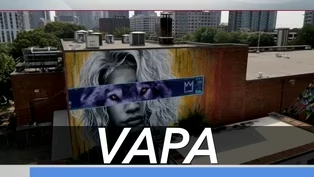
(energetic music) - [Sheila Saints] The Hal Marshall Center in uptown Charlotte sat empty for years.
You may recognize the building from that unique mural that faces 277.
Mecklenburg County occupied the former Sears Department store until 2017.
Charlotte art leaders knew the vacant facility would be a perfect hub for the creative community.
They collaborated with the county to transform the space.
It was out with the old and in with the new.
Now it's a vibrant arts incubator and nonprofit called the Visual And Performing Arts Center.
- [Arthur Rogers] You will not find a more diverse collective of artists under one roof.
- [Sheila Saints] Arthur Rogers, a professional artist, is leading the effort.
- And I'm like, well why isn't this here in Charlotte?
Why isn't there a space for artists that the community, the municipality was supporting to help them?
Because every other major city in the country, you know has figured it out.
And I refused to accept that it couldn't happen.
- [Sheila Saints] Eleven arts organizations joined together to form VAPA.
They're repurposing the building into a center for more than 100 artists to create, rehearse, exhibit and perform.
The county is leasing the 157,000 square foot, three-story building to VAPA.
Members are motivated by the opportunity to create a space of their own.
- [Arthur Rogers] The artists themselves have cleared the building.
Helped prepare the building, helped to getting the condition that it is currently under.
But we've got big plans.
- This space well, you could not see the floor.
You couldn't really see across the room.
It was covered in cubbies, big giant shelves, metal desks, wires all over the place.
The walls were all different colors.
So it looked nothing like this.
So we just kind of cleaned everything out and painted it to make a blank slate.
- [Sheila Saints] Arthur's wife, Joanne Rogers, owns Nine Eighteen Nine Studio Gallery, a main tenant.
- I am thrilled.
They're reaction is... Everyone that come's in here is amazed by what we're doing.
The level of work that's here, and they're looking for ways to support, which is exactly (laughs) what's great about this space.
- [Sheila Saints] Collage artist John Miles leases one of the studios in the gallery, which also showcases his work.
- One thing as an artist, you have to be around other artists.
So this the perfect opportunity to be around other artists and it let's the juices just floweth.
- [Sheila Saints] How grateful are you to have this?
- [John Miles] On a scale of one to 10, 14 and a half.
- [Sheila Saints] Jerry Taliaferro says having his photography studio here provides inspiration.
- It opens up a lot of possibilities, you know.
One of the great things is you're working around other artists, and it's kind of a, I don't know, synergy.
- Right now I'm experimenting with a flow medium with the acrylics and so I'm trying to get a water look.
- [Sheila Saints] The center has share spaces for working artists like Leigh B. Williams, who's art was featured in the Art Pop Street Gallery.
She showed us her process.
- So I usually have several paintings going at a time so I can allow one to dry, not work on it too much.
- The goal of VAPA is to keep the spaces affordable and accessible for artists.
That's why artists only pay $3 a square foot per year to lease a space here.
A 12 x 14 studio would lease for about $500 annually.
- [Arthur Rogers] The demand for artists spaces, affordable, accessible artist spaces, is ingrained in our mission statement.
Because the need is that great.
- [Sheila Saints] So great that VAPA is nearly full with more than 170 applicants on the wait list.
- Cover for my friends comic book that he's hiring me to draw.
- [Sheila Saints] Here you'll find a comic book illustrator, JazzArt Charlotte, The Light Factory, and Charlotte's Off Broadway.
Studios for podcasting, recording music and dancing.
There's even a tea bar.
- I think it is just having the confidence in your authentic self.
- [Sheila Saints] Keli Semelsberger is a founding member of VAPA, and her Charlotte Comedy Theater is an anchor tenant.
- I thought the idea was brilliant and I've always thought that artists should be together instead of all off doing their own little thing.
The power of the collective.
So this is a home to a lot of artists that need a place to play.
So I'm beyond, I'm over the moon.
- [Sheila Saints] The center is open to the public.
VAPA believes in nurturing the relationship between the community and artists.
- [Arthur Rogers] Make no mistake, this is a public amenity.
It's forward facing to the community.
We want to make sure that our doors are open for the public to come in to engage, communicate, if necessary buy directly from the artist.
- [Sheila Saints] Much like the signatures on this wall which one day will be painted over, the artists hope to make their mark on the Charlotte community for generations to come.
For "Carolina Impact," I'm Sheila Saints reporting.
Thank you so much Sheila.
The center provides low cost studio and exhibition spaces through donation and grants.
Well I've got a special friend joining me now, it's Kennedy Warren.
She is a junior at Nation Ford High School in Fort Mill, South Carolina.
Kennedy welcome to "Carolina Impact."
- Thank you so much.
- Well she wants to go into broadcasting, so she came for a tour today and I decided to put her to work.
She's going to help me introduce this last story.
Are you ready?
- Yes ma'am.
- Whenever you are.
- As we count down to your favorite stories from the PBS playoffs, tonight we share this story viewers choose as their second favorite.
- Back in 2020, "Carolina Impact" gave you a sneak peek at the movie filmed in Roane County.
No big name Hollywood stars.
- The real star was China Grove.
"Carolina Impact's" Jeff Sonier and photojournalist Doug Stacker takes us back to the small town for the big premiere.
- Yeah China Grove is a long way from Hollywood but you know those old Hollywood movies where the unknown gets discovered and then becomes a star.
Well, China Grove may be about to have its own Hollywood moment.
(energetic music) They're rolling out the Roane County red carpet for the premiere of the film "Fall Nights in China Grove," and on this fall night everybody who helped put China Grove on the big screen gets to see China Grove on the big screen.
(energetic music) - So obviously we wanted to take a second to come out and just thank you, China Grove, for making this movie.
Without you guys, the people, the town, there is no "Fall Nights in China Grove."
(applause) Without further ado, "Fall Nights in China Grove."
(cheers and applause) (upbeat music) ♪ Well I'm getting tired working hard every day ♪ - [Jeff Sonier] Yeah here's the opening scene from "Fall Nights in China Grove."
Set in this high school hangout diner.
Later, well here's the diner again.
- [Announcer On TV] Let me tell you there's-- - Can we get you something to drink?
- Yeah, I'll just have a water.
- [Jeff Sonier] And here's the diner again.
- I'm taking an order Gary.
- This is a prank right?
You know the whole face thing, it's makeup.
- [Jeff Sonier] And if it all looks a little familiar, well most of the diner footage was actually filmed at Gary's Bar-B-Q, a fixture here in China Grove since the 70s.
- [Woman] Sauerkraut?
- [Jeff Sonier] Looking pretty much like customers at Gary's see it every day, except in the movie scene the customers are actually all actors - Hey Gary, look.
- [Jeff Sonier] and extras.
Filming in the restaurant nights and Sundays when Gary's was closed.
- I usually just left and let them have the run of the place and give 'em my phone number and they'd call me when they got through.
And I trusted 'em.
- You ready prima donna?
- [Jeff Sonier] Same story for these bar scenes filmed at The Lucky Turn Around, a friendly neighborhood, everybody knows your name beer joint on Highway 29.
(bottles clink) Although if you look closely, you might spot a few of the regulars making their Hollywood debut.
- I'm not sure those rules apply when everything on the truck is undocumented.
- I was just a stand in, shooting pool while the actors were behind working at the bar and stuff.
- [Jeff Sonier] Could be your big break?
- Yeah (laughs).
- [Jeff Sonier] And then there's the old C&D Salvage yard in China Grove, which has several scenes in the movie.
Doubling here as a late night crime scene.
- How much do you think we can get for all of this?
- Box truck full of scrap metal maybe 25.
(metal crunches) - They would go down to the scrap pile, set up all their gear and everything, and shoot for like hour after hour.
Like sometimes till like two and three in the morning.
All at night.
Yes it was.
- [Jeff Sonier] Now were you in the movie?
- [Kellie Ghent] No I was not.
Three kids.
- [Jeff Sonier] Yeah.
- (laughs) - [Jeff Sonier] So how exactly did China Grove find itself in a feature film?
(engine revving) - We wanted to show up and really give them a show that they could say, "Hey, I made that movie."
Because they did, we didn't make this movie China Grove made this movie.
- [Jeff Sonier] But when Horace Priester and Aleks Kapetanovic wrote this movie more than a year ago, they'd never even heard of China Grove.
Until two producers on the film, who grew up in China Grove, told Priester and Kapetanovic about their hometown.
- You've got to check out this town it's so quaint and charming.
And we drove up here and checked it out and never looked back.
It really had already a lot of these locations that were already written.
Just ready to go.
- A lot of people had heard about it so when we come knocking on a door that we haven't knocked on for the last six months, they're like, "Oh, we know you, the movie boys are here."
- [Jeff Sonier] What the movie boys found in China Grove was the perfect small town setting for their first film, from the red house on Main Street that became the movie home of one lead character.
- Hey t-shirt guy, you always throw girls a shirt and walk away?
(train engine revving) - [Jeff Sonier] To the daily trains through downtown China Grove that were filmed at full speed, along with slow motion trains from the nearby Spencer Shops.
- Woo!
Got my back!
- [Football Players] I've got your back!
- [Jeff Sonier] But Priester and Kapetanovic say the toughest scenes to film were the high school football scenes at South Rowan Stadium.
- You have multiple things going on.
You have a game going on on the field.
You have people on the sidelines and then you have people in the stands, and then you also have sports announcers in the press box.
All done at different times.
- Down!
- [Sports Announcer] You gotta have a touchdown here.
Meyers takes out first and (inaudible) over the top and were set.
- It's where the guy flips over into the end zone, that's me, and my son-in-law that actually flipped him.
- [Jeff Sonier] David Lambert is usually the resource officer here at South Rowan.
Except for that one night when he put on the pads and joined the actors, and the high school players, on the field on camera.
- They kept saying, "Don't get anybody hurt, don't get anybody hurt."
He said, "Now flip me, flip me."
So it was awesome.
I kept on nudging my wife, I was there for that, I was there for that.
- [Jeff Sonier] And Officer Lambert was there for the premiere too, along with everybody else from China Grove who wanted to see their little town on the big screen.
- I thought the movie was great.
They've done China Grove well.
- Really we were just hoping everybody loved it.
We've been here for a year.
- I think it was just fun for them and equally fun for us just to pull up to that theater and you see the street filled with people and right there in lights it says, "Fall Nights in China Grove," which not only us has been dreaming of, but now this whole town has been dreaming of and it all came true.
♪ Whoa, oh China Grove (China Grove" By The Doobie Brothers) - Thanks so much Jeff.
Next week, we'll finish up the PBS Charlotte playoffs with our number one most requested story.
Before we go tonight we'd love your feedback on the show and your story ideas.
You can send both to feedback@wtvi.org.
Well I want to thank our friends from Trinity Oaks Retirement Community in Salisbury for being in our studio audience tonight.
They were great.
That's all the time we have, thanks so much for joining us.
We always appreciate your time, and we look forward to seeing you back here again next time on "Carolina Impact."
Good night my friends.
(energetic music) - [Announcer] A production of PBS Charlotte.
- [Narrator] Wells Fargo is proud to support diversity, equity and inclusion in our employees, our customers and the communities we serve, as well as through content on Carolina Impact.
Video has Closed Captions
Clip: S9 Ep23 | 5m 33s | A charlotte mother and her autistic son who created a dog treat business (5m 33s)
Carolina Impact: April 26, 2022 Preview
Preview: S9 Ep23 | 25s | The Green Book Exhibit, VAPA, Autism Awareness, and Fall Nights in China Grove (25s)

Video has Closed Captions
Clip: S9 Ep23 | 6m 14s | China Grove's small town, small budget movie makes it all the way to Amazon Prime. (6m 14s)
Video has Closed Captions
Clip: S9 Ep23 | 5m 53s | A travel guide called the Green Books for African Americans (5m 53s)
Video has Closed Captions
Clip: S9 Ep23 | 5m 13s | A profile on the new Visual and Performing Arts Center (5m 13s)
Providing Support for PBS.org
Learn Moreabout PBS online sponsorship
- News and Public Affairs

Top journalists deliver compelling original analysis of the hour's headlines.

- News and Public Affairs

FRONTLINE is investigative journalism that questions, explains and changes our world.












Support for PBS provided by:
Carolina Impact is a local public television program presented by PBS Charlotte