
Carolina Impact: April 27, 2021
Season 8 Episode 23 | 25m 59sVideo has Closed Captions
Carolina Impact: April 27, 2021
Carolina Impact: April 27, 2021
Problems playing video? | Closed Captioning Feedback
Problems playing video? | Closed Captioning Feedback
Carolina Impact is a local public television program presented by PBS Charlotte
Carolina Impact: April 27, 2021
Season 8 Episode 23 | 25m 59sVideo has Closed Captions
Carolina Impact: April 27, 2021
Problems playing video? | Closed Captioning Feedback
How to Watch Carolina Impact
Carolina Impact is available to stream on pbs.org and the free PBS App, available on iPhone, Apple TV, Android TV, Android smartphones, Amazon Fire TV, Amazon Fire Tablet, Roku, Samsung Smart TV, and Vizio.

Introducing PBS Charlotte Passport
Now you can stream more of your favorite PBS shows including Masterpiece, NOVA, Nature, Great British Baking Show and many more — online and in the PBS Video app.Providing Support for PBS.org
Learn Moreabout PBS online sponsorship- [Male Narrator] This is a production of PBS Charlotte.
- Just ahead on Carolina Impact.
- [Jeff] Tent City is gone, but Charlotte still has a homeless problem.
I'm Jeff Sonier, and uptown, we'll explain why moving homelessness isn't the same as solving homelessness.
- [Amy] We'll introduce you to a new East Charlotte business that may have you saying, "Where's the beef?"
And we meet a tattoo artist who changed a law so she could change the lives of cancer patients.
Carolina Impact starts right now.
(upbeat music) - [Male Narrator] Carolina Impact, covering the issues, people and places that impact you.
This is Carolina Impact.
- Good evening, thanks so much for joining us, I'm Amy Burkett.
Out of sight, out of mind, but at least not out of money.
We're talking about the effort to solve Charlotte's homeless problem.
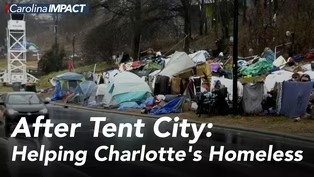
Specifically, that homeless Tent City where hundreds used to live, on the edge of uptown, near the freeway.
Charlotte City Council is now spending millions in COVID funding from Washington, D.C. to keep a roof over their heads, instead of a tent.
But that funding doesn't help everyone.
Carolina Impact's Jeff Sonier takes us to uptown for a look at who's still surviving on the streets.
- Yeah, forget home sweet home, uptown is still home street home for a lot of folks.
Just ask the volunteers who serve Charlotte's homeless population, one homeless person at a time.
Bringing them the basics: something hot to eat, something cold to drink, and sometimes, just someone to talk to (upbeat music) - [Daryl] If you're new to the community, we want you to know that we are here every week.
- [Jeff] It all starts with a meal and a place to meet.
- [Man With Gray Shirt] How you doing, man?
- [Daryl] What's up bro?
You doing okay?
- [Man With Gray Shirt] Yes sir, how about yourself?
- [Daryl] I'm good, man.
- [Jeff] Free clothes and shoes for your feet.
- [Daryl] Let them know what you're looking for size wise, if you need jeans or whatever.
- [Jeff] And then out onto the street.
- [Daryl] Let's grab this light real quick.
We want to make sure that what we do out here is more than just giving food, it's more than giving clothing, it's about helping to restore dignity in their lives by the way that we treat them and the way that we see them.
- [Jeff] Daryl Sutherland and his ministry, Rice N Beans, have been helping the homeless for 10 years.
They're the volunteers with the wagons on the streets of uptown every Tuesday and Wednesday night.
- [Daryl] You doing okay?
Can we get you a happy meal?
- [Jeff] Handing out ham sandwiches, hot dogs, - [Daryl] All right, so we got a happy meal for my friend here.
- [Man Seated On Bench] Okay.
- [Daryl] Okay, this is Alan.
- [Jeff] and a little humanity at the bus shelters and park benches.
- [Daryl] How you doing, man?
- [Jeff] The places that Charlotte's homeless call home.
At least, for a while.
- [Person In Striped Shirt] Well, where you been?
- [Daryl] What's up there, Cornbread?
- [Woman In Black Shirt] I've been asking about you.
- [Daryl] How you doing?
You know, it's sitting on a park bench, and sometimes, we'll come down, and that's what we'll do.
We'll have hot dogs or water in our bag, and we'll just sit down with people and spend a great deal of time with them.
And then when the Tent City, obviously, when that moved out, and they moved them into the hotels, then there was quite a big population that we don't see now.
So it's a good thing because they're not on the street anymore, and that's awesome, but it's difficult because you become friends with them, and you just kind of wonder how they're doing, you know?
- [Jeff] Charlotte's Tent City was a miserable, muddy mess that day back in February when Mecklenburg County moved in, moving out hundreds of homeless by bus to local hotels.
For a few months, at first, and now, thanks to COVID funding from the feds, and from city council, for a whole year.
- Well, I think the challenge is that they're all at the hotels now with, kind of, a ticking clock.
It's not a permanent solution, (continues speaking inaudibly) - [Jeff] We're on a Zoom call with Katherine Firmin-Sellers from United Way, which is working to prevent another homeless Tent City in the future.
The visibility of Tent City really did bring the problem to the fore for a lot of folks who, maybe, didn't see it, or, maybe, didn't want to see it before that.
- That's absolutely correct.
The problem of homelessness, both sheltered and unsheltered, is not new.
It wasn't created by the pandemic, but it is also very unfortunate that it takes it takes that kind of public visibility to garner the public attention and the public outrage that will then mobilize a response.
The money is one thing, but the reality is that we're not solving homelessness by any stretch.
- [Daryl] Why don't you guys care for him?
I'm going to take hot dogs across the street to our friend across the street there.
You know, when Tent City moved, we were still out that next week, and we were feeding people.
All right, take care man.
Be careful, okay?
Be careful.
I'm gonna take these over here.
The obvious problem is not just moving them from Tent City to a hotel.
That's geography, right?
I mean, that's just a different location.
- [Man On Stairs] Thank you very much.
Thank you.
Thank you.
- [Daryl] Here you go, man.
Here's that.
- [Man On Stairs] Appreciate it, appreciate it.
God bless you.
God bless you.
- [Daryl] Here's your water for you, and another water.
I brought one just for you, just in case.
- [Woman On Stairs] I appreciate it.
- [Man On Stairs] Appreciate it, man.
Appreciate it.
- [Daryl] All right, God bless you guys.
- [Man And Woman On Stairs] You, too.
- [Daryl] Stay safe tonight, all right?
I see a lot more transient people coming through.
They come in for a short period of time and then they're gone.
Nobody home.
He's not here.
Oh, well.
I thought, maybe, he might've gone and done the hotel thing with the tent people, but if you saw him.
You know, we had a guy who used to sit right over there on that park bench every week.
And I served Vance for probably six years.
He was a vet.
We did so much with Vance, because we had gotten to a place where Vance was a friend.
He was a part of our family.
And he passed away a year-and-a-half ago.
Love them whether they want us to love them or not.
How you doing, man?
Yeah!
I haven't seen you in a while, man.
How you been?
Good to see you.
- [Man Seated Beside Scaffolding] You got sodas?
- [Daryl] Soda?
- [Man Seated Beside Scaffolding] Yeah.
- [Daryl] Let me check and see.
We got any sodas, Zach?
- [Zach] Hey, do we have any Diet Cokes?
- [Daryl] We may have a soda left.
If we got one left, it's yours, my friend.
- [Man Seated Beside Scaffolding] Okay, can I get water?
- [Daryl] Yes.
Can we get a water as well?
- [Man In Blue Gingham Shirt] Water, too?
- [Daryl] Yes.
All right.
- [Man Seated Beside Scaffolding] Say a prayer.
- [Daryl] Saying "thank you, Jesus.
Amen."
All right.
All right, my man.
You take care of yourself, Okay?
- [Man Seated Beside Scaffolding] I will.
- [Daryl] Stay safe now.
- [Man Seated Beside Scaffolding] I will.
- [Daryl] All right?
All right.
When we embrace them, when we treat them like they're somebody, when we listen to them, that's just healing.
That's healing in some deep places that we can't just fix in a 90 day program, you know?
- [Interviewer] Maybe that's the thing that helps them get out of that tent, you know?
- [Daryl] I sure hope so.
I sure hope so.
I sure hope so.
Yeah, in Daryl Sutherland's world, helping the homeless here in Charlotte means more than just writing a check or dropping off a donation.
He says it doesn't cost a dime to spend a little time with someone on the streets, and it might just help get them off the streets.
Or, help them survive the streets.
Amy.
- Thanks so much, Jeff.
If you want to know more about Rice N Beans, that help for the homeless group that we just learned about, visit pbscharlotte.org to find out how to volunteer, or how to donate.
Well, a dream and determination: the driving forces behind Ink & Iris, the first ever tattoo shop in Lincolnton.
It wasn't easy opening the doors, but the owner, like her clientele, doesn't let obstacles stop her.
Carolina Impact's Sarah Colón-Harris introduces us to a tattoo artist using her skills to permanently restore confidence and hope to cancer patients.
(upbeat electronic music) - [Sarah] Tattoos have long been a form of self-expression.
For some, it's permanent artwork to feed the soul.
And here, in the small town of Lincolnton, North Carolina, Shawna Moore and her husband are determined to make history with their tattoo shop, Ink & Iris.
- [Shawna] There's so much more to it.
It's not just a tattoo, and that's my whole philosophy.
- [Sarah] Not just a tattoo, but a tool to restore hope and confidence in cancer patients and others struggling with hair loss.
But before she could transform lives, Shawna had to prove her point that her work is more than just a tattoo.
So, this hometown girl with a passion for progress took her case to city council and challenged the city's ban on tattoo shops.
- It wasn't zoned, and I said, "Well, how can I change that?"
- [Sarah] Now, one year later, her shop is the first of its kind in town, appointments booked out for months.
- It was really special to see all my hard work pay off in such a positive light for the industry.
Not just for me, but for the tattoo industry as a whole.
You know, we kind of get bad raps sometimes.
And it was just nice to see how quick it changed, just in my town.
(upbeat synth music) - [Sarah] As a cosmetic tattoo artist, Shawna prides herself on transforming the outer appearance to build self esteem.
Particularly in clients suffering from hair loss.
- A lot of women who have had breast cancer, with the chemo treatments and the loss of hair.
I've done Alopecia patients, men.
You know, a lot of people think it's makeup.
It's just for women.
But for men, same thing.
They experience Alopecia and cancer and hair loss.
Now, do you want to look super surprised all the time?
- [Terry] No, not really.
- [Shawna] No?
Okay.
- [Sarah] Today, Terry Morton is treating herself to a new pair of eyebrows.
- I'm a cancer survivor, and went through six months of chemo, and, hair grew back, eyebrows didn't grow back.
- [Sarah] Her daughter, Jaclyn, here for moral support, still gets emotional thinking about her mother's stage IV lung cancer diagnosis.
- She was just like, "It's no big deal.
We're gonna beat this.
It's gonna be just fine."
And I'm like, "Whew!"
My mom, you know?
I've got to be there for her.
I was very emotional.
I remember, explicitly, her surgeon told myself, my dad, and my mom, "You may want to think about your wedding plans.
You know, you would want your mom to be there."
And she was like, "Don't worry, we're still going to have a wedding.
I don't care if it's in a hospital room.
We will have a wedding."
And we did.
We had a beautiful wedding.
My mom was there.
So we are just blessed that she is here and blessed that she is getting her eyebrow services today.
- The average cost for permanent makeup here at Ink & Iris is about $350, and even though this location has only been open for about a month, business has already skyrocketed.
- [Shawna] So you'll see me kind of place them, put them on, place them, until they're perfect.
- [Sarah] Terry's expectations today are simple.
- I'm expecting not to have to draw them on, because I do a horrible job at that.
And I guess it's for vanity purposes, but I figure after all I've been through, I deserve this.
- [Shawna] And then, one more.
- [Sarah] And it wouldn't be a transformation (camera shutter sound) without a before picture.
With that out of the way, Shawna gets to work by mapping out Terry's face to determine the look of her brows.
Then, it's on to tracing the outline, and finally, the actual tattooing using a mix of colors to match Terry's skin tone and natural hair color.
The anticipation is mounting, and I couldn't help but ask: do you ever get afraid that you might make a mistake?
- [Shawna] I do, but it's quickly gone, because this is my job, and I got a job to do, and these women are counting on me.
- [Sarah] Finally, her moment is here.
It's time for the big reveal.
- [Shawna] Boom, boom boom!
- Oh, my gosh!
- [Sarah] The result: permanent eyebrows and a newfound confidence.
- [Shawna] You look good.
- [Terry] I have eyebrows!
- [Shawna] You do, and you can move them.
- [Terry] Ta da!
- [Shawna] Yeah.
- [Terry] They move.
- [Sarah] It's the before and after that makes Shawna's historic battle to open the shop all worth it.
- The fact that I can give her that little smidge of extra confidence that she once had?
I mean, my job is done.
You know?
That's huge for me.
- [Sarah] An opportunity to use art to heal.
- [Shawna] I hear their stories, I appreciate their stories.
I'm sympathetic to everything they're telling me, and the biggest thing is I'm grateful that I get to share these little moments with all these different people.
It's great.
It's a whole experience.
It's not just a tattoo.
(laughs) - [Sarah] Transformation with a little ink and a little heart.
For Carolina Impact, I'm Sarah Colón-Harris.
- Thanks so much, Sarah.
It's great to see how those new eyebrows give women confidence.
This is Shawna Moore's second tattoo parlor.
She also operates S'Moore Ink in Dallas.
Lincolnton wasn't alone in previously saying no to tattoo shops.
Three others were Davidson, Marvin, and Weddington.
Well, Charlotte's East side is known for it's eclectic collection of restaurants, coffee shops, and art venues.
Which makes the opening of a quirky new eatery even more unique, because it combines all three.
Carolina Impact's Sheila Saints takes us inside this new one-of-a-kind venue to meet the owners who just might look familiar to fans of Charlotte's 90s music scene.
(upbeat music) - [Brenda] Order, please.
Bag and tag it.
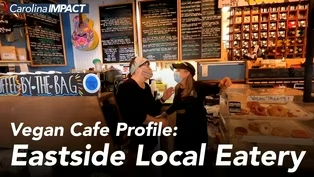
- [Sheila] Tucked away in the Eastway Crossing Shopping Center sits a unique Charlotte gem: the EastSide Local Eatery.
The café serves vegan and vegetarian dishes, muffins, coffee, and more.
- [Brenda] Order up!
- [Sheila] It's a destination for locals looking for a comfortable environment, eclectic charm, and healthy food, like their gourmet Impossible Burger.
- It fools people.
I've had people call me from the car and say, "You've made a mistake.
I'm vegan and you put meat on mine."
I'm like, "No, we didn't, because we don't have any in the building."
- [Brenda] It's a very small kitchen, so it's kind of like being in a studio apartment in New York City or something."
(laughs) (upbeat rock music) - [Sheila] The cozy interior includes artwork and a concrete floor designed to look like the ocean.
The café reflects the creativity and diversity of East Charlotte.
- [Brenda] I love this side of town.
I grew up here.
This side of town, I've always thought, has a real heartbeat.
That's what I like about starting a business right here.
(acoustic guitar music) - [Sheila] Musicians Brenda Gambill and Gina Stewart opened the café with a third partner.
Gina works the front counter and kitchen.
Brenda cooks and creates the menu.
(upbeat rock music) They're also the founding members of the 90s Charlotte band Doubting Thomas.
- [Gina] We didn't really set out to be a full service restaurant.
We're a bunch of rock n' roll musicians and this is where we landed.
- [Brenda] A lot of times when you say vegan, people say, "Oh, no.
Nope.
Nope.
I am strictly a meat-eater.
I'm this, that."
And you know what?
Sometimes people are and they want a change.
Maybe one day a week, two days a week.
- I'm not a vegan by any stretch, but I can eat vegan here and feel like I'm just eating a standard diet.
But I'm getting way less of the bad stuff and much more of the good stuff.
- [Brenda] Japanese Iced Coffee is a cold brew that we do here.
- The iced coffee here is the best iced coffee in town.
And, what makes it so special is that Brenda came up with coffee ice cubes, so that when the ice is melting, you're never getting watery coffee.
- [Brenda] Hello, I want a Puppucinno.
- [Sheila] And dogs are welcome to enjoy a Puppucinno in the whimsical outdoor courtyard.
- [Gina] The sign is special because the week that we opened, The Last Word, which was a coffee shop, Uhaul place, bookstore, over near UNCC, closed.
And the lady very kindly called us and said, "We've got some cups, we've got shelves, come get everything that we've got."
I said, "What about your sign?
Can I have your sign?"
And she was like, "What're you going to do with it?"
We have cilantro over here, we have rosemary, and we grow lettuce, and the birds usually eat it, but that's okay.
- [Sheila] And do you use these herbs in your meal preparation?
- [Gina] (nodding) Mhmm!
If they do well, and they usually do.
We have a bird bath that was a gift, we have a lemon tree that was a gift.
We also have birdhouses up here.
He made these birdhouses.
His name is Dean Forshay and he has an Etsy shop, and he makes all these beautiful birdhouses, and we sell those.
Ninety-five percent of it is things other people were throwing away.
Even down to the heaters, the actors' theater gave us all these heaters.
These are file cabinets we found on the side of the road, made planters out of.
So I think people feel that.
I think people feel that creativity and they feel inspired by it.
- And something new is in store for the café.
They just received a grant.
They're going to knock a hole in this wall, put in a garage door, and that will allow customers to enter the video store next door, and provide some necessary indoor dining.
- [Gina] Their concession stand and our bar will become one when that garage door is open.
It's going to be unlike anything Charlotte has ever seen, really.
- [Sheila] And it will add to the already welcoming environment.
- [Betty] There's nothing I don't like.
From tacos, to the Impossible Burger.
Also, we love the chili.
And Brenda can put a twist on vegan chili in the winter.
This is a no-stress zone.
To me, it's just like no stress at all.
- [Chris] It's a feeling of being at home.
It's like a feeling of being on the back porch or the screened in porch.
The feeling of community, would be the best way to describe it.
- [Brenda] Carolina Burger - [Sheila] And the community supported the Eatery during the pandemic, which is why meals come with this sticker.
The owners are grateful for their customers.
For Carolina Impact, I'm Sheila Saints, reporting.
Thanks so much, Sheila.
EastSide Local Eatery currently serves breakfast and lunch, but they recently applied for a permit to sell alcohol, and may extend hours in the future.
Well, it's that perfect time of year to get out and enjoy the great outdoors, because the weather is practically perfect.
Exploring the gorgeous Carolina waterfalls makes for exciting day trips.
Carolina Impact's Jason Terzis introduces us to the woman who led the charge to keep some of the most impressive falls open to the public.
(water rushing) - [Woman] Am I good?
You better believe I'm good.
- [Interviewer] You good to go?
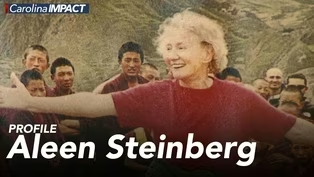
- [Jason] Her name is Aleen Steinberg.
- I have been called Aileen, Eileen, Arlene, Elaine, Ah-leen.
Aleen.
A-L-E-E-N. - [Jason] And it's because of the efforts she spearheaded that DuPont State Recreational Forest and its majestic waterfalls are open to the public, and not hidden behind a gated subdivision.
- We found Cedar Mountain in 1963, and it's been a love affair ever since.
- [Jason] Aleen and her family discovered the mountains of Western North Carolina while traveling from Florida for Summer vacations.
She practically raised her kids here.
- [Aleen] Just coming to the area and driving down a country road, and seeing cows in the pasture, and wild roses blooming on a fence by an old barn.
It was like I had come home.
Like I...
I felt centered.
I belonged here.
- [Jason] The locals embraced the Steinbergs, making it all the more inviting.
- [Aleen] We built a home here in 1967, so we put our roots down and we've spent every Summer here ever since.
And I've been a resident now since '98.
- [Jason] All through the 1970s, and 80s, DuPont was off limits to outsiders, but that didn't stop some locals from sneaking in.
- [Aleen] The mountain people were wonderful about including us in their lives and showing us their paths into the woods.
And taught us to look for the prints of animals.
We weren't just walking through the woods, we were learning about the woods.
We were learning about the sassafras leaves, and we were learning about sourwood.
And learning about the prints of a deer, or a bear, or a raccoon.
And they were welcoming.
They were anxious to share these wonderful acres with us.
- [Jason] Of course, the big highlight of those hikes into the trails of DuPont was getting a glimpse of the waterfalls.
- It was awesome.
There are no words to describe it.
You just stand in awe at these rushing waters and these magnificent falls.
- [Jason] When the DuPont Corporation closed its manufacturing plant in the 90s, it put the land up for sale.
Developers jumped in, outbidding the state in an attempt to turn in into a gated housing development.
- We couldn't fathom these acres being behind closed gates, being behind a gated community, because our rallying cry that it was for the people, not a privileged few.
- [Jason] That's when Aleen jumped into action.
- [Aleen] And that was when a whole group of us, everybody that was really interested in fighting for the falls got together.
- [Jason] A core group of roughly two dozen people emerged, led by Aleen, who organized the first meeting.
- The electricity in the room, the energy, was incredible.
We dubbed ourselves the Friends of the Falls.
We were a 501(c)3.
And we started to fight.
We wrote letters.
We sent emails.
We stood on street corners with pamphlets.
We talked to community clubs, to churches, to Boy Scout groups and Girl Scouts.
We talked to photographers, and anglers, and hunters, environmentalists.
- [Jason] Those efforts started making inroads with the community.
- [Aleen] Every major newspaper in North and South Carolina carried an editorial supporting our fight.
- [Jason] Aleen remembers the exact date all those efforts, all four years of it, finally paid off.
- We were having a meeting here at my home that night.
We met every Monday night for weeks.
On the 23rd of October, in 2000, the Council of State took the land by eminent domain.
And the developer was ultimately paid $24 million for it.
I mean, we were celebrating.
Champagne was popping.
(laughs) Oh, what a night.
- [Jason] DuPont then officially opened to the public.
And then, in 2013, a new log cabin style visitors' center opened.
It was named in Aleen's honor: the Aleen Steinberg Center.
- It was a total surprise to me.
I just am grateful and honored that it's named for me, that's all I can say.
- [Jason] A lifelong adventure-traveler, Aleen has seen the world.
She's climbed the Himalayas and hiked on every continent.
She's even written a book about her life and love of traveling.
- I can still do my mile a day.
- [Jason] Now, even at 90, Aleen is still sassy, and still going strong.
- I feel fantastic.
- [Jason] She's always had that spirit to get out, to go, to do.
- And it's just believing in yourself and not giving up when the going gets tough.
- [Jason] And it's that spirit and attitude that will enable DuPont to have visitors for generations to come.
For Carolina Impact, I'm Jason Terzis, reporting.
- Thanks so much, Jason.
I love those waterfalls at DuPont so much, I invited my friend from Denver, Colorado to come visit so that I could take him there.
And I look forward to doing it very soon.
Well, if you'd like to learn more about our region's beautiful waterfalls, PBS Charlotte Passport members can watch our Carolina Waterfalls documentary on demand any time they want.
Well, that's all we have time for this evening.
Thanks so much for your time.
We always appreciate it.
And we look forward to seeing you back here again.
Next time, on Carolina Impact.
Goodnight, my friends.
(upbeat acoustic music) - [Male Narrator] A production of PBS Charlotte
After Tent City: Helping Charlotte's Homeless
Video has Closed Captions
Clip: S8 Ep23 | 6m 55s | Charlotte's tent city is gone. Who's still staying on the streets of Uptown? (6m 55s)
Carolina Impact: April 27, 2021 Preview
Preview: S8 Ep23 | 30s | Carolina Impact: April 27, 2021 Preview (30s)
Champion of Waterfalls at Dupont
Video has Closed Captions
Clip: S8 Ep23 | 4m 58s | Meet the lady who championed the battle to keep Dupont State Park public (4m 58s)
Eastside Local Eatery: Vegan Cafe Profile
Video has Closed Captions
Clip: S8 Ep23 | 4m 57s | A cafe in East Charlotte with an interesting twist to their menu. (4m 57s)
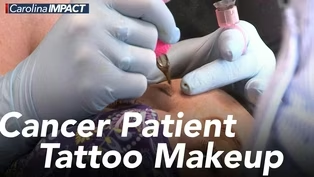
Shawna Moore: Cancer Patient Tattoo Makeup
Video has Closed Captions
Clip: S8 Ep23 | 5m 3s | Tattoo Artist and business owner Shawna Moore uses her skills to improve lives (5m 3s)
Providing Support for PBS.org
Learn Moreabout PBS online sponsorship
- News and Public Affairs

Top journalists deliver compelling original analysis of the hour's headlines.

- News and Public Affairs

FRONTLINE is investigative journalism that questions, explains and changes our world.












Support for PBS provided by:
Carolina Impact is a local public television program presented by PBS Charlotte