
Carolina Impact: April 9th, 2024
Season 11 Episode 1120 | 28m 29sVideo has Closed Captions
Retirement: Generational Diversity, Four Stages, New Life After, & New Technology Skills
Generational Diversity in the Workplace; Learn what experts call the phases of retirement and methods to navigate the roadmap; Retirement marks a fresh start with more time, see how locals are pursuing their passions; & Seniors are becoming more tech savvy as smart technology redefines the aging experience.
Problems playing video? | Closed Captioning Feedback
Problems playing video? | Closed Captioning Feedback
Carolina Impact is a local public television program presented by PBS Charlotte
Carolina Impact: April 9th, 2024
Season 11 Episode 1120 | 28m 29sVideo has Closed Captions
Generational Diversity in the Workplace; Learn what experts call the phases of retirement and methods to navigate the roadmap; Retirement marks a fresh start with more time, see how locals are pursuing their passions; & Seniors are becoming more tech savvy as smart technology redefines the aging experience.
Problems playing video? | Closed Captioning Feedback
How to Watch Carolina Impact
Carolina Impact is available to stream on pbs.org and the free PBS App, available on iPhone, Apple TV, Android TV, Android smartphones, Amazon Fire TV, Amazon Fire Tablet, Roku, Samsung Smart TV, and Vizio.

Introducing PBS Charlotte Passport
Now you can stream more of your favorite PBS shows including Masterpiece, NOVA, Nature, Great British Baking Show and many more — online and in the PBS Video app.Providing Support for PBS.org
Learn Moreabout PBS online sponsorship(bright music) - [Announcer] This is a production of PBS Charlotte.
- [Narrator] This week on a special "Carolina Impact: "The New Age of Aging."
They say age is just a number.
Maybe that's why age 70 today looks and feels a lot different than it used to.
- I remember the first time I felt I was getting older.
- [Narrator] If you're a baby boomer, hitting your golden years, today's new age of technology means getting older and getting better.
- I think it's just like breaking down that stigma where we think older adults can't do it.
They can do it and they're actually doing it better than I am in some cases.
- [Narrator] Whether it's keeping up with your younger coworkers on the job- - There's currently four different generations right now in the workspace.
- [Narrator] Or keeping up with your kids and grandkids at home by keeping up with what's new.
- So you can continue to go to the website or you can download the app.
- You just take two fingers.
It takes a little practice sometimes.
- [Narrator] And if you're retiring, it can be inspiring.
- Okay, you gotta find something that you love to do.
- [Narrator] See how baby boomers here in the Carolinas are still growing as they grow older.
"Carolina Impact's: The New Age of Aging" starts now.
- Good evening.
Thanks so much for joining us for this special "Carolina Impact."
I'm Amy Burkett.
Advancements in healthcare improved living standards and evolving societal attitudes have led to a significant increase in life expectancy.
Individuals are finding themselves with more years to enjoy after retirement than ever before.
What truly distinguishes this era of aging is not just the quantity of years, but the quality of life experienced.
Rather than settling into a sedentary existence, many retirees are embracing vibrant, active lifestyles, filled with meaningful experiences, from embarking on new adventures, to pursuing lifelong passions.
This trend reflects a paradigm shift in how we perceive and approach aging.
Many folks are staying in the workforce longer than ever and others are sharing their expertise to mentor young entrepreneurs on business and ethics.
There are four different generations currently in our US workforce and that takes some adjusting.
"Carolina Impact's" Jason Terzis has our story.
(TV statics) ♪ Thank you for being a friend ♪ - [Jason] Just the opening notes.
♪ Travel down the road and back again ♪ - [Jason] And you know what it is.
♪ Your heart is true ♪ ♪ Your a pal and a confidant ♪ - [Jason] The 1980s classic "The Golden Girls," the critically acclaimed primetime Emmy Award winner for Outstanding Comedy series.
Looking back, what's kind of interesting is the four ladies starring in the show weren't really that old.
Three of the actresses were in their early '60s and Rue McClanahan who played Blanche was just 52.
That's a stark contrast from the actresses of today, like 54-year-old Jennifer Lopez, 55-year-old Jennifer Aniston, 59-year-old Sandra Bullock and Michelle Pfeiffer, who at 65 is older than all the Golden Girls were when the show premiered.
Put a modern day hairstyle on Alice from "The Brady Bunch" and you see the difference.
Call it the new age of aging.
And whether it's in Hollywood or in real life, things are constantly evolving.
- It's an exciting time.
As you had mentioned, there's a lot of change going on.
There's currently four different generations right now in the workspace.
- [Jason] The baby boomer generation was known for its roll up the sleeves work ethic, with many staying in the same job and career for years, if not decades.
- As boomers are obviously retiring and going into a different stage in their life, there's Zoomers kind of coming up.
- [Jason] As that transition unfolds, so too does the face of business ethics.
While some baby boomers might look at Gen Z as entitled, perhaps Gen Z isn't who some boomers think they are.
- And it's a large shift from what they had obviously kind of grown up with and then what they're seeing now.
So sometimes a change can be kind of worrisome and anxiety-inducing.
- I think our current students are a bit cynical with respect to their attitudes toward business, large businesses in particular.
- [Jason] Denis Arnold teaches ethics at the Belk College of Business at UNC Charlotte, primarily working with grad school students.
- And my research focus is corporate misconduct and corporate social responsibility.
We use cases of corporate misconduct as examples of what not to do.
- Just a lot of ethical dilemmas that tend to come up in, you know, business situations are just real life examples.
Like, we've had multiple case studies.
We talked about the events that happened at Wells Fargo.
- [Jason] The Wells Fargo Cross-selling scandal, which broke in 2016, was caused by the creation of millions of fraudulent savings and checking accounts created on behalf of clients without their knowledge or consent.
- And they targeted the elderly, they targeted people with English as a second language.
- Yeah, you think, how did it get this far?
How did no one stop it?
How did they like, make this the basis of their operation?
- And then people who blew the whistle were fired.
- [Jason] Then there's the modern day case of Sam Bankman-Fried, the founder of the FTX Cryptocurrency Exchange, who's now facing up to 50 years in prison.
- And he was just running a big Ponzi scheme using crypto.
So the mode of scam was totally not new, just what he used to perpetrate it was sort of new for our generation, you know, crypto.
- [Jason] It's cases like these that Arnold breaks down with his ethics classes, making students more aware of the business world they'll soon be entering.
- I think the misconduct that we've seen over the last 10 years, really since the financial crisis of 2016, 2017, has provided us with a multitude of case studies and illustrations of how not to govern a corporation.
- I don't wanna work at a place that's gonna be breathing down someone else's neck or breathing down my neck.
You know, I don't want to work at some place where I'm hurting the world or I'm hurting someone else necessarily.
I always wanna do good.
- I'm going on the healthcare side of business.
So that's definitely like a big thing that I'm looking forward to in like, evaluating the companies that I apply to.
- [Jason] The group SCORE, which stands for Service Core of Retired Executives, is a nonprofit founded in 1964 that provides free business mentoring services to perspective and established small business owners.
Even though most of the people volunteering these days are far from retired.
- We take any and all people who want to be mentored in any aspect of their business and we donate our time to do that for them.
- [Jason] What SCORE volunteers are noticing is the changing dynamic of what recent college grads are looking for as they enter the business world, namely ethical companies and more focus on work-life balance.
- Well, we have more evidence in the social sciences that shows what employees look for in an organization.
- They're really looking for different initiatives that the companies have to offer for wellness, for mental health, for diversity and inclusion, for training opportunities.
I personally think it's really exciting.
I know that sometimes they're getting a bad rap for wanting more and asking for more, but at the same time it's kind of holding companies and kind of holding corporations to a higher standard.
- [Jason] So could one argue that one generation is more ethical than another?
Probably.
- I really think the upcoming workforce of Gen Z, they are in some ways more ethical than people of my generation, millennials.
- So I don't think it's fair to kind of label one more ethical than the other.
- [Jason] As the next generation becomes more powerful, they'll likely see things differently in the business landscape, but whatever the generation, each could probably learn a thing or two from the others.
- I think our generation asks a lot of why.
A lot of people have the mindset of this always been like this, how it's gonna continue, but I think we're pretty good at breaking barriers and saying like, okay, it's going like this, but it hasn't always been positive.
How can we do something differently?
How can we make it better?
- They're kind of questioning each other.
So Gen Z is questioning the kind of boomers or older kind of generations.
They're not quite kind of experts just because they've been in the field for so long or longer than a Gen Z kind of newer graduate has been.
And at the same time, the boomers are also questioning the Gen Zers and saying, "Well, why do you do things like this?"
So if you can have a collaborative conversation, you can come to hopefully some type of understanding or middle ground or kind of understanding that they're actually looking for some of these similar things too.
- [Jason] Each generation has its own set of ethics and values, doesn't make anyone right or wrong, just different.
For "Carolina Impact," I'm Jason Terzis reporting.
- Thank you so much, Jason.
Some of the business professionals we spoke with said Gen Z has more pressure on it to learn to make impacts on the business world while getting bombarded with all the mentally challenging aspects of social media and the scrutiny that comes with it.
Well, older adults are increasingly recognizing the role that technology plays in improving quality of life, particularly among those over 70.
Studies show an overall rise in tech usage among older adults from AI powered virtual assistants, and smart devices to health and wellness trackers.
"Carolina Impact's" Rochelle Metzger and videographer John Branscum show us tools helping seniors harness the power of innovation.
(gentle music) (phones chiming) - [Rochelle] Technology is a part of our everyday lives with smart devices and virtual assistants taking center stage.
- And it's just almost mind-boggling what can be done with technology.
- [Rochelle] Absent gadgets aren't just tools for the younger generations, they're enhancing the journey of active aging.
- On our refrigerator we can communicate with Alexa when we're at the store to see we needed some more milk or eggs.
- [Rochelle] For seniors, like 85-year-old Bill Fox, technology keeps him informed and connected to family.
- There you are.
Hello, Gwen, how things at the beach?
- Fox and wife Gwen live at The Sharon at SouthPark, a senior living community in Charlotte.
While most of the residents know how to use a computer and email, the Sharon offers classes to keep residents current on the latest technologies.
- So you can continue to go to the website or you can download the app.
- [Rochelle] According to a new AARP report on 2024 tech trends, 61% of adults, 70 plus say they have the digital skills necessary to fully take advantage of being online.
In addition to an overall rise in tech usage, older adults confidence in the industry to meet their needs improved slightly in the past year.
- I think it's just like breaking down that stigma where we think older adults can't do it, they can do it.
Anybody here who's not using Cubigo?
- [Rochelle] Jessica Bourque is Director of Vitality and Wellbeing at the Sharon.
She leads monthly tech support classes.
- I think the pandemic really helped with that.
We had the time and the need to learn new things.
Typically, we weren't sort of thought as as early adopters to any technology, but now it's really changed for the people who live here.
They're excited to learn new things.
I think the hardest part is just sort of keeping up with the pace of the changes.
- I feel like I've come a long way and yet in comparison to what my grandchildren and children can do, I feel like I'm still a novice.
- I get a lot of suggestions about- - [Rochelle] In this class, residents including 79-year-old Mary Hammond are reviewing how to navigate Cubigo, a digital platform that acts as an all-in-one community hub for the Sharon.
- You can do maintenance request, which I've done.
You can do housekeeping requests, you can look up your balance of your food bill.
- We get a lot of the same questions.
How do I get into Cubigo?
What if I lose my password?
- Younger Americans don't have a corner on the tech market.
Check this out.
According to a new AARP study, older Americans, 50 plus like Mary, are about as likely as younger adults, 18 to 35 to own smart devices like an iPad, smartphone, or laptop.
Residents at the Sharon range in age from 65 to 100, and their technological prowess runs the gamut.
- I just learned today how to screenshot an email.
Here's this new system.
- [Rochelle] Lynda Opdyke is a member of the Sharon's Library committee, which is in the middle of moving from a handwritten to a digitized library system.
- Learning this new system and how to set it up has caused me to stretch my skills a little bit.
- [Rochelle] According to the 2024 AARP survey, 85% of Americans 50 plus have heard of generative AI, yet 60% of respondents say they're undecided about its impact.
Jody Eason-Williams is the Sharon's IT Director.
He says, advancements in artificial intelligence will redefine the aging experience.
- With the technology in the future.
We are looking towards more AI capabilities and bringing that into the facility and hopefully that will help the independent residents, you know, even gain more independence as time goes on.
- [Rochelle] Technology keeps 89-year-old Freda Nicholson connected to her six children, 14 grandchildren, and four great-grandchildren.
- We do Zoom family meetings and that of course is really fun with the big family.
- [Rochelle] Age-related impairments like vision or hearing loss can make using technology difficult.
Nicholson began losing her sight to macular degeneration eight years ago.
She knew that keeping her independence meant learning how to use assistive tools.
- I had to use computers and things like that with my work, but now I'm totally dependent on my technology.
- [Rochelle] Now, legally blind, Nicholson relies on an electric magnifier, voice-to-text and screen reader apps.
- [Freda] To read my emails, I just go- - [Automated Voice] Your amazon.com order has shipped.
- [Rochelle] Nicholson has even become a resource for other seniors.
- I've done two seminars for residents here.
And then I one-on-one, if somebody calls me and said, "Can you show me how to have my phone read to me," and they'll come to my cottage and I'll do that.
- [Rochelle] She even taught me a thing or two.
- You just take two fingers.
- [Automated Voice] From amazon.com, address.
- It takes a little practice sometimes.
- [Rochelle] Technology will continue to enhance the aging experience for those willing to embrace change.
Nicholson proves that with a little practice, it's never too late to learn something new.
For "Carolina Impact," I'm Rochelle Metzger.
- Okay, I think some of those seniors could teach me a thing or two about tech.
Thanks so much, Rochelle.
The AARP report also shows that ensuring older adults are able to fully participate in this digital age requires affordable solutions, digital readiness and more technical support.
The number of Americans retiring daily has nearly doubled since the year 2000.
The latest research shows about 10,000 people turn 65 each day, which is the average age of retirement.
How do you prepare for that transition from work time to simply me time.
Many are only worried about their financial health, yet the experts say not being prepared mentally and emotionally for that change could leave you open for a bumpy ride.
As "Carolina Impacts" Bea Thompson and videographer Russ Hunsinger show us, there are phases to retirement and methods to navigate it.
- [Retiree] 002.
- [Bea] All across the country, Americans are retiring.
The largest group known as baby boomers are in the midst of their retirement years.
In the United States, around 11,000 Americans are expected to celebrate their 65th birthday each day in 2024.
- All right, that's great.
- [Bea] This trend is expected to continue for the next decade and it comes with a measure of uncertainty and fear for some.
- I see more people that are anxious about it.
It's like, what's it going to be like?
So it's more, not really dreading it, but it's more concern about what this is going to be like.
- Hey, Steve, come on back.
- [Bea] She counsels her clients on navigating the retirement roadmap and it's potential roadblocks, and she says there are many.
- How do you squeeze all the juice outta retirement?
- Dr. Riley Moynes, an author and retired educator recently published "The Four Phases of Retirement: "What to Expect When You're Retiring."
The first phase called "The Vacation" represents the ideal retirement.
So we asked some retirees at Friendship Missionary Baptist Church, how they approached retirement.
- I was excited because I knew it was time.
I knew I wanted to do some traveling, so I was able to do that, but then I began to focus on me.
(water trickling) (gentle music) - [Bea] And that focus for many retirees can become the expansion of a hobby like gardening.
That's what retired assistant health department director Dr. Lena White did.
She's a lover of gardens and growing.
Now she's teaching others at the church.
- You know, when you retire and you have the time, you can do stuff like I did, which was get into Master Gardener's program with the county.
I think you gotta find something that you love to do.
You know, you can take your hobby that you had while you were working maybe, and then just expand it.
- [Bea] The experts say that, so-called vacation phase, representing the view of an ideal retirement generally last about a year.
But then comes phase two when the retiree begins to feel a sense of loss.
That phase is described as loss of a routine, loss of a sense of identity, the loss of work relationships, a loss of a sense of purpose, and for some, a loss of a sense of power.
For many retirees, anxiety and depression become a one-two punch in their lives.
- A lot of times people won't admit that they're depressed and sometimes they don't even know that that's what it is.
- There are stages and some of those are unpredictable, but there's definitely some loss and grief there.
Loss of job, role loss.
Maybe somebody was in a helping profession and they enjoyed helping and now all of a sudden they're going to really miss helping others.
- I think I was one of the lucky ones.
Yeah, but I've had some friends and have heard of some family members of friends who didn't have a plan and they don't do anything and they are miserable, miserable people and it's very sad 'cause there's so much that you could do.
- [Bea] For many, the loss phase ends when they accept phase three.
That's a time of trial and error.
- Let me see what you broke.
- [Bea] We asked ourselves, "How can I make my life more meaningful again "and contribute."
- Now we're gonna be making more of these lap blankets for folks in wheelchairs and folks who sit a lot.
- [Bea] And the need to keep trying and experimenting with different activities.
- Then some active things.
I've taken up pickleball, which is crazy.
I never thought I would be doing that, but I play pickleball three or four times a week.
- I think you have to be able to do something.
It can be something just as simple as taking a neighbor somewhere, you know, or just, you know, like we do.
We do knitting and crocheting.
- [Bea] And the fourth phase may be the best.
It is described as the time to reinvent and rewire.
The experts say during this phase, individuals answer these questions.
What's the purpose?
What's my mission?
It's also the time that individuals find the activities that fit their lives and doing service for others.
- I would say to make a plan and what do you really want to do with your life?
And also ask your body, what does your body want to do?
Does it want to join an exercise group?
Does it want to garden?
- Going home, sitting in front of the TV is not good.
You know, I think, and you have to find what your niche is.
You have to know yourself.
- There's a balancing act that you have to do.
You have to have some time to yourself where you aren't doing anything, where you just meditate or you rest or you take a nap.
- The first month after retirement, I didn't do anything.
I really didn't.
I didn't realize how tired I was.
I slept a lot.
But then after that I said, "Okay, I'm ready now."
- [Bea] And the retirees all agree when it comes to those retirement years, the best answer is simple.
Do you and do it well.
For "Carolina Impact," I'm Bea Thompson.
- That's incredible advice.
Thanks so much, Bea.
Experts also say to make your retirement plans well before your planned exit.
And they recommend giving yourself at least a year in advance to start making those decisions, which include checking on your financial health.
Freed from the constraints of work schedules, many seniors discover hidden talents or reignite interests that sat dormant for decades.
This newfound freedom provides the space for seniors to rediscover themselves and engage in activities that ignite their passion.
"Carolina Impact's" Dara Khaalid and Marcellus Jones show us how two local men haven't let heartbreak stop them from pursuing their dreams.
- [Dara] Into the water he goes with the splash, then he's off, one arm at a time.
69-year-old Carlos Glender glides to the pool at Charlotte Latin.
- [Carlos] I feel almost natural in the water.
- [Dara] Natural and quick.
He uses every part of his body to rip through the water.
- [Carlos] It's a wonderful feeling.
- [Dara] Coming up for air as needed, Glender stays in his lane keeping the pace.
- [Carlos] And it's really a breathing thing where you control your breathing.
You don't start out too fast.
- [Dara] The senior tells me swimming has been a passion of his since he was young.
However, with a busy career in the Navy, he didn't have much time to swim.
- I served in naval aviation.
I started out as an avionics technician for the Navy and then eventually became an officer.
And I served 20 years and I retired as a Lieutenant Commander.
- [Dara] Glenda's career in aviation didn't stop there.
His next job took him to Ohio, where he worked for an air cargo company.
- Became the AOG manager, which is aircraft on the ground.
So we had a team of people that worked 24/7.
And we supported the fleet of aircraft.
Whenever anything breaks, our team would be like the emergency response people to solve the problem.
- [Dara] After 12 years, he landed a new job at Wright Patterson Air Force Base.
He planned to work there for a while.
However, in 2017, he got news he never saw coming.
- [Carlos] I was diagnosed initially with bladder cancer.
When you hear the word cancer, you think of the worst.
- [Dara] Glender says this forced him to retire sooner than expected, but it gave him a new perspective on what really mattered in life.
- [Carlos] That cancer diagnosis kind of led my wife and I to realize to spend more time with family.
And my daughter and grandkids lived in Charlotte, so we moved down from Cincinnati area.
- [Dara] Seven years later, he spends lots of time with family and he's cancer free.
- Okay, here we go.
Back.
(gentle music) - [Dara] Plus, he has plenty of time enjoying his passion here, and staying active in his community.
- I'm involved with a group called Senior Scholars.
I volunteer to be the curriculum manager.
So I find speakers that speak on scientific topics and that's really my passion.
- And just a little over eight miles away at the Barclay at SouthPark, there's someone else pursuing a passion post-retirement.
- [Maxey] I think it's just kind of neat that the colors come to life after you've drawn it.
- [Dara] With each stroke of a brush, his drawing begins to transform.
- [Maxey] Most people, I think see their dogs by their eyes.
- [Dara] 79-year-old Maxey Sanderson concentrates on every detail using black paint to bring the dog's eyes to life and brown to complete the ears.
- [Maxey] I just think it's amazing.
- [Dara] For this senior, creating art was something he always admired.
- I had some artists working for me.
I could technically tell you how you make sure the colors can be seen on a computer screen for somebody that's colorblind.
- [Dara] Before retiring, Sanderson spent 25 years as president of a software company.
Although he frequently worked with artists throughout his career, he never thought he'd become one himself.
That all changed when he got to his retirement community.
- When I came here, they had lots of activities.
The first class was November of the year ago.
- [Dara] It wasn't Sanderson's plan to be at the Barclay at SouthPark, but after his wife Gay was diagnosed with leukemia in 2020, that's where they ended up.
- Really was doing it for her to come rehab here, so Layla and I could be here with her.
- [Dara] In 2022, Sanderson's wife of 52 years passed away.
- One of the hardest things after losing a spouse is, and Layla helps with this somewhat, but it's the coming and going.
Is you don't hear, goodbye.
You know, you don't hear, hello.
And the silence are the loudest noises you hear.
- [Dara] With each slow downward stroke on his canvas, it resembles the tears he's cried as he mourned his wife, but also the tears of joy as he flows into his newfound passion.
- I didn't realize how painting reflects your feelings.
- [Dara] Fortunately, Sanderson doesn't have to paint or live alone.
- [Maxey] She loves to chase the ball.
- [Dara] Layla, his 8-year-old Shihtzu, who isn't shy at all, keeps him company.
- This would be a mighty lonely place at night.
She was a real good dog to my wife and comforted her, and I can tell she misses her sometimes too, and I can tell that she's reflecting on it in her way.
- [Dara] As Sanderson continues to paint and Glender swims, it's healing and teaching them both how to truly enjoy life.
For "Carolina Impact," I'm Dara Khaalid.
- Thank you so much, Dara.
Glender tells us this spring he's participating in the Mecklenburg County Senior Games where he hopes to win some medals.
And Sanderson has several commissioned paintings he's doing for friends for free.
As seniors continue to embrace active lifestyles and engage with technology, they're discovering newfound opportunities for personal growth, social connection, and fulfillment.
This shift not only enhances their overall wellbeing, but also challenges ageist stereotypes, and promotes a more inclusive society.
Thank you so much for joining us for this special "Carolina Impact: The New Age of Aging."
Goodnight, my friends.
(upbeat music) - [Announcer] This is a production of PBS Charlotte.
Video has Closed Captions
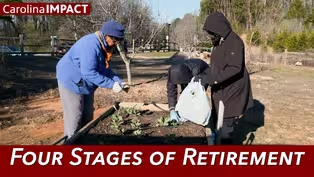
Clip: S11 Ep1120 | 5m 55s | Learn what experts call the phases of retirement and methods to navigate the roadmap. (5m 55s)
Generational Diversity in the Workplace
Video has Closed Captions
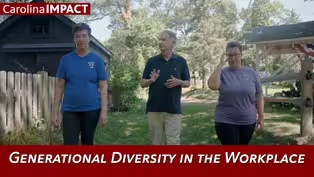
Clip: S11 Ep1120 | 6m 30s | Which generation is better when it comes to business ethics? Baby Boomers or Gen Z? (6m 30s)
Video has Closed Captions
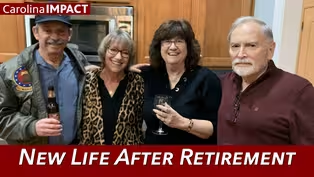
Clip: S11 Ep1120 | 5m 22s | Retirement marks a fresh start with more time, see how locals are pursuing their passions. (5m 22s)
Video has Closed Captions
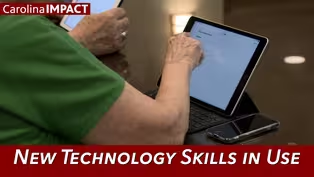
Clip: S11 Ep1120 | 5m 31s | Seniors are becoming more tech savvy as smart technology redefines their experience. (5m 31s)
Carolina Impact: April 9th Preview
Preview: S11 Ep1120 | 30s | Retirement: Generational Diversity, Four Stages, New Life After, & New Technology Skills. (30s)
Providing Support for PBS.org
Learn Moreabout PBS online sponsorship
- News and Public Affairs

Top journalists deliver compelling original analysis of the hour's headlines.

- News and Public Affairs

FRONTLINE is investigative journalism that questions, explains and changes our world.












Support for PBS provided by:
Carolina Impact is a local public television program presented by PBS Charlotte