Carolina Impact: Education Equity
Season 9 Episode 27 | 30m 6sVideo has Closed Captions
Looking for answers after the pandemic. More promises? Or real progress?
Looking for answers after the pandemic. More promises? Or real progress?
Problems playing video? | Closed Captioning Feedback
Problems playing video? | Closed Captioning Feedback
Carolina Impact is a local public television program presented by PBS Charlotte
Carolina Impact: Education Equity
Season 9 Episode 27 | 30m 6sVideo has Closed Captions
Looking for answers after the pandemic. More promises? Or real progress?
Problems playing video? | Closed Captioning Feedback
How to Watch Carolina Impact
Carolina Impact is available to stream on pbs.org and the free PBS App, available on iPhone, Apple TV, Android TV, Android smartphones, Amazon Fire TV, Amazon Fire Tablet, Roku, Samsung Smart TV, and Vizio.
Introducing PBS Charlotte Passport
Now you can stream more of your favorite PBS shows including Masterpiece, NOVA, Nature, Great British Baking Show and many more — online and in the PBS Video app.Providing Support for PBS.org
Learn Moreabout PBS online sponsorship- [Narrator] Wells Fargo is proud to support diversity, equity and inclusion in our employees, our customers and the communities we serve, as well as through content on Carolina Impact.
- [Announcer] This is a production of PBS Charlotte.
- [Amy] Tonight on a special Carolina Impact, we explore education equity.
When you're waiting years for Charlotte's public schools to improve, how long is too long?
- They want something better, they want something different.
- [Teacher] Does that word go with that word?
- [Amy] When you see reading scores dropping lower than ever, how low is too low?
- These are just numbers that we have never seen before in Mecklenburg County.
It should be frightening for everyone in our community.
- [Amy] Tonight, Carolina Impact looks inside CMS for answers.
After the pandemic, more promises or real progress?
- When you look at words on a piece of paper or in a text, that you're able to read those words and understand what they mean.
- [Jeff] Are we not doing that now?
- [Teacher] We are doing that.
- [Amy] And what about alternatives outside CMS?
How are other cities dealing with schools that don't make the grade?
- It's mind-numbingly tragic.
And vouchers have provided an out for some of those children.
- Sometimes you just gotta change up things, change is good.
- [Amy] Whether you're a parent, a teacher, a taxpayer, or just a concerned citizen, these our schools, our kids, we're talking about.
Can't we do better for them?
- Mama!
I found my name.
- [Amy] Our Carolina Impact special, Education Equity, starts now.
Good evening, thank you so much for joining us.
I'm Amy Burkett.
In Charlotte, we love our teachers, just like many other places.
We support our schools and our classrooms.
But what about our school system?
When our kids bring home report cards that show them falling farther and farther behind, what grade do we give our Charlotte Mecklenburg public schools for failing to teach them better?
We first reported on poor reading scores at CMS six years ago.
And since then, well, third grade reading has only gotten worse.
Carolina Impact's Jeff Sonier joins us from a CMS elementary school with more.
- Yeah, 2016 was when we first used Charlotte's Web to illustrate Charlotte's problem.
Charlotte's Web is a third grade book.
Most eight, nine year olds ought to be able to read it easily.
Charlotte's problem is that most CMS third graders couldn't read Charlotte's Web then and they still can't read Charlotte's Web now.
- [Girl] "Wilbur was now the center of attraction..." - [Boy] "On the farm.
Good food and regular hours..." - [Girl] "Were showing results.
Wilbur was a pig any man would be proud of."
(soft rock music) - [Jeff] Listen closely, parents.
This is what third grade reading is supposed to sound like.
- "Ever since the spider had befriended him, he had done his best to live up to his reputation."
- [Jeff] Six years ago, we brought you into this third grade classroom to see why so many third graders don't read like this.
In 2015, it was only 47% making the grade, with minority students around 30%.
Years behind in reading, but with promises back then that CMS could fix this with the help of advocacy groups like Read Charlotte.
- There really are no excuses.
I mean, if we want to look at who's at fault, we just need to look in the mirror.
- "Charlotte's web said 'some pig,' Wilbur had tried to look like some pig."
- "When Charlotte's web said 'terrific,' Wilbur had to try to look terrific."
- [Jeff] But halfway through 2022, third grade reading isn't terrific.
Only 13.4% at CMS are reading at grade level.
Black and Hispanic students are below seven percent, which means your third grader probably sounds more like these first graders.
- "It is not easy to look..." - [Jeff] Same book, but listen to the difference.
These kids are struggling.
- "Wilbur was now the center of attraction on the farm."
- [Jeff] When third graders read like first graders, everything else just gets harder.
And when reading test scores bottom out like this, well, how low can you go?
- "Charlotte had written the world... (indistinct) - "And Wilbur really looked..." - "When Charlotte..." - [Munro] Yeah so, you know, third grade is really a fork in the road of a young child's life and it's the pivot point between learning to read and reading to learn.
I don't want to find out how low we can go.
- [Jeff] Read Charlotte executive director, Munro Richardson, adds these latest lowest-ever reading scores aren't just from the pandemic when CMS schools were closed.
These are the projected reading scores from CMS third graders after returning to school for a full year of full-time in-person learning.
- These are just numbers that we have never seen before in Macklenburg County and should be frightening for everyone in our community.
It's time to take action.
We need to help our children.
- [Jeff] So, what can parents expect to see going forward that's either different or better than what we've done so far?
- Well, I think one of the biggest changes that the school district has made, when I got here six years ago, if you went into 10 different schools, you'd see 10 different ways of teaching reading.
That is gone.
- And you think this will ultimately help the third graders?
'Cause that's what we're really talking about, right?
- Yeah so, it really is about helping children from kindergarten through third grade, where some children come to school and they don't know how to write their name.
- Go!
- [Munro] It's as if children are expected to run a race and some are, you know, 100 yards or more behind others.
And so, part of our job is to even that starting line, getting every child, you know, at least to the same place, where they're able to be successful.
- It's not a school system problem, it's a community problem.
- [Jeff] Dr. Devonya Govan-Hunt says her organization, the Black Child Development Institute, is using advanced reading software in its after school program that CMS isn't.
- I like that one.
- But does that word go with that word?
- No.
- [Jeff] And asking parents questions about reading that CMS doesn't.
- That one?
Okay, and what other one?
- And parents have not always had this type of conversation, like, this is exactly what your child needs, this is exactly how you can do it in order to push them forward.
- This one?
- Mm-hmm.
- And this one?
- Uh-huh.
- [Jeff] BCDI even brings their reading checkup software to these weekend workshops for kids and parents in supermarket parking lots.
- You'll see children actually sitting down at computers in the parking lot, taking those two short quizzes.
- [Robot] Two of these words go together and one does not belong.
- [Devonya] And when you use that tool to be able to assess all of our children to figure out exactly what they need individually.
- [Jeff] So you're customizing the classroom experience for each child.
- Yes.
100%.
- Mommy!
Mama, I found my name.
- [Devonya] And parents are coming to us saying, I know there's an issue, I wanna solve it, tell me what to do.
- You can pick two.
- [Devonya] They want something better, they want something different.
- I think part of it is how we as a district move forward together.
- [Jeff] Beth Thompson is assistant superintendent at CMS for teaching and learning.
- I think we will see, continue to see outcomes improve for students.
And when you look at words on a piece of paper or in a text, that you're able to read those words and understand what they mean.
- [Jeff] Are we not doing that now?
- We are doing that.
- "Instead of palm trees he saw smoke stacks..." - [Beth] Will all of that translate immediately to an end of grade test?
Perhaps not.
- [Jeff] But Thompson adds, even if their test scores aren't higher, that doesn't mean our kids aren't reading better.
- [Beth] Because preliminary data shows that growth is happening, in really significant ways for our children.
- "...received an invitation to play in the major leagues in America.
What an honor!"
- And if you're looking for another sign that reading has been a problem here in Charlotte for a long, long time, well, those third graders we heard in the story reading Charlotte's Web?
Well, they're all in high school now.
Amy.
- Thank you so much, Jeff.
You can check out Read Charlotte's full annual report on reading success at CMS on our website, pbscharlotte.org.
Reading scores varied greatly across the state throughout the COVID-19 pandemic.
While CMS saw a significant drop in standardized tests, other districts experienced a minimal drop.
The time away from the classroom seemed to only exasperate the reading issues within CMS.
As Carolina Impact's Jason Terzis reports, the decision on when to return to in-person learning seemed to make all the difference.
- "When I say begin, read the words the best you can.
Point to each letter and tell me the sound or read the whole word."
- [Jason] At N. B.
Mills Elementary School in Statesville, teacher Alyssa Westlake works with her third grade students on reading fundamentals, focusing on the main sounds within words.
Two years ago, this end of school lesson didn't take place.
- The last two years have been, like, nothing I've ever seen before.
- It's been a wild ride.
- [Jason] When the COVID-19 pandemic reached the United States in March of 2020, pretty much everything, including education, came to a screeching halt.
- And at first, it was like, haha, this is kind of fun and different.
- [Jason] In Union County, Amanda Sturner, a mother of four boys, turned her home office into a virtual classroom.
It was perfect, or so she thought.
- I set up, like, in my office... (Amanda laughs) I was so naive, I had a table, and I was, like, this is perfect.
Like, I'll do my work, they'll do their work, right?
Like, they had their own little desk, their workstation.
Oh, that did not work.
I mean, they didn't wanna do it.
- [Jason] For teachers and administrators, online learning proved to be just as challenging.
- We didn't go to school to learn how to teach virtually.
We went to school to see you face to face each day.
- A lot of kids didn't have internet and that was a struggle.
- I don't know how many webcams we bought, but it was a plethora.
- [Jason] As the 2020-21 academic year approached, school boards nationwide faced a tough decision.
When to go back and how to do it safely.
Iredell-Statesville Schools were among the first in the Charlotte region to go back to in-person learning.
- We knew that being in the seat was the best way for our kids to get an education and we gave options.
So if you did not feel safe with that, we did synchronous learning.
- These kids were happy to be back.
They wanted to come back, they wanted to see us.
- That's why I felt like our administration team, support staff, everybody from the top-down did a great job communicating what needed to be done.
- [Jason] By early October of 2020, district elementary schools were back full-time, five days a week.
Middle and high schools soon followed.
- My experience with the virtual learning is it is nowhere close to being in the classroom, sitting down with the teacher or with the supports that we have here.
I don't think you can compare it.
- These other districts that had been going back two and three days a week and then quickly five days a week, they were able to do it with no huge outbreaks, no huge problems.
- [Jason] Iredell-Statesville's decision to return to school paid off on standardized tests.
According to the Department of Public Instruction, third grade reading scores overall in North Carolina in 2021 dropped an average of over 10 points from where they were in 2019, the last full school year before the pandemic.
The school district with the least amount of loss regionally?
Iredell-Statesville at just five percent.
- It makes you feel good 'cause we worked so hard.
You know?
I mean, we worked harder than we've ever worked for the last two and a half years.
And it's a reward.
You know, it feels good for somebody to say, "You guys did really well."
- I think if we've learned nothing else, face to face instruction cannot be replaced.
- [Jason] Charlotte-Mecklenburg Schools suffered the worst loss in reading performance at nearly 20%.
That district was among the last to go back to in-person learning with many students opting to stay remote the entire school year.
- CMS was slow to look at the data and look at what other people had done and then adjust.
And there wasn't really a willingness to kind of look at our neighbors and say, oh, this works.
- I think our district leadership made the best decisions that they possibly could at the time, given the circumstances.
- [Jason] Math scores suffered even more, with the state average down 20 percentage points.
CMS lost nearly 30%, with Iredell-Statesville losing just five.
- There was a clear difference in terms of how much time you spend in the classroom and how you did on those end of year tests.
- I'm just really happy that we were able to continue pushing our students forward and that we got that economic growth for one of the most challenging times that I've ever experienced, we were still able to come out growing our students.
- [Jason] CMS says, keep in mind, those numbers are from 2021, not this school year, where end of grade testing is just now wrapping up.
CMS is also a much larger district than its surrounding neighbors.
- CMS's view of the story was it's not fair to compare us to Iredell County or Union County.
And historically, CMS compares itself to Wake County public schools, to Durham, to these other large urban districts.
- And there's data that supports that the efforts we've done specifically around reading foundational skills are proving fruitful.
Will all of that translate immediately to an end of grade test?
Perhaps not, although I think we will see increases there as well.
- [Jason] It's been a whirlwind two years for everyone involved in education.
Students, teachers, administrators, and parents.
Everyone, though, is just glad the worst of all this is finally behind us.
Or so we hope.
For Carolina Impact, I'm Jason Terzis reporting.
- Thank you, Jason.
The dissatisfaction from some parents with our public schools begs the question, what else can be done?
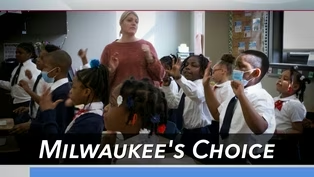
In Milwaukee, Wisconsin, they've got the oldest and most successful school choice program in the country, using public tax dollars for school vouchers so low-income families can send their kids to private schools instead.
Carolina Impact's Jeff Sonier and video journalist Doug Stacker traveled to Milwaukee to see first-hand how it works.
- Yeah, here in Milwaukee, the public schools face a lot of the same problems that Charlotte Mecklenburg schools face, especially the low-income and minority schools.
(kids chanting) Where the kids fall farther and farther behind state standards in reading, and math, and just about every other subject.
But the difference here in Milwaukee is that decades ago, well, Milwaukee decided to do something about it.
(soft piano music) Since the '60s, Milwaukee's historic Harambee School has been a haven in this minority neighborhood.
(kids chanting) A place they could count on, educating generations of kids in Milwaukee's inner city.
(kids chanting) But Harambee isn't a public school, it's a private choice school campus and every second grader you see in this classroom transferred out of Milwaukee public schools because of problems that sound a little too familiar to CMS families.
Just ask Milwaukee teachers.
- You see the same thing you see in every major city which is insane turnover, and then every time you turnover teachers, kids fall behind.
- [Jeff] And parents.
- And it just wasn't a great experience, he started out as K3 and he didn't flourish, he didn't really succeed the way that I wanted him to.
- [Jeff] And even the former Milwaukee school superintendent.
- Yeah, I mean, when I was superintendent, there were over 100,000 kids in the Milwaukee public school system.
Today, there's 60,000.
And the reason for that is because parents have other options.
- [Jeff] Dr. Howard Fuller says the shakeup in Milwaukee's public schools came when he and other leaders in the African American community pushed for the Milwaukee Parental Choice Program, using tax dollars for vouchers that let low-income families send their kids to better private schools instead.
- Let's say you're a family, we've created an education ecosystem in the city of Milwaukee that gives low-income and working class parents choices that they would not ordinarily have.
- But the view of vouchers here in Milwaukee's minority neighborhoods as a school choice program created by and supported by local black leaders to benefit the minority neighborhoods, well, it's a lot different than the view of vouchers back home in North Carolina.
The advocacy group Public Schools First North Carolina says our traditional public schools consistently get traditionally high marks from parents, that "voucher programs siphon money from local public schools," and that vouchers were originally created for white families who wanted to keep their children in segregated white schools.
(soft piano music) What you see in Milwaukee, instead, are the best choice schools in the city's poorest neighborhoods, with mostly minority families using Milwaukee's full tuition vouchers to escape low-performing public schools just a few blocks away.
- [Henry] For those families, it's an absolute lifeline.
Without vouchers, we would not be serving 1200 children on three campuses and be a five star school.
- [Jeff] Henry Tyson is the superintendent of St. Marcus Lutheran School, an inner city Milwaukee choice school where the students are 95% minority and 80% low-income, but their reading scores are eight times higher than similar low-income minority public schools.
- [Henry] So what that means is if your child is walking to a school with 400 kids in it, eight of them can read at grade level.
It's mind-numbingly tragic and vouchers have provided an out for some of those children.
- Next paragraph.
- [Colette] The kids weren't reading and the teachers told me, "Your girls, they're not reading."
- [Jeff] That must have been a shock.
- It was a shock.
It was a shock.
- [Jeff] Colette Lewis talks about her twin girls before they started in the voucher program at St. Marcus four years ago when she found out what they weren't learning in the public schools.
- [Colette] I played the blame game.
I played the blame game on myself, on the teachers, because how did we miss this?
How did we miss this, you know, with these kids?
It's there, it's plain in sight, we should be in tune with our kids.
- [Jeff] But after the blame is gone, then you gotta find a better way.
- [Colette] Then you gotta find a better way.
- Sometimes you just gotta change up things, change is good.
- [Jeff] Tiffany Street says for her special needs son, Dante, the change from a public school to a choice school changed everything.
- Honor roll to, you know, honor student and, I mean, he's doing great things.
- It's really evident that if you can keep teachers, you see better student retention, which leads to better success rates.
- [Jeff] Former public school teacher, David Menk, says here at St. Marcus teachers get coaching, and training, and time to work with struggling students one on one.
It's a difference that parents who send their kids to inner city public schools often never hear about.
- But the minute they walk in the doors of that school, they're three years behind because they just don't know that at that school, nobody reads on grade level.
- So a lot of times when parents are seeking another school, they're finding out that we have more resources than they even thought.
They want to be here and are so excited when they get that call or that letter.
It's just, there's tears, absolute tears.
- The voucher program has resulted in, you know, maybe two dozen really, really good schools.
(soft piano music) - They set the bar very high.
- [Jeff] Raevion Piggee is a graduating senior this year on his way to Marquette University next year, giving us the tour here at HFCA, another one of those really good inner city Milwaukee schools.
- There's no such thing as failure here.
- [Jeff] That started out as a choice school 10 years ago.
- I'm glad they pushed me this way 'cause, like, now I'm successful, now I have a high school diploma, now I'm going to college.
- [Jeff] And he's not the only one.
In fact, ever since this low-income, mostly minority high school opened, every single senior here for 10 years has been accepted to college.
- But you see UW Green Bay, UW Platteville, Whitewater, Parkside, those are UW schools.
- [Jeff] Howard Fuller, the former Milwaukee school superintendent we met earlier, shows us the college acceptance letters here at the high school they named in his honor.
Not Howard Fuller High, but Howard Fuller Collegiate Academy.
(soft piano music) - [Howard] It isn't about what kids are like when they walk in here, it's what are they like when they walk out of here.
Because what choice is about, it's a self-determination issue, it's giving low-income and working class black and brown families a way to determine what is best for their children.
The type of school that it is shouldn't matter.
We would not have what we have today if back in the 1980s, there was not those of us who were willing to fight for it.
(soft piano music) - Yeah, Dr. Fuller adds that what works here in Milwaukee, the school choice program, may not work everywhere, it may not work in Charlotte-Mecklenburg but he says because of the success they've had for decades here in Milwaukee, it's worth trying.
Amy.
- Thanks so much, Jeff.
In North Carolina, school choice vouchers are known as Opportunity Scholarships but are vouchers are limited to about $6,000 and only pay part of tuition.
Families have to make up the difference.
The Wisconsin programs pays up to $9,000 per child and private schools accept vouchers as full payment for tuition.
In Mecklenburg County, about 1,300 students used the private school vouchers last year.
In Milwaukee, that number was over 28,000 students.
You'll find more information on North Carolina's Opportunity Scholarship vouchers at pbscharlotte.org.
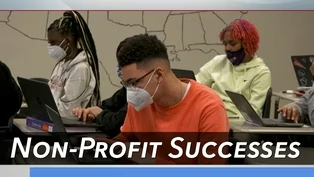
Well, about a third of CMS students speak a second language and the majority of them are Spanish speaking.
Data shows these students tend to score below grade level without the proper support.
Carolina Impact's Sarah Colon-Harris introduces us to two non-profits bridging the gaps.
- [Sarah] Charlotte's east side has long been a hub for the immigrant community.
The area's walkability factor, access to transit, eclectic restaurants, and bilingual businesses often attract newcomers and young professionals.
Hope permeates the air.
- Our families have professional goals and career aspirations.
(speaks Spanish) - [Sarah] But learning a new language while navigating a new country with different customs is daunting.
- It doesn't matter if a family comes here as immigrants, as refugees, parolees, asylum seekers, when we start a new life in a new country, we leave so many things behind.
- If you were to ask me what the primary hurdle for our families is is isolation.
(speaks Spanish) - [Sarah] Families feeling isolated by language barriers often struggle with preparing their children for school, unless they tap into available resources.
(sings in Spanish) - Yay, good job!
- [Sarah] To bridge the gaps, these two non-profits nestled in the heart of the east side provide programs ensuring multilingual children and their parents don't get left behind.
- What about silly?
- [Sarah] Tatiana works as an apprentice at Charlotte Bilingual Preschool.
The school prepares Spanish speaking children ages zero to five to enter school.
(speaks Spanish) Like the rest of this group, she's training to become a teacher while also taking college classes.
(speaks Spanish) A native of El Salvador, the preschool provided her son and daughter with the community and resources they needed.
- He started learning English here, so and we reinforced that in house too, and once he was going to kindergarten, he didn't even need to go and be separated to go to ASL classes.
- [Sarah] Data shows the pandemic had a disproportionate impact on Latin-X children.
In North Carolina, students learning English had a composite pass rate on tests of 14% versus 48% for other learners.
Yet at Charlotte Bilingual Preschool, students showed significant improvements in social-emotional development, cognitive development, math, and Spanish and English literacy.
The percentage of students meeting expectations skyrocketed from seven percent to 94% over the 2021 school year.
- They really prepare them to read, like, the love for reading and it's something that, to this day, every night, every day, he wants to read.
- [Sarah] Sonia Cisneros says that love for reading carried her son into kindergarten.
- I see how it made a big impact in his learning.
- [Sarah] Creating a pathway to big dreams.
- My big dream is to be a police officer.
- My big dream to be a doctor.
- The Charlotte Bilingual Preschool serves nearly 300 children at no cost or reduced cost and while the school helps prepare children before school, just around the corner there's another organization helping to prepare refugee and immigrant families after school.
Anti-violence messages capture the heart of the young people behind these windows.
- Our families come from all over the world.
Latin America, Southeast Asia, Africa, the Middle East.
- [Sarah] Our Bridge for Kids offers after school enrichment for children in grades K through eight.
Here, staff create a sense of belonging, a safe space to process a new life in a new country, away from trauma and violence.
(speaks Dari) It's a familiar story for Sadaf Alemi.
- [Sadaf] Everybody around left my country to go somewhere for safety and that's why we came here.
- [Sarah] The 24 year old recently fled Afghanistan with her two parents and two siblings after the Taliban invasion.
Her life as a college student changed overnight.
- The educational system, economy, security, safety, women's rights, everything is different.
So when someone say that I come from other country to US, I feel them, I understand them.
(soft guitar music) - [Sarah] Like Sadaf, the children here have experienced similar culture shock.
- A lot of our families, when they leave, you know, they arrive here and two days later, the kids are in school, and families have to understand the bus, and the times, and, you know, teachers and classes and it's very challenging without the proper support.
- [Sarah] Executive director Sil Ganzo says the organization focuses on three areas.
- English acquisition, of course.
Social emotion and wellbeing, our programs are trauma-informed, which means that we understand that everyone has a story.
- [Sarah] 10 year old Yousef joined the after school program two years ago after arriving from Afghanistan.
- Like, a big place you can learn at, and you can, like, do many things, they can help you with your homework, they helped me a lot.
- [Sarah] He enjoys the tutoring and time with friends.
In two years, his grades have gone up.
- When I first started, I'd get, like, Bs.
Now I get A plus.
- [Sarah] Proof that hope is always within reach, even when you're starting over.
For Carolina Impact, I'm Sarah Colon-Harris.
- Thank you, Sarah.
CMS also provides services to English learners through its Language Instruction Education Program.
As we've seen throughout tonight's Equity and Education Special, high quality education for all isn't easy.
There's a lot of work to be done to make every classroom in every school in every neighborhood a place where our kids get the education they need to thrive.
Maybe that solution is somewhere here at home, or maybe the best example to follow is somewhere else.
But as we heard in Milwaukee, change is good.
And nothing changes unless you're willing to fight for it.
We'll continue to track education performance and search for possible solutions.
We'd love your feedback on tonight's show.
Please send your comments to feedback@wtvi.org.
Well, that's all the time we have this evening.
Thanks so much for joining us.
We look forward to seeing you back here again next time.
Good night, my friends.
(exciting music) - [Announcer] A production of PBS Charlotte.
- [Narrator] Wells Fargo is proud to support diversity, equity and inclusion in our employees, our customers and the communities we serve, as well as through content on Carolina Impact.
Carolina Impact: Education Equity Preview
Preview: S9 Ep27 | 30s | Looking for answers after the pandemic. More promises? Or real progress? (30s)
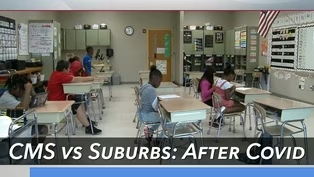
Video has Closed Captions
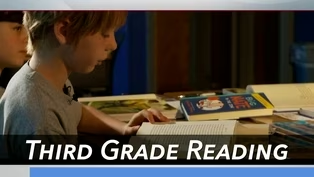
Clip: S9 Ep27 | 5m 6s | Post pandemic grades of students from CMS and suburban schools (5m 6s)
Video has Closed Captions
Clip: S9 Ep27 | 7m 49s | In Milwaukee, they’ve got the oldest and most successful school choice program in the US (7m 49s)
Video has Closed Captions
Clip: S9 Ep27 | 5m 40s | Most CMS students speak a second language and the majority of them are Spanish-speaking (5m 40s)
Video has Closed Captions
Clip: S9 Ep27 | 6m 30s | Reaction to 'lowest ever' test scores, and how to help young students read better. (6m 30s)
Providing Support for PBS.org
Learn Moreabout PBS online sponsorship
- News and Public Affairs

Top journalists deliver compelling original analysis of the hour's headlines.

- News and Public Affairs

FRONTLINE is investigative journalism that questions, explains and changes our world.












Support for PBS provided by:
Carolina Impact is a local public television program presented by PBS Charlotte