
Carolina Impact: February 15, 2022
Season 9 Episode 17 | 25m 57sVideo has Closed Captions
Harvey Gantt, Webb Custom Kitchen, Tryon Arts, President Polk
A profile of Harvey Gantt, Webb Custom Kitchen, The city of Tryon Arts and Crafts, President Polk's Pineville History
Problems playing video? | Closed Captioning Feedback
Problems playing video? | Closed Captioning Feedback
Carolina Impact is a local public television program presented by PBS Charlotte
Carolina Impact: February 15, 2022
Season 9 Episode 17 | 25m 57sVideo has Closed Captions
A profile of Harvey Gantt, Webb Custom Kitchen, The city of Tryon Arts and Crafts, President Polk's Pineville History
Problems playing video? | Closed Captioning Feedback
How to Watch Carolina Impact
Carolina Impact is available to stream on pbs.org and the free PBS App, available on iPhone, Apple TV, Android TV, Android smartphones, Amazon Fire TV, Amazon Fire Tablet, Roku, Samsung Smart TV, and Vizio.

Introducing PBS Charlotte Passport
Now you can stream more of your favorite PBS shows including Masterpiece, NOVA, Nature, Great British Baking Show and many more — online and in the PBS Video app.Providing Support for PBS.org
Learn Moreabout PBS online sponsorship- [Narrator] Wells Fargo is proud to support diversity, equity and inclusion in our employees, our customers and the communities we serve, as well as through content on Carolina Impact.
- [Narrator] This is a production of PBS Charlotte.
(soft music) - Just ahead on a special "Carolina Impact" highlighting our history.
- Harvey Gantt's story in Harvey Gantt's own words.
I'm Jeff Sonier in uptown Charlotte, the city's first black mayor talks about his life before becoming a civil rights legend.
- Plus this old theater turned restaurant gives us a movie and a little creative cuisine, and we'll take you on a one tank trip to Tryon for a peak into this tiny town's thriving art scene.
Tonight, we're introducing you to some of the people and places which make up our rich history.
"Carolina Impact" starts right now.
(upbeat music) - [Narrator] "Carolina Impact," covering the issues, people and places that impact you.
This is "Carolina Impact."
(upbeat music) - Good evening, thanks so much for joining us.
I Amy Burkett.
We talk a lot about race here in Charlotte, about equity and equality and seats at the table where decisions are made.
But 39 years ago, Harvey Gantt was first to pull up a chair at Charlotte City Hall.
A black mayor elected in a mostly white and definitely Southern city.
It was a defining moment then and a historic moment now.
One of many moments in Harvey Gantt's lifetime.
As we celebrate Black History Month here, "Carolina Impact's" Jeff Sonier joins us from uptown with more on Gantt, Charlotte's first African-American mayor then and now, Jeff.
- Yeah, Harvey Gantt is a civil rights icon here in Charlotte and across the Carolinas.
But this isn't a story about Gantt's political leadership or his professional success as an architect, or even this center for African-American arts and culture named in his honor.
This is Harvey Gantt's personal story in his own words.
- I grew up in Charleston, but I actually was born in a place called Adams Run.
Adams Run, South Carolina.
I got raised by a village of folks, watched us play marbles in the front yard and hopscotch for my sisters.
- [Narrator] Harvey Gantt reminisce here at Central Piedmont Community College about the early days, long before his family's civil rights fight to enroll him at Clemson.
- How did your father feel about it?
- He was always for me, 100%.
- Before winning election as Charlotte's first black mayor and becoming a role model for future mayors.
- Harvey could listen to 11 different opinions and at the end of it, he could make everybody feel like the decision was theirs and that is truly an art.
(upbeat music) - [Gantt] Good evening fellow Democrats.
- [Crowd] Harvey!
Harvey!
- [Narrator] For politics brought Gantt and Charlotte to the brighter lights of a national audience.
- Their work and their ideals inspire us every day.
- [Reporter] As we drive into Charleston across the magnificent double span of the Cooper River Bridge-- - [Narrator] What also inspires Gantt today are those early days growing up in Charleston, at first, near his dad's job at the Naval yards north of town.
- Our first experience was public housing, like a lot of people back then.
So I got the benefit of living in public housing and actually that experience was not a negative one for me, as I so often hear.
- [Narrator] And then later during the '50s and '60s, Gantt talks of his teen years in Charleston proper.
- [Reporter] You can let your driver take you down (indistinct), East Battery with its palatial homes and gardens.
- [Narrator] But not living in these mostly white touristy sections of town that you see in the old South Carolina travel films.
(soft music) - It was a single family house in a salt of the earth working class neighborhood, of people who were doing the best to make ends meet.
But we also observed some indignities that my parents experienced.
They couldn't try on the clothes in the department store like white people could and we started asking questions about that.
What they did explain was these were obstacles to be overcome eventually, and that they expected with our education that we would overcome.
♪ We shall overcome - [Narrator] Gantt's questions about segregation in Charleston as a child led to activism in his teen years.
At all black Burke High School, Gantt joined other students in a lunch counter sit-in at the downtown Kress Store.
- We decided to do it.
We just decided to do it and we did it and got arrested.
And by the way, we didn't tell our parents that we were doing it for one of the... Not that they would've frowned upon us doing it, but they were fearful of what that might mean.
You're gonna get arrested, you might not be able to get into the college that you applied for.
And remember, the priority in my family and a lot of other families is you are going to school and you're gonna get an education.
♪ Someday - [Narrator] Gantt reminds this college audience at Central Piedmont that his college years began not at Clemson, but as a freshman at Iowa State.
- This guidance counselor said to me, "You like challenges.
Why don't you accept the challenge of going to a predominantly white institution?"
I went to Iowa State, had a good experience, met very fine teachers, professors.
The kids in Iowa were wonderful.
They hadn't seen a lot of black people there.
I felt I was getting an education there, understanding the people there.
But you know what?
It got too cold in Iowa.
(soft music) I really was a child of the South.
(soft music) - [Narrator] But Gantt found out quickly that Clemson in the early '60s could be a cold place too.
- I applied five times and each time there was some new rule, some new thing.
- [Narrator] Until finally came the ruling in a lawsuit filed by Gantt's father, that Gantt and other qualified black students are entitled to what the court called, "Freedom from racial discriminatory policies," changing Clemson and eventually all South Carolina colleges forever.
- I got in in January of 1963.
Clemson was a wonderful experience.
To this day, I relished that experience, but people also said to me, "You're gonna be lonely and isolated there, and they didn't want you there in the first place."
And they professed not to want you.
And the cameras left town and news people left and I was hungry and when I got in the line of the cafeteria (soft music) were nothing but black faces on the other side of the line, serving the food and the smiles that came from them was priceless.
They could probably imagine their child, their niece, their nephew, their somebody, they might also serve one day, was gonna get that education.
And it made all the difference in the world.
(audience clapping) (soft music) - Jeff Sonier joins me now in the studio.
Jeff, you have covered Harvey Gantt for more than three decades.
- Yeah, he was a city council member.
I was a new city council reporter in 1980.
He had already been on council for six years, so I covered him through his winning mayoral campaign, his losing mayoral campaign against Sue Myrick, both of his US Senate campaigns against Jesse Helms.
And it was interesting to listen to him at Central Piedmont in in that story, talking about the days before we knew Harvey Gantt, before he was a household name, before he came to Charlotte.
A lot of the things that he talks about, you can see how, what happened in his childhood and his younger days kind of shaped him as a public figure.
He was kind of brash, not afraid to take chances, had a family that was very supportive of him taking chances.
And as you mentioned in the lead into the story, everything he's done, so many things he's done in his life have been defining moments, meaningful moments that had effect on far more people than him alone.
And it's just, he's a fascinating guy to listen to.
And again, Charlotte in many ways, he's also a successful architect.
So he's left his mark on this town in a lot of different ways, politically obviously, leadership, just like I said, a fascinating character and fun to cover over the years.
- So he's one of those guys though that there's no way you could squeeze all the interesting stories into that package that we just watched.
What accidentally got left on the cutting room floor that you couldn't squeeze in, that you wanna share with us now?
- Yeah, he talked for about an hour and 1/2 and it was like digging into Harvey's scrapbook.
He talked about when they moved out of public housing and into a neighborhood in Charleston, his dad had carpentry skills.
And so his dad built the house and he was six or seven or eight years old and helping his dad with a lumber and all that.
And he thinks that's what kind of spark his interest in architecture to begin with and also ultimately led to him being a successful architect.
The thing that's really struck me about his stories were the importance of education that both of his parents impressed upon him and his sisters.
And also the fact that his...
There were role models.
There was structure within public housing and poor neighborhoods that helped him overcome a lot of the same barricades and obstacles that people have today.
- Great story.
Jeff Sonier, thanks so much for sharing it with us.
- Thank you.
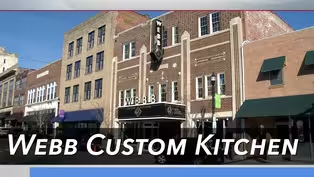
- It first opened as a movie theater in the '20s, since then, Webb Custom Kitchen in Gastonia has transformed into a modern experience where old cinema meets modern dining.
"Carolina Impact's" Jason Terzis shows us how this golden age treasure stores up nostalgia with its unique ambience.
(air whooshing) (upbeat jazz music) - [Narrator] It's everything you'd expect in a fine dining establishment.
Unique appetizers, succulent salads, lobster tails, and of course, steaks.
(upbeat jazz music) But its not in uptown, South Park, Lake Norman or Valentine, it's in Gastonia.
(upbeat jazz music) - We've won pretty neat awards from such place as Forbes Magazine, Top 100 romantic restaurants in America and even Yelp, our guest at Yelp voted us at top 25 steakhouse in America.
- [Narrator] And it's definitely not housed in your typical restaurant setting.
- I take every opportunity to come, not only for my own personal pleasure, but to show it off to anyone who's in town.
(upbeat jazz music) - [Narrator] Since opening its doors six years ago, Webb Custom Kitchen has quickly become the hotspot in town in what for decades, was known as the Webb Theater.
- Movie theaters were the rage.
There were up to six movie theaters in just downtown Gastonia alone.
- [Narrator] In the early part of the 20th century, downtown Gastonia was a thriving, hustling, bustling city.
- This was just a historic downtown, full of history, full of tradition.
- [Narrator] In the 1920s, J.F Webb opened the Webb Theater.
- These are the milk kids doing a scrap drive in front of the Webb Theater back in the 1930s.
They just collected things for war effort and Mr. Webb ran it for forever.
His family became the landlords of it and other operators came in and ran the Webb Theater, but it always remained the Webb Theater.
- [Narrator] The theater stayed in business well into the 1980s.
- It's just been an iconic place throughout my lifetime because I came to the movies here, back in segregation.
Dated my husband here in this building for the movies.
- [Narrator] But as area mills closed, the ones thriving downtown business district hit hard times.
To this day, there's still a lot of empty storefronts.
- I happened to be mayor from 1999 to 2011 and you know what happened in 2007, eight, nine, 10?
We couldn't get a penny's worth of private development.
I mean, none.
- [Narrator] Meanwhile, Jim Morasso was a restaurant lifer living in Charlotte.
His impression of Gastonia wasn't the best, a friend in the business told him about the theater becoming available.
- So I said, "Brad, where is it?"
He goes, "It's in Gastonia, you should come and see it."
I said, "Yeah, I don't think so."
He goes, "Why not?"
I go, "It's in Gastonia."
- [Narrator] Reluctantly, Jim finally agreed to go take a look.
- Well, the secret is, maybe you should know what you're talking about before you come to a judgment.
And I drove down to downtown Gastonia having never been there before, but just had my own opinions about it and I was wrong.
I walked into this building of Webb Theater and I was like, "What great bones, what a great opportunity?"
- [Narrator] Jim bought the theater from the city and spent the next seven months renovating and restoring.
- Our initial investment, we thought would be a few hundred thousand dollars.
We ended up putting in almost 3/4 of a million dollars into the process.
- [Narrator] The result, one of the most unique dining experiences in the region, a higher-end steakhouse that pays homage to its movie theater roots.
(upbeat jazz music) - So it is about the food, it's about the atmosphere.
It's about the people working in here.
It's about the experience you have when you walk out of this restaurant and you say, "That was great.
I can't wait to tell more people about this restaurant."
- [Narrator] During renovations, old canisters of film were discovered, which now serve as wall art.
The old concession stand is now the wine room.
The theater's balcony sections transformed into dining areas, up top in the back are the original marquee letters.
And along the walls, an assortment of old movie projectors and film canisters.
- This dates back to the 1930s and '40s.
- [Narrator] There's even an old student ID card for reduced admission to the theater and a keepsake belonging to a Hollywood pioneer.
- It is silent projector from Greta Garbo's flat in Stockholm, Sweden.
- [Narrator] And serving as a backdrop to it all, up on the big screen, a continuous loop of classic movies.
- We're just stewards of this building and we felt it was important that everything that we did was of a high quality.
The investment, although it may have seemed a little bit large at the time, it has more than paid for itself.
- [Narrator] And for a guy who once admittedly never considered Gastonia, Jim is now in the process of investing and renovating other downtown buildings.
He purchased Citizens National Bank, restored the old clock tower out front and plans on turning it into a tech and business hub.
- We also got involved with redesigning living in downtown Gastonia.
We purchased a building called the Rustin Building, which was an old furniture store.
It was in rough, rough shape.
- [Narrator] And how about this?
During renovation old ads for Coke and Pepsi were discovered painted on the walls.
Those are now gonna be incorporated into the condos that will soon be coming.
- This city is gonna be alive with other developers who are coming to the city who see the opportunity.
- And it wasn't until the economy started turning around that people came to town and said, "Wow, we've gotta do something."
And Jim was one of those, he's one of our greatest pioneers.
- It's like a clean canvas that I had the opportunity to paint and contribute to.
- [Narrator] Jim has taken that canvas and is doing all he can to turn it into a masterpiece.
For "Carolina Impact," I'm Jason Terzis reporting.
- Thank you, Jason.
Last year, the Gaston Gazette awarded Webb Custom Kitchen, the best of the best for business lunch, brunch and fine dining.
Did you know our nation's 11th President James K. Polk called Mecklenburg County home?
He was born in Pineville in 1795 before his rise to president.
"Carolina Impact's" Jason Terzis and photo journalist, John Branscomb takes us to the historic site where visitors get a glimpse into what life here was like during his childhood.
(soft music) - [Jason] Pineville's Main Street bustles with shops and traffic and the Little Sugar Creek Greenway offers an escape.
But there was a time just after the American Revolution when just a few settlers called this area home.
One of those families, the Polks.
- Well today we're at the President James K. Polk's State Historic Site, which is the birthplace of our nation's 11th President, James K. Polk.
James K. Polk was born here on the property.
He was here the first 11 years of his life before the Polks eventually left Mecklenburg County here in the fall of 1806 to move out to South Central Tennessee.
- [Jason] Site manager, Scott Warren says this site not only shares Polk's story and presidency, but also interprets life here in Mecklenburg County as the United States found its way as a new nation.
- You know the Polks when they were here had a large working farm, almost 429 acres.
The Polks along with the five enslaved people that were here during the time of the Polks worked the farm here, they grew cotton, corn and would certainly take that into Charlotte to sell.
- [Jason] Outside, preserved on the site, are several cabins from around Mecklenburg County.
- [Scott] We've got three historic structures that were moved here in the 1960s when the site was being developed.
And we actually think that the larger cabin is really a good example of the type of home that the Polks would've had when they were here.
- [Jason] He says staff at the Polk site are also working hard to include the stories of those once enslaved on this very land.
- Our Assistant Site Manager, Kate Moore, has been doing a lot of research on the enslaved that we're here at the Polk Farm.
We do know that there was five enslaved individuals here, and really what we're striving to do is give them a little more voice.
Give them a little more prominent presence here at the site.
(soft music) - [Jason] Inside the Visitors Center is where you learn more about the site's namesake, James K. Polk, the 11th President of the United States.
- When you first come in, you'll get a sense of the history of Mecklenburg County, the environment that the Polks were in, that they farmed in, lived in at that time, it transitions over into the growth of the United States during the 1820s.
Our next section gets into the election of 1844 and how Polk was nominated from the floor of the convention.
And it finally ends with one of the landmark events that happened here in Polk's presidency, the Mexican War.
- [Jason] Warren says Polk's presidency is often overshadowed by more well known presidents of the era, but nonetheless, impacted the country's path.
- Polk is right in between two very strong presidents, Jackson, who was Polk's mentor and the seventh president, and then Lincoln on the other end of the spectrum.
When he was in power and was in office, he actually accomplished four things that were certainly monumental in United States history.
He acquired all the way out to California.
He settled the Oregon Territory boundary dispute with Great Britain.
He ended up lowering the tariffs at that time and also he ended up really kind of corralling in the federal funds that were scattered throughout the United States in various private institutions and state banks.
- [Jason] A visit to the James K. Polk Site offers far more than a bit of trivia on a former president.
It offers perspective on where we've been as a county, a state, and a nation.
For "Carolina Impact," I'm Jason Terzis reporting.
- Thank you, Jason.
Guided tours of the historic cabins are also available.
If you are looking for a short getaway, you might enjoy a trip to Tryon.
This charming small town, about 90 minutes away from Charlotte is known for its equestrian events and thriving art scene.
In tonight's "One Tank Trip" photojournalist, Russ Huntinger introduces us to some of the artists there.
(air whooshing) (soft music) - The art scene is just exploding here, but for our locals, we know that it's really not anything new.
This has been something that has formed and informed our history and our past and it's also going to inform our present and our future.
Just walking down our main street, you'll come into contact with a host of really beautiful galleries with all sorts of different mediums.
So the art scene here is just unmatched.
- What do you like?
If you like art, we have it.
If you like theater, we have it.
(soft music) - This is the Tryon Fine Arts Center and it covers all the arts.
We do performing arts, visual arts.
We have a gallery, we have amphitheater, we do arts and education.
We have artists from all over the world that come and perform here.
(soft music) We have our local theater that also performs here and we have children's classes in music and theater.
Our mission is to be the creative driving force for exhibits, performances, arts education, and community collaborations in the Foothills.
(machine whirring) - Fine Arts and Crafts School's emphasis is both on heritage and contemporary arts and crafts.
What makes us stand out is our emphasis on education.
People come here for the unique opportunity to learn traditional and rare art making practices.
There's a weaving studio, there is fused glass, stained glass, there's pottery, there's jewelry and silversmithing and there's wood.
- We are a custom blacksmithing and ornamental iron work.
Artists are attracted to this part of the state because it's a great place to live.
There's outlets for your work and the galleries and the nonprofit art centers that are just all around here.
From (indistinct) South Carolina to Asheville.
(upbeat music) - This is an independent theater.
This is a building that has been an operating theater since 1938 and recently in the past couple years, there's been heavy innovations done to restore it to a 1950s art deco aesthetic.
We do tend to hold more independent films than larger studio films.
I'd say of course, it's gonna be a 50-50 mix.
Here in town, we have the Tryon International Film Festival every year in October.
It is a film festival that brings together a lot of smaller filmmakers, but also some relatively larger ones and covers a large scope of themes.
(upbeat music) - Tryon Painters and Sculptors is a nonprofit member support group with close to 250, mostly local member artist.
(upbeat music) We are here to promote our members products and to also provide a place for the community to learn arts of different kinds.
We offer classes and workshops here.
- I do silk painting using dyes on silk and I also do silk scarves and silk bags, they're quilted.
Also, I do rice paper collage on lamps.
I think if you're an artist or an art appreciator, this is the place to be.
(upbeat music) - [Interviewer] What do you think makes Tryon so special?
- The people always has, and I think it always will and one of my favorite mottos is, "Nearly perfect, always Tryon."
(upbeat music) - The 2022 Tryon International Film Festival is in October this year.
To learn more about the arts in Tryon, head to our website at pbscharlotte.org.
Well, we'd love your feedback on tonight's show or if you have a story idea for us, please send them to feedback@wtvi.org.
Thanks so much for joining us, we always appreciate your time.
And we look forward to seeing you back here again next time on "Carolina Impact."
Goodnight my friends.
(upbeat music) - [Narrator] A production of PBS Charlotte.
(soft music) - [Narrator] Wells Fargo is proud to support diversity, equity and inclusion in our employees, our customers and the communities we serve, as well as through content on Carolina Impact.
Carolina Impact: February 15, 2022 Preview
Preview: S9 Ep17 | 30s | A preview of the February 15, 2022 show (30s)
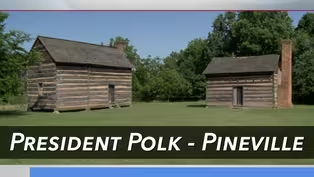
President James K. Polk Historic Site
Video has Closed Captions
Clip: S9 Ep17 | 3m 39s | President James K. Polk State Historic Site. (3m 39s)
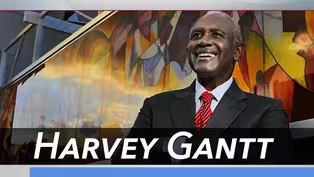
Video has Closed Captions
Clip: S9 Ep17 | 6m 33s | Charlotte's 1st black mayor, and a civil rights icon. Harvey Gantt's story (6m 33s)
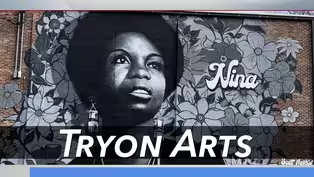
Video has Closed Captions
Clip: S9 Ep17 | 3m 47s | Take a trip to a tiny North Carolina town with a thriving art scene (3m 47s)
Video has Closed Captions
Clip: S9 Ep17 | 5m 25s | Offers a unique experience combining modern dining with old cinema. (5m 25s)
Providing Support for PBS.org
Learn Moreabout PBS online sponsorship
- News and Public Affairs

Top journalists deliver compelling original analysis of the hour's headlines.

- News and Public Affairs

FRONTLINE is investigative journalism that questions, explains and changes our world.












Support for PBS provided by:
Carolina Impact is a local public television program presented by PBS Charlotte