
Carolina Impact: February 20th, 2024
Season 11 Episode 1116 | 19m 9sVideo has Closed Captions
The South Carolina Primary, Becoming Clinton College's President, & Slot Car Racing Track.
Big Names, Small Towns: The South Carolina Primary, From homelessness, to leading a local college: how one president accomplished his dream, & The Slot Car Track in Kannapolis lets racers experience the fun of controlling a race car.
Problems playing video? | Closed Captioning Feedback
Problems playing video? | Closed Captioning Feedback
Carolina Impact is a local public television program presented by PBS Charlotte
Carolina Impact: February 20th, 2024
Season 11 Episode 1116 | 19m 9sVideo has Closed Captions
Big Names, Small Towns: The South Carolina Primary, From homelessness, to leading a local college: how one president accomplished his dream, & The Slot Car Track in Kannapolis lets racers experience the fun of controlling a race car.
Problems playing video? | Closed Captioning Feedback
How to Watch Carolina Impact
Carolina Impact is available to stream on pbs.org and the free PBS App, available on iPhone, Apple TV, Android TV, Android smartphones, Amazon Fire TV, Amazon Fire Tablet, Roku, Samsung Smart TV, and Vizio.

Introducing PBS Charlotte Passport
Now you can stream more of your favorite PBS shows including Masterpiece, NOVA, Nature, Great British Baking Show and many more — online and in the PBS Video app.Providing Support for PBS.org
Learn Moreabout PBS online sponsorship(upbeat music) - [Presenter] This is a production of PBS Charlotte.
- Just ahead on "Carolina Impact."
- Why do the biggest names and presidential politics keep coming to small town South Carolina looking for votes?
I'm Jeff Sonier.
We'll explain the make-or-break South Carolina primaries.
- Plus the big reveal in a Charlotte story tied to football desegregation and two men who have the same last name.
And from homelessness to leading a local college, we'll show you how one president persevered to fulfill his dream.
"Carolina Impact" starts right now.
(upbeat music) Good evening.
Thanks so much for joining us.
I'm Amy Burkett.
South Carolina's first in the South presidential primary season was only about a month long this election year.
Democrats casting their ballots at the start of February.
Republican voters going to the polls at the end of February.
But as usual, when South Carolina picks its presidential candidates, the whole country watches.
"Carolina Impact's" Jeff Sonier and videographer Max Arnold explore why a small state like South Carolina plays such a big role in who gets to the White House.
- Yeah, before Super Tuesday, before the big Republican and Democratic national conventions, well, if you wanna be president, first, you have to come to South Carolina, and then you've gotta get through South Carolina.
It's another Friday night just outside Lancaster, South Carolina.
And as the sunset shadows get longer, so do the lines at Indian Land High School as these small town folks.
- I do like it because I'm coming from a country that it's not like that.
- [Jeff] With their small town votes.
Have you made up your mind yet?
- No.
- [Jeff] That's why you're here, I guess.
- Yes.
- [Jeff] Get ready for another big decision, choosing who we all get to vote for in November.
- Well, I think we should hear the candidate in person if we have the opportunity.
- I will say it's a great day in Indian Land, and this is a perfect example, power.
We've got such a strong community right here in Indian Land, South Carolina.
Thank y'all for showing up tonight.
(supporters clapping and cheering) - [Nikki] Oh, look at the crowd.
- [Jeff] And here's the candidate they're showing up for on this Friday night.
- [Nikki] It's a great day in South Carolina.
(supporters clapping and cheering) - Former governor Nikki Haley, running this time in the GOP primary for president, reminding her fellow South Carolina voters why South Carolina votes are so important so early in the presidential process.
- Only two states have voted.
We've got 48 states and territories that still have to go.
(supporters clapping and cheering) Yes, they were referring to us as the beast of the Southeast, which are still on.
(audience clapping and cheering) - [Jeff] At the same night, Haley had the high school stage in Indian Land, vice president Kamala Harris was on another stage, in Orangeburg.
- And it is so wonderful to be back in this beautiful state.
This is my third trip to South Carolina just as the beginning of the year.
- [Jeff] And a few days before that, President Biden himself stopped by this local Columbia barbershop.
- Shook hands with our team members, shook hands with the clients who were being serviced.
- [Supporters] USA.
- [Jeff] Also, don't forget, former president Trump on the coast in Conway for another South Carolina campaign rally.
- Well, thank you very much, South Carolina.
We've had a great relationship with South Carolina.
- [Jeff] Yep, for one month every four years, welcome to ground zero in presidential politics and South Carolina's reputation as the launchpad for some presidential campaigns and the graveyard for others.
- So for both parties, South Carolina is a really important testing grounds but for very different reasons.
- [Presenter] Winthrop University's Dr. Scott Huffman explains that for Democratic candidates, South Carolina is the first presidential primary with a large number of minority voters.
- So because African Americans are such an important part of any winning Democratic presidential coalition come November, South Carolina is the first test of that support and that enthusiasm.
- [Jeff] And for Republicans, their test in South Carolina is appealing to a broader range of religious, social, and fiscal conservatives, a lot more than those voting in Iowa or New Hampshire.
- If you are the type of Republican who can win over that coalition of conservatives, then you might be the type of Republican who can sweep the 11 states south.
- [Jeff] But Dr. Huffman adds that the real primary winners aren't the candidates but these South Carolina voters who see them face to face in the pressure of a presidential race instead of just watching campaign commercials on TV.
- Where our voters get to see the candidates while they're on the cusp of really being in or being kicked out.
And so those face-to-face meetings really do make a difference in how the voters physically see them versus the voters who only see the national campaigns.
(patriotic music) - And I do get political candidates come in, but they're usually just getting lunch.
- [Jeff] Here at Leigh Anne's Restaurant in Lancaster, we grab a table in the corner with owner Greg Lusk, who says his regulars don't usually talk politics here, not even during the primary season.
- You know, they sit down, and they just talk about really what's going on around town, the other things.
Sometimes a little politics gets involved, but it's never aided.
- [Jeff] Four years ago, though, during the last primary season in 2020, well, Lusk remembers there was that week that the Bernie Sanders campaign came to town.
- I think it was about five days, like pretty much the entire week, that there was almost 20 of those guys regularly coming through here.
So, so they really swarmed, swarmed the area.
You know, they all had their clipboards.
They're excited to go out and talk to all the neighborhoods.
So that's really the biggest during any primary season or even during elections that I've seen groups swing by.
- [Jeff] Which brings us to the other big winners in the South Carolina primaries, those local businesses, big and small, all cashing in before the candidates cash out.
- As a South Carolinian, thank you to all those campaigns that come down here and spend money in hotels and restaurants, and everywhere else.
It's a bump to our economy as well, to be honest.
- Turns out the South Carolina primaries are also a pretty good predictor of who will be on the presidential ballot this November.
South Carolina Democrats have been right about their party's nominee every year but once since 1992.
And South Carolina Republicans, well, they've been right about their party's eventual nominee every year but once since 1980.
Amy.
- Thank you, Jeff.
For more on presidential politics from a Carolina's perspective, check out our website, pbscharlotte.org.
We'll link you to the Winthrop Poll, which surveys the attitudes and opinions of voters all over the South on the election and many other important issues.
Now we have a story of perseverance.
Dr. Lester McCorn went from dealing with homelessness to becoming a college president.
"Carolina Impact's" Dara Khaalid and Marcellus Jones take us to Rock Hill to learn more.
(gentle music) - [Dara] Building relationships fuel Dr. Lester McCorn at Clinton College.
(gentle music) Whether he's bonding with his staff through laughter or creating new ways to help students, the president tells us his heart is in everything he does.
- I don't think you can do this job without empathy.
You can't work at an HBCU and not have empathy.
You can't lead to the next level people who are trying to make it, trying to figure it out.
- [Dara] In November, 2018, McCorn became the 13th president of the college after serving as acting president for over a year.
- And I actually had people who said to me, "We prayed for you."
Right?
We were praying for someone to come who would love this school, who would have vision and passion and, you know, help grow the school.
- [Dara] For him, this was an answer to his own prayers, the ones he prayed as a little boy trapped in poverty.
- I grew up very poor.
I'm from the housing projects of Worcester, Mass.
And when I was 13 years old, we got evicted for the first time.
Most of my teenage years, I was homeless.
And we really went from pillar to post.
- [Dara] McCorn's single mother did the best she could to support he and his sister.
They relied on soup kitchens for food as they struggled to keep a roof over their heads.
- The last time we got evicted, I had like a quarter in my pocket and went to a payphone, and I called my pastor.
And he just asked one question, where are you?
And he came and picked me up and moved me into the parsonage of the Belmont Street, AME Zion Church in Worcester, Massachusetts.
- [Dara] He says his pastor, Dr. W. Robert Johnson III, became the father he never had and encouraged him to go to college.
- And I actually entered ministry when I was a student at Morehouse.
I started pastoring a church at 20 years old while I was a student.
And that's what took me to different places across the country.
- [Dara] He had the opportunity to lead several churches across the US while furthering his education.
After pastoring for nine years at Pennsylvania Avenue AME Zion Church in Baltimore, he wanted a change, one that led him to Rock Hill.
- [Lester] I found nothing but potential when I came here.
And so I just rolled up my sleeves and went to work and began to develop a good team around me.
- [Dara] One of those team members is senior vice president for Business Services and financial officer, Archinya Ingram.
- That's one of the things that really makes Clinton College a special place.
A lot of us are here for the mission.
Coming to work every day is not work.
It's just what we do.
- [Dara] Ingram tells me an accomplishment she's proud of under McCorn's leadership is their recent reaffirmation of accreditation by TRACS, the Transnational Association of Christian Colleges and Schools.
- We were the first HBCU to go through our reaffirmation process, our tenure reaffirmation process, with zero findings, zero recommendations or zero suggestions.
So what does that implies?
That tells us that we were able to hit every standard of our accrediting agency.
- [Dara] However, McCorn's vision for the school didn't stop there.
He's created intervention programs to help students who are academically falling behind, built a $2 million academic center for excellence, and started new majors like cybersecurity, elementary education, and nursing, which was in high demand.
- I got a chance to meet prospective students, and we would ask them, what are you interested, you know, and majoring in?
And what came up over and over again was nursing, right?
I wanna be a nurse.
Then I started looking into this thing.
I was like, this is a big deal.
- [Dara] Whether students are in a nursing class or speaking at campus events, - For progress, we got the remedy.
- [Dara] the ones we spoke to say they feel right at home.
- The environment is very welcoming for anyone.
- [Dara] Even if they're far from home.
- [Benz] I'm actually an international student coming in from Paris, France.
- [Dara] Freshman Benz Joseph tells us the transition from France to the US hasn't been easy with so many cultural and educational changes.
- It's been tough.
I'm not gonna hide that, but I know that I'm here for a reason, and the fact that I'm here proves that.
- [Dara] However, the support he receives at school has helped him adjust.
- I really appreciate the fact that we have more than just professors and faculty members here and staff here.
We have, you know, great leaders.
For example, our president, President McCorn, he teaches us.
- [Dara] As McCorn and I walk the campus together, he tells me that's what matters most, giving students the same nurturing college environment he had so they can find their voices and go change the world.
For "Carolina Impact," I'm Dara Khaalid.
- Thank you, Dara.
McCorn tells us his next college project is to upgrade the residence hall into a living learning center so students have modern amenities and a space to study.
Finally tonight, drivers, start your engines.
That phrase is well known in our area.
From the big races at Charlotte Motor Speedway to the small dirt tracks, racing is in our blood, and the competition remains fierce.
You can be a part of the action too without having to strap into a car.
I'm talking about slot car racing.
You may remember the toy.
Snapping the track together to turn the living room floor into a racetrack.
Producer Russ Hunsinger shows us how you can relive those memories at the slot car track in Kannapolis.
- [Announcer] Get ready.
(timer beeping) Go.
♪ I'm travelin' down the road ♪ And I'm flirtin' with disaster ♪ - [Brentley] Fun, very competitive, very fast.
♪ My life is runnin' faster - It just gets my heart rate going.
It's exciting.
Slot car racing, they're just little cars that are controlled by the track off of this little controller.
- We're in the town of Dale Earnhardt.
So Kannapolis is where Dale Earnhardt was born.
So everybody around here is into racing.
You know, NASCAR racing big time.
Not everybody could get in a big car and race, but this slot car racing is something that anybody can race.
And you can just come and play and have a good time.
It's for all ages.
We have the youngest racers, four years old, the oldest racer's 84 years old.
We have series races just like NASCAR's series.
The slot car also has series.
We have rules.
All you gotta do is build a car to those rules, pay your entry fee, and you can race.
(upbeat music) - When you're standing there controlling that car, it's a hundred percent focus on keeping that car on the track or making sure you try to stay on.
You know, if you're in the slot and you basically get in the gas quicker than the other guy going in or out of a turn, just that little bump can just knock somebody off and, - Crack.
- you know, you don't like to do that.
And of course, you don't do it on purpose, but of course, sometimes, sometimes it just happens.
- Usually, with that guy down there, that Ryan Dayvault guy, he likes to talk a lot of smack.
He thinks he's real good, and he'll crash you real quick.
But you know, it's okay.
What comes around, goes around.
Rubbin' is racin'.
(chuckles) ♪ Yeah, runnin' down a dream - You need a good trigger finger.
(chuckles) - Win the let off and win the go pretty much with your controller.
When you let off the controller going into a turn, it'll help you steer better in going into the turn.
- These cars like this are somewhere between 50 and 70 feet per second.
You can go around that track in about four seconds with all the turns and stuff and, you know, so I mean you're moving.
And you know, it's a challenge to keep it on the track.
- You can get pretty competitive and even within the family, I mean, racing the slot cars.
- Very seriously.
Ask my wife.
Do I take this seriously?
- Yes.
(Wade chuckles) And of course, the camaraderie, the fun, the joking around with the guys.
It's just a bunch of fun.
And it's really cool to hand a young kid that's never done it before to hand him a car and let him run.
(upbeat music) - [Lanika] My son likes to come over here and race.
Go.
- Go.
- He knows that he's controlling something, and it's going really, really fast.
And then not only that, he gets very competitive with it.
So he raced with some of the guys who are like members.
I was amazed how poised he was as a 3-year-old, like racing with them on a round track.
- We enjoyed doing this together.
Probably the one hobby that we're all, when one of us is doing it, the other one's doing it.
I mean, we're always, something we do together.
(upbeat music) - We've had several school groups actually come in because they're soldering and electronics involved.
So it's a learning experience for, you know, anybody.
- I am just putting a new motor in my modified just to see if we can get it to run a little bit quicker.
I love building them and seeing how fast I can get 'em and going from there.
- [Ryan] You started learning how cars work.
Electricity, mechanics, gear ratios, weight distribution, tires, the type of rubber.
I mean, there's all these different variations.
- You can customize your body that's on it.
All of the chassis are a hand-built.
So you have some leeway there and making it your own car.
♪ He's going the distance ♪ He's going for speed - I do think it's family friendly, not just for true racers, 'cause I know nothing about slot cars.
I just know to put it on there and go.
- For the younger generation, it's something that they have not seen before.
It's totally different from a video game.
It's hands-on.
And then for the older adults, you can be a child again, you know, and play with toys and have a good time.
- Thank you, Russ.
Did you know legendary driver Dale Earnhardt won his very first trophy racing slot cars in Kannapolis?
If you're interested in trying slot car racing, you can rent a car and a controller by the half hour, or you can bring your own and rent the track time.
If you have an interesting story idea like this one, email us the details to stories@wtvi.org.
Before we go this evening, I wanna thank the students from the Film Studies Program at the University of North Carolina at Charlotte.
We're glad they were with us today, learning about all the behind-the-scenes tips and tricks of broadcasting.
Well, that's all the time we have this evening.
Thanks so much for joining us.
We always appreciate your time and look forward to seeing you back here again next time on "Carolina Impact."
Goodnight, my friends.
(upbeat music) - [Presenter] This is a production of PBS Charlotte.
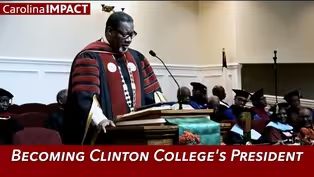
Becoming Clinton College's President
Video has Closed Captions
Clip: S11 Ep1116 | 5m 2s | From homelessness, to leading a local college. How one president accomplished his dream. (5m 2s)
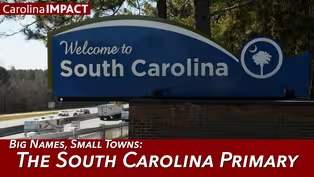
Big Names, Small Towns: The South Carolina Primary
Video has Closed Captions
Clip: S11 Ep1116 | 5m 58s | A launch pad for some campaigns, a graveyard for others - with the spotlight on SC voters. (5m 58s)
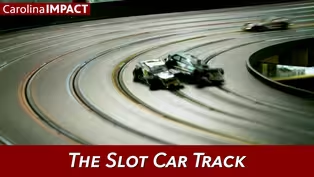
Video has Closed Captions
Clip: S11 Ep1116 | 4m 25s | The Slot Car Track in Kannapolis lets racers experience the fun of controlling a race car. (4m 25s)
Carolina Impact: February 20th, 2024
Preview: S11 Ep1116 | 30s | The South Carolina Primary, Becoming Clinton College's President, & Slot Car Racing Track. (30s)
Providing Support for PBS.org
Learn Moreabout PBS online sponsorship
- News and Public Affairs

Top journalists deliver compelling original analysis of the hour's headlines.

- News and Public Affairs

FRONTLINE is investigative journalism that questions, explains and changes our world.












Support for PBS provided by:
Carolina Impact is a local public television program presented by PBS Charlotte