
Carolina Impact: February 6th, 2024
Season 11 Episode 1114 | 19m 30sVideo has Closed Captions
Freshlist Food Hub, Small Towns, & Nonna Maria's Italian Deli
A local organization bridges the gap between farmers and consumers, See how the small towns of Badin and Wadesboro are reinventing themselves economically, & Meet Your Neighbor: Enza Pilla of Nonna Maria's Italian Deli & Market.
Problems playing video? | Closed Captioning Feedback
Problems playing video? | Closed Captioning Feedback
Carolina Impact is a local public television program presented by PBS Charlotte
Carolina Impact: February 6th, 2024
Season 11 Episode 1114 | 19m 30sVideo has Closed Captions
A local organization bridges the gap between farmers and consumers, See how the small towns of Badin and Wadesboro are reinventing themselves economically, & Meet Your Neighbor: Enza Pilla of Nonna Maria's Italian Deli & Market.
Problems playing video? | Closed Captioning Feedback
How to Watch Carolina Impact
Carolina Impact is available to stream on pbs.org and the free PBS App, available on iPhone, Apple TV, Android TV, Android smartphones, Amazon Fire TV, Amazon Fire Tablet, Roku, Samsung Smart TV, and Vizio.
Introducing PBS Charlotte Passport
Now you can stream more of your favorite PBS shows including Masterpiece, NOVA, Nature, Great British Baking Show and many more — online and in the PBS Video app.Providing Support for PBS.org
Learn Moreabout PBS online sponsorship- [Announcer] This is a production of PBS Charlotte.
(bright music) - Just ahead on "Carolina Impact," A Charlotte business bridges the gap between farmers and restaurants.
And from New York to the Queen City, we meet one woman sharing her Italian culture.
"Carolina Impact" starts now.
(bright upbeat music) Good evening, thanks so much for joining us.
I'm Amy Burkett.
farm to table restaurants across our region have grown exponentially over the last several years, creating an increased demand for fresh local food.
A local food hub devoted to the sustainability of family farmers has become a critical part of the local food supply chain.
"Carolina Impact's" Kathleen Llewellyn and videographer Marcellus Jones tell us more.
(melodic music) - [Kathleen] These vegetables were grown by family farmers Emma Hendel and her husband, Elliot Seldner, who owned Fair Share Farm near Winston-Salem.
Now they're being placed in the care of Freshlist, a food hub that will sell them to restaurants and consumers across the Charlotte region, and by way of that, help Emma and Elliot maintain their business.
- Working with Freshlist has opened doors that we would not have had access to otherwise.
- [Kathleen] Emma and Elliot started their farm 10 years ago with the goal of growing the best produce possible and making a living doing it.
But like many family farmers, they've experienced a number of challenges, including selling the fresh foods they grow.
- Someday, there's people banging down the doors for product, and then so it's like, okay, people want this and you grow it, and the crickets, you know, there's no one there to buy the products.
- [Kathleen] That's why Jesse Ledbetter gave up his corporate career and created Freshlist to serve as a critical connector in the local food supply chain.
- We've got pretty much the standard stuff on here.
I am excited that this is the latest we've ever pushed the basil.
- In 2014 when we started Freshlist.
Charlotte had just kind of, like, burgeoning culinary scene where the table movement was really starting to come to the city.
There were a lot of family farms that were still in the area, that their only way of selling product was through either farmer's markets or directly to chefs.
And so I was trying to figure out how we can bridge that gap and just make it easier for farmers to ultimately get their products to chefs and vice versa.
- [Kathleen] Freshlist sources a variety of vegetables from family farmers like Emma across the region, keeps a list of what's available on its website and delivers directly to the doors of customers, providing regular, easy access to an abundance of fresh local food.
- So it broadens the reach for a single chef to be able to incorporate as many farms as possible with one order weekly, instead of having to call five or six farmers at different times and different days, set up different delivery dates and things of that nature.
It's all very streamlined.
- [Kathleen] And it allows farmers who regularly work from dawn to dusk to streamline the scope of their efforts.
- So they're our voice here in Charlotte doing that face-to-face communications.
They have so much more reach than we do, because they have more people out getting into those restaurants, talking up our products.
- It is a huge part of our business operations.
We're so lucky to have a partner like that.
The way that they are able to work with 200 to 300 regional farms around here, it's something we could never do on our own.
- [Kathleen] In addition to the five Tonidandel-Brown restaurants, Freshlist provides fresh local food to more than a hundred area eateries.
- Not only can you find our farmed products in some of your favorite fine dining restaurants in Charlotte, you can also see us in fast casual restaurants and in coffee shops and in breweries.
- [Employee] Awesome.
(knives slicing) (melodic music) - It is the lifeline for our restaurant.
- [Kathleen] And a lifeline for Carolina farmers who are dwindling in number.
A study from the American Farmland Trust found North Carolina to be the second most threatened state in the US for losing farmland.
And it projects the number of lost agricultural acres across the state to surpass 1 million by 2040.
- The average, you know, American farmer is 68 years old.
This profession is getting older and there aren't enough young people coming into it to make it that economically viable.
And so what we see ourselves in, we work with a lot of new and beginning farmers who are just starting out on this journey, and we're able to help provide an extra market channel for them.
- Anybody that's spent time at a farmer's market or on a farm with farmers knows that they are people that are doing selfless work.
They are taking care of their community themselves, the planet, with not a whole lot in return.
And it's the not a whole lot in return part that we're trying to change.
- [Kathleen] Since its inception, Freshlist has facilitated the purchase of more than $7 million of food from area farmers.
The company is also addressing food insecurity by helping direct nonprofit relief funds to farmers so that fresh produce can be distributed to those in need.
- We're grateful for everything that they do and the vision that they have, because you need people in organizations that are thinking bigger than what's currently going on in order for change to be enacted.
- [Kathleen] Major accomplishments for a team of nine that's been around for less than a decade, but Ledbetter says Freshlist is far from finished.
- Luckily we have a good team and we got a great farm community.
Got lots of support on the chef side and partners, non-profit for profit.
It's a great ecosystem and we're excited to do more of the work that we're doing.
- [Kathleen] That work will be fueled by $749,000 local food promotion grant that Freshlist was awarded last year by the USDA.
For "Carolina Impact," I'm Kathleen Llewellyn.
- Thank you, Kathleen.
Freshlist retail service provides home delivery for certain zip codes inside the Charlotte region.
For those in other areas, orders can be picked up at the company's warehouse or at Free Range Brewing in NoDa.
Well, if you drive the back roads of the Carolinas, you'll pass through countless small towns and communities.
Often a single industry makes up the backbone of their economies.
But what happens when the factories close?
"Carolina Impact's" Jason Terzis and producer, John Branscumb, take a look at the history of two local towns and how they're reinventing themselves.
(bright guitar music) - [Jason] Have you ever heard of a company town?
Popular in the late 19th century and early 20th centuries, these towns were built by corporations to support a factory mill or mine.
They often included a general store, schools, housing and churches, everything a worker and their families might need.
Badin, the Stanly County town with the French name is a prime example.
- [James] Badin had its heyday.
In fact, it was so busy in Badin that people in Albemarle would take a bus to come to Badin.
Right now it's probably the opposite, right?
- At Badin Coffee.
- White chocolate, dirty chai.
Any food today, guys?
- [Jason] James Wahab serves up some sweet treats.
- [James] Strawberry Danish it is.
We have a winner.
- [Jason] And brews a variety of beverages.
- This is Bella, this machine produces a lot of great espresso for the town of Badin.
It's nice to have a small town coffee shop.
- [Jason] James and his wife set up shop along historic Falls Road, Badin's defacto main street.
- Originally this was Badin Hardware.
Badin is one of those small towns that got caught in history.
It's outside of major city limits and it's kind of this one of those towns that time forgot.
- [Jason] Since opening their little shop, word's gotten out, and once again, folks like John Jenkins from Albemarle make the trip to Badin.
- I came out for some sweets and as you see, I've had three different desserts and a caramel latte, and just really, just hanging out.
It's a great place to hang out.
The specific desserts are, like, you can't get 'em anywhere.
They make 'em fresh, they are unique.
- Our apple turnovers are a little legendary, and we got these macaroons we just started.
Those are homemade, and that is not easy.
Those are tricky little cookies.
- [Jason] Tricky little French cookies seem fitting in this small North Carolina town with a French connection.
(motorcycle engine revving) Drive the streets of Badin and you might notice distinct four-unit townhouses and old stone line storm drains.
It's effectively a planned community.
A plan started in the spring of 1913 by the French company, L'Aluminum Francais, and named after the company President Adrien Badin.
To feed the power devouring aluminum smelter, the French company started building a hydroelectric dam on the Yadkin River.
But best laid plans don't always work out.
(guns firing) In 1914, World War I broke out across Europe and as a result, financing for the project dried up for the French.
And American investors took advantage of the abrupt French exit.
Eventually, the Pennsylvania based aluminum company of America, also known as Alcoa, took over to finish construction of the dam, the aluminum plant and town.
- I grew up in the town of Badin.
I'm a third generation Alcoan.
My grandfather, he worked in the plant.
My father worked in the plant.
I was fortunate, I got to work there towards the end.
- [Jason] Change, however, was on the horizon for Badin.
After nearly a century in operation, the Alcoa plant produced its last aluminum in 2010.
In recent years, other industries have moved to the site.
- There is a small recycling unit over there now that they try and recycle electronics.
There's an outfit coming in, Consolidated Alloys, they've invested coming in here to build these pipe fittings for the Navy.
- [Jason] More than a century since its founding, Badin now finds itself in transition.
- We're like a unique retirement community.
We got very limited business, but we have people coming to Badin and retiring.
If you grew up in a small town, Badin's still got that atmosphere.
- [Jason] Laid back, but still with a lot to offer.
- The big thing is the lake and having the boat access, a lot of fishing, that's the big thing.
We have lots of tournaments here.
The other thing is Morrow Mountain State Park is very close.
- [Jason] Back at the coffee shop, James sums up the energy of Badin.
- To meet lots of nice people, it has a nice small hometown feel that people are really looking for.
I think some of them are trying to escape the city and find a nice small town where they can feel at home and welcomed.
And everybody comes through that front door is welcome.
- [Jason] Badin isn't the only small town working to reinvent itself.
Down in Anson County, the town of Wadesboro's economy relied on the textile industry for much of the 20th century.
But when the American textile industry declined, Wadesboro's once vibrant business district suffered.
- [Resident] It's a little slower than it was then.
- Downtown's a little different, a little more conservative.
It's little more quieter.
A lot of the like, the big belt stores, you know, they're no longer there.
They did have the movie theater too back then, and it was up and running real well.
So now they have their back, so they're doing plays instead of showing movies.
- [Jason] The live plays happening at the Ansonia Theater are just one of the signs that Wadesboro's Downtown is seeing renewed investment.
- My name is Monica Schulze.
I am the owner and executive chef for the Ansonia Soup Company.
And we feature fresh made soups, salads, panini's, homemade breads, scratch made European desserts every single day.
- [Jason] Schulze took a risk in starting her restaurant.
- I believe Wadesboro is in the very beginning of a renaissance.
There are businesses that are coming in.
There are new ideas for businesses that are out there.
This is brand new.
Wadesboro's never seen anything like what we do.
- [Jason] Originally from Pennsylvania, Schulze only recently adopted Wadesboro as her new hometown.
- I have lived in big cities.
I've been in Chicago, Miami, and Los Angeles, San Francisco, and I would trade it all just to be here.
The big city is not all as cracked up to be granted.
There is accessibility for ingredients.
There's accessibility for, you know, fine restaurants and entertainment.
There's all of the things that are luxuries, but I wouldn't want to go back to that, because of so many people, because of the crime, because of the expense, because you don't even get to know your neighbor that much anymore.
Here we all know each other.
- [Jason] Small town economies are often dependent on a single industry, and when the industry goes away, it's the creativity and determination of the residents in towns like Badin and Wadesboro that keep the towns alive and vibrant.
For "Carolina Impact," I'm Jason Terzis reporting.
- Thank you so much, Jason.
Small towns across the country have also seen a post COVID revival as folks with the ability to work from home seek out a quieter way of life.
I grew up in one of those small towns.
Great place to live.
Well, speaking of seeking a different way of life, one local woman moved from the New York area to Charlotte with her family to escape the fast pace.
However, when she arrived, she realized there weren't any Italian places that reminded her of home.
In this week's Meet your Neighbors segment, "Carolina Impact's" Dara Khalid and videographer, John Branscum, show us how she's giving the Queen City a taste of authentic Italian.
♪ I have always wanted to have a neighbor just like you ♪ ♪ I've always wanted to live in a neighborhood with you ♪ ♪ So would you be mine, could you be mine ♪ ♪ Won't you be my neighbor (fast piano music) - [Fred] Hi, neighbor.
(bright music) - [Dara] Whether you've been to Italy or not, once you step inside Nonna Maria's Italian Deli & Market, you might feel like you're there.
- [Enza] As we place orders, we try and bring in new products, authentic Italian great food.
- [Dara] That includes tender meats like prosciutto and salami, aged cheeses, perfectly packaged sugary treats and pastas that vary and shape and size.
- [Enza] That's what we eat when I go to Italy.
It's how we eat when we're here at home.
- [Dara] For co-owner Enza Pilla, it's important to create an atmosphere inside her Matthews business that showcases the food she grew up eating.
- That's how I was raised.
You know, my mom cooked all the time and it was delicious.
(laughs) You know, there was never a bad meal.
- [Dara] Pilla remembers her mother, Maria, an Italian immigrant making dishes from her native country and their New York home.
She also remembers tasting those same dishes overseas.
- Every summer, me, my mom and my sister would be off to Italy, and then my dad would meet us.
So you get up, you have breakfast, you go hang out, play around a little bit.
You come back for lunch, you know, a big lunch.
- [Dara] Big lunches mean more to Pilla now since losing her mother.
So when she opened Nonna Maria's in 2022 with her husband, Rich, there was no question about who it would be named after.
- [Enza] She was my best friend, so this is the least I could do for her.
- [Dara] For one New York customer, the business reminds him of childhood memories with his own mom.
- In our town, we had an Italian deli, and my mom used to shop at 'em religiously and get all kinds of stuff, and she was a pretty good Italian cook.
- [Dara] After seeing a post on Facebook, Rick Swartenberg decided to come to the deli with his wife.
They ordered the Reuben sandwich, held hands to say grace and savored every single bite, - The whole menu looked good, but, you know, you can only try so much at one time.
- [Dara] Swartenberg is right.
With over 18 sandwiches on the menu, various desserts and bagels fresh from the toaster, you can't enjoy them all at once.
Food isn't the only piece of Italy the owners want their customers to experience.
- Before we opened, we didn't know what colors to paint inside.
And I said, well, let's think about this.
It's an Italian deli, right?
What's the Italian colors?
Well, I said, let's do that.
We'll pick three colors and we'll just run it through.
- [Dara] Pilla's husband and co-owner, Rich Garcia, tells me they were intentional with every piece of decor.
Beige maps on each table outlining Italian cities, upholstery fabric with images of pasta and pictures hanging on the walls of cobblestone robes and homes in Italy.
- I talk about blood, sweat, and tears.
Forget about it.
It was a lot of work, but we did it.
We finally got it together.
You know, I did all the painting, I did the floors.
We shipped my brother-in-Law down from New York.
He helped me with all the counters and some other minor things.
- [Dara] And if you pay close attention to the walls near the menu, you'll notice a New York Yankees flag and a New York City Police Department sign, a few mementos to remind them of the state they left behind.
The couple moved from the Big Apple to Charlotte in 2020 with their daughter, Abby, to escape the hustle and bustle, but were disappointed when they couldn't find any Italian business similar to what they had back home.
- When we first came down here, we were looking for this type of establishment, and we went to a couple of places that we just did not like.
- [Dara] This pushed them to create their own business, one that had everything they loved about New York and Italy.
- We started with tossing the idea of let's open just like an Italian market.
And then that became, well, why not breakfast?
And then that became, well, why not lunch?
And then this has just snowballed into where we are today.
- Because of my hometown and upbringing, it was a high Italian population where I grew up, and the Italian foods and special foods were a big part of it.
When I saw what Nonna's was gonna be, it piqued my interest, 'cause there's really not that many in the area.
- [Dara] Regular customer, John Peattie, grew up in Northeast Ohio and has been a fan of Italian food for decades, so much so that he makes his own dishes at home.
But he says there's something special about coming into a place like Nonna Maria's.
- Of course, I couldn't help not get a sandwich.
I went outside.
I sat there and ate it.
It was one of the most delicious sandwiches I've ever had in my life.
- [Dara] As customers continue to walk away with a little piece of Italy, Pilla smiles, knowing her mother would be proud.
For "Carolina Impact," I'm Dara Khalid.
- Of course, that story made me hungry.
Thanks so much, Dara.
Another touch of Italy Pilla adds to her business is importing seasonal Italian goods.
Well, before we say goodnight, I wanna recognize our wonderful studio audience, home schoolers from Lincoln County Seeds of Promise.
Well, that's all the time we have this evening.
Thanks so much for joining us.
We always appreciate your time, and look forward to seeing you back here again next time on "Carolina Impact."
Goodnight my friends.
(inspirational music) - [Announcer] This is a production of PBS Charlotte.
(bright music)
Carolina Impact: February 6th, 2024 Preview
Preview: S11 Ep1114 | 30s | Freshlist Food Hub, Small Towns, & Nonna Maria's Italian Deli (30s)
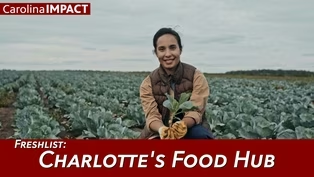
Freshlist: Charlotte's Food Hub
Video has Closed Captions
Clip: S11 Ep1114 | 5m 23s | A local organization bridges the gap between farmers and consumers. (5m 23s)
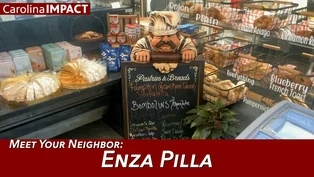
Meet Your Neighbor: Enza Pilla
Video has Closed Captions
Clip: S11 Ep1114 | 4m 35s | Originally from New York, a local woman gives Charlotte a piece of her Italian heritage. (4m 35s)
Video has Closed Captions
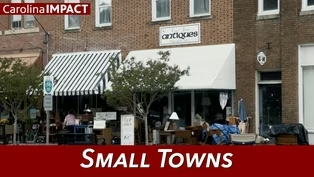
Clip: S11 Ep1114 | 6m 12s | See how the small towns of Badin and Wadesboro are reinventing themselves economically. (6m 12s)
Providing Support for PBS.org
Learn Moreabout PBS online sponsorship
- News and Public Affairs

Top journalists deliver compelling original analysis of the hour's headlines.

- News and Public Affairs

FRONTLINE is investigative journalism that questions, explains and changes our world.












Support for PBS provided by:
Carolina Impact is a local public television program presented by PBS Charlotte