
Carolina Impact: January 25, 2022
Season 9 Episode 14 | 24m 39sVideo has Closed Captions
Felons finding jobs amidst worker shortages, Gest carts, Camino Health, Aerial Arts
Felons finding jobs amidst worker shortages, Gest carts, Camino Health, Aerial Arts
Problems playing video? | Closed Captioning Feedback
Problems playing video? | Closed Captioning Feedback
Carolina Impact is a local public television program presented by PBS Charlotte
Carolina Impact: January 25, 2022
Season 9 Episode 14 | 24m 39sVideo has Closed Captions
Felons finding jobs amidst worker shortages, Gest carts, Camino Health, Aerial Arts
Problems playing video? | Closed Captioning Feedback
How to Watch Carolina Impact
Carolina Impact is available to stream on pbs.org and the free PBS App, available on iPhone, Apple TV, Android TV, Android smartphones, Amazon Fire TV, Amazon Fire Tablet, Roku, Samsung Smart TV, and Vizio.
Introducing PBS Charlotte Passport
Now you can stream more of your favorite PBS shows including Masterpiece, NOVA, Nature, Great British Baking Show and many more — online and in the PBS Video app.Providing Support for PBS.org
Learn Moreabout PBS online sponsorship- [Narrator] Wells Fargo is proud to support diversity, equity and inclusion in our employees, our customers and the communities we serve, as well as through content on Carolina Impact.
- [Announcer] This is a production of PBS Charlotte.
- Just ahead on Carolina Impact, worker shortages forcing some businesses to close or shorten hours, could eliminating barriers for workers with criminal convictions bridge the gap?
Plus move over Uber, there's a new ride in town and it's free making uptown travel a little bit easier, and meet the dynamic duo taking folks for a different kind of spin with aerial arts.
Carolina Impact starts right now.
- [Announcer] Carolina Impact covering the issues, people and places that impact you.
This is Carolina Impact.
(bright music) - Good evening, thanks so much for joining us.
I'm Amy Burkett.
We've all seen the help wanted signs at businesses in the area.
Employment analysts estimate there are tens of thousands of open positions, but there are some people applying for jobs having hard time getting in the door.
Carolina Impact's Coleen Harry shows us why some believe hiring people with a criminal record could make a difference.
(slow music) - [Coleen] Meet a young man who loves to read, but before Korinthin Worley got to this point in his life where he devours words, (siren wailing) he went through some things.
- I went into prison for selling cocaine.
- [Coleen] Worley was released after spending almost three years behind bars.
He says he was determined to take a different path and was looking forward to better days, (keys jangling) but he knew that having a conviction would haunt him.
- I know I would probably still deal with it like as far as trying to get a job and stuff, things of that nature.
(bright music) - [Coleen] Advocates for people and families impacted by incarceration say unemployment is one of the biggest reasons people recommit crimes and are sent back to prison.
Some job applications for the private sector ask about convictions.
Getting past checking this box and landing the job has been difficult for some who served time.
- Well, it matters because we're all human and we all exist on this world, you know, on this planet like to do, you know, better for and with each other.
That's not a business response, right?
Businesses should do it because it affects their bottom line.
(bright music) - [Coleen] Patrice Funderburg is the executive director of the nonprofit, the Center for Community Transitions, which focuses on families and individuals who were in prison.
One of its programs helps individuals with convictions get jobs.
- It is the social stigma of being in jail or prison that creates not so much the barrier that we're aware of of the person who experienced that justice conviction, but on the employment side, not understanding how to implement processes along the employment life cycle that can account for that.
- So we started out this morning, you told me about yourself, we're starting to have a conversation, developing a relationship.
- [Coleen] These students in this class were once incarcerated.
They're learning about job interviews.
- Thank you so much for coming in.
- We provide the tools and resources and support for that individual to take the steps that are led by that individual to accomplish their goals.
- [Coleen] Advocates say, getting people with convictions ready for work is just one part of the equation.
Advocates say employers and their hiring process need to re-examine how they're looking at applicants.
- Most companies today have, you know, stood up for (mumbles) as a condition of employment.
They don't ask the conviction question until a conditional verbal offer of employment has been extended.
- [Coleen] Funderburg says even if company executives believe in giving second chances, that message isn't always filtered down through the hiring process.
- If the background check vendor is not a part of the development of that second chance process, then that person is gonna get flagged out, right?
If the HR business partner or the recruiter or the talent acquisition person within the company doesn't have an understanding of the probability of that happening then the person who has the justice involvement is only gonna get an email to say, "Thanks for interviewing with us.
After completion of your background check, we're not gonna move forward with you."
(upbeat music) - [Coleen] Genpak, a food packaging manufacturers started hiring workers with records.
When the pandemic forced restaurants to close dining areas, takeout orders, kept food service businesses afloat, that meant an even greater demand for Genpak's food packaging.
While they worked to keep up with orders, the company had to find more workers.
- The postal workers out there today, they have a lot of choice.
You know, companies like us are desperate, we'd like to hire more and more people so we can improve our utilization rates.
But you know, we're weathering, it's been difficult.
- [Coleen] Kevin Kelly, president of Genpak says he told his recruiters to think outside the box.
It used to be that they had a lot of people walking in and applying for jobs.
- What we do is as soon as they walk in the door, we get them into either a kiosk, we also have tablets at all of our locations as well and they're able to go in and put in an online application immediately.
- [Coleen] In 2020 with job applications from walk-ins slowing Genpak executives widened their search for applicants.
- We've had such a close working relationship with the economic division of Mecklenburg County.
And then they've mentioned this as a possibility to sort of link us with some programs, we didn't hesitate one bit.
And I think I said it in passing, "Hey, I think we're gonna become a second chance employer."
- [Coleen] Patrick Rorie, who is the corporate training manager says so far, they've hired about 50 people who formerly incarcerated.
- We take a look at every single background screening that comes to us just to see what it is.
- [Coleen] Rorie says doing Genpak's job interviews, he's noticing that some of the applicants who have a conviction are upfront about their record.
- They actually are taught how to market and brand themselves.
So they come right to us in the interview, though they are not required to do so, they come right out to us and say, "This is what I did, this is what I learned from it."
- They come back to the (mumbles) that, you know, these folks, a lot of them haven't had that chance and we feel like that's, you know, a vital thing.
And it certainly serves our needs if we can give somebody that opportunity and they build a career with us.
(bright music) - [Coleen] Worley took the classes that the Center for Community Transitions teaches.
He has earned different certificates, ready to join the workforce.
He says he heard back from a few jobs.
- I feel a lot better, I feel a lot calm and peaceful, just motivated.
And this is the same, like the same, ain't nothing changed 'cause I actually, I mean, a little bit it added fuel to how I'm already feeling as far as what I wanna do with my life.
- [Coleen] Now on the path he visualized and mentally prepared for.
For Carolina Impact, I'm Coleen Harry.
- Thank you, Coleen.
Genpak executives say the company hasn't had any safety issues with any of it's second chance employees.
In the last few years transportation options have expanded tremendously evolving from trains, buses and taxis to Ubers, Lyfts and in some cities, electric scooters, but now there's a new service in Charlotte.
As Carolina Impact's Jason Terzis shows us, the best maybe is free.
(upbeat music) - [Jason] The multicolored lights coming from the disco ball are a dead giveaway, this isn't your typical car.
(upbeat music) - And they have the disco ball and the music.
It's a whole experience.
- [Jason] In fact, it's not even a car at all.
- They're completely the street legal, they have lithium-ion batteries, they're completely electric.
- [Jason] It's Charlotte's newest mode of transportation.
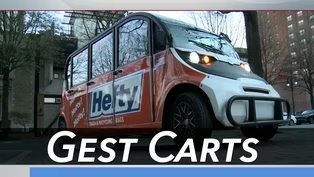
GEST Carts, which stands for green, easy, safe transportation.
Think of it like a high-end golf cart with seating for six, it provides an easy and environmentally friendly way to get around town.
- These are the "Teslas of the street legal low speed vehicles."
- I saw it as a great opportunity.
I'm a native from Charlotte, so I thought it would be a great time to be able to provide a safe transportation to our Uptown and South End areas throughout the city.
- [Jason] The service launched in December and will serve Uptown, South End, Plaza Midwood and NoDa, anywhere around the uptown area.
- For us, we're in a concentrated three to five mile urban core radius.
So we just... And we focus on that and strictly just go in there.
And our trips are five to 15 minutes from point A to point B.
- [Jason] Right now GEST Carts runs primarily on Friday and Saturday nights.
Also during Hornets and Panthers games or whenever there's a big event happening Uptown.
And just like so many other things these days, riders can get it through an app, the Gest Passenger app.
- Well, one of the big opportunity for us will be when the soccer team come so we'll operate on those Saturdays as well.
So just be tuned into our social media accounts so you can see the different times that we'll operate in addition to Fridays and Saturday.
- Well, I saw them on social media and I also saw some news stories about it.
So I downloaded the app and then it's free.
So I thought that was really, really cool.
So, we thought we'd use it to go to the game tonight, for the Hornets game.
- [Jason] Wait, did she just say it's free?
Yeah, that's right, riding in the GEST Cart is absolutely free.
- People was like, where is this coming from?
Is it free?
What's the catch?
Is it really free?
You know, we had to explain it to them, yes, it is free.
- [Jason] So there's gotta be a catch somewhere, right?
- We tell them there's no catch.
We just want you to... We just want you transport you safe, make sure you have fun and make sure you have fun and get to their destination safely.
- The reason that it's free is it's all paid for by advertisers.
But it's one company per vehicle, so they're the ones that are covering the cost and they're... That's the reason why it's free for the consumer.
- [Jason] The service was created by South Meck High School and UNC Charlotte graduate, Patrick Dye.
He along with wife, Lauren, a former Cincinnati Bengals cheerleader launched GEST Carts in the other Queen City, Cincinnati, which is where they live now.
- My wife and I, we lived in the city and there's different districts in Cincinnati, same way in Charlotte.
You got NoDa, you've got, you know, Plaza Midwood, you've got (mumbles), you've got, you know, Uptown, South End.
Well, we got sick and tired of every time we wanted to go somewhere, spend 10 bucks each way.
- Uber and Lyft can get so expensive just to go a short distance.
So this is free, so it seems like a win win.
- [Jason] Things started really taking off this past year with GEST opening up franchises in multiple US cities.
- [Dye] So we have Cincinnati, Detroit, Chicago, Denver, Charlotte, Atlanta, Las Vegas, but within the next six months, we'll have Pittsburgh, Philadelphia, Seattle, Phoenix, and Scottsdale.
- [Jason] Each franchise is locally owned and operated.
Startup costs including the carts can exceed $100,000.
But it's that wrap-around advertising, a moving billboard, if you will, that pays the costs.
- And ultimately we wanna make sure our franchisee is making money and we're making money.
And not every city is the right fit, so we'll tell them, "Hey, sorry, before you even dive into this, no, you're not gonna win."
- [Jason] The carts go up to 25 miles per hour and run eight to 10 hours on a full battery charge.
The owners try to create a fun experience for riders, hence the light of disco ball.
- They love the fact that, you know, we have the music aspect of where, you know, we let them choose their music.
They love the spinning disco ball on the inside.
- [Jason] By the end of the year, the hope in Charlotte is to have at least a half dozen GEST Carts up and running, if not more.
So there's a good chance you'll be seeing these things all around the Uptown area.
We're looking to bring six to eight carts to the city which will provide numerous job opportunities for drivers as well as mechanics.
Just anybody looking for a part-time job or looking for additional jobs within the city.
- I never thought it would get this big, this fast, but we knew we knew we had a viable product, but now it's all about execution.
I mean now to the point where we're hiring board members, we're bringing on board members, we're bringing on executives.
- [Jason] So if you're in and around Uptown and tired of paying for Ubers and Lyfts or taxis and public transportation doesn't get you to your final destination, your solution could already be on the street right in front of you.
For Carolina Impact, I'm Jason Terzis reporting.
- Thank you so much, Jason.
Always nice to have options.
As is the case with most startups, GEST's main focus is getting the word out.
You need to download the app if you're interested in riding.
Well, out of all of US cities, Charlotte ranks number eight, when it comes to people having high cholesterol.
According to recent data, it's impacted about a third of our population.
For patients with language barriers and no insurance seeking treatment can get complicated.
As Carolina Impact circle on Harris reports, one local nonprofit is creating access for the Latino community with a new state of the art kitchen and gym.
(treadmill beeping) (upbeat music) - [Sarah] On any given day, this is where you'll find Consuelo Avalos breaking a sweat, lifting weights and doing cardio.
Like many of us, Avalos packed on a few quarantine pounds she's anxious to get rid of.
- I really enjoy walking and during the pandemic I gained more than five pounds.
So for me, it was necessary and I saw this program at Camino Vida.
- [Sarah] Avalos joined the program at Camino Vida after suffering from high blood pressure.
Paulina Martinez is her fitness trainer.
- (speaking in foreign language) - (speaking in foreign language) (laughing) - [Sarah] She says weights intimidate many of her newcomers.
- (speaking in foreign language) - Especially women.
Martinez works to put them at ease.
- Most of them, they're either not exercising at all or they're doing the wrong thing.
So most of them, if they go to a gym, they're just doing treadmill for like 40 minutes.
And so their body gets used to that and they're not seeing any changes.
And then when they get here and they start working with us, they just kind of learn a lot of different exercises.
(upbeat music) - [Sarah] As a mother and grandmother, 56 year-old Avalos says it's important to her to stay healthy and active for her family.
Here she's down the support she needs to learn how to eat and workout properly.
- I feel so much better.
I learned how to eat better, how to know what to eat, what to buy, what to eat at the house, what portions and the other thing that's important, exercise.
- (speaking in foreign language) - [Sarah] A health and wellness program, Camino Vida, is part of the Camino Clinic's efforts to address health issues in the Latino community, including diabetes, high cholesterol and obesity.
- The program was developed specifically for patients of Camino Clinic and primarily the clinic serves Latino first-generation immigrants that primarily speak Spanish.
And so what we were finding is that were a lot of patients were coming in with high blood pressure.
- [Sarah] The new health center includes a state-of-the-art gym and kitchen where clients enrolled in the one-year program, work with the nutritionist to learn what to eat and how to prepare healthy meals.
- I am Panamanian, my parents are from Panama.
So I really like working with the Latino community.
I like being someplace where I feel like it's appreciated and it's more like a family and it doesn't really feel like work, like I'm doing work while I'm here.
So I really enjoy like the community feel, the family feel and just being able to connect with them on a different level that includes food, which I love.
(Reatna laughs) (upbeat music) - [Sarah] That personal insight into the Latino culture helps Taylor develop nutritional plans, incorporating ethnic foods.
(blender whirring) - Because when you think healthier, generally you're thinking like a green salad or like a parfait.
And that might be something that you're totally not used to eating, especially as a Latino.
For example, we have a lot of population who eats like squash, like chayote or nopales, those are very nutritionally rich vegetables that they can continue to eat in their diet and doesn't have to be like a green salad.
- [Sarah] The program is paying off with improvements in weight loss and lower cholesterol levels.
- We're also seeing improvements in A1C and their blood pressure and all those other things as well.
So we're definitely seeing the results in the data.
And individually, I think that primarily what we see a lot of is that they have improved self-esteem.
- [Sarah] Camino Vida is one of four areas at Camino, a nonprofit.
The center also offers a behavioral health program and upward mobility program focused on employment and financial services and the food pantry.
The community also has access to an onsite thrift store.
- We've made a good attempt at trying to, you know, bring in bilingual professionals in all the areas.
But I don't believe that the capacity has grown with the growth of the Latino population.
So we are more overwhelmed today, even though we've got greater capacity than we were at the beginning, because the need is so great.
- [Sarah] Rusty Price launched the Camino Center in 2003 after serving internationally on missions trips.
- And so I just said, we've gotta do something.
And we'd already started the nonprofit, but we were focused more internationally.
And so that's when we decided to start the clinic and the clinic was born.
(upbeat music) - [Sarah] What started with just a handful of volunteers has grown from 25 employees just a few years ago to more than 85 employees.
Rusty says today, the need is even greater.
- The specific needs, there's these gaps between the broad community and then the Latino immigrant community.
And we've figured out how to be a bridge and how to do that.
So now we're looking to scale across the state and even out to other states and take what we've learned and hopefully be able to influence or start other programs just like Camino in other places.
- (speaking in foreign language) - [Sarah] For Avalos being in an environment where she can feel seen and heard has made all the difference on her journey to healthy living.
For Carolina Impact, I'm Sarah Colon-Harris reporting.
- Thank you, Sarah.
The annual cost for Camino's program is $240 per person.
Financial assistance is also available.
Hitting the gym isn't the only way to get your body moving.
In south Charlotte, two women take movement to another level literally with aerial arts classes.
Video journalist John Branscum shows us how they're using the art form to not only push physical limits, but also spark joy.
(upbeat music) - The easiest way when talking about aerial, because everyone knows what Cirque de Solei is, is just that.
Have you seen Cirque de Solei?
- [Mel] It's one of those things where this is very, very physically demanding, but also very mentally stimulating.
- [Chris] I was like I could be like I Spider-Man.
- It makes me feel like a little kid, it's like an adult playground.
My name is Sarah Hahn and I am the co-owner of Bloom Movement Artistry.
- My name is Katie Rothweiler.
I am co-owner of Bloom Movement Artistry.
We teach aerial, we teach fire arts, we teach dance in Charlotte, North Carolina.
(upbeat music) I specialize in lyra, that is my baby.
That's my spirit apparatus, I guess.
(Katie laughs) - Doing trapeze is like... Do you ever watch ice skating and how they start to...
They start that spin where they're just kind of going and they're like that motion?
That's how I feel on a trapeze where it's like, you're an ice skater on a ring and you're so beautiful.
And you take up so much space, even though you're in such a small little area, it just brings me joy.
(Sarah laughs) - I like hard apparatus like a lyra because I can move myself around it, whereas silks, sometimes they have a mind of their own.
Silk is fabric that is connected up to the top and then it comes down into different pieces at the bottom.
And so that one's gonna be requiring you to hold yourself up in the air a bit more than some of the other apparatus.
So it definitely does really test your endurance and get you a lot stronger.
We really do try and combine the fitness aspect with the artistic aspect to create a fun workout.
(upbeat music) - My name is Mel Fox and I'm a student at Bloom Movement Artistry.
And I come here to work out and be creative and just flow a little bit on my lyra hoop.
I actually started my aerial journey because I was doing a blog post for the company that I (mumbles).
And I wanted to pick kind of the weirdest thing I could do.
So I picked a lyra and I got on this hoop and I had no idea what I was doing.
And it was so much fun, but the next day I could not lift my arms.
It was such a great workout that I was like, I have to go back.
Aerial was completely different.
And every single time I learned a new trick or a new move or learned how to like move my body in a different way, it was just very fulfilling.
But more than that, what kept me around for so long is the community.
- I think we're offering more than just fitness here.
Here, it's more like you're in a family, you're all working towards your goals and you're supporting each other.
So not only are you coming in here to like feel strong and confident and powerful, but like you're also here to cheer other people on while you're also being cheered on.
So it's like a really cool community that's just forming and growing at all times.
- My name is Chris Polizzi and it just makes you feel like you can do it no matter what body type, gender or skill level muscle, you know, everyone can do it.
(upbeat music) - Bloom, which is our yearly festival that we do, it is a showcase, it's aerial, it's dance, fire, lots of different types of circus performance and things like that.
That show happens yearly, it's a big deal.
- I did my first performance ever about six months into doing aerial.
I had never felt more supportive than I had at that point and time.
This community is unlike any other community I've been a part of.
Everyone like genuinely wants you to succeed and that was a new feeling for me.
- I get inspired by seeing my students do the things that they've been dreaming about.
So having someone come in here, look at something and say, "I'm never gonna be able to do that."
And then in a few months, having them do the skills that they really never thought they were gonna be able to do, it's huge.
You wanna make sure that everyone is feeling happy and successful in this space.
- Art is (laughs) probably one of the most important things to the human experience in general.
It makes living worthwhile.
This is my favorite place in the whole world to be.
(Sarah laughs) - Thank you, John.
Bloom Movement Artistry also offers belly dancing and fire art classes.
We'd love your feedback on tonight show.
Or if you have a story idea, you can send them to feedback@wti.org.
Well, thank you so much for joining us.
We always appreciate your time and we look forward to seeing you back here again next time on Carolina Impact.
Good night, my friends.
(bright music) - A production of PBS, Charlotte.
- [Narrator] Wells Fargo is proud to support diversity, equity and inclusion in our employees, our customers and the communities we serve, as well as through content on Carolina Impact.
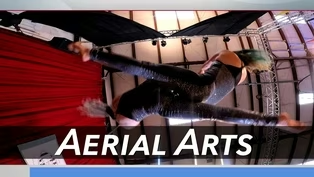
Video has Closed Captions
Clip: S9 Ep14 | 4m 19s | Bloom Movement Artistry offers classes in the aerial arts, dance, and fire breathing (4m 19s)
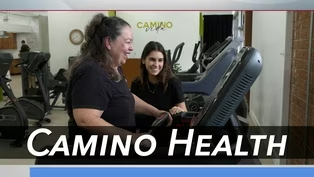
Video has Closed Captions
Clip: S9 Ep14 | 5m 22s | A local non-profit is creating access for the Latino community. (5m 22s)
Carolina Impact: January 25, 2022 Preview
Preview: S9 Ep14 | 30s | Carolina Impact: January 25, 2022 Preview (30s)
Video has Closed Captions
Clip: S9 Ep14 | 4m 55s | Move over, Uber. There's a new ride in town... and it's free! (4m 55s)

Video has Closed Captions
Clip: S9 Ep14 | 6m 10s | Businesses needing workers, and some workers needing a second chance. (6m 10s)
Providing Support for PBS.org
Learn Moreabout PBS online sponsorship
- News and Public Affairs

Top journalists deliver compelling original analysis of the hour's headlines.

- News and Public Affairs

FRONTLINE is investigative journalism that questions, explains and changes our world.












Support for PBS provided by:
Carolina Impact is a local public television program presented by PBS Charlotte