
Carolina Impact: January 31, 2023
Season 10 Episode 13 | 29m 19sVideo has Closed Captions
Letters from Vietnam, Real African Art Gallery, Fashion Re-Imagined, Tweetsie R.R.
Letters from Vietnam, Lucy's Boys Part II, Real African Art Gallery, Fashion Re-Imagined at the Mint, Tweetsie Railroad
Problems playing video? | Closed Captioning Feedback
Problems playing video? | Closed Captioning Feedback
Carolina Impact is a local public television program presented by PBS Charlotte
Carolina Impact: January 31, 2023
Season 10 Episode 13 | 29m 19sVideo has Closed Captions
Letters from Vietnam, Lucy's Boys Part II, Real African Art Gallery, Fashion Re-Imagined at the Mint, Tweetsie Railroad
Problems playing video? | Closed Captioning Feedback
How to Watch Carolina Impact
Carolina Impact is available to stream on pbs.org and the free PBS App, available on iPhone, Apple TV, Android TV, Android smartphones, Amazon Fire TV, Amazon Fire Tablet, Roku, Samsung Smart TV, and Vizio.

Introducing PBS Charlotte Passport
Now you can stream more of your favorite PBS shows including Masterpiece, NOVA, Nature, Great British Baking Show and many more — online and in the PBS Video app.Providing Support for PBS.org
Learn Moreabout PBS online sponsorship- [Announcer] Support for Carolina Impact comes from our viewers and Wells Fargo.
- [Narrator] Wells Fargo has donated $390 million.
- Honey, like I said, you get your own room.
- [Narrator] To support housing affordability solutions across America.
- You're never gonna get it!
- [Narrator] Doing gets it done.
Wells Fargo, the Bank of Doing.
- [Announcer] This is a production of PBS Charlotte.
- Just ahead on Carolina Impact.
- It's a friendship that started in wartime but lasted a lifetime.
I'm Jeff Sonier with more on our series about letters from Vietnam, part two of Lucy's Boys coming up.
- Plus we'll learn how a local art museum is helping craftsmen in Zimbabwe, and we'll give you a real Wild West experience not so far from home.
Carolina Impact starts right now.
- [Announcer] Carolina Impact, covering the issues, people and places that impact you.
This is Carolina Impact.
(energetic music) - Good evening.
Thanks so much for joining us.
I'm Amy Burkett.
A few months ago, we celebrated Veterans Day by telling you about Lucy Caldwell, a USO volunteer who wrote letters for wounded Marines in Vietnam.
Many were last letters saying goodbye to family and friends, but Lucy's letters were also often the beginning of a long road to recovery for those Marines who survived the war.
Carolina Impact's Jeff Sonier and videographer Doug Stacker have part two of Lucy's Boys, about a Statesville veteran.
- Lucy Caldwell's book published back in the seventies about her years as a USO volunteer in Vietnam is titled, "SIN One Way Economy Class," which refers to the boarding pass on Lucy's one one-way flight to Singapore, which eventually landed her in Vietnam.
It's a flight that countless Marines and Marine families are glad that Lucy Caldwell made because of the difference that Lucy Caldwell made in their lives while she was there.
(typewriter clicking) - [Narrator] On one of my last nights in NSA in early 1970, I stopped to talk with a man who lost both legs and his right arm.
He was in his early twenties.
(typewriter clicking) - [Jeff] Chapter 33 of Lucy Caldwell's book, "Willy and the Third Herd," is the heroic story of this young North Carolina corporal leading his fellow Marines through a Vietnamese ravine.
- [Narrator] They were in the bush outside An Hoa.
- [Jeff] That's not Lucy's voice you're hearing, but these are her words.
- [Narrator] Willy was from the 5th Marines and had been point man on patrol when it all happened.
(gunshots firing) - I was getting close to the time of coming home.
- [Jeff] Dale Wilson, known as Willy to his Marine platoon, isn't so young anymore, but that moment that Lucy Caldwell writes about, that memory of his last patrol in Vietnam, doesn't fade easily.
- I had my people spread out good.
Everybody's far enough away and going through the ravine.
My point man motioned the way to go, and that's when it went off.
- [Jeff] Wilson had seen this kind of Vietnamese booby trap before in these Marine training films at Parris Island, Camp Lejeune.
- [Announcer] The Viet Cong rely heavily on mines and booby traps to knock out vehicles and kill their enemies.
(explosion booming) On foot paths and trails, along hedgerows, on fence gates and on rice paddy dikes.
Many VC mines like that prepared with this mortar round are rigged for detonation with pressure type devices made of bamboo or of wood.
These are some of the explosive devices the VC plant as mines and set as booby traps.
- Best I can understand, it was commanded to detonate an artillery round, we fire stuff out and if it didn't go off they'd put a blasting cap in it and run it under the rice paddies, and there's not much way of seeing wires.
(explosion booming) All my guys were circled there.
I told them get a perimeter going.
They was all in a circle.
- [Narrator] When he had been hit, Willy's first thought had been for the platoon.
Even as parts of his body were torn from him, Willy turned back to yell a warning: "don't come near, it's okay, but stay there, leave me alone.
Don't get hurt."
- Just leave me on the poncho and this leg was gone and this one, the boot blew off, so I probably knew something was happening there, and when a hand fell off, I knew I was hit pretty good and they got me on the chopper.
The corpsman went with me and put me to sleep for the surgery.
It must have been the same night because I woke up and there was food there.
It looked like a little lady walking down the hallway there, and I thought, I was trying to eat those peas and they was going off the plate.
I said ma'am, I said, give me a hand on this supper here 'til I learned how to navigate this thing.
And she said sure, Marine, and she come over and introduced herself as Lucy Caldwell.
- [Narrator] With a smile of pure courage, Willy asked if I'd help him with his tray a corpsman was setting down.
- She helped me eat my plate there, guiding the corn and peas of all things, all part of it.
- [Narrator] After a few mouthfuls, he looked up.
"Are you the one who helps with the letters?"
"Surely am."
- Just a fine lady.
We sat there a couple hours and talked, and I asked her to write my folks a letter, because I was concerned that they'd be worried about me.
- [Narrator] So we wrote a letter to his family on a farm outside Statesville, North Carolina to tell them not to worry and that he was okay.
- That's you?
- Yeah.
- Wilson shows us his Lucy letter in this Vietnam scrapbook, a now yellowed clipping also published in the Statesville newspaper, Lucy writing to his family that "of course I stayed with Dale until he went off to sleep.
He is the most remarkable man, as you well know, and my heart aches with yours to have him so critically wounded."
You know, the honest truth is you didn't know whether you were gonna survive at that point, did you?
- There was very few that did, triple amputees.
There was very few back then.
I realized it wasn't so much about me.
It's hard to believe how hard it is on the parents and the ones behind.
- [Narrator] Then Willy asked almost shyly, "would you possibly have time to write a second one?"
"Of course, I'm all yours.
Who does this one go to?"
- Well, I wanted to write a letter to my guys back out in the bush and tell them I was doing all right and doing fine.
- [Narrator] He wanted to write back to his outfit to be even more careful, to watch every leaf, every twig, and to stay alert.
Then he wanted to tell them they were the greatest outfit and that he was thinking of them.
- I am so truly honored, and I'm so proud to stand here in front of you today.
- [Jeff] Years later, Wilson's Third Herd Marines are still close.
- The guys I served with are here today and their wives and families, so I just want to thank you again and God bless you all and thank you, and Semper Fi.
(audience applauding) - [Jeff] They joined him when Wilson won the National Disabled Veteran of the Year Award back in 2009.
And here at home, more Vietnam memories.
(gentle music) - Oh, here's some more pictures of some of my guys.
- [Jeff] But on this day, back where he belongs in Irondale County with his wife Linda at his side.
- I got my girl here.
- [Jeff] Wilson talks about his other girl, Lucy Caldwell, and their lifelong friendship that survived Vietnam, just like he did.
- What a lady there.
She meant a lot to a lot of us that knew her.
- [Narrator] Linda and Dale, and now Joshua and a tiny Stephanie are special to me as I know them so well, but there are thousands more who deserve a happy way of life.
- [Dale] She just loved her Marines and proud of them.
- I think that we never know where our influence ends, and I love the fact that we're sitting here talking about something that happened more than 50 years ago.
- [Narrator] To me, some of the obstacles looked enormous, but it never seemed to enter Dale's mind that some of his plans might have to be changed.
His spirits were always high and he made up his mind he was going to lick this thing.
- [Jeff] What's your last memory of Lucy?
- All the things that she'd done for the country and for the guys.
- Seeing her coming down that hall, that was not what you were expecting.
- No, but Lucy, she was just down to earth, but she's seen a lot more than I did during her time over there.
That was amazing.
That was just something to admire.
You don't give up and you don't quit.
(typewriter clicking) - Coming up in March, many of the wounded Marines who wrote letters with Lucy Caldwell from their Vietnam hospital beds will gather for a first ever reunion of Lucy's Boys at the Patriots Point Naval and Maritime Museum in Charleston.
We'll be there too to bring you that story.
You'll find a link to more information about Patriots Point at our website, pbscharlotte.org.
Well, the pandemic that circled the globe changed our world.
For a Zimbabwe native who called Charlotte home, the impact on his nation was devastating.
The lack of tourism along with an economy turned upside down meant families went hungry, but a local man turned things around for dozens of craftsmen.
Carolina Impact's Bea Thompson shares with us how the innovative project became a win for everyone.
(lighthearted music) - [Bea] It's the look you would expect of a high-end New York art gallery, vibrant paintings, sculptures that portray nature, a mother and child sculpture, pieces that seem to come to life, pieces that bring to mind a certain artistic yet quite bohemian lifestyle.
But this art has a higher meaning and purpose.
It sustains the lives of families and individuals in small towns in Zimbabwe on the east coast of Africa.
- The need to support my fellow Zimbabwean countrymen who are artists in this business is a founding stone on how I got here in principle.
- [Bea] Meet Cal Ganda.
The newly minted gallery owner came to the United States more than two decades ago to attend UNC Pembroke.
But two years ago, a global health crisis became the impetus for a gallery with a purpose.
- With the pandemic, most of these artists were not getting the traffic through tourism that they typically would have gotten in normal times.
So when I went home in August, 2020, the pandemic was basically at its height and the suffering of my people actually drove me into considering a way that I could support them at a larger scale.
- [Bea] And this is where it all begins, native Zimbabweans using natural resources to support themselves and their families.
You could call it nature's gift to the artisans.
- [Cal] Zimbabwe, you may or may not know, but the name of the country means house of stone.
So dzimba, it's house, ibwe, it's stone.
Most of what I have in the gallery, what I call Shona stone sculptures, and this is a staple of art within the country of Zimbabwe.
- When I talk about art, it's in me, it's in my veins, in my blood.
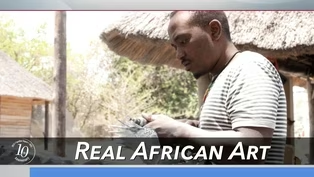
(drill buzzing) - [Bea] He is one of more than several dozen artists whose works are displayed in the Real African Art Gallery.
He learned the art of stonework from a neighbor who was a craftsman.
Now as an artist, his knowledge of that craft provides for his family.
- To give my family, to take care of my parents, my mother in her area and some brothers and sisters around me and my relatives close to me and taking care of them also.
- [Bea] Future generations know of animals that may vanish before they ever see them.
- If I do an elephant on a stone, some generations to come, they will see the type of elephant.
So after some centuries, people will know there was an elephant here.
(pleasant music) - [Bea] In the gallery, you can see the elephants and other rare endangered animals memorialized through art.
For its part, the gallery works directly with these artists to make sure they are compensated.
- [Cal] We don't have a middleman.
We are buying this piece of art directly from the artists themselves.
Second point, we pay our artists about fair market prices.
- [Bea] And just as each piece reflects the artistry of the craftsman, each artist has his own story.
- I'm the last born in a family of nine.
I started stone carving at a tender age.
- [Bea] Inspired by men in his community, this last son and the family took his art in the direction of nature.
- I'm also inspired by nature and day by day living to do my artworks, showing the messages of love, peace and togetherness.
- [Bea] Look closely in the gallery and you will see where artists have signed their pieces, giving them a sense of ownership of their works while letting the world know their names.
- [Cal] It's important that people know who's making their art.
On our website, we give them full credit, they write their own biography so people get to know who they are.
- [Bea] For the past two years, Ganda and his brother have imported the art to America and Charlotte to display and sell in the gallery.
During that time, more than $70,000 have been returned to the pockets of the artists.
For many, knowing their art is traveling across the globe has signaled a change.
- Working with the Real African Art, they have changed my sales in my career and even changed my life.
- Here I am in Zimbabwe in Africa, but my art and sculpture is being sold in America, so it's important in my career, my talent.
- [Bea] And that talent, along with art in many forms, now graces homes across the region.
But for the man who came to the United States to go to school, who played soccer, but whose loyalty was to aid his countrymen, this gallery is doing more than just keeping up with art trends.
- Honestly speaking, at the end of the day, the amount of people that I can lift out of poverty through this venture will tell me how much I would have succeeded.
On the other hand, if I can also share my culture and my heritage through art with this part of the world, I believe I would have succeeded.
- [Bea] When the goal is to turn a simple stone into a sculpture or vibrant colors on a canvas into art that connects the world while uplifting those families economically, then the formula of success for this venture has apparently been found.
For Carolina Impact, I'm Bea Thompson.
- Thank you so much, Bea.
The gallery is open 11:00 a.m. to 7:00 p.m. most days.
When we think of the word art, most people often think about paintings or drawings, maybe sculptures, but there's no true definition of what constitutes art.
I've always seen clothing as art, too.
Carolina Impact's Jason Terzis takes us to the Mint Museum for its Fashion Reimagined exhibit.
(exciting music) - [Jason] It's the Mint Museum's newest exhibit, featuring some of the oldest clothes you may ever see.
Fashion Reimagined, a historical perspective of clothing styles and designers from the 1700s to modern times, now on display at the Mint Museum's uptown location at the Levine Center for the Arts.
- This is a very lively and dynamic gallery, and you have a feeling of joy and happiness here.
- [Jason] Mint supporters and local media members recently attended the exhibit's grand opening in which Fashion Reimagined does its best to once again show that fashion is indeed an expression of art.
- The collection was built by this group of women who recognized that fashion was a really important design, craft and art form.
- [Jason] The exhibit is divided into three distinct themed sections, minimalism, pattern and decoration, and the body reimagined, with each piece showing the designer, timeframe it was produced and what the garment was intended for.
- The fabric here in this ensemble from about 1770, the beautiful beige wool was one of the greatest luxury products being produced in Britain at the time.
- [Jason] The exhibit is being done in conjunction to celebrate the 50th anniversary of the men's fashion collection's founding in 1972.
- We've got between about 8,000 and 10,000 items, so obviously that would be very hard to display all in one gallery.
- This is only 50 of over nearly 8,000 extraordinary examples of really masterworks of design, but also we wanted 50 fashions to celebrate the 50th anniversary of the founding of the collection.
- [Jason] The collection began with local family heirlooms, donated old clothes people found in their attics and basements.
- Three members of the Women's Auxiliary, it's now called the Mint Museum Auxiliary.
They were inspired by the historic costume collection at Reynolda House Museum in Winston-Salem.
- [Jason] And over these last five decades, it's evolved into one of the largest collections in the southeast.
- They were mostly receiving donations until about 1991.
- And then gradually, the museum itself began to strategically build the collection through purchases, most of which were funded by the Mint Museum Auxiliary.
- [Jason] As you might imagine though, caring for and preserving the garments is a job in and of itself.
- They're either stored flat in acid-free archival materials.
Some of them are hanging with supports, but in every case they are sort of like deflated sculptures.
- [Jason] With thousands of choices, deciding which outfits to showcase at Fashion Reimagined was pretty taxing to say the least, and then getting those selected pieces ready to be put on display presented its own set of challenges.
- As a conservator, my philosophy is basically do the least amount of work on a garment.
One of the garments, the front panel of the skirt had a stain on it that had eaten through the fabric, so there was a hole in it, and so I went back to New York and I had someone hand dye some silk to match the fabric and I replaced that old silk.
- She makes the curator's dream and the fashion history manifest.
- It wasn't just one time period that we were dealing with that we sort of could do in an assembly line.
Each garment, because they were so different, you had to kind of approach in a completely different way.
- [Jason] The Mint's library keeps a scrapbook filled with newspaper articles, magazine write-ups and pictures from local morning TV talk shows all about the collection from the last 50 years.
- In earlier times, there was a lot more coverage of our fashion collection in the paper.
- [Jason] What's perhaps most interesting is the Mint's collection is almost better well known within the fashion industry outside of Charlotte than it is right here at home.
- The Mint's fashion collection is full of extraordinary objects, objects that are rare that you don't find in other museums.
Again, it's like Charlotte's secret.
- As Charlotte has grown and all these people from other places have come in, a lot of the pieces of our history have kind of sunk into the background.
People just don't know, and we are moving so fast that we forget to tell the story.
- [Jason] And that's part of the reason why we're telling the story now.
- I think it's huge for us to be able to tell the story, because this is a part of our history.
- [Jason] Whether you call them works of art or not, Fashion Reimagined is on display now for all to see.
For Carolina Impact, I'm Jason Terzis reporting.
- I just love looking at all those fashions.
Thanks so much, Jason.
The Mint's Fashion Reimagined exhibit remains on display through July 2nd.
Do you like old cowboy movies?
My 90-year-old mom still loves them.
You can be a part of your own western just a short drive away.
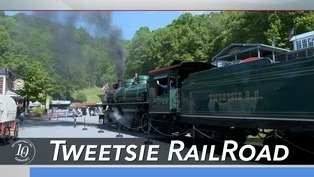
Jason Terzis is back, and with the help of producer John Branscomb, they take us all aboard a trip to Tweetsie Railroad near Blowing Rock.
(whistle blowing) - [Jason] Welcome aboard The Tweetsie Railroad, located between Boone and Blowing Rock.
- What people expect is an exciting, Wild West experience on the train.
Keep your eyes peeled.
Our Number 12 locomotive is 107 years old.
They can see it, they can smell it, they can hear it.
There are cowboys, there's actions, there's horses.
I am Chris Robbins, President of Tweetsie Railroad.
It's fun.
You can be a cowboy, you can be a locomotive engineer, you can be a conductor.
Kids can live out their fantasy here.
- [Jason] The Tweetsie Railroad as we know it today holds a unique place not only in North Carolina's history, but American history.
- Tweetsie Railroad is North Carolina's first theme park.
In fact, it was one of the first theme parks in America, and a lot of Wild West theme parks cropped up in the late 1950s and sixties, 'cause every show on television was a Western.
- [Jason] In the era of mega theme parks owned by corporations, Tweetsie stands out as a throwback of sorts.
- Many Wild West theme parks have come and gone over the years.
Most of them are gone, but we still survive.
My uncle and father started it back in 1956.
They acquired the locomotive, had it restored down the southern railroad shops in Hickory, North Carolina, brought it up here in 1957 and the park opened July 4th, 1957.
We have our Number 12 locomotive, which they call the Tweetsie locomotive.
That's the only surviving locomotive with the East Tennessee and Western North Carolina Railroad that ran from Johnson City to Boone, North Carolina every day from about 1918 to 1940.
- [Jason] The Eastern Tennessee and Western North Carolina Railroad retired the Number 12 locomotive in 1940, but continued operating the route for another decade.
A unique feature of the old railroad, it used narrow gauge trains and track.
- A narrow gauge train can go around tighter turns than a standard gauge train can, and everything can be a little narrower so you don't have to cut as wide a path into the mountains or cut as big a tunnel.
(exciting music) - [Jason] As you might imagine, not just anyone can make their way into the cab to take the reins of one of these historic iron horses.
- [DJ] I've been playing trains about 10 years.
- [Jason] Meet Tweetsie engineer DJ Romine.
- That picture was made about 20 years ago.
The guy on the right is the engineer.
His name is Matt Ernst.
He's our current Director of Engineering.
Of course, back then I was just a little kid really interested in the train and Tweetsie Railroad.
It's a great privilege to say I'm one of the Tweetsie engineers.
- [Jason] The locomotives devour shovels of coal like kids eat candy, and you won't find anything electronic on any of them.
Everything is mechanical, and that means maintenance, and a lot of it.
- [Chris] Our Number 12 locomotive is 105 years old.
Our Number 190 locomotive was built in 1943.
The thing is, you gotta keep them up.
- [Jason] Director of Engineering Matt Ernst describes the work best.
- A lot of work, everything with a steam locomotive is either hot, heavy or dirty, or sometimes all three.
We do an intense amount of preventive maintenance.
It's a continuous process and we stay on top of it.
- [Jason] He says to make repairs, you simply can't just go to the store for parts.
- We make virtually every part that's on it with the equipment we have here in the shop.
We've got some large lathes that also date back to the steam locomotive's heyday.
There's no CNC modern computerized machinery in the shop.
(whistle blowing) - [Jason] Now remember, a trip to Tweetsie is more than just a ride on a classic train.
Tweetsie sticks to its roots as a Wild West theme park.
- My name is Texas Pete, and this is my best friend, Tabasco.
- [Jason] Passengers get treated to a full on Wild, Wild West show.
- There's enough for everybody.
Some people like funny shows, some people want the action.
Try to make sure we get a good mix of that for everyone to be able to enjoy, some big spectacle going on and things like that too, just to kind of entertain the kids of all ages.
- There's so many sensory things going on with the rides and with the train and then with the entertainers.
You can't be a passive guest here at Tweetsie.
- Getting my grandkids off of those phones is a big deal to me, so bringing them here, that was part of the plan.
- Did you have fun today?
- Yeah.
- Very fun.
His first time here as well.
(exciting music) - [Jason] Tweetsie offers more than just train rides and the Wild West show.
There's a petting zoo, gold panning, saloon shows and other classic rides for kids of all ages.
According to Robbins, the park annually attracts around a quarter million visitors, and credits sticking to what they know best for the park's success.
- I think just staying true to our mission, making it fun, keeping it fun, wanting to keep it running.
North Carolina's growing, that helps.
Seems like Charlotte and Raleigh and Winston-Salem are all booming, bringing new people into the state, some of them who have never been to Tweetsie Railroad.
A lot of these people came here to Tweetsie Railroad when they were kids.
Now they're bringing their kids or their grandkids, but we're also introducing it to new audiences.
- [Jason] For Carolina Impact, I'm Jason Terzis reporting.
- Thank you, Jason.
It just looked so darn fun.
Tweetsie Railroad operates on a seasonal schedule starting in April and offers a ghost train in the fall, followed by a Christmas themed train every December.
Well, we'd love your feedback on tonight's show and your story ideas.
You can send both to feedback@wtvi.org.
Thanks so much for joining us.
We always appreciate your time and look forward to seeing you back here again next time on Carolina Impact.
Goodnight, my friends.
(energetic music) - [Announcer] A production of PBS Charlotte.
Support for Carolina Impact comes from our viewers and Wells Fargo.
- [Narrator] Wells Fargo has donated $390 million.
- Honey, like I said, you get your own room.
- [Narrator] To support housing affordability solutions across America.
- You're never gonna get it!
- [Narrator] Doing gets it done.
Wells Fargo, the Bank of Doing.
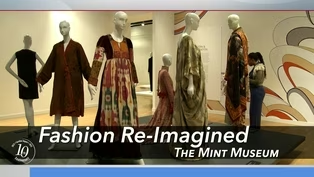
Fashion Re-Imagined at the MINT Museum
Video has Closed Captions
Clip: S10 Ep13 | 5m 20s | A sneak peak at The Mint Museum's latest exhibition: Fashion Re-imagined. (5m 20s)
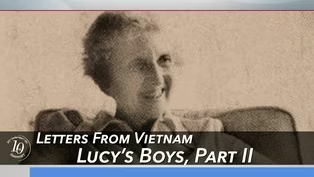
Letters from Vietnam: Lucy's Boys Part 2
Video has Closed Captions
Clip: S10 Ep13 | 8m 20s | 'My heart aches with yours.' Wounded Marines remember 'Lucy's letters' from Vietnam. (8m 20s)
Video has Closed Captions
Clip: S10 Ep13 | 6m 13s | Cal Ganda, from Zimbabwe, uses this gallery to help support artists from his country (6m 13s)
Video has Closed Captions
Clip: S10 Ep13 | 5m 2s | Experience a wild west adventure while riding the Tweetsie Railroad near Blowing Rock. (5m 2s)
Providing Support for PBS.org
Learn Moreabout PBS online sponsorship
- News and Public Affairs

Top journalists deliver compelling original analysis of the hour's headlines.

- News and Public Affairs

FRONTLINE is investigative journalism that questions, explains and changes our world.












Support for PBS provided by:
Carolina Impact is a local public television program presented by PBS Charlotte