Carolina Impact: January 10, 2023
Season 10 Episode 10 | 28m 10sVideo has Closed Captions
5 new CMS school board member, Round-Abouts, Charlotte Art League, Morrow Mtn State Park
Five new CMS school board members, Round-Abouts in NC, Charlotte Art League, Morrow Mtn State Park
Problems playing video? | Closed Captioning Feedback
Problems playing video? | Closed Captioning Feedback
Carolina Impact is a local public television program presented by PBS Charlotte
Carolina Impact: January 10, 2023
Season 10 Episode 10 | 28m 10sVideo has Closed Captions
Five new CMS school board members, Round-Abouts in NC, Charlotte Art League, Morrow Mtn State Park
Problems playing video? | Closed Captioning Feedback
How to Watch Carolina Impact
Carolina Impact is available to stream on pbs.org and the free PBS App, available on iPhone, Apple TV, Android TV, Android smartphones, Amazon Fire TV, Amazon Fire Tablet, Roku, Samsung Smart TV, and Vizio.
Introducing PBS Charlotte Passport
Now you can stream more of your favorite PBS shows including Masterpiece, NOVA, Nature, Great British Baking Show and many more — online and in the PBS Video app.Providing Support for PBS.org
Learn Moreabout PBS online sponsorshipSupport for Carolina Impact comes from our viewers and Wells Fargo (VO) Wells Fargo, has donated 390 million dollars... (Mom) Honey like I said, you get your own room.
(VO) to support housing affordability solutions across America.
Doing gets it done.
Wells Fargo, the bank of doing.
- [Narrator] This is a production of PBS Charlotte.
- Just ahead on "Carolina Impact."
- [Jeff S.] Can parent power fix what's wrong with Charlotte Mecklenburg schools?
I'm Jeff Sonier with more on the newly elected moms and dads winning seats on the CMS school board.
- [Amy] Plus drivers growing weary over traffic delays.
Could roundabouts ease their pain?
And how one organization uses affordable space to help local artists keep the creativity flowing.
"Carolina Impact" starts right now.
- [Narrator] "Carolina Impact" covering the issues, people and places that impact you.
This is "Carolina Impact."
(flourishing music) - Good evening, thanks so much for joining us.
I'm Amy Burkett.
Change is coming at CMS, and Charlotte Mecklenburg School parents say, it's about time.
After years of falling test scores, failing low income schools, and firing school superintendents, five new school board members were chosen by the voters on election day.
So what does this new school board majority mean for the future of Charlotte Mecklenburg schools?
"Carolina Impact's" Jeff Sonier and video journalist Doug Stacker have more on the growing power of parents in CMS politics.
- Yeah, it's appropriate that so many CMS campuses also double as polling places on election day, especially this past election last November since four out of five newly elected school board members also currently have kids at CMS.
Plus, lots more voters showed up in November Normally, turn-out for a for a school board race is around 20% This past election it was almost 45% And apparently many of those school board voters, were looking for something or somebody different.
(gentle inquisitive music) - I think it's different because people want change.
- [Jeff S.] Stephanie Sneed joins the CMS school board.
- Hi, I am the reason why my mommy, Stephanie Sneed is running for school board.
- [Jeff S.] After campaigning as a CMS school parent.
- [Claire] If you want our kids to read, please vote for Sneed.
- Okay, (laughs) that's good.
- Thank you.
- Okay, thank you.
- When we're talking about that target age, third grade reading, those third grade reading numbers include my son.
- [Jeff S.] It really changes your perspective, doesn't it?
- [Stephanie] I think it does.
My perspective is not from 20 years ago or anything like that.
This is what I'm living now.
- [Jeff S.] And Sneed's not the only one.
New district one school board member Melissa Easley is a current CMS mom too.
So is new district six school board member, Summer Nunn.
In district three, new school board member Dee Rankin is a current CMS Dad.
- Thanks for coming.
- [Jeff S.] With lots of other CMS parents volunteering in those school board races.
- [Claire] Hi, ma'am.
My name's Claire.
I'm a CMS mom and I'm supporting Stephanie Sneed.
- Okay.
- [Jeff S.] To help their fellow CMS parents win those school board races.
- She has a son in the school system and she's an amazing attorney, so we would love to have you vote.
- [Claire] Well, I think that the parents are very fed up with the performance of the schools in our district and in particular with how far behind their children have fallen.
- Yeah, I think too, people had a chance with COVID-19 to sit at home and really see what was going on in the school system.
- The same thing we are asking is two times anything, 23.
- [Angela] They sit there with their children, they see how teachers taught.
- Six divided by two equals one.
- [Angela] It opened up a lot of people's eyes, and they wanted something different coming out of this, and they say, "Hey, we need a change.
My child needs a change."
- [Jeff S.] That call for change was amplified by digital billboards on busy Charlotte highways, paid for by newly formed parent political groups with changing messages about how many CMS schools were performing poorly and which current school board members voted to keep classrooms closed and empty.
- [Stephanie] I think what's different this time is that COVID exposed to us the gaps.
Even people that thought their children performance was okay, they might have figured out that maybe not, maybe I should be concerned.
- [Jeff S.] Sneed says that after COVID, failing students at poorly performing Charlotte Mecklenburg schools, went from being someone else's problem to, well, everybody's problem.
- [Frank] What we did is what we thought was best at the time and we're investing to help accelerate their recovery.
- [Jeff S.] And Sneed adds that parents aren't satisfied anymore with the answers they're getting from CMS about those falling test scores.
- That we're recovering faster than our peers.
But we need to wrap our arms around schools, not try to tear them down.
- [Jeff S.] Yeah, nobody's wrapping their arms around leadership though, and that's the problem I suppose.
- You know what, I care most about our teachers, our principals and the students they serve and the families they're from.
And if someone doesn't wrap their arms around us as leaders, that is what it is.
- Can't keep doing the same thing.
I mean, if it's bad, say it's bad and say this is bad and this is what we're going to do about it.
- I think parents are looking for honesty, as well as transparency.
They're not looking for the political answer to the educational question anymore.
- I think the message is is that it's time for change, that we have to have new leadership that is going to be laser focused on student outcomes and laser focused on the issues that parents care about.
- [Jeff S.] And that next laser focused issue for CMS parents is choosing a new CMS superintendent.
- I'll answer that for you.
- [Jeff S.] After interim superintendent Hugh Hattabaugh announced right after the election his early resignation at the end of 2022, for personal reasons.
- I just wanna be clear, it's not an easy job.
- [Jeff S.] Only eight months after the last CMS superintendent, Earnest Winston was fired by the school board.
- So at some point the board may say, "Well, your four years have been enough."
- [Jeff S.] And the superintendent before that, Clayton Wilcox, well, it was three years ago when he resigned too under pressure from the school board.
So there's a real opportunity for this next school board to affect change, real change going forward, right?
- Yes, absolutely.
That's one of the things that I've been talking about is that we have to get this right, you know what I mean?
We have been on a revolving door of superintendents, which is decimating the system.
We have to get someone who's going to consistently be there, who has the vision and the capability to move us, move us forward.
- [Jeff S.] Now for this story, we also talked with one of the CMS school board challengers who didn't win on election night.
Reverend Monte Witherspoon is the pastor at Steele Creek AME Zion Church and also a member of the African American Faith Alliance.
That's a clergy group that's been critical of CMS in the past as they try to improve minority schools and empower minority parents.
- I talk to parents who are absolutely fearful and terrified about the future of their students in CMS, whether it's from disciplinary issues to, to curriculum, whatever the case may be, how they label their children, all these issues, and just the failure rate.
I think parents and our citizens who are saying enough is enough, I think they want just a new voice, new ideas at the table, new energy and a common sense of purpose and direction.
- Yeah, lots of new voices and ideas and energy at the table now after the election.
It'll be interesting to see how much of a voice those outside groups like the Faith Alliance have, now that theres a new school board majority, and also, how will the new majority interact with those old school board holdovers, that they were critical of, during the campaign.
By the way, three out of four of the school board hold-overs, well, they face reelection this coming November.
Amy.
- Thank you, Jeff.
In Charlotte Mecklenburg, school board election results dating back to the early 2000s show only two incumbent school board members defeated for reelection over the past 20 years, compared to this most recent school board race with three out of four incumbents all losing on the same night.
Did you know North Carolina ranks number two among the states with the most roundabouts?
Engineers say there are about 500 statewide.
Transportation officials introduced roundabouts in 2000 as a traffic solution.
"Carolina Impact's" Coleen Harry takes a look at why some Weddington residents say they want a roundabout of their own.
(gentle pop music) - [Coleen] If you've driven anywhere in the greater Charlotte area, you understand how this driver feels.
- You sit there for a long time and you think, well, it's my turn, but your turn doesn't come for a long time here 'cause there is a lot of traffic on this road.
It's unbelievable.
- [Coleen] At this spot in Charlotte, Oakdale, Sunset, Miranda, Lawing and Simpson Roads all meet.
- It is absolutely the worst.
(horn beeps) - [Coleen] It's near William Wilson's house.
- And you really have to have your head on a swivel to get out of here safely.
It's really tough.
- [Coleen] It drives him crazy.
- [William] Look at it, look at the traffic.
It's backed up.
You got traffic turning in.
You got a guy coming out of this one.
You got people coming.
It's a mess.
(laughing) It's a mess.
(soft mellow music) - [Coleen] Meanwhile, in Union County, the Ranjana family in Weddington has been there and done that with terrible intersections.
These days though, the stop at Tilly Morris in Weddington Matthews Road near their house is heavenly.
Finally.
- [Suprita] I love it.
I love that it's there now.
I don't even have to wait even for 30 seconds, I would say.
(funky pop music) ♪ I'll be the roundabout ♪ The one to make you out and out ♪ - [Coleen] That's because there's now a roundabout.
After three months of construction, it opened in August and traffic flows.
There's no long wait, no heads on a swivel.
For drivers here, this is a far cry from what they dealt with when this was a regular intersection.
- [Suprita] It was a nightmare.
Maximum, I have, I think, waited for five minutes, I would say.
Someone comes and gives you... Out of courtesy, they would come and give you like, okay, go now.
Otherwise it's hard.
(soft tense music) - [Sean] It's one of the busier intersections.
A lot of people live in Union County, but work in Mecklenburg County.
Mecklenburg County is maybe a mile that direction.
So this is one of the main ways into town, so that creates all that traffic volumes on Matthews Weddington Road.
- [Coleen] Engineers proposed the roundabout after Weddington leaders heard complaints from residents and asked the state to help ease the congestion.
The whole process took about six years and cost about $2.6 million, paid for with federal and local money.
Was it money well spent?
- I think everyone is enjoying the roundabout for sure.
- It should help provide a more reliable travel time for motors.
When they get the intersection, instead of having to wait and wait and wait and find those safe gaps in traffic, they should be able to just flow on through much more smoothly, much more on time, and more safely as well.
(pulsating pop music) - [Coleen] What you see here is part of a statewide move by transportation officials to put a roundabout at tricky intersections.
In fact, North Carolina has the second most roundabouts in the US.
Why did the state move to roundabouts?
- Yeah, roundabouts are mostly for safety.
They are superb for safety.
- [Coleen] A traffic management engineer, he says roundabouts reduce crashes because drivers are moving slowly.
But not every intersection is getting a roundabout.
State officials say it's expensive to install one, can run as much as $6 million, mainly because of real estate and utility costs.
- [Joe] It is not an easy answer.
We have to put the right design in the right place to get the best benefits.
- [Reporter] The multi-lane roundabout is designed to safely handle more traffic at busier crossroads.
- [Coleen] So they tend to put roundabouts where two medium-size streets that have two lanes meet with moderate traffic.
- [Joe] Our process for finding good places is led by communities, cities, planning organizations, and then, in turn they're getting input from citizens who say, "Hey, we got a problem here."
- And let me tell you, right here on Miranda Road, you better be going that way because if you're trying to go this way, you can't get out.
Literally they need a roundabout, a light, something.
- [Coleen] Remember that intersection in Charlotte where five roads converge?
The state is planning to put two roundabouts.
- Thank God.
- It can't get any worse.
It has to help.
So yeah, yeah, it'll be a good thing.
See ya.
- [Coleen] Frustrated waiting for an opening so he could turn, William cut through a parking lot.
He knows the roundabouts won't be here soon, but he can't wait for them to ease the anxiety.
- It takes us a little while to learn, but we figure it out and we're much kinder.
We're kinder, gentler people when we have a roundabout.
(laughs) - [Coleen] One more reason drivers are looking forward to seeing more.
For "Carolina Impact," I'm Coleen Harry.
- Thank you, Coleen.
Transportation officials say because roundabouts are so expensive, they're considering minimizing future costs by installing what they call mini roundabouts, which they tell us are considerably cheaper and cost about a third less than the average $6 million roundabout.
Well, with inflation up, the cost of space is also high.
According to the Consumer Price Index, inflation jumped just over 8% over the last 12 months.
Whether it's home prices, rent for apartments or office space, prices have surged since the pandemic.
When it comes to artists, one local organization wants to keep rental prices in check so creativity doesn't suffer.
"Caroline Impact's" Jason Terzis introduces us to the Charlotte Art League.
(lively percussive music) - [Jason] With big sweeping strokes, Joseph Medina DaSilva creates his latest abstract.
- It's one of the greatest things that happened to this side of town.
- [Jason] Across the way, Tanya Murphy delicately adds a clear coat layer to her painted wood houses.
- I've been an artist my whole life.
- [Jason] Walter Sanders, meanwhile, adds some accent colors to his painting.
- It's such a delight to be here.
- [Jason] While Kelli Horne creates her latest work of art from the comfort of a La-Z-Boy.
- I've been picked on about the chair.
Yes, I know.
I don't stand to paint.
- [Jason] And it's all taking place at the Charlotte Art League.
- There are some really great visionaries that came up with this concept.
- It is a destination.
- [Jason] The main goal of the Art League, bringing people together through the creative process, art aficionados and the artists themselves.
- We are a non-profit arts organization that's been around for 55 years, and a lot of people still walk through the door and say, "We didn't even know you guys existed."
- It's about building community and it is about bringing in artists to not only learn, but also to showcase their talents.
(low jazz music) - [Jason] Think of the Art League as a working co-op of sorts, individual artists creating in mini studios, all under one roof.
- The gallery systems are great, but what's good about this is, this is community based.
- And we're all in the same boat.
We're just trying to have some fun and get better at what we do.
So this is a perfect place to do it.
- [Jason] For its first several decades, the Art League was located in South End.
But with all the redevelopment happening there, the league was forced out by higher rents.
They're now in a new location on Charlotte's north side near NoDa.
- And I'm finding in the short time that I have been here with the Charlotte Art League, that this is a real sense of community where not only the artists are coming together, but business owners are coming together, and they're collaborating more.
They're trying to figure out ways to not only grow their art business, but also their just business as entrepreneurs in general.
- [Jason] Attached to the Independent Picture House, the Art League's new space offers more than just studios for artists.
There's gallery and performance space and a separate area for creatives of a different variety.
- And they added an extra component where is, where it is art meeting technology, and that has to do with the Digital Arts Accelerator space where we're in right now.
- We have a coworking space for 13 digital artists, a photo video studio, a high-tech conference room, two podcast booths.
We've got filmmakers upstairs, we've got poets, we have photographers.
Yeah, you name it.
- This space is really designed to bring community members in so that they can learn and participate and develop a community in digital arts.
- The leadership here is all about giving back.
So this beautiful building is open to community organizations, constantly hosting things, exposing young people, old people to art, to the excitement of creation.
- [Jason] The highest monthly rent for studio space at the Art League is a modest $285 a month.
But still, why would artists choose to pay for a space when most could probably just as easily work out of their own homes, an extra bedroom, garage, basement, or a bonus room?
- [Tanya] I tried doing my artwork at home, and what I'd end up doing was my laundry, (chuckles) vacuuming, cooking, things like that.
- Art's great at home.
I love to paint at home, but it's just not the same at all.
- I get to leave my house, come here, make a mess.
It's a small condo.
Look at all this stuff.
- We do get a little bit more exposure, and that's one of the things that most artists like myself need is exposure.
And we get that here because we have a lot of people walking through.
- That's what you come here for, to be around other people who love it and who you can get input from and energy from and give them energy and to be, to be part of the creative world.
- [Jason] Space in the new facility is in high demand.
The wait list sits at 30 people all trying to get one of the coveted 58 studio spots.
- [Bridget] In Charlotte the thing that's missing is affordable workspace, is affordable art studio spaces.
- [Jason] The Art League is doing what it can to make Charlotte a more well-rounded city, offering classes, workshops, and STEM programs for kids.
The hope is to one day be thought of in the same vein as places like the Mint Museum.
- We have a very large creative community in Charlotte.
We just aren't getting that air time.
- We needed this.
Artists are always looking for homes, places to work, places to show their work, and I think that the group of people behind Charlotte Art League brought that to us.
- [Jason] Keeping the creative juices flowing, one artist at a time.
For Carolina Impact, I'm Jason Terzis reporting.
- Thank you, Jason.
The Charlotte Art League is free and open to the public Thursdays through Sundays from 1:00 to 7:00 PM.
If you're looking for a unique day trip, combining history with the outdoors, we've got just the place for you.
It's about an hour from Charlotte and dates back some 12,000 years.
"Carolina Impact's" Jason Terzis is back with a one-tank trip to Morrow Mountain State Park in Stanley County.
(gentle guitar strumming) - [Jason] Naturalist John Muir once said, "The mountains are calling and I must go."
For folks in the Charlotte region who answer that call, often that means a trip to the Blue Ridge Mountains of western North Carolina.
But to the east in Stanley County, there's another option.
- [Jeff D.] We're at Morrow Mountain State Park right in the middle of the Uwharrie mountain range that goes up through the middle of North Carolina.
- [Vanessa] It's beautiful, it's tranquil.
- [Jason] Somewhere around half a million visitors pass through the gates at Morrow Mountain State Park each year.
Visitors like Vanessa Mullinix.
- [Vanessa] I call it decompression, to hear the animals and the birds and play.
I grew up playing in the woods, so I love it.
- [Jason] Inside the nearly 6,000 acre park, you'll find plenty of things to do.
- [Jeff D.] There's a lot of opportunity for exploring.
You can come visit some of the historic sites.
We have a natural history museum where you could come and you can see the geology.
You can see the Native American history, the early settler history, the natural history of what animals are found in the park today.
- [Jason] Morrow Mountain State Park was created in 1935, the same year President Franklin D. Roosevelt signed the Social Security Act into law, Amelia Earhart became the first person to fly solo from Hawaii to the United States mainland, and baseball player Babe Ruth retired.
- Morrow Mountain State Park was the third state park in North Carolina following Mount Mitchell State Park that was created in 1916.
Fort Macon came shortly after that.
- [Jason] The mountain hasn't always been called Morrow Mountain.
That name came when James Morrow purchased the property at auction with plans to create a tourist attraction by charging folks to drive up to the top.
- [Jeff D.] So he would charge people 50 cent a car to travel up to the top of his mountain.
He called it Morrow's Mountain with a possessive S, and it became a local landmark.
- [Jason] The early construction of Morrow Mountain State Park benefited from two Depression-era work programs.
- [Jeff S.] Under FDR'S New Deal process, they were able to create the Civilian Conservation Core, the CCC and the WPA, the Works Progress Administration to try to pull people out of the Depression.
- [Jason] You'll find examples of the CCC and WPA's work throughout the park.
- [Jeff D.] A lot of this infrastructure that we find in state parks is commonly referred to as parkitecture.
They used a lot of the natural stone that's found locally.
They used a lot of the wood from the park areas and surrounding areas to build structures that blend in well to the natural environment.
WPA built the park swimming pool.
They built the lodge and the office.
It was called Uwharrie Lodge at the time.
- [Jason] The park proudly highlights the connection to the Depression-era work programs.
- That's what makes Morrow Mountain special.
When you ride around and you see the stone walls and you see the buildings built of stone, these buildings that blend in, that is a reflection of the CCC and WPA under FDR'S New Deal.
- [Jason] There's about 500 million years of geologic history in the Uwharrie mountain range.
- [Jeff D.] Some geologists argue that the Uwharrie range could be the oldest mountains in the world.
- [Jason] The unique geology attracted Native Americans to Morrow Mountain for thousands of years.
- [Jeff D.] The top of Morrow Mountain is an old native American quarry, considered by many archeologists to be one of the most significant quarry sites for Native Americans in North America.
They would chip off chunks of rock.
They would work it down to rough pieces, and then take it down later and work it into tools or what we now know as arrowheads or spear points or scrapers.
- [Jason] Arrowheads like these and other significant artifacts have been discovered near Morrow Mountain at what's known as the Hardaway Site, but the site is currently off limits to the public.
- [Jeff D.] They worked it down by soil level, so when they would find a projectile point in a certain soil level, they were able to put an age to it.
The artifacts that they actually excavated and removed were sent to Chapel Hill to be further studied, and they're still studied to this day.
- [Jason] The natural resources that attracted Native Americans to the region were documented by 18th century European Explorer, John Lawson.
- [Jeff D.] When John Lawson came through in the 1700s, he described bison being in the area, elk being in the area, black bears, tundra swans, passenger pigeons, which are extinct today.
This area looked a lot different than it does now.
- [Jason] Lawson's account of the area's abundant resources attracted European settlers to the area.
Welcome to the historic Kron family homestead.
- [Jeff D.] The Kron family moved to this region in the early 1800s.
They moved here because Dr. Francis Kron from Prussia, who had met his wife in Paris, moved here because his wife Mary had a rich relative, Henry Delamothe who lived here.
He was into the gold business.
Dr. Kron was not a doctor at the time.
He was an expert of languages.
He taught at UNC Chapel Hill.
He taught in New Bern, he taught in Salisbury.
As he continued to teach, he realized there wasn't a whole lot of money in teaching, so he decided to try to become a physician.
He was considered to be one of the first doctors in the southern Piedmont of North Carolina.
He made his own concoction of medicines.
Dr. Kron was also a very well known horticulturalist.
He grew things such as oranges and pineapples, and people around here never seen asparagus or broccoli.
What he also did was he documented the challenges he had.
His documentation is still used today by many horticulturalists.
- [Jason] In the mid-20th century, the park recreated the buildings, which the family lived and worked.
- [Jeff D.] Walk up, and it's a reflection of what life may have looked like in the 1800s.
You have an old cabin style house.
There's a few old trees.
There's an old magnolia tree that Dr. Kron planted in the 1800s.
There's a Japanese chestnut tree that sits behind the Kron house that was planted by Dr. Kron that still stands.
It's a state champion tree.
Just to imagine that area in the 1800s and how people lived is just something to fathom.
- [Jason] From the Native American sites, the Kron family homestead, classic Depression-era park buildings, vast natural and cultural history, paired with camping, hiking, and boating, there's a little bit of everything through the gate at Morrow Mountain State Park.
For "Caroline Impact," I'm Jason Terzis reporting.
- Thanks, Jason.
Morrow Mountain State Park is free and stays open year round with the exception of Christmas.
Well, before we head out tonight, we'd love your feedback and your story ideas.
You can send both to feedback@wtvi.org.
That's all the time we have tonight.
Thanks so much for joining us.
We always appreciate your time and look forward to seeing you back here again next time.
Good night, my friends.
(flourishing music) - [Narrator] A production of PBS Charlotte.
Support for Carolina Impact comes from our viewers and Wells Fargo (VO) Wells Fargo, has donated 390 million dollars... (Mom) Honey like I said, you get your own room.
(VO) to support housing affordability solutions across America.
Doing gets it done.
Wells Fargo, the bank of doing.
Carolina Impact: January 10, 2023 Preview
Preview: S10 Ep10 | 30s | New CMS board members, NC Roundabouts, the Clt Art League, the history of Morrow Mtn. (30s)
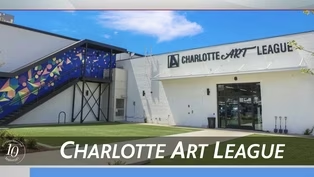
Video has Closed Captions
Clip: S10 Ep10 | 5m 13s | A look at the Charlotte Art League. Who they are and what they do for the community arts (5m 13s)
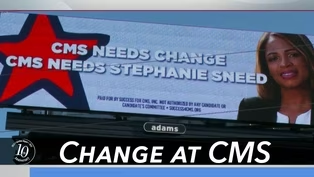
Charlotte-Mecklenburg Schools: Change
Video has Closed Captions
Clip: S10 Ep10 | 7m 12s | Five new CMS school board members mean change is coming to Charlotte-Mecklenburg Schools. (7m 12s)
Video has Closed Captions
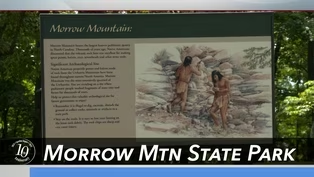
Clip: S10 Ep10 | 6m 18s | A look at the history of Morrow Mountain State Park (6m 18s)
Video has Closed Captions
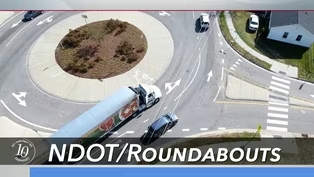
Clip: S10 Ep10 | 5m 3s | N.C. is one of the first states to use roundabouts. We look in to the roundabouts (5m 3s)
Providing Support for PBS.org
Learn Moreabout PBS online sponsorship
- News and Public Affairs

Top journalists deliver compelling original analysis of the hour's headlines.

- News and Public Affairs

FRONTLINE is investigative journalism that questions, explains and changes our world.












Support for PBS provided by:
Carolina Impact is a local public television program presented by PBS Charlotte