
Carolina Impact: March 22, 2022
Season 9 Episode 19 | 25m 28sVideo has Closed Captions
Messages from Ukraine, Alopecia Runner, Discovery Place IMAX Theater, Ship in a Bottle
Messages from Ukraine, Alopecia Runner, Discovery Place IMAX Theater, Ship in a Bottle
Problems playing video? | Closed Captioning Feedback
Problems playing video? | Closed Captioning Feedback
Carolina Impact is a local public television program presented by PBS Charlotte
Carolina Impact: March 22, 2022
Season 9 Episode 19 | 25m 28sVideo has Closed Captions
Messages from Ukraine, Alopecia Runner, Discovery Place IMAX Theater, Ship in a Bottle
Problems playing video? | Closed Captioning Feedback
How to Watch Carolina Impact
Carolina Impact is available to stream on pbs.org and the free PBS App, available on iPhone, Apple TV, Android TV, Android smartphones, Amazon Fire TV, Amazon Fire Tablet, Roku, Samsung Smart TV, and Vizio.

Introducing PBS Charlotte Passport
Now you can stream more of your favorite PBS shows including Masterpiece, NOVA, Nature, Great British Baking Show and many more — online and in the PBS Video app.Providing Support for PBS.org
Learn Moreabout PBS online sponsorship- [Narrator] Wells Fargo is proud to support diversity, equity and inclusion in our employees, our customers and the communities we serve, as well as through content on Carolina Impact.
- [Narrator] This is a production of PBS, Charlotte.
- Just ahead on Carolina Impact.
- "Far from home, but still getting messages on the phone."
That's how Ukrainians here in Charlotte are keeping up with the war and with their loved ones.
I'm Jeff Sonier in uptown with more on what they're doing locally to show support.
- Making peace with having alopecia, how a Charlotte marathon runner is going the distance to prove bald is beautiful.
Plus, how do you get a ship in a bottle?
We'll introduce you to a local artist putting his patience to the test.
Carolina Impact starts right now.
(upbeat music) - [Narrator] Carolina Impact covering the issues, people and places that impact you.
This is Carolina Impact.
(upbeat music) - Good evening.
Thanks so much for joining us.
Am Amy Burkett.
Russia's invasion of Ukraine brings the pain of war close to home here in Charlotte from the sky high gas prices we're all paying at the pump, to those scenes of war time destruction we see every day on every news channel.
But Ukrainians living in Charlotte feel a different sort of pain.
for them what's happening back home is personal.
Carolina Impacts' Jeff Sonier is in uptown with more on the messages from Ukraine and the support for Ukraine here in the Carolinas.
- Yeah, the pro Ukraine protest rallies here at Romare, Bearden and Park started just a few days after the Russian invasion of Ukraine.
(protestants chanting) At this demonstration, about a thousand from Charlotte, small, but vocal, Ukrainian community are rallying behind, the friends and family members still in Ukraine that they left behind.
When they came to the Carolinas.
(siren wailing) Night after night.
(bomb rumbles) - My sister-in-law and two little kids all are over there.
And she lived not far from Kyiv.
(helicopter engine roaring) (speaks in foreign language) - And day after day.
(bomb rumbles) Flight after flight.
(helicopter engine roars) Friends, and family pray.
- We didn't think that this place could be attacked.
We just couldn't even think about that.
(soft music) I started asking them.
"How are you doing guys?"
"What is going on?"
And they started answering me.
So it was crazy-- - Julia Prannyk waits for news now on stop.
As she waits on customers here at her south end Charlotte leather shop.
- And my husband just told me.
"Julia, you need to call Tanya and say her to get to her car and drive to leave."
And I was.
"What are you talking?"
And he said "now".
(siren wailing) And she jumped on her car and she was driving probably 20, 25 hours with two kids.
(bomb rumbling) From that place where she lived to leave to Western Ukraine, to cross the border to Poland.
(crowd screaming) - The battle for the capital city of Kyiv appears to be underway.
- Julia, like everybody else is watching a war half a world away.
(bomb explodes) (soldiers speaking in foreign language) But this Ukraine fighting doesn't seem so far.
Not when the streets are so familiar.
(guns firing) (soldiers speaking in foreign language) And not with Russian bombs falling on buildings in your old Ukrainian neighborhood.
- It's really, really hard for me the first time I saw the building, and I recognized this building because this building is across the building I used to live.
(crowd singing) - In uptown, is local Ukrainians sing and chant.
(crowd chanting) And carry their signs of support to the streets.
Olga Nikolayenko shares images of the Charlotte rally with her loved ones still in Ukraine.
(speaks in foreign language) - They are messaging phone.
And they are telling us how they are doing.
Are they standing in the shelters, are they trying to be as safe as possible.
My parents staying in the Kyiv right now, and many were my friends there.
- Olga and her husband Nick, left Ukraine five years ago, bringing their family and their florist business to Fort Mill.
After Olga's name was chosen in Ukraine's government lottery for US visas.
- We just wanted second chance, you know.
- A chance to escape the war they knew was coming then.
(bomb blasts) The war that's a reality now.
- You are here and you can't do nothing.
Just maybe telling people what's going on in Ukraine and that's all.
- [Crowd] Freedom for Ukraine!
Freedom for Ukraine!
- I wish my family will be here with me and all my friends, everyone.
But that's not possible right now.
(crowd chanting) - Just because it's not safe.
You can get bombed right on the highway.
It's horrifying because you recognize the places, you know people who are affected, you are glued to your phone where people just post stuff and it's hard to keep up the spirit like, we've been bombed.
Yeah.
We went down to the basement, and that's the daily life.
You cannot really get used to it.
It's all destroyed, people are dying, no jobs.
And Putin is still telling same fairy tales.
- [Crowd] Stop, Putin, stop the war!
Stop Putin, stop the war!
- Nick and Olga add that what they see online from Ukraine, isn't the same as what we see on the news.
(piano music) - I believe what US outlets have been covering is a little fraction of what's going on.
It's way worse.
In reality.
- This is so terrible.
So heartbreaking to see all these people, especially kids in the shelter.
- And they wonder if the next message from Ukraine, the next phone call from their friends and family might be the last.
- If I will talk tomorrow with them or not.
But no one can help us.
So yeah, I just want to see all my friends and my family and that's all.
I just want that stopped.
I want to see my parents, my friends.
(piano music) (crowd chattering) - Jeff Sonier joins me in the studio.
Now Jeff, let's talk a little bit about, we saw the rallies of support more than just Ukrainians at those rallies?
- Yeah.
We saw about a thousand Ukrainians in the Park, but there's only about 10,000 Ukrainians in all of Charlotte.
So what they're really trying to do with these protests is gather more support from other groups.
And well, we're seeing some symbolic support, taking Russian vodka off the shelves at ABC stores, the real support is coming from like restaurants, bakeries, breweries, who are putting together fundraisers among their customers, raising funds, not for the war itself but the refugees, the victims of the war, the relief efforts that are happening over there right now.
Also from Catholic charities which typically works with refugee groups in Charlotte.
They say, they're not getting refugees from the Ukraine, but they are already getting phone calls from families in Charlotte, willing to open their doors and welcome Ukrainian families into their homes.
Again, just another sign of what people are feeling and the empathy and the sympathy they're feeling after seeing these scenes of war on the news every night.
- What about other non-profits?
Are they getting involved and able to help?
- Yeah, especially a couple of the North Carolina non-profits; Samaritan's Purse, which is based in Boone.
They've already got a field hospital on the ground in the Ukraine, serving those refugee families.
And they're working with churches there to help house those families.
And there's another group based in Burlington called Feed the Hunger.
Their mission is to feed children around the world.
They've shifted a lot of their efforts right now to the Ukraine and the surrounding companies or countries, I should say Moldova and Poland.
That's where these millions of refugees are headed right now.
They're trying to make sure that once they get there and they're safer, that they have something to eat until hopefully their country is back to normal then go back home.
- Jeff, thanks so much for sharing this information.
- Sure.
For the latest on what's happening in the Ukraine and how it affects us here at home, head to pbscharlotte.org you'll find a link to the PBS news hour with constant updates.
Well, a Charlotte runner makes peace with her hair loss.
One marathon at a time research shows about 2% of the US population struggle with alopecia.
She's now using her running platform to connect and inspire others.
Carolina Impacts Rochelle Metzger shares her details.
(upbeat music) - Marathon training is hard work.
- I love like the mental toughness.
I feel like that is like me in my element.
- Going the distance takes discipline and grit.
- Running through the night when it's cold, maybe it's raining, just like all of that.
That is like when I am at my best.
- For Lindsay, Walter running helps her focus on who she wants to be and not on how others see her.
- The more I was running marathons, crossing finish lines, doing well, just gaining confidence in myself and slowly just like coming to grips with my reality that I didn't wanna face.
- Lindsay has alopecia universalis.
Total hair loss on her scalp, face and body.
- I was bullied a ton as a kid for wearing a wig and not having eyebrows.
- Her condition often draws stares.
And sometimes even worse.
- There are people who do make very rude comments, who have said to me, I was prettier when I wore my wig or 'Why don't you do something with your head?'
- Lindsay was just two years old when her hair fell out, she wore a wig to preschool.
It became her security.
- When I would wake up, I would wear it all day, keep it on and just playing sports too.
I would use double-sided tape to help the wig stay on my head.
- Lindsay says running has been a huge stepping stone in her alopecia journey.
- It's actually during a run that I took my wig off mid run.
And that really was the turning point for me.
(upbeat music) I just remember like tears in my eyes.
And it really was the first time that I knew I didn't need a wig, and I felt confident without it.
- For Lindsay, every step, every race brings her closer to self acceptance.
You may recognize these famous face, Ricki Lake, Jada Pinkett Smith and Congresswoman Ayanna Pressley.
All three women publicly revealing their private battles with alopecia using their public platforms to raise awareness and start a dialogue for others living with the same reality.
Their message.
"You are not alone."
According to the National Alopecia Areata Foundation, about 6.8 million people in the US and 147 million worldwide have or will develop the autoimmune disease during their lifetime.
- You can have just regular alopecia areata, which is what we think of when a child gets a little bald spot and then it gradually grows back in over the next year.
You can have alopecia totalis, which would be everything here.
You can have alopecia universalis, which is all the whole body.
Actively, probably about 25 to 50.
- Dermatologist.
Mark Darst says, there's no cure, but there are treatment options available.
Andy says the latest clinical trials are promising.
- We have some wonderful new medicines in pipeline.
- Unfortunately, treatment doesn't work for everyone.
- People don't realize how hard it is not to have eyebrows or eyelashes, because these are both decorative and protective devices.
- There's no one else in my school or community that had alopecia, and so it was very isolating, very lonely.
- So she started Lindsay's little pals, a pen pal program for young people with alopecia, - We will always have a special bond.
I will never forget you in your sweet words, you inspire me.
- I'll never forget that first letter, even if I would've only have gotten, one letter, it just meant so much to me and all that.
I really am helping someone.
- She now has boxes full of letters from kids and parents wanting to connect with someone who understands what they're going through.
- I've loved be a head power, Lindsay, Walter.
And I get so excited whenever she sends a message.
- Hi, everyone.
I'm here with my friend.
- Lendsay Walter.
- For Molly from Minnesota, having a mentor who knows what it's like to lose all of your hair is life changing.
The 12 year old overcame bullying and found her voice as an alopecia advocate.
- Say what you want to, but this is me and this is who I am.
And this is who I want to be.
(footstep approaching) - Lindsay, a lifetime of making strides big and small has finally brought her to a place of self love.
She encourages others to create their own path to happiness.
- Be proud of yourself and rock what you have.
And alopecia truly is the greatest gift that I never knew I needed, but I'm so grateful for.
It's made me such a better and stronger person.
- Lindsay's proud of all the finish lines she's crossed and the medals she's earned.
But being a role model, she says is the best reward of all.
For Carolina Impact, I'm Rochelle Metzger.
- Thanks so much, Rochelle.
The National Alopecia Areata Foundation offers a substantial support network for patients and their families, including a youth mentor program.
You can find an in-person group near you or join an online community at no cost.
We've provided a link on our website for more details.
Whether it's radio, television, phones, or just any other electronic device, technology constantly evolves.
What your parents or grandparents used once might look like a foreign object to your kids.
Carolina Impacts' Jason Terzis takes us inside the new IMAX theater at discovery place for a look at its state-of-the-art technology.
(machines roaring) - That sound.
That unmistakable sound.
Hear it for just a second and you know exactly what it is.
- [Commentator] Now, here is a motion picture film, a thousand feet, 16,000 separate photographs.
- The motion picture industry has evolved over the years, but the basic premise has always remained the same.
- [Commentator] The film unwinds from the reel and rewinds onto another reel after it runs through the projector.
- And much like the telephone industry, which went from this.
- You wanna talk to Mr. Galiman, one moment Sir I'll connect you.
- To this.
- And we are calling it iPhone.
(audience cheers) - The film industry is at a point where it's not even a film anymore.
- So we're really excited about this new technology.
It's truly transformed how the IMAX theater works.
- Charlotte's IMAX dome theater opened in 1991 in Uptown's Discovery Place.
The first of its kind in the Carolinas.
The nearly a 300 seat theater stands 78 feet tall and with a super wide screen for the first 30 years of its existence, loading a film was a labor intensive job sometimes involving up to three people.
- It's a little bit like doing surgery.
I would say that, if you think about all the technicians that are in, in addition to the physic and the anesthesiologist in an operating room, that's exactly what went on.
- And so it was really a huge lift for our theater team to really care for the film and get the theater up and running.
And so they were having to splice film and thread film, and making pivots in real time took a lot longer.
And so it was really time intensive.
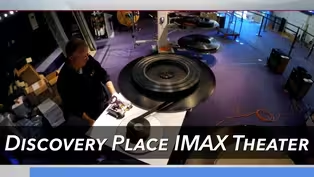
- To get these super heavy films into place, a special hydraulic lift had to be used.
- These are massive platters that weigh quite a bit.
They're four to six feet in diameter and so one false move and you could severely damage that film.
- The few times that we've done first run Hollywood releases, which could be upwards of an hour and a half or two hours.
That film footage if it were unrolled would extend almost all the way from Discovery Place to the Charlotte airport.
- When the COVID 19 pandemic hit two years ago, Discovery Place, as well as the IMAX dome theater were forced to close.
- We suddenly were faced with the situation where no one was going to the movies.
- But instead of seeing the shutdown as a doomsday scenario, officials viewed it as an opportunity and began transitioning the theater from traditional film to digital technology, which had only just been created.
- This opportunity came to us almost on the heels of the pandemic, that we were able to make that investment and spend the time to truly update this space.
- We were really fortunate to have financial supporters who also saw it as an opportunity because at the same time, we were making very hard cuts to the amount of personnel that we had on staff.
- Thanks to $1.2 million of renovations.
The theater got new seats, carpets, and all the necessary equipment to switch over from film to digital technology.
- You know, this is an example of technology in action.
- With our new projection system, it's a 4k laser projector and it is spotless.
The quality is so amazing, really feels like you're almost in a 3D environment with the immersion.
- So what used to be a heavy lifting multi person job is now as simple as plugging in a hard drive and clicking Play.
The new system provides sharper, brighter and more vivid images and a new audio system with six laser aligned, loud speakers.
♪ Get back ♪ Get back ♪ Get back to where you once belonged ♪ ♪ Get back Jo Jo - The new system made its debut in February with the Beatles recently released rooftop concert.
- It was like being at a rock concert, like your private rock concert.
And when the film ended, the audience applauded like you would had when you go to a concert, we were the number one theater in the country out of several hundred theaters that showed the Beatles.
We had the highest attendance.
- In March crowds lined up again.
This time for the new Batman movie.
- Good afternoon, and welcome to the Accenture I AMX film theater here at Discovery Place.
(log beeping) - Only eight IMAX dome theaters nationwide have gone digital.
And it was kind of difficult for our cameras to capture what being in the theater with a huge high quality picture display and surround sound audio is really like.
- It took my breath away quite honestly.
And I wasn't even expecting that crispness and that true feeling of immersion.
And it's unreal.
And so I think people will be really excited.
- The plan for the theater is to showcase a mix of IMAX movies, documentaries, new Hollywood releases and even video gaming.
- Having the opportunity to bring this to Charlotte now, I think is perfect timing.
Cause people are starting to wanna get out of their houses get back to normalcy.
- Perhaps the only issue now left, figuring out what to do with all the huge leftover film reels sitting out in the hallway.
For Carolina Impact.
I'm Jason Terzis reporting.
- Thanks Jason.
Although it's the largest, the Dome Discovery Place isn't the only IMAX theater in the area.
There's AMC Northlake and IMAX in north Charlotte, Regal Stone Crest at Piper Glen in south Charlotte and the AMC in Concord Mills.
Well, North Carolina has a rich maritime history.
The waters off our coast are known for shipwrecks and exploration.
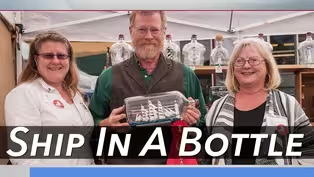
That history has inspired one local man to create ships in a bottle.
So if you've ever wondered, how does the ship get in that bottle?
Well, photo journalists Russ Hunsinger, gives a look into the process.
- Now how to make a ship in a bottle?
(upbeat music) So the art probably goes back, probably about in the mid 1700.
The sailors in their off watch period would make ships in bottles put in various scenes.
And a lot of those ships went to sweethearts and some of 'em went to paying for their on land lodging and bar bills.
(flute music) Well, what got me into the ship models?
I don't know.
It's probably just been a general interest throughout my youth and life.
And I guess it might just be a past life regression sort of thing.
(flute music) So I just decided to devote into preserving the ship and bottle art.
And it's been pretty successful.
First off you need to decide what type of ship you're gonna make.
And what period of ship that's gonna be.
So I'm gonna be working on a pirate ship, from North Carolina, Blackbeard, the pirate Edward Teach.
(flute music) I like using whiskey bottles for some cause they're good.
They got a good masts.
And so this particular Queen Anne's Revenge, I'm just gonna fit nicely into that one right there.
You start off with a piece of wood.
And I'm using Carolina red, Cedar.
(machine roars) And I cut that out.
(grinder roars ) And then I'll sand it and shape it up.
And I'll put on some decking, any type of war, sailing ships, you know, revenue cutters.
They got gun ports.
I can add on cannons (thunder rumbling) About 85% of the work in a ship in a bottle is done outside of the bottle.
The main key in ship in a bottle is setting your mast.
Your mast are on a hunch.
Get your rigging on.
I'm using some heavy button and craft thread.
It's a black thread and it mimics the standing rigging that was tarred on a ship.
To get your sales, I'm using a cotton resume paper.
For most ships I'll use a white, just white paper.
What I will do, I will take my morning coffee grounds with the filter.
I will just stain that paper.
(tides whooshing) You're going to be having ocean in your bottle.
I use plasticine clay.
Once everything is all ship shaped you might say, you just drop all the mast, and I'm amazed at how long it takes to build a ship that it only takes less than a minute to insert the ship, and raise up the mast, and the flag is already up.
And there we have a Blackbeard Queen Anne's Revenge in a bottle.
(smooth music) - I have always wondered how they get those ships in those bottles.
Well Jim's work has been featured in the film, the lovely bones, and can be seen at the graveyard of the Atlantic museum in Hatteras.
Before we go tonight, we'd love your feedback on our show and your story ideas.
You can send both to feedback@wti.org.
Well, that's all the time we have this evening.
Thanks so much for joining us.
We always appreciate your time and look forward to seeing you back here again.
Next time on Carolina Impact.
Goodnight, my friends.
(upbeat music) - [Narrator] A production of PBS Charlotte.
- [Narrator] Wells Fargo is proud to support diversity, equity and inclusion in our employees, our customers and the communities we serve, as well as through content on Carolina Impact.

Carolina Impact: March 22, 2022 Preview
Preview: S9 Ep19 | 30s | Local Ukrainian messages, IMAX theater, alopecia runner, and a ships in a bottle artist. (30s)
Video has Closed Captions
Clip: S9 Ep19 | 5m 9s | Discovery Place IMAX theater makes the transition from film to digital (5m 9s)

Video has Closed Captions
Clip: S9 Ep19 | 4m 40s | Lindsay Walker, a marathon runner with Alopecia, documents her struggles and success (4m 40s)

Video has Closed Captions
Clip: S9 Ep19 | 5m 42s | Watching the war -- on a phone. How local Ukrainians are keeping up with their loved ones. (5m 42s)
Video has Closed Captions
Clip: S9 Ep19 | 3m 38s | How does he do that? A profile about local artist Jim Goodman and his craft. (3m 38s)
Providing Support for PBS.org
Learn Moreabout PBS online sponsorship
- News and Public Affairs

Top journalists deliver compelling original analysis of the hour's headlines.

- News and Public Affairs

FRONTLINE is investigative journalism that questions, explains and changes our world.












Support for PBS provided by:
Carolina Impact is a local public television program presented by PBS Charlotte