
Carolina Impact: March 23, 2021
Season 8 Episode 17 | 24m 15sVideo has Closed Captions
Vaccine super sites, podcasting, quilting and a profile of PCI group.
Vaccine super sites in Charlotte with a goal of 1 million COVID shots, podcasting in the Queen city, the art and craft of quilting, and a business profile of PCI Group in Fort Mill, SC.
Problems playing video? | Closed Captioning Feedback
Problems playing video? | Closed Captioning Feedback
Carolina Impact is a local public television program presented by PBS Charlotte
Carolina Impact: March 23, 2021
Season 8 Episode 17 | 24m 15sVideo has Closed Captions
Vaccine super sites in Charlotte with a goal of 1 million COVID shots, podcasting in the Queen city, the art and craft of quilting, and a business profile of PCI Group in Fort Mill, SC.
Problems playing video? | Closed Captioning Feedback
How to Watch Carolina Impact
Carolina Impact is available to stream on pbs.org and the free PBS App, available on iPhone, Apple TV, Android TV, Android smartphones, Amazon Fire TV, Amazon Fire Tablet, Roku, Samsung Smart TV, and Vizio.

Introducing PBS Charlotte Passport
Now you can stream more of your favorite PBS shows including Masterpiece, NOVA, Nature, Great British Baking Show and many more — online and in the PBS Video app.Providing Support for PBS.org
Learn Moreabout PBS online sponsorship- [Announcer] This is a production of PBS Charlotte.
- Just ahead on "Carolina impact" - Well, it's not a Panthers game here at the stadium or a NASCAR race at the Speedway, but it sure feels like one.
I'm Jeff Sonier.
Stick around as thousands show up to get their shots, at one of the Charlotte areas COVID vaccine super sites.
- [Amy] Plus, we'll introduce you to a Charlotte business thriving after moving from New York and we'll take you inside a podcast studio to teach you how it's done, with a former NFL player.
"Carolina Impact" starts right now.
(upbeat music) - [Announcer] "Carolina Impact" Covering the issues, people and places that impact you.
This is "Carolina Impact" (upbeat music continues) - Good evening, thanks so much for joining us.
I'm Amy Burkett.
1 million COVID shots from frozen January to the 4th of July.
That's the goal of two Charlotte area vaccine super sites at Bank of America stadium and Charlotte Motor Speedway.
Thousands signing up and lining up on weekends, not for game day or race day, but for vaccine days.
Everybody getting the shots they need to prevent getting the virus that nobody wants.
PBS Charlotte's, Jeff Sonier, shows us what it's like inside and outside on vaccine weekend.
- Well, first thing to remember, if you are coming here to the stadium or the Speedway for your COVID shot, is to make sure you make a patient appointment first and then just like on game day or on race day, on vaccine days, if you are one of the patients here, well, that's also what you'll have to bring.
You know, some patience.
(acoustic piano music) Like a lot of things worth waiting for, this vaccine weekend at Bank of America Stadium, starts with a line.
In this case, a long line.
(acoustic piano music continues) - Hey there.
Do you have an appointment today?
- [Male] Yes - Walk in or drive through?
- [Male] Drive through.
- Drive through, you're gonna be on the right hand lane.
Okay.
Behind that truck, straight ahead.
Okay.
You have a good one.
- [Jeff] On one side of the stadium, this line is for the patients getting their vaccinations without getting out of their cars.
You know, a needle in your Volkswagen beetle, a shot in your Fiat, maybe even a vaccine in your limousine.
Everybody rolling down their windows and rolling up their sleeves.
Hospital workers checking each patient ID, each patient getting a mark on their windshield.
Then a packet of information and then finally, the vaccination.
After another line or lane into one of these tents, where the shots are given.
(acoustic piano music) - And we got the right partners, who know how to set up mass events, move people safely through these events and do it with speed.
- [Jeff] Dr. Dave Callaway is Chief of Disaster Medicine at Atrium Health, which is scheduling the appointments and providing the medical staff at the stadium.
They're also providing the vaccine itself.
On this weekend, 9,000 doses a day.
- [Dr. Dave] We're working through the drive in and the walk in processes where we split and it went smoothly.
We were able to keep social distancing.
We're able to move people quickly through the lines, give them their shots.
(acoustic piano music) - Thanks for your patience.
Step into the white tent and have some fun.
(acoustic piano music continues) Have a good time folks.
- [Jeff] Here on the walk in side of the stadium, it feels like a Panther game day.
No tailgaters, but a steady stream of fans or patients, here on Stonewall Street.
Often do you come down to the stadium?
(acoustic piano music) - Never - [Jeff] Still, on this grey Saturday, Marilyn Boyle says, "Yeah, it's worth it."
Even after getting stuck in the uptown vaccine traffic chain.
(acoustic piano music continues) - The traffic was terrible.
You know, everybody's tryna cut ahead of everybody but, I left an hour before I was supposed to and I'm still late.
(acoustic piano music) - [Jeff] But, you're here.
- I'm here - [Jeff] Here, for the COVID shot, she would have waited three months for otherwise.
- Hey and I don't really care.
I'm not in a hurry.
- [Jeff] You just wanna get your shot.
- I just wanna get my shot.
(acoustic piano music) - [Nurse] Hi.
Any signs or symptoms of COVID?
- No, none.
(mumbles) - [Jeff] Outside the stadium, the first temperature test comes at the front of that long white tent entrance.
After that, the line turns into a zigzag and then another temp test just before heading inside.
- [Nurse] Any signs or symptoms of COVID?
- No.
(indistinct) - [Jeff] That's where we catch up with Terry Payne, who moved to Charlotte from Durham to be closer to her extended family and then came COVID.
- And we are in a pandemic.
We can't go anywhere, do anything.
I have grandkids.
I have to quarantine before I can come see them.
- [Jeff] That's why she's at the stadium today.
Filling out cards, answering questions.
- Is this your first COVID vaccine?
Okay.
Do you have any food allergies?
Do you have any medication allergies?
- [Jeff] Terry waiting patiently in line with other patients just outside the stadium vaccination area, before finally getting what she came for.
A little rubbing alcohol from the nurse, and then a shot in the arm to prevent Coronavirus that Terry thinks might just give our predictable pandemic lives, a shot in the arm too.
- So I think we're good to take the vaccine and get back to normalcy, get back to work, to school.
To travel, to fun, to hiking.
- And looking at the excitement of the community, that's actually coming in, it's heartwarming.
We've gone from fear to hope, by being able to provide vaccines.
(acoustic piano music continues) - I hate needles.
- [Jeff] Michael Brown and his wife are heading home, after their COVID vaccines.
And he says, except for that needle, this whole max VAX thing at the stadium, worked out pretty well for them.
Were you surprised you could get in, get an appointment, get out so quickly today?
- It took a little while to get the appointment, about two days on the phone trying to get through.
But yeah, getting in and getting out was okay.
- [Jeff] How long of a line was it?
- [Michael] Oh, my God!
Probably a mile and mazes.
- [Jeff] And since this is just their first of two vaccine doses, the Brown say they're ready to do it all again.
The traffic, the crowds, the lines.
Yeah.
Even the needle.
- I'll feel better after I take the second one.
- [Jeff] A month from now, right?
- Yes.
(acoustic piano music) - In fact, everybody who gets a vaccine appointment here at the stadium and the Speedway, also gets an automatic return trip, one month later for dose number two.
And while you don't have to get your COVID shot here, well, if you don't have a car, there are bus routes and a light rail line right nearby to make getting to the stadium, maybe a little bit easier.
Also the folks who got their vaccinations here say that the appointments are a little bit easier to get and a little bit sooner to get, which I guess is the whole idea, to vaccinate as many people as possible, as quickly as possible and as safely as possible.
Amy?
- Thanks so much, Jeff.
To find out more about the next big vaccine weekend, check out our website @pbscharlotte.org.
You'll find a link to an Atrium Health webpage with details about all upcoming vaccine super site events.
Well, for years now, the Carolinas have been a hotspot for relocating families.
I was one of them back in 2013.
Since 2015, North Carolina has averaged more than 110,000 new residents annually.
With South Carolina adding more than 60,000 each year.
It's no wonder both states consistently rank in the top 10 for population growth.
But, it's not just people moving here.
Lured by cheaper land and better taxes, companies from up North are also migrating South.
"Carolina Impact's" Jason Terzis, introduces us to one of those in tonight's business profile.
(upbeat music) - [Narrator] The two one (indistinct) - [Jason] It's a family owned business, born out of the 1969 world series.
- [Narrator] And next to the world champion.
- [Jason] That's now it's second generation.
- My father was nice not to gift the business to us.
- [Jason] Employing some 250 people in Fort Mill.
- Instantly saw that this place was our home.
- [Jason] And over the course of 50 plus years, has grown into one of America's largest printing companies.
- 50 years, its remarkable.
You just don't see that.
- [Jason] Churning out more than a million pieces of mail a day.
- We produce about 400 million outbound packages a year.
So, we'll go through about 700 million envelopes a year.
- [Jason] The P in PCI group, it doesn't stand for printing as you might suspect, instead- - Players Computer Inc. - [Jason] Those players- - Bud Harrelson and Jerry Grote.
- [Jason] Used a portion of their 1969 World Series Championship money to invest in a start up computer company.
Chris Kropac Senior, an engineer by trade was Harrelson's neighbor at the time on Long Island.
- And said, "Hey, can you help me out?
You understand about this computer stuff.
I don't, I'm a baseball player.
Can you help me out and run the business?"
- [Jason] PCI started as an outsourcing company, doing large scale data entry work, utilizing its celebrity investors to generate business.
- Did a lot of payroll for the city of New York.
We keep parking tickets for the city in New York.
- [Jason] As a young kid, it was only natural for Chris Kropac Junior to hang out with his dad at the office.
- My dad always worked, went there over the weekend.
So, when you're hanging out with dad on Saturday and Sunday, you have no choice, you go to the office and that's your play area.
Right?
- [Jason] Chris Junior, went off to college, with absolutely no intention of going to work for his father.
- I never wanted to be in the business, never wanted to be in the computer business, I actually wanted to be in the food business, somehow, some way.
- [Jason] But after six years working in a deli, Chris was ready for a change.
- I said to my dad, I said, "Hey.
I don't think I can do this the rest of my life."
I said, "I wanna do something.
Dad, maybe I'll come work for you."
And my interview was, "Well, you never said you wanted to work for me.
You said, actually, you never wanted to work for me."
I go, "Yeah, I don't.
But I don't know what else to do.
So why don't I try it out there?
And if it doesn't work, then I'll go someplace else."
- [Jason] With brother-in-law Skip, also on board, PCI steadily grew.
Transitioning from data entry into more direct mail, sending out letters on behalf of collection agencies.
One of which, had people manually putting bills into envelopes.
I go, "They manually search?"
I go, "You know, I have a machine that could do that."
And she goes, "You have a machine that could do that?"
"Well, I have a machine that could do that."
- [Jason] After 33 years, Chris Senior retired.
Leaving the company to Skip and Chris Junior.
- We took over in 2003, when his dad retired.
So we're 50 50 partners.
- [Jason] PCI enjoyed sustained growth.
But the cost of doing business on Long Island was getting to be too much in the form of high taxes, utilities and wages.
- I did a big study on moving from New York, 100,000 square foot facility New York, 100,000 square foot facility down in the South and it said, I could save a lot of money, almost a million dollars a year, going down South.
I said, "It's a no brainer.
We've gotta do it."
- [Jason] After ruling out Atlanta and Knoxville, they settled on Charlotte.
- Lancaster County, which I'm located in right now, gave me a great incentive package that gave me a six and a half million dollars of tax deferment over 10 years, which was great, it was gonna pay for the move, more than pay for the move, did everything.
- I can't believe that this is almost too good to be true, the Charlotte area.
- [Jason] Moving 22 employees and all that equipment, PCI settled into a 93,000 square foot facility, sitting on 34 acres in 2008.
And after surviving the financial crisis, saw it's business triple in size, with the acquisition of a major healthcare client.
- In June of 2014, we had 80 employees.
By October, 2014, we had 240.
- [Jason] 2017 saw another expansion with the opening of a second production facility in Dallas, giving PCI quicker access to the Western half of the United States.
- So Chris and I, we're responsible now for 300 roughly people, that's 300 families that we feed and support.
So it's a big responsibility.
- (indistinct) hear the pop, pop, pop, pop.
That's the folding going on right now.
- [Jason] The constant home of the production line, huge million dollar machines rolling off paper, feeding into gigantic printers, envelopes churned out and sealed.
- Each beam of one of these machines produce about 22,000 number 10 envelopes an hour.
- [Jason] Everything then shrink, wrapped and sent off to the post office, all while maintaining accuracy and most of all, security.
From outside gates to key card access, cameras just about everywhere and a network operating center, keeping track of worldwide cyber threats.
- We're constantly investing money.
I've just spent $3 million over the last three years into upgrade our IT infrastructure.
- Everything that we produce here and print here, we treat with the highest level of integrity and care because you're dealing with people's personal information.
- We print a lot of checks for our clients and print anywhere between six to eight million checks a month for our clients.
- [Jason] Over five decades in business.
- Did my father ever think we'd get to 50 years?
No.
- [Jason] With unimagined growth.
- In 2003, we were roughly doing $3 million in business.
We just eclipsed $57 million in 2019.
- [Jason] It's no wonder, you'll see symbols of American patriotism all over PCI's corporate offices.
- We don't know anything other than this company.
- It's heart shattering where we came from, where we are now.
Very, very lucky.
- [Jason] You might say these guys are living proof of the American dream.
For "Carolina Impact" I'm Jason Terzis, reporting.
- Thanks, Jason.
We're happy to report that Chris Kropac Senior is now 87 years old and doing very well.
He left Long Island for South Carolina to be closer to his family and grandchildren.
Well, these days you can pretty much buy anything you want at an online store, but there was a time, not that long ago, when you couldn't and things had to be made by hand.
Jason Terzis and producer of John Branscum, introduce us to two ladies keeping the tradition of quilting alive.
(acoustic guitar music) - [Jason] On a chilly night, many find comfort snuggling under a warm quilt.
These handcrafted treasures are often passed down through the generations.
But before you can hand down or even get comfy under that quilt, someone has to know how to make it.
Someone like longtime quilter, Jane Godshall.
- When you make a quilt, you put three fabrics together.
You have your top layer, your batting, and then the backing.
And then you sew through all three layers and that makes a quilt.
- [Jason] The technique of quilting dates back, thousands of years but just a couple hundred years ago, as American pioneering families moved West and further away from the nearest general store, quilting proved to be an essential skill.
- The 1800's definitely, because you had a much greater movement in the country and they needed the warmth as they went.
So yeah, again it became a necessity that they had to have bed coverings.
- [Jason] Those early pioneering women were resourceful and little went to waste.
- The pioneer women would do them by candle light and put every bit of scrap that they could find from old clothing or whatever into it.
- [Jason] In the early 20th century, the resourceful spirit continued as a new source of cloth came into Vogue.
- Farmers and companies got onto this real quick that women needed fabric.
So, feed sacks came into being, where they would actually be printed.
They'd come in and whether it was your hog feed or your corn or flour or whatever.
It would come in a fabric.
So, women would use that.
(acoustic guitar music continues) - [Jason] When it comes to quilts, there's a wide range of style and purpose.
- There's hand work, there's machine work.
There's modern quilts, there's traditional quilts.
There's just all kinds.
Quilts could be political.
That was a big thing that started in this country.
During the times of women's suffrage, there were a lot of quilts made about that.
- [Jason] But, eventually the need to make quilts diminished with modern manufacturing.
Then another shift, a societal shift.
- When women were going back to work, sort of in the fifties, but definitely in the sixties and seventies, there were more careers happening out there and then women who had careers and had families to take care of.
So the time was just not there.
- [Jason] Jane says it was around the American bicentennial in 1976, when quilting went from essential skill to more of a hobby and craft.
- People got interested again.
And that's when, as far as documentation goes, it became more of an industry.
- [Jason] These days, Jane is a member of two local quilting guilds and shares her years of knowledge at various quilt shows.
Her long-time friend and fellow guild member, Theresa Justice, was first exposed to quilting by her mother but it wasn't until the 1990s, when she got serious about the craft.
- I like to think of myself as a traditional quilter.
- [Jason] Theresa put her skills to use, after discovering a forgotten family heirloom.
- That is a, what they call a postage stamp quilt.
It's made up of one inch blocks.
And my husband's aunt Gertrude, actually made that all by hand.
- [Jason] But Theresa says, aunt Gertrude left this one with a bit of work.
- She gave it to my mother-in-law, who put it in a closet for many years and I discovered it one day at her house.
And I asked her if I could take it home and finish it for her.
- [Jason] And finish it, she did.
Today, this quilt made up of tiny squares, is a cherished multi-generational heirloom.
(acoustic guitar music continues) Quilters like Theresa and Jane, say it's hard for them to not quilt.
- I seriously can't just sit and watch a movie.
I need to be knitting or sewing or doing something.
Cause I feel like I'm wasting time otherwise.
And this is something I love to do.
- [Jason] But it's not just about the history of the craft or the quilts themselves, there's more going on here.
- [Jane] Other quilters are my closest friends and you get closer like sisters.
- [Jason] For "Carolina Impact" I'm Jason Terzis, reporting.
- It's nice to see the quilting tradition remains strong for future generations to love and learn.
Well, have you caught the podcast craze?
50% of US homes listen to podcasts.
16 million Americans, call themselves avid podcast fans.
Did you ever wonder how they're made?
"Carolina Impact's" Sheila Saints, takes us into the studio to find out.
(upbeat music) - I mean 230 pounds, 4% body fat.
No dawg!
I don't remember you.
- [Sheila] That's former NFL player, Steve Smith Senior, behind the microphone.
- A lot, a bit about your story also too but- - [Sheila] In his podcast cut to it, Smith and co-host Gerard Little John, interview athletes and entertainers.
Getting to know the private person, behind their public persona.
- On the podcast, we really just...
I try to ask questions and talk to the guests about who they are as a human being.
As a parent, as a father, as a mother, as a business woman, businessman.
Just all encompassing a real holistic look at the athlete, at the individual.
- [Sheila] Smith's podcast is a client of the Queen City Podcast Network.
a group of about 30 local contributors, producing fresh content every week.
Seeing, what made you decide to start a podcast?
It's a lot of work.
- Yes, it is and I have a great team.
I have a lot of people around me that are assisted me and really the question is, what do we wanna be?
And we wanna be a podcast that really emphasizes the individuals in New Jersey, male and female.
- [Sheila] A podcast is a series of digital audio files, you can download from the internet and the Queen City Podcast Network is the first of its kind in the country, to operate as a business.
- Commercial radio in particular, has kind of turned its back on local and we're kind of embracing that.
And I think, we're providing a service, whether it's news and current events or comedy or food or whatever it is that people in a local environment need to hear.
(upbeat music) - [Sheila] National radio personality and podcaster, Sherry Lynch, hosts and distributes three podcasts from a home studio in Charlotte through her own company, Now Media.
- One of the perks of working from home.
(upbeat music) In the content space, in the content creator space, women are doing incredible work.
- [Sheila] Lynch started podcasting in 2006.
- Back in 2006, podcasts were called RSS feeds.
If anybody had a name for them at all and it was super fringy and it was so fringy that this was before Apple began digitally encoding those podcasts to put them into iTunes.
I mean, it was just the frontier, it was the wild west.
Podcasting is just the newest version of the ancient human impulse, tell me a story.
That's all podcasting is, it's this moment's response to tell me a story.
So, it's very democratic.
The barrier to entry to have a podcast is very, very low.
- [Sheila] In 2020, Charlotte virtually hosted its first podcast festival, 14,000 people registered.
So, what makes podcasting such a thing in Charlotte?
- Charlotte is very tech savvy, I think.
I think that's got a lot to do with it.
I think there are a lot of people here, who have something to say and you wanna be heard.
And here in Charlotte, there's been a very distinct effort to kind of bring podcasters together.
- You may be thinking, I wanna start my own podcast but what does it take?
It turns out it takes a good idea and a good microphone.
- Well, here's the great news for people that would like to get into podcasting.
The gear that you need to produce a really high quality product is very very cheap, again, super democratic.
- You can get a relatively inexpensive microphone, a USB microphone that just plugs into your laptop and like literally, maybe $50 later, you're ready to go.
- You need a story to tell, you need to know who you're telling it to and why you're telling it.
And if you have all of that, you're on your way to being a podcaster.
- [Sheila] It's easy to find podcasts on a smartphone or computer.
- Put up that app, search for a topic you like, if it's sports or rock climbing or music or whatever it is and just start exploring.
There's 1.2 million podcasts for you, just waiting for you to find them.
Like I promise, there's something out there, you'll wanna listen to.
- There's so many wonderful stories and deep meaningful connections to be made in this medium.
How can you not love podcasting?
I mean, how can you not love it?
If you don't love it, I challenge you.
You haven't found the right one.
- It's a surprise, every time.
We have such a great conversation that they get a different perspective of me, I get a different perspective of them.
Intertwine, I'm talking about- - [Sheila] So, give a listen or maybe pick up the microphone.
You might leave inspired, educated or entertained.
For "Carolina Impact" I'm Sheila Saints, reporting.
- Thank you, Sheila.
I'm close to starting my own podcast these days to go along with the next book that I'm writing called The Dirty F-word, lessons we learned from our failures.
Check out my YouTube channel, to see how my guests share details that can help us all.
Well, that's all we have time for this evening.
Thanks so much for your time.
We always appreciate it.
And we look forward to seeing you back here again, next time on "Carolina Impact" Good night, my friends.
(upbeat music) (upbeat music continues) - [Announcer] A production of PBS Charlotte.
Video has Closed Captions
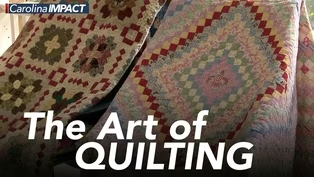
Clip: S8 Ep17 | 4m 2s | Quilting requires persistence and patience but the completed work can last a lifetime. (4m 2s)

Business Profile: PCI Group and Chris Kropac
Video has Closed Captions
Clip: S8 Ep17 | 5m 29s | A computer company started by two professional baseball players. (5m 29s)
Carolina Impact: March 23, 2021 Preview
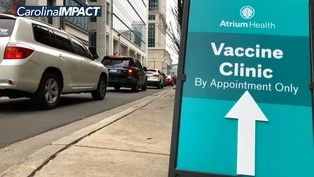
Preview: S8 Ep17 | 30s | Carolina Impact: March 23, 2021 Preview (30s)
Video has Closed Captions
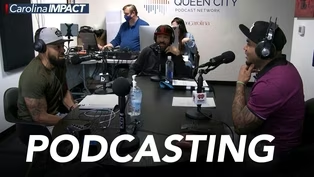
Clip: S8 Ep17 | 4m 55s | Podcasts have become the place for in-depth stories and conversations. (4m 55s)

Video has Closed Captions
Clip: S8 Ep17 | 5m 58s | One million COVID shots, that's the goal of Charlotte's vaccine super sites. (5m 58s)
Providing Support for PBS.org
Learn Moreabout PBS online sponsorship
- News and Public Affairs

Top journalists deliver compelling original analysis of the hour's headlines.

- News and Public Affairs

FRONTLINE is investigative journalism that questions, explains and changes our world.












Support for PBS provided by:
Carolina Impact is a local public television program presented by PBS Charlotte