
Carolina Impact: March 29, 2022
Season 9 Episode 20 | 26m 45sVideo has Closed Captions
Foster Care Families, Womens Health, Beauty Shop Retiree, GEM Theater
Foster Care Families, Womens Health, Beauty Shop Retiree, GEM Theater
Problems playing video? | Closed Captioning Feedback
Problems playing video? | Closed Captioning Feedback
Carolina Impact is a local public television program presented by PBS Charlotte
Carolina Impact: March 29, 2022
Season 9 Episode 20 | 26m 45sVideo has Closed Captions
Foster Care Families, Womens Health, Beauty Shop Retiree, GEM Theater
Problems playing video? | Closed Captioning Feedback
How to Watch Carolina Impact
Carolina Impact is available to stream on pbs.org and the free PBS App, available on iPhone, Apple TV, Android TV, Android smartphones, Amazon Fire TV, Amazon Fire Tablet, Roku, Samsung Smart TV, and Vizio.

Introducing PBS Charlotte Passport
Now you can stream more of your favorite PBS shows including Masterpiece, NOVA, Nature, Great British Baking Show and many more — online and in the PBS Video app.Providing Support for PBS.org
Learn Moreabout PBS online sponsorship- [Narrator] Wells Fargo is proud to support diversity, equity and inclusion in our employees, our customers and the communities we serve, as well as through content on Carolina Impact.
- [Narrator] This is a production of PBS Charlotte.
- Just ahead on "Carolina Impact."
More than 12,000 North Carolina children live in foster care.
We'll introduce you to foster families navigating the overwhelming process.
And a nonprofit, helping more families step up to help.
Plus studies show black women have higher mortality rates than any other group.
We're honoring women's history month with a look at a new initiative, prioritizing black women's health.
- And lots of exciting changes here in downtown Kannapolis.
Except for the one place that's still exactly the same as you remember it.
I'm Jeff Sonier, come with us on a tour of the old Gem Theater.
- "Carolina Impact" starts right now.
(air whooshing) (upbeat music) - [Narrator] "Carolina Impact," covering the issues, people, and places that impact you.
This is "Carolina Impact."
(upbeat music) (air whooshing) - Good evening.
Thanks so much for joining us, I'm Amy Burkett.
About 600 kids in Mecklenburg County live in foster care.
However, only about 60 families are licensed to provide that care.
Children often have to navigate neglect, trauma, social work changes, and a shortage of families before getting placed.
Carolina Impact's Jason Terzis introduces us to the families doing the work to bring comfort and a nonprofit, helping those families through the challenges.
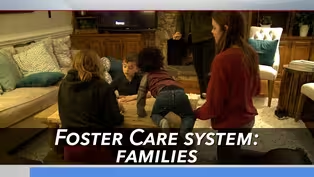
(air whooshing) (upbeat music) - [Narrator] An evening at the Reed house in South Charlotte, mom, Josclyn works on dinner.
Dad, Paul works on a crossword puzzle, while the kids work on a game of UNO.
- [Kid] Yellow, yellow, yellow.
- [Narrator] There's eight year old, Riley, six year old, Zach, and baby Jordan.
Along with some neighborhood kids and also two year old, Trey.
The little guy was enamored with our video camera.
We're not allowed to reveal Trey's true identity because he's in foster care and has been with the Reeds since he was just three days old.
- Just the idea of not only helping the child, but trying to kind of help the whole family.
it seemed like a worthy course.
- [Narrator] The Reeds often talked about having their own biological children and also adopting.
But once they got plugged into their church community, Ian met other families in the foster care system, their thought process switched from adoption to fostering.
- I like the idea and the mission behind it of, you're with people kind of while they're going through some stuff and might get better, it might get worse, but you're here for the kids no matter what.
(paper tears) - [Narrator] Nicole Taylor, serves as the Executive Director of Congregation for Kids or CFK.
Its main goal is to partner with area churches and the Department of Social Services to help fill in the gaps of the foster care system.
- We are not an agency.
What we do is we exclusively partner with Mecklenburg County Youth and Family Services and we recruit and train and then pass those folks along to DSS to become fully licensed.
- They made it easier than it would've been otherwise.
- You're still getting licensed through the county, but they kind of hold your hand through that process and make it much more enjoyable, (chuckles) if training can be enjoyable.
- [Narrator] This past year, CFK recruited and trained 43 foster parents serving 276 children.
Issued support gifts to 63 kids aging out of the system, including a mentorship program, and celebrated 482 foster parents and social workers at various events.
- These are the only people put in place by our government to intercede on behalf of vulnerable children and families.
And their job is incredibly difficult.
- I feel like all DSS organizations do the best that they can with what they have.
But I think that where we fail the children is not necessarily the Department of Social Services, I think it's us as community.
(upbeat music) - [Narrator] The North Carolina, Department of Health and Human Services says neglect, abuse, and dependency are some of the main reasons children are put into the foster care system.
Many of the kids suffer anxiety or PTSD.
- [Woman] You're dealing with in that have trauma.
- [Narrator] But the main goal of the system, is to someday reunite those kids with their parents or another family member.
- The goal is always reunification.
That's most important.
Children need their family.
- The courts and the judges give the biological family time to work their case plan, to do everything they need to do in order to get their children back.
And that just takes time.
- [Narrator] Another issue adding to the big picture problem is the high turnover rate of social workers, which some reports put at roughly 30% a year, burnout, stress, and low salaries, are all listed as contributing factors.
- I spoke with a teenager a couple of weeks ago, he had eight social workers while he was in care.
He ended up aging out of the system, but eight social workers.
- [Narrator] Issues within the court system only add to the problem.
- Six out of our last seven court hearings have either been canceled or continued.
- In our case, we've had a couple different judges.
- [Narrator] And CFK says, as children grow older, it becomes harder to find them homes.
- When those kids turn 18, they technically age out, meaning the government says, "Good luck, you're an adult now."
- I think it's a broken system.
- Because of the high rate of homelessness when children age out.
Incarceration, early pregnancy, drug addiction, all of these things.
They're pretty grim statistics in terms of children that age outta the system.
- [Narrator] While not being able to show the kids faces, protects their identity, it also serves as a disadvantage.
- In our country, you don't see orphanages.
The United States orphanage is the foster care system.
In this country, we fiercely protect kids that are in foster care so much so that they become invisible.
- [Narrator] Janira Cho and her husband, Charles recently fostered two young sisters ages four and five.
It was an eyeopening experience.
- My house was maybe their fifth house, those vital moments, when they need their mom and their dad, they were clinging onto people that they barely knew.
- [Narrator] During their seven months together, they did everything as a family, birthdays, vacations.
- I really wanted to take the time to get to know them and know their story, so that I could in turn help them.
- [Narrator] The girls eventually reunited with their birth mother and to this day, Janira is able to keep in touch with them, which is something that doesn't happen too often.
- At the end of the day, I feel like I was one of the lucky ones because I still have contact with the girls.
And they're still part of my family, but there's children that stayed here as well after the girls, that I'll never see again.
So it's like you lose a family member.
- [Narrator] Working full time and on her master's degree, Janira and Charles are taking a break from fostering.
They might do it again someday, which explains why their guest room is still set up for kids.
- There's really kids that are in need and there's not enough homes.
It's very sad.
I get teed.
It breaks my heart.
- [Narrator] It's a tough situation for everyone involved.
For "Carolina Impact," I'm Jason Terzis reporting.
- Thanks so much, Jason.
There are a number of ways you can support the foster care system.
You can donate goods to families, support a social worker, or attend an orientation on becoming a foster parent.
For more information, head to our website pbscharlotte.org.
Well, statistics in our state show, black women have the highest mortality rates for heart disease, stroke, and breast cancer.
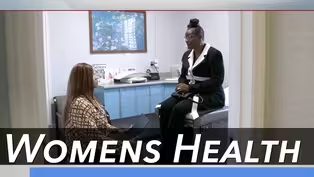
In an effort to change that, a new initiative in Mecklenburg County has not only prioritized African American women's health, it has also dedicated a place for information and resources to support better health.
Carolina Impact's Beatrice Thompson, has our story.
(air whooshing) - [Instructor] So that when you take your next breath in, (breathes in heavily) you're ready to exhale and fold.
Reach, reach, reach out.
- We spend a lot of time focusing on other people and taking care of other people and not necessarily ourselves.
- Come on now, stretch.
- We as women of color, and specifically high achieving women of color, we need to be okay with saying, we need help.
(upbeat music) - [Woman] Are we killing ourselves?
- Slowly but surely.
- [Narrator] They are among the millions of African American women all across the country who are sounding the alarm about their health and their healthcare.
While the data shows African American women are becoming more physically active, the statistics are still dismal.
Compared to white women, Black women are 30% more likely to die from heart disease.
They're twice as likely to die from a stroke and twice as likely to be obese.
And, they're twice as likely to have diabetes.
Overall, black people are 10% more likely to report experiencing serious, psychological distress than white people.
And that's according to the Department of Health and Human Services, their off of minority health.
It has become an area of study that's called the weathering effect, which harms the individual's health through repeated exposure to socioeconomic adversity and discrimination.
- It's a concept that looks at African American women in particular and the level of stress that we endure over our lifetimes that leads to our early death and leads us to develop health problems sooner in our lives.
- So let's talk about this onboarding process.
Coaching consulting, doing some strategic work with women CEOs, that's what the day consists of.
If I get a chance to eat, I'll squeeze in some food.
- [Narrator] While directing her clients on how to reach their next level, Dr. Montae also realizes she is in the number with most women of color, helping others meet their needs, while many times not prioritizing her own.
- It's definitely been a challenge for me because everyone sees me as having it all together.
Everyone sees me as the strong person, everyone comes to me with their problems.
And so, I wake up some days and I'm like, "Well, who do I go to."
- [Narrator] Compound those issues with the public health pandemic of COVID and African American women across the nation are feeling the knockout punch on their personal health.
- What we heard from women is we never got a chance to risk.
We never got a chance to breathe.
We never got a chance to really stop and process.
So now we're bringing all of that stress, that tension, just the exhaustion of taking care of other people.
Now we have to go back to work, back to life.
That's taking a toll.
- We need to do the research to see what's going on in our communities and other communities and what resources are available.
That's what got us started.
- We recognize that when you are looking for healthcare in this county, it's very challenging and very difficult.
We just couldn't find where do women actually go when they actually need certain health services?
There's just not a suppository of that information.
(upbeat music) - [Narrator] In Mecklenburg County, it led do a healthcare initiative launched by women.
In partnership with UNC Charlotte, a Directory of Services for Physical and Mental Health is being compiled, designed to aid women of color, navigate the healthcare system.
- I'm hoping that they include an evaluation piece, as people go out to these different offices and organizations and agencies that we have a chance to see how they really treat patients.
I think that's important because the relationship between a patient and a doctor can either heal you or kill you.
- [Narrator] The outreach effort will be housed at the Mady M. Smith Women's Health Equity Institute, name for the county's first African American Health supervisor, who championed the advancement of blacks and public health.
According to Emmanuel, the ultimate goal of this Institute, is to provide information on the health of black women in Mecklenburg County.
- Not just what the data say, but our lived experiences that we are going through, that we actually can come together and be able to navigate together those resources, both physical health, as well as our own mental and emotional wellbeing, which is often sometimes left out.
- [Narrator] The initiative has garnered the support and backing of the council on Black health, which is monitored and reported on this issue nationwide for the past two decades.
- This type of event, and this activity in this Institute, provides an opportunity really to focus on women and particularly black women.
And to really think about what makes a difference in improving health and black women.
- We certainly have an in depth experience that really is misunderstood.
And we have those areas of health inequity that happen to do with just us being black women in America and just not understood.
(upbeat music) - [Narrator] And as for that myth of the super black in a cap caring for everyone, well, the coach has a few words.
- We need to be okay with accepting help, and it not feeling like it's taboo for us to lay down that cap.
(upbeat music) - For "Carolina Impact," I'm Bea Thompson reporting.
- Thank you, Bea.
We have more information on the new initiative on our website, pbscharlotte.org.
According to north Carolina's Secretary of State, a record 178,000 businesses launched in 2021.
Reports also show more businesses are owned by minorities, women, and younger adults.
But in the beauty supply shop industry, less than 10% of businesses are owned by black women.
Even the research shows, black women spend an average of 54 million a year on ethnic hair and beauty products.
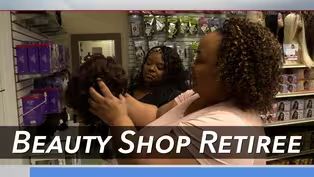
Carolina Impact's, Tonia Lyon introduces us to a small business owner and retiree collaborating to change that trend.
(air whooshing) (upbeat music) - [Narrator] Come on into Michelle's Beauty Supply in Monroe (bell rings) and expect some surprises.
- A lot of people come in and say, "You know what?
I'm just gonna buy something just because you are a black (indistinct)" (upbeat music) It's beautiful experience.
- [Customer] Can you show me the different lashes that you have?
- [Narrator] Customers like Sherika agree.
She says this fight selling black hair care products, the majority of beauty stores she's been to aren't owned by black women.
She loves shopping here for herself and her daughters.
It's tidy and welcoming, she says.
- It just feels like home.
It feels like family.
- When they walk through the door and they see my face, it's a big smile they come across their face and they're like, "Oh my God, you're African American."
- It means a lot because I have brought my nine year old in and she's looked around the store.
She finds all kind of cute bows here and different things that she wanna try.
So it makes me feel good.
(upbeat music) - [Narrator] Michelle took a risk on the beauty shop business after working through and rejecting a couple of other ideas.
She figured if she spends money on hair and beauty products, her friends would too.
- [Michelle] This is my baby.
I have worked years to start my own business.
- [Narrator] And even though Michelle opened her doors during COVID... - You have to build that relationship with the customers.
And we're doing really good with that.
- [Narrator] Business is slowly and steadily increasing.
- I take the time out to help them find just the right hair.
And I let them know they are be beautiful and that the hair is only just enhancing their beauty.
That is part of my job, is to make you feel good.
- Michelle got three degrees and took extra classes to get her business started off right.
She and her husband were working multiple jobs to keep it open.
In the midst of the struggle, her husband connected with a friend at church, they were praying.
Michelle needed capital, this friend didn't have that.
But what he did have was time.
- And then champagne blonde.
And I have to make sure they were all on the right hooks.
- He will come by on Sundays, just to check on us to make sure we was doing okay.
And he was in the process of retiring.
And he said, "Hey, Michelle."
He said, "I can help out."
- [Narrator] So Bruce McDonald stopped working for pay and found greater purpose as a beauty shop volunteer.
(upbeat music) - You use a tool.
- [Woman] Bruce came in and I showed him a few things.
- [Narrator] Customers double take when they see Bruce.
- When people walk in, isn't so much about my skin color, my balding, my gray hair.
I do get looks and generally when I do, I try to make a joke about.
- [Narrator] And he knows though he can't help with everything.
- This is outre expressions.
So you've got shampoos, conditioners, gels, edge control.
- [Narrator] He is serious about what he can help with.
Bruce used to work as an Operations Director and Financial Analyst.
So he knows how to build systems and how to keep things organized.
- I look at how much we do in sales month over month and week over week.
And we had the best week we've had since I've been here year, last week.
And so those are the things that excite me.
The women here have been phenomenal.
The conversations I've had, the patients they've had with me has just been great.
And it's been fun.
I've learned a lot.
- Oh my God, he's excellent.
- [Narrator] It's a fulfilling position for Bruce.
- I'm actually very happy doing this job.
I guess that means my heart's in the right place.
- [Narrator] And his presence and willingness builds Michelle's belief that her business can thrive despite limited capital.
- He was a God sent to help us out.
- I think it's about helping people.
And I'd like to see when she succeeds.
- It just fills my heart with joy.
He's willing to help out and he don't even want any pay.
He just doing it from the goodness of his heart.
That means a lot.
- [Narrator] Michelle dreams about opening more beauty supply locations, and eventually being able to quit her day job, so she and her family can keep building the business together.
Bruce looks forward to that day.
And in the meantime is embracing his role as the white guy dedicated to helping his friends in the black owned beauty shop.
For "Carolina Impact," I'm Tonia Lyon reporting.
- Thanks, Tonia.
Some estimates show senior volunteers provide 78 billion in economic value nationwide.
A night at the movies, or maybe a Saturday matinee, isn't quite what it used to be.
Now there's Netflix and Prime and all those other channels that let you watch almost any movie you want, right from the comfort of your own comfy couch, even on your phone.
But for a lot of us, there's still something special about the big screen and the smell of fresh popcorn at the concession stand, especially in Kannapolis where Carolina Impact's, Jeff Sonier takes us to a historic theater, that's now getting national recognition.
- They call the Gem Theater, the showplace of Kannapolis.
It was this old mill town's first movie theater.
And today, well, it's still a local landmark, that takes you back to the good old days.
(upbeat music) There aren't many old theaters left from the 1930s that are still showing movies today.
(man humming) ♪ It's home sweet home to me keep on singing ♪ ♪ Mr. Blue Bird - [Narrator] But at the Gem Theater where fans used to line up for blocks at the box office to see Roy Rogers on the screen.
(upbeat music) Well, every night it's still lights.
- [Man] There is a set of dimmers just like this up in the projection booth.
- [Narrator] Camera, action.
- [Man] We have the stage curtains that open and close before the movie.
We have the footlights that brighten and dim and is a little more theatrical.
They walk into the auditorium and usually it's wow.
(engine roaring) (screen beeping) (upbeat music) - Gem Theater President and Manager, Steve Morris says what also wows first timers at the Gem is this bird's eye view they get from the movie theater balcony.
- Reminds me of the theater that I went to when I was growing up.
(upbeat music) - [Narrators] For others it's the marque out front.
that brings back memories.
(upbeat music) Or here in the lobby may be the best movie popcorn anywhere.
And for long timers at the Gem, well, every film is sort of a flashback to their younger days.
(seat creaks) Right down to the familiar sound of their favorite old seat.
- That the seat creaked when she sat down.
And that was the sound that she loved to hear because she knew what was to follow.
(upbeat music) We hear the same stories.
This is where they had their first job.
This is where they came on their first date before they got married.
And this is where they brought their child to see their first movie.
- [Narrator] We're talking with Morris 80 years to the day after a fire destroyed much of the champ.
Backstage you can see the old metal ladder that still worked from the heat of those flames, but remarkably this old brick behind the curtain survived the blaze.
So did the art deck old front facade with that iconic Gem marque.
And here's the old projection room also preserved with one of its two original cameras.
(upbeat music) - In the very early days, I would show real one on one projector, real two on the other and go back and forth.
- [Narrator] Now Gem's old projector is side by side with a new digital projector.
Otherwise though, this 1936 theater itself looks pretty much like it did when it was rebuilt and reopened after that old fire.
(upbeat music) - Well, you see the details and the ceiling, you see the plaster work, you see the birds on either side, which of course people comment about a lot.
Those were produced here in Kannapolis.
They were carved by artisans that worked for Cannon Mills.
(upbeat music) - [Narrator] Cannon Mills built three other theaters in Kannapolis too, including the old Swanee Theater just around the corner.
Today the Swanee building is still there, but it's not a movie house anymore, nope.
The Gem Theater is the only one that's still open.
And now it's finally on the National Register of Historic Places.
- It is a significant recognition of the importance that this building has in the memories of people in Kannapolis, and Cabarrus and Rowan counties.
There are thousands and thousands of people that have grown up coming to the movies here.
(upbeat music) - [Narrator] That Gem history is also captured in 1700 snapshots that the Gem theater is now sharing with us from their early days as a so-called picture palace, 85 years of bringing Hollywood glitz and glamor to blue color Kannapolis.
Not just the movies, but live traveling shows too.
(upbeat music) And today's Gem Theater isn't just for movies either.
(upbeat music) Check out the Gem's red carpet crowd, here at the North Carolina Music Hall Of Fame, induction ceremony.
- [Man] Ladies and gentlemen, the legendary Briarhoppers.
(upbeat music) - [Narrator] Including current members of the original Blue Brass Band, that's actually older than the theater is.
(upbeat music) The Briarhoppers first played on the radio in 1934, 2 years before the Gem opened its doors.
And now North Carolina music history, meets North Carolina theater history.
- [Host] How is everybody doing tonight?
(crowd cheering) - [Narrator] The Hall of Fame audience settling into those same freaky Gem Theater seats.
(upbeat music) As the Hall of Fame band warms up backstage, those still standing old brick walls through the back room.
(upbeat music) Until finally it's time for the show, with the best view here at the Gem, where else?
From the balcony.
(upbeat music) - We keep making those memories.
This is the location where it doesn't matter where you grew up.
Doesn't matter where you're from.
And then to have those performers on the stage and get to hear that live music that we normally don't have here, is really a treat.
(upbeat music) (audience applauding) - That Hall of Fame night was something special, but so are all the decades of date nights and family matinees here at the Gem.
Where the more things change, the more they stay the same.
Amy.
- Thank you, Jeff.
Before we head out tonight, we'd love your feedback and your story ideas.
You can send both to feedback@wtvi.org.
Well, that's all the time we have this evening.
Thanks so much for joining us.
We always appreciate your time.
And we look forward to seeing you back here again, next time on "Carolina Impact."
Good night, my friends.
(upbeat music) - [Narrator] A production of PBS Charlotte.
- [Narrator] Wells Fargo is proud to support diversity, equity and inclusion in our employees, our customers and the communities we serve, as well as through content on Carolina Impact.
Video has Closed Captions
Clip: S9 Ep20 | 4m 38s | A profile of an African America women-owned beauty shop (4m 38s)
Video has Closed Captions
Clip: S9 Ep20 | 5m 42s | A look at some of the major issues facing the foster care system (5m 42s)

Video has Closed Captions
Clip: S9 Ep20 | 6m 14s | Movie popcorn? Check. Balcony seat? Check. We tour the historic Gem Theater in Kannapolis (6m 14s)
Video has Closed Captions
Clip: S9 Ep20 | 5m 42s | African American women and an increased risk of chronic diseases. (5m 42s)
Providing Support for PBS.org
Learn Moreabout PBS online sponsorship
- News and Public Affairs

Top journalists deliver compelling original analysis of the hour's headlines.

- News and Public Affairs

FRONTLINE is investigative journalism that questions, explains and changes our world.












Support for PBS provided by:
Carolina Impact is a local public television program presented by PBS Charlotte