
Carolina Impact: May 10, 2022
Season 9 Episode 25 | 25m 41sVideo has Closed Captions
Indianapolis VS Charlotte, Occupational Therapy, Bison Farm Adventure, Fabric Artist
Indianapolis VS Charlotte: Bus lines or Rail lines, Occupational Therapy, Bison Farm Adventure, Fabric Artist
Problems playing video? | Closed Captioning Feedback
Problems playing video? | Closed Captioning Feedback
Carolina Impact is a local public television program presented by PBS Charlotte
Carolina Impact: May 10, 2022
Season 9 Episode 25 | 25m 41sVideo has Closed Captions
Indianapolis VS Charlotte: Bus lines or Rail lines, Occupational Therapy, Bison Farm Adventure, Fabric Artist
Problems playing video? | Closed Captioning Feedback
How to Watch Carolina Impact
Carolina Impact is available to stream on pbs.org and the free PBS App, available on iPhone, Apple TV, Android TV, Android smartphones, Amazon Fire TV, Amazon Fire Tablet, Roku, Samsung Smart TV, and Vizio.
Introducing PBS Charlotte Passport
Now you can stream more of your favorite PBS shows including Masterpiece, NOVA, Nature, Great British Baking Show and many more — online and in the PBS Video app.Providing Support for PBS.org
Learn Moreabout PBS online sponsorship- [Narrator] Wells Fargo is proud to support diversity, equity and inclusion in our employees, our customers and the communities we serve, as well as through content on Carolina Impact.
- [Announcer] This is a production of PBS Charlotte.
- Just ahead on Carolina Impact.
- They're saving hundreds of millions of dollars on transit here in Indianapolis, and they're saving neighborhoods too.
So if it works in Indy, could it work in Charlotte?
- Plus, we're going behind the scenes of central Piedmont's occupational therapy program.
Meet a mother and daughter learning together.
And, she not only makes (air whooshes) her own clothes, she also makes her own fabric.
We'll introduce you to an artist creating eco-friendly fashion.
Carolina Impact starts right now.
(air rumbles) - [Announcer] Carolina Impact, covering the issues, people and places that impact you.
(air rumbles) This is Carolina Impact.
(air rumbles) - Good evening, thanks so much for joining us, I'm Amy Burkett.
Charlotte's got a transit problem.
Big plans for new light rail lines, but no money to build them.
And a housing problem, rising rents and home prices.
So tonight, PBS Charlotte goes on the road to see how other cities are finding solutions.
Maybe we can learn something.
Carolina Impact's Jeff Sonier and Doug Stacker.
Join us from Indianapolis with more.
- Yeah, it turns out that they ask a lot of the same tough questions here in Indianapolis that we ask ourselves, back in Charlotte.
Like, how do you grow your transit system when light rail is so darned expensive?
Or, how do you bring better jobs to blue-collar neighborhoods that really need the work?
Or how do you get developers to build more affordable housing?
Well, they're finding out, here in Indy, that the answer to all three questions might be the same.
(fluttery piano music) - [Electronic voice] Doors opened.
- [Jeff] Riding the Red Line here in Indy, is a lot like riding the Blue Line in Charlotte.
They're both all-electric rapid transit.
- [Electronic voice] Doors closing.
- [Jeff] With doors for passengers on both sides, the Red Line whooshing (graphic whooshes) down the middle of Indy's busiest boulevards, past all the traffic, (wheels screech) stopping at modern, new transit stations every half-mile, every 10 minutes during peak hours, connecting the University of Indianapolis, to the south, with Indy's Broad Ripple restaurant and Arts District, to the north.
- Doors opening.
- Thank you so much.
- [Man] Thanks John, appreciate it.
- [Jeff] But here's the difference.
While Charlotte's Blue Line is light rail, Indy's Red Line has no rails.
(machinery scrapes) It's what Indianapolis calls, "Bus Rapid Transit", or BRT, the first BRT in the country to use (motor rumbles) all electric-powered buses.
(traffic whooshes) No overhead wires either.
They just plug 'em in, charge 'em up here at the Indy Transit Garage.
To serve a Red Line, that's within a quarter-mile walking distance of 50,000 potential passengers, and almost 150,000 jobs.
(motor rumbles) - And I think many cities, they feel they've made it, or they've accomplished something, if they've got that light rail, that shiny car.
- [Jeff] Inez Evans is the CEO of IndyGo, the Indianapolis transit system, where electric trolleys on tires instead of tracks are part of Indy's history.
And its future, too.
- Overall, running bus rapid transit, or rubber tire version, is cheaper, number one.
And it is the precursor to running rail, should, and if, you ever decide to do a rail project, Does light rail really work every place?
My opinion is no, it does not.
Because it does not have the ability to serve as many people as it could.
(bus rumbles) - [Jeff] Evans' point is, why spend billions on one light rail line when you can spend millions, instead, on multiple BRTs to multiple locations?
- The only thing that's missing from our bus rapid transit stations are rail lines, the actual tracks on the ground.
That is what gives you flexibility.
(vehicle rumbles) (signal beeps) - [Jeff] Indy's already building its next BRT, the Purple Line, here on north 38th Street, 15 more miles of light-rail-style transit stations and BRT lanes through many of this city's historically Black and low-income neighborhoods.
And the neighbors here aren't just getting transit, either.
(traffic whooshes) Streets filled with potholes for years're finally being repaved for the BRT project.
New, wider sidewalks are on the way, too.
And so are new jobs.
- [Ken] Yeah, you don't see a lot of, you know, $15-million projects that're creating jobs in this part of town.
- [Jeff] But Ken Kramer says Cook Medical's new manufacturing plant came here specifically because of that future BRT line.
- We're in a clean room in a manufacturing facility that is going to be building medical devices.
We're in a training mode right now, but we're on the east side of Indianapolis at 38th and Sheridan.
We were zeroed in on a location that would be on the Purple Line.
- [Jeff] Kramer's the president of Goodwill in Indianapolis, which is training 100 workers for these new jobs.
- Right here in this part of town, it's one of the highest from a poverty standpoint, and unemployment, in the city of Indianapolis.
So bringing jobs to this part of town is really a big thing.
- It's not- (indistinct) - And Kramer adds that the Purple Line is also bringing a hospital/health center next door, and a grocery store all served by the same BRT station right at their front door.
(motor rumbles) In fact, all along Indy's new BRT lines, vacant lots and boarded-up buildings are finding new life in these old neighborhoods.
- Yeah, this is affordable workforce housing, which means keeping our historic neighbors in their neighborhoods, and also making sure that they have a place to go that's both affordable and high-quality.
- [Jeff] Developer Eric Armstrong is building four units of affordable housing at 38th and Broadway, where these old apartments have been abandoned for 20 years.
- And you could be in a two-bedroom unit for, you know, 800, $900.
- Wow, that's unheard of.
- Yeah.
- And you're literally right in front of a BRT station.
- [Eric] Yeah, that was a big part of why we wanted the location.
- [Jeff] And a few blocks away, near another Indy BRT station... - [Michael] This is Parkside at Tarkington, it will be a 60-unit, 55-and-older senior, affordable, mixed-income housing development.
- [Jeff] Michael McKillip shows us what used to be a vacant 1950s office building right down the street from multimillion-dollar mansions, until his nonprofit, Midtown Indy Community Group, and the city, made a deal with the property owner (birds chirp) to keep it affordable.
- A property of this size would be a... You really would rarely have an opportunity to do what we've done here.
It was important to us, from the early days of planning BRT, that we identify properties that could be land-banked ahead of time.
I think this is replicable in any city.
(calm music) - [Jeff] So how about Charlotte's transit plan?
Could we build more of these cheaper BRTs instead of light rail, and then use them to lure more jobs and more affordable housing to low-income neighborhoods?
- I mean, the original plan, which was, you know, endorsed by Mecklenburg County voters, did have a lot of BRT, but we heard strong recommendations and feedback from the public of a desire for light rail for the southeast and west corridors.
(signal beeps) - [Jeff] But Indy has strong recommendations and feedback from the public too, in favor of BRTs over light rail.
So maybe it depends on who you ask, and what you ask, and where are you ask.
- From where I'm at, I'm one block north and one block east of, now, a new transit stop.
The neighbors that've been fighting to get the value in their properties upgraded with the progress of the bus rapid transit, we're seeing that, how we're really building a dream together.
- [Jeff] And if you're looking for a cost comparison, well, Charlotte's Blue Line extension, light rail from Uptown to UNC Charlotte, is about nine and a half miles long, has 11 stations, and cost $1.2 billion.
Here in Indianapolis, the current bus rapid transit line is 13 miles long, has 28 stations, and cost just under a $100 million, which means bus rapid transit in Indy is 12 times less expensive than light rail in Charlotte.
Amy?
- Thanks so much, Jeff.
To find out more about how bus rapid transit works in Indianapolis, and how it might work in Charlotte, head to our website, pbscharlotte.org.
Well, when was the last time you gave any thought to opening a kitchen cabinet?
Or twisting off the lid of a jar?
Day-to-day motor skills can often be taken for granted until we need help.
That's what occupational therapy assistants are trained to help us do.
It's one of many workforce development programs offered by Central Piedmont.
Carolina Impact's Jason Terzis has our story.
(air whooshes) - [Will] We're going to get (air whooshes) this bag of coffee outta the cabinet.
- Okay.
- And then we're gonna get this mug outta the cabinet.
- Okay.
- And then we're gonna take this to the sink, and fill it up.
- Will Vega walks - And you can do (both chatter) - Terry Morris through the steps of doing one of life's most basic tasks, making coffee.
- [Will] See how far away you are from the counter, and how far away you are from the walker?
- Yes.
- If you're reaching like this, it's less safe.
- But while doing it, - But- - [Jason] Will wants to make sure Terry is as safe as possible.
- But you show me things that I do that I shouldn't do.
(Will chuckles) - The 92-year-old (both chatter) is recovering from a stroke, and lives by herself.
- So, I stand up?
- [Jason] Will works with Terry on various kitchen and laundry-room chores, as well as strength-building exercises.
- 'Cause I like the idea of problem-solving with a person one-on-one, in, like, a really dynamic kind of context.
- [Jason] For Will, serving others (indistinct) isn't anything new.
But in this capacity, it is.
- And then, here in Charlotte, I managed a tap room at a local brewery, worked in packaging in the back of the brewery for a bit.
So a little bit of everything.
- [Jason] He spent a few years working at NoDa Brewing.
- I mean, it's a great industry.
- [Jason] But ultimately decided he wanted to take his career path in a different direction.
- I mean, it was honestly just Googling medical fields, and, like, certifications and licensures.
And that was when I found out about occupational therapy.
- I love occupational therapy, but we have a really crappy name, 'cause it's very misleading.
- People assume occupational means, like, job work.
But it actually is a lot of different things.
Like, you have your activities of daily living.
- Think of your occupation as the job of being you, and whatever it takes to do what you need and want to do in your life.
- Basically, therapy to get people back to doing what's important to them.
- So for an infant, it could be reaching for a toy.
For a school child, it could be writing and opening their book bag.
For a teenager, it could be learning to drive a car.
For an adult, it could be making a meal.
For a senior, it might just be still being able to dress yourself.
- [Will] Now, grab the top of your jacket, and throw it over your shoulder.
- [Jason] The Occupational Therapy Assistant program at Central Piedmont Community College launched a decade ago, - All kneel, - [Jason] with program Chair, Brenda Kennell, - and then you get that.
- leading the way.
(class chatters) - So again, you're working on repositioning your body without falling.
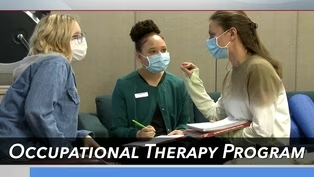
- [Jason] The two-year associates program teaches students how to assess (class chatters) and monitor patient performance related to movement, sensation, cognitive skills, and daily routines, and features lots of in-class simulations.
(class cheers) (class applauds) - Most people learn by doing.
And even though students say to us, "Can't you just tell us what's the right way to treat somebody with a stroke?"
No, I can't, because if you have 100 people with strokes, you have 100 completely different patients.
- Oh!
(students laugh) - Practicing all these things, and throwing curve balls at them helps them figure out what the real world is gonna be like.
This activity has so many options for grading it up and down.
- Okay.
- [Jason] 25 students are admitted to the program each year, (class chatters) and over the last four years, graduating students have a 100% pass rate on the national board certification exam.
- I could not be more proud of our students.
Their record in passing the exam, I think, is a testament (upbeat music) to the quality of our faculty.
- [Jason] According to the US Bureau of Labor and Statistics, the median annual wage for occupational therapy assistants was nearly $62,000, as of May of last year.
Overall, employment is projected to grow 34% from 2020 to 2030, much faster than the average for all occupations.
That translates into nearly 9,000 job openings annually.
- So the majority of our graduates go to work in either pediatrics or geriatrics.
And those are two settings which employ a lot of OT assistants.
- I think it's very competitive, but a lot of people get jobs in the nursing home area.
That's just the first place people go.
- I've had a few different positions, now, and it's definitely, there're opportunities out there.
You're gonna put your hands on the counter, both hands.
We're gonna move the walker out, so you can get close to the counter.
But- - For Will, his career path has done a 180, of sorts, from serving beers, to serving others.
- But it is crazy to think about, just, where I was six years ago versus now.
- [Jason] And his supervisor at The Pavilion at Brightmore, and the person who hired him, is rehab director Paige Villarreal.
She's a graduate of Central Piedmont's Occupational Therapy Assistant program, herself.
- I was very excited to hire Will, and our other graduate here, and continue on the tradition of great OTAs coming out of the program.
- One of the things that's so great about occupational therapy as a profession is you will never be bored.
And you can redefine yourself all the time.
- [Jason] While the name occupational therapy might still be confusing to some, (class exclaims) if you, a family member, or friend is ever in need of one, (student laughs) the graduates of Central Piedmont will be ready.
For Carolina Impact, I'm Jason Terzis, reporting.
- Thank you so much, Jason.
You can learn more about other programs Central Piedmont offers (air rumbles) on our website.
Just click on the Education tab, and the Getting to Work tab to view our Technical Career video library.
Well, in South Carolina, data shows agritourism farms increased nearly 79% since 2012.
During the pandemic, demand for outdoor activities motivated even more farmers to diversify their operations.
Carolina Impact's Rochelle Metzger shows us how some local growers are turning their land into go-to recreation destinations.
(air rumbles) (hoofs patter) (upbeat banjo music) (air whooshes) - [Rochelle] A safari experience (engine purrs) in a most unexpected place.
(machinery squeaks) (birds chirp) Herds of bison roam the rolling hills, grazing in pastures as far as the eye can see.
Originally from South Africa, - Welcome to the wet side.
(gravel crunches) - [Rochelle] Fred Ilse owns and operates Tatanka Bison Ranch, offering visitors a unique opportunity to view and learn about bison in a natural environment.
- Our main business is agritourism.
Our motto, which is, "Preservation, agritourism, education."
People coming out here and learning about these amazing animals, and how we holistically manage our land.
- [Rochelle] The sprawling, 215-acre property is nestled in the heart of York county, South Carolina, about a 45-minute drive from Uptown Charlotte.
- [Fred] A lot of people're unaware that bison were indigenous to the Carolinas.
(birds chirp) From my research that I did, the last ones in the wild in South Carolina was 1798.
We had prairies out here, and we had big herds of bison.
(motor rumbles) - Together with wife, Dana, they offer guided tours (upbeat music) to groups and school children.
- Kids are always happy to learn new things, and we tell them everything from how we farm these animals, how we farm a ranch, and then we spend a lot of time actually with the bison, and showing the various features of the bison.
(motor rumbles) - [Rochelle] And with Fred, no feature is off-limits.
- [Fred] And now, I'm gonna let you sniff some bison poop.
- [Rochelle] It's an exciting time on the ranch.
- [Fred] Mamas are all pregnant.
- [Rochelle] They're expecting 12 to 14 calves this year.
The couple also sell bison-meat products and host events, including farm-to-table dinners.
Tatanka is one of more than 500 registered agritourism farms in the state.
Though there are many more that invite the public to visit in some small way, according to Jackie Moore, marketing specialist with the South Carolina Department of Agriculture.
- It's growing really fast.
- [Rochelle] Agritourism combines the essential elements of agriculture and tourism.
Moore says the state is seeing new trends, from work-on-a-farm experiences and overnight stays to virtual visits and adult entertainment.
- There's a lot of fun things that kids do in a farm, like corn mazes, Easter egg hunts.
Now, farms are opening them up for adult versions, like having wine or beer, having an Easter egg hunt where there're coupons in them.
- [Rochelle] Another new feature, hiking trails.
- Used to be, you go to state parks when you wanted to go hiking.
Well, now farms, they've got a lot of land.
Christmas tree farms, you know, they set up hiking trails through their farms.
And that's a new trend that came out of COVID.
- [Rochelle] The South Carolina Agritourism Association even started a passport program that's grown in popularity.
The state prints 20,000 booklets a year.
- Kids can take these to the farms, and they stamp them, just like your little passport.
And at the end of the year, they turn it in and they get prizes.
(chickens cluck) - For family-owned operations like Bush-N-Vine, diversifying their offerings means new sources of income.
- That really adds value to what we're doing, here, and makes us more sustainable.
- [Rochelle] You can find Bush-N-Vine Farm on Filbert Highway between York and Clover.
It's open all year long.
- Lot of it's hand labor, and it's not easy.
The summertime's not fun, 'cause it's hot.
And so, we get started as soon as the sun comes up, and, you know, sometimes we try to quit early if it's hot, but a lot of times we go till late in the evening.
- [Rochelle] The land has been in Sam Hall's family for more than a century.
They started growing produce in 1979.
Over the years, they added an open-air market where you can buy buckets of strawberries, ripe melons, and tomatoes fresh off the vine.
- [Clerk] That come down for you?
- [Rochelle] The cafe offers sweet treats, while seasonal activities attract visitors like Beth Brennan and her two boys.
- They come pick the fruits, you know, the berries that we can take home.
There's a playground out back, so they love that.
- [Rochelle] Brennan says it's important for kids to learn where food comes from, and to support the few local farms that are left.
- There're so many shopping areas, and new homes, and things like that.
So it takes up all the land, there's not as many farms anymore.
- [Sam] We want it to be here for many generations to come.
Food is important to all of us.
(flagpole clinks) - [Rochelle] For farmers like Hall, and ranchers like Fred Ilsa, the shift to agritourism (motor rumbles) means more than just growing and selling food.
- [Fred] The whole thing is about sharing the experience.
- [Rochelle] Experiences that last a lifetime.
For Carolina Impact, I'm Rochelle Metzger.
- Thank you, Rochelle.
The South Carolina Agritourism Association makes it easy to find participating farms.
Visitors can search by county or activity.
Well, when you say weaving, baskets often come to mind, not clothing.
However, textiles came about when natural-spun fibers like hemp, wool and silk were woven together in a simple over-under pattern.
Producer Russ Hunsinger introduces us to a textile artist staying true to this timeless art form by creating her own fabric and garments with all-natural fibers.
(air rumbles) (calm music) (wheel squeaks) (parts click) (air whooshes) - I really feel connected to the past, because it is such an ancient craft.
(parts rattle) It's so cool to me to know that I am just one person, one thread, in the giant tapestry of weavers.
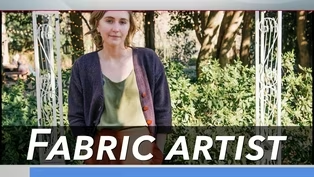
Hi, I'm Elizabeth Ranunculus, and I'm a fiber artist.
(loom squeaks) (shuttle rattles) Fiber artist, that would be someone who primarily works with fibers, textiles, (loom squeaks) so, yarn, fabric.
Weaving is a form of meditation for me, (shuttle rattles) because it is repetitive.
You really get in the zone, and there's this flow that starts (loom squeaks) to happen with your hands (loom rattles) connecting to your feet, connecting to your mind.
(loom squeaks) (calm string music) I knew I wanted to do weaving, creating art for a living after I made my first big dress.
And I got a lot of positive feedback on this, and people messaging me, "Can I have one?
I want one.
Where can I get one?"
I design whatever I'm gonna weave on paper, and then I bring it onto the loom, and create this fabric that can either be used just as fabric, (wheel squeaks) and really transformed into anything.
I also create wall art pieces, so, more tapestry-woven items.
But my favorite thing to make is clothing, specifically zero-waste-designed clothing.
(calm music) So I specifically design my pattern pieces for what I'm going to weave on the looms.
(parts rattle) (loom squeaks) I cut it in a way that leaves no waste behind, or very, very little waste.
Each garment is made with intentionality.
I start with yarn that is all-natural materials, so, like, cotton, linen, hemp.
This is Icelandic wool.
The different climates around the world affects what the wool is gonna feel like.
Some wools are softer than others, some are thicker, coarser.
Oh, another one I just got is kudzu.
Like, the stuff that grows everywhere.
And I never thought that I would be able to weave with it.
(upbeat music) So this is one of my favorite pieces.
This one took about 70 hours.
I like to wear pieces that are unique, and that people stop and go, "Oh my, where did you get that?
I love that."
And I go, "Oh, I made it."
And then that creates a conversation.
And so, that's another thing about my clothing, is, they are conversation-starters.
Then I get to explain my ethics, my beliefs, to that person.
(fingers snap) Nature is at the core of my work.
Everything I create, from the materials that I use, to the message that I want to put out in the world, nature, our environment, sustainability, eco-friendly, eco-conscious, all of that (machine scrapes) (shuttle rattles) is why I create.
So when someone sees the final product that I've created specifically for them, it brings me so much joy and happiness.
It feels like my chest is gonna burst.
(laughs) (machine scrapes) (shuttle rattles) First of all, I want them to love it, and be happy, and hope it fits.
But also, the cloth is at the core of the piece, 'cause that is what I spend the most time on, is creating the cloth.
More so than creating the pattern, or cutting or sewing.
So I want them to feel that whenever you touch it, it's almost like your favorite blanket, and's that tactile quality that really connects you to something.
(loom rattles) - Oh, the talent she has.
Thanks so much, Russ.
Elizabeth currently works as a seamstress, but hopes to eventually turn her passion for weaving into a full-time business.
(air whooshes) That's all the time we have (air whooshes) this evening.
We'd love your feedback, and your story ideas.
You can send both to feedback@wtvi.org.
Thank you so much for joining us.
We always appreciate your time, and we look forward to seeing you back here again next time on Carolina Impact.
Good night, my friends.
(air rumbles) (upbeat music) - [Announcer] A production of PBS Charlotte.
- [Narrator] Wells Fargo is proud to support diversity, equity and inclusion in our employees, our customers and the communities we serve, as well as through content on Carolina Impact.
Video has Closed Captions
Clip: S9 Ep25 | 4m 50s | Agriculture tourism and farming (4m 50s)
Carolina Impact: May 10, 2022 Preview
Preview: S9 Ep25 | 30s | Light Rail comparison, Agri-tourism, CPCC Occupational Therapy, and a local fabric artist. (30s)
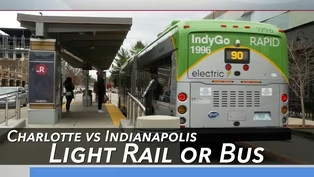
Charlotte vs Indy: Is Light Rail the Right Rail?
Video has Closed Captions
Clip: S9 Ep25 | 7m 43s | Charlotte vs Indianapolis: Light Rail vs Bus (7m 43s)
Video has Closed Captions
Clip: S9 Ep25 | 3m 52s | ElizabethRanunculus, fabric artist who creates one-of-a-kind & bespoke handwoven garments (3m 52s)
Video has Closed Captions
Clip: S9 Ep25 | 4m 58s | An inside look at Central Piedmont's Occupational Therapy Assistant Program (4m 58s)
Providing Support for PBS.org
Learn Moreabout PBS online sponsorship
- News and Public Affairs

Top journalists deliver compelling original analysis of the hour's headlines.

- News and Public Affairs

FRONTLINE is investigative journalism that questions, explains and changes our world.












Support for PBS provided by:
Carolina Impact is a local public television program presented by PBS Charlotte