
Carolina Impact: May 17, 2022
Season 9 Episode 26 | 23m 46sVideo has Closed Captions
College after Covid, Violins of Hope, Pipe Organ school, The old jail in Dallas, NC
College after Covid, Violins of Hope, Pipe Organ school, The old jail in Dallas, NC
Problems playing video? | Closed Captioning Feedback
Problems playing video? | Closed Captioning Feedback
Carolina Impact is a local public television program presented by PBS Charlotte
Carolina Impact: May 17, 2022
Season 9 Episode 26 | 23m 46sVideo has Closed Captions
College after Covid, Violins of Hope, Pipe Organ school, The old jail in Dallas, NC
Problems playing video? | Closed Captioning Feedback
How to Watch Carolina Impact
Carolina Impact is available to stream on pbs.org and the free PBS App, available on iPhone, Apple TV, Android TV, Android smartphones, Amazon Fire TV, Amazon Fire Tablet, Roku, Samsung Smart TV, and Vizio.

Introducing PBS Charlotte Passport
Now you can stream more of your favorite PBS shows including Masterpiece, NOVA, Nature, Great British Baking Show and many more — online and in the PBS Video app.Providing Support for PBS.org
Learn Moreabout PBS online sponsorship- [Narrator] Wells Fargo is proud to support diversity, equity and inclusion in our employees, our customers and the communities we serve, as well as through content on Carolina Impact.
- [Announcer] This is a production of PBS Charlotte.
- Just ahead on "Carolina Impact."
- College after COVID in the Carolinas.
I'm Jeff Sonier, we'll explain why some schools have record numbers of students on campus while others are still waiting for those COVID dropouts to come back.
- Plus this historic Gaston County jail gets a facelift.
We'll take you behind the scenes of this massive preservation project.
And we'll learn about the preservation of one of the oldest musical instruments.
"Carolina Impact" starts right now - [Announcer] "Carolina Impact," covering the issues people and places that impact you.
This is "Carolina Impact."
- Good evening, thanks so much for joining us.
I'm Amy Burkett.
It's cap and gown season again at colleges in the Carolinas.
After a whole year of in person classes for most schools, in person graduations are returning, but not all students are returning, and that's the new normal of college after COVID on some campuses.
Carolina Impact's Jeff Sonier and photojournalist Doug Stacker take us back to school to explain why some college students aren't coming back.
- Yeah, these college campuses aren't the ghost towns anymore that we saw during the pandemic college actually looks normal again.
It feels normal again, but a closer look at enrollment numbers on some campuses shows that after college interrupted, that sense of renewal, well, it all depends on the school.
(gentle piano music) We've been covering COVID at college for more than two years now, starting when students moved out and schools closed down, COVID's arrival versus college survival.
- Very eerie, just like a dead campus.
- [Photographer] One, two, three.
(camera snaps) - [Sonier] Since then, we've seen cap and gown seniors snapping photos with friends.
(camera snapping) As four years of college ends with graduations on hold.
(door and trunks slamming) And parents told more than once to pack up and pick up their college kids, families balancing concerns about health first and education later.
- Once we got home, we could kind of put things into perspective and he could understand how serious the virus was and what was going on and what needed to happen to stay safe.
I think he kind of just kind of, you know, got used to the fact that we are in a situation that is definitely not the normal.
- We announced the difficult but necessary decision to delay the start of in person instruction at UNC Charlotte.
- [Sonier] We saw big schools, like UNC Charlotte, going mostly online for months at a time.
(bell ringing) With smaller schools like Belmont Abbey bringing students back to in person instruction and also dealing with in person infection.
- You know, there was a moment of fear of like, oh my gosh I don't know what this is and I have it - [Sonier] But that was college and COVID then, and this is college after COVID now.
- 'Cause we needed to keep people apart from each other.
Now we're thinking about the ways in which we can bring them back together - [Sonior] At Wingate University, provost Jeff Frederick isn't seeing the drop in enrollment that other schools are.
- Across the landscape of higher ed, it's down about 7%, particularly on the four year side.
Community colleges across the country are down a little bit more than that.
- [Sonior] But while student numbers here at Wingate are pretty much the same as before COVID, student needs are different now.
- Maybe they're opting out.
Maybe they're taking less classes maybe they're in a part-time role.
So how do you get students caught up?
What about students who need a temporary leave of absence?
How do we help them?
- [Sonior] Frederick adds the other key to keeping the students you have and getting back the students you lost is bringing back the student experience that everybody missed during COVID.
- [Frederick] And getting back to tours and football games and street fairs around campus and special events like that.
I think those are the things that people hold onto.
- [Sonior] Are you a better school today than you were before the pandemic because of the pandemic?
- You know, I'd say we're a different school and we're more sensitive to all kinds of things.
I think people are really figuring out how much they missed each other.
- [Sonior] In fact, at some local colleges like UNC Charlotte, enrollment is actually up after COVID, to its highest level ever, with 30,000 plus students in Fall 2021.
- [Instructor] If you haven't signed in up front I do ask that you do so with your own pen.
- [Sonior] Meanwhile, at Central Piedmont Community College that same two year back and forth.
- [Instructor] So drafting your essay is 2% of your course grade - [Sonior] From in person learning before and after COVID.
- [Instructor] And just try to remember that.
Like do your best job, but don't let it overwhelm you.
- [Sonior] To all those online classes during COVID.
- We want everybody to feel safe in our learning environment, okay?
All right, any questions now?
- [Sonior] Apparently has some students who dropped out of college now staying out of college.
- You hear in the pandemic about people having to choose work or school or working parents that were trying to figure out childcare.
We had people who had lost jobs and trying to figure out how they were gonna afford homes.
We had all kinds of situations that it wasn't school.
- But Chris Cathcart, Central Piedmont's VP of Student Affairs says the challenge now is reaching out to those COVID dropouts, letting them know that COVID doesn't have to mean giving up their college dream.
Who are the toughest ones to get back on campus?
- I would say with little thought, the toughest students to get back are gonna be our adults that, you know, have settled into a new normal.
And so, like I said, it is life circumstances but we have to help with those life circumstances.
- They still want to be in college.
They just aren't sure if they can be in college.
- Yeah, yeah some of them.
Some of them aren't sure.
Those numbers that we are missing are people we're missing and that's what makes this work so important to us.
They're coming to us for hope.
They're coming to us for the promise of that next level.
- Yeah, and Cathcart adds that coming back to campus after COVID, well it can be a difference maker for those students, especially in this post pandemic economy.
It's a way for students to get those job skills or that college degree they need for the job or the career that they're looking for.
That was true before COVID and that's still true today.
Now it's just up to the students and the college to find a way.
Amy?
- Thank you so much, Jeff.
To find out more about college after COVID and the dropout rate at colleges across the country, check out our website at pbscharlotte.org.
Well, a collection of violins largely silent for decades are giving voice to the horrors of the Holocaust.
Some of the instruments were once owned by the prisoners of Nazi concentration camps but thanks to restoration, a book and now a concert series, the violins are coming back to life.
Carolina Impact's Jason Terzis has our story.
(violin playing) - [Terzis] The 1998 drama the Red Violin is the story of a mysterious instrument passed down generation to generation, spanning multiple centuries, countries and owners.
There's a real life version of the film, with multiple violins and harrowing stories at the center of it.
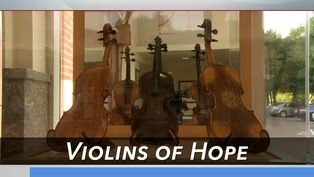
- Violins of Hope tells a story of six violins and what they and their owners went through together during the Holocaust.
- [Terzis] The Violins of Hope first went on exhibit in Charlotte 10 years ago UNC Charlotte musicology professor Jay Grymes was so moved by it, he traveled to Europe to learn more.
- I took a trip out to Tel Aviv and met with Amnon Weinstein.
He's the patriarch of the Violins of Hope Project.
He's the one who started to collect these violins and restore them with his son Absalom.
And I spent about a week with the Weinsteins in their workshop and I learned their stories.
And it was during that trip that I became inspired to write this book about the Violins of Hope - [Terzis] Jay's book, released in 2014, chronicles the stories of six Jewish violinists and their instruments, in and around the time of the Holocaust.
- The violins come to the Weinsteins usually through either the children of the survivors or their grandchildren.
So it's my job as historian to sort of flesh those stories out, do some fact checking and put everything in the correct historical perspective.
- [Terzis] In certain cases, the violins themselves may have saved their owners' lives in the form of preferential treatment from Nazi guards.
- I was really fascinated by these stories this idea that music, this art form that I love and that I've dedicated my life a career to in certain circumstances could actually make the difference between whether someone lived, whether they died.
- The Nazis took the great instruments for themselves.
They did not leave the really great instruments with the musicians in the camps.
- [Terzis] Five of the roughly 95 restored violins recently came back to Charlotte as part of a national tour.
New music was written and performed by an ensemble of faculty and students from UNC Charlotte, Queens University and Central Piedmont.
(violins playing) "Intonations" also featured two of the Violins of Hope.
- And there were times in practicing when I was watching the words while I was playing that I just started crying because the the stories are so incredibly sad and I would just have to stop.
- [Terzis] Dr. Mikylah Myer serves as the Assistant Dean and Professor of Violin at West Virginia University.
She drove the six plus hours to be a soloist in the performances, playing a violin that dates back to 1871.
- It's a gorgeous instrument.
And it's considered one of the really most playable and beautiful instruments in the collection.
- The violin that Dr. Myers were playing on tonight was once owned by Henrik Z Heifdel.
He was a promising young violinist who was dismissed from his orchestral positions in Germany simply for being Jewish.
And he might have perished in Nazi occupied Europe had he not been offered a position as one of the first concert masters of the Palestine Orchestra, now the world famous Israel Philharmonic.
And so playing the violin is what got him out of Europe and to safety.
(violins playing) - [Terzis] For Dr. Myers, playing on a violin with historical significance is nothing new - But I also play on this violin, which was my grandfather's violin.
And this is sort of another side of the story of World War II.
He was about to go on to become a big time soloist but he was drafted.
This violin that he was playing on at that time went with him to the war.
And this landed on the beach at Normandy, D-Day plus two - [Terzis] The music for Intonations was written from the perspective of what if the violins themselves could talk.
What would they say about their past and the people who played them?
(opera singing) With Audrey Babcock singing soprano and the words appearing on screen, the stories of resilience and survival came to life.
- The stories are told from the perspective of the violin.
So when Audrey, the singer, was singing, she is giving voice to the violin that I'm playing - [Terzis] The seventh and final movement of the piece is called liberation, representing the liberation of the Jewish people when the concentration camps were finally shut down.
(violins playing) That's when the second Violin of Hope appeared on stage, played by 15 year old David Karpov.
- My part is when the young performer walks in is passing from generation to generation.
So you'll see I'll walk out slowly playing my part, while Ms. Mikylah still playing her part.
- These violins have passed from one person to the next and this music will live on from one musician to the next.
- [Terzis] The atrocities of World War II and the Holocaust will never be forgotten.
Thanks to Violins of Hope, the music and the instruments of the time won't be forgotten either.
- I think it says a lot that even in the worst of times, even in mankind's darkest hours, people held onto their music or they held onto their violins, and that's what gave them hope.
- To know that these violins were in the circumstances that they were in, and they were often the thing that saved people's lives makes the exhibit and the music and the whole experience for anyone who has a chance to participate in it very very special and meaningful.
- [Terzis] For Carolina Impact, I'm Jason Terzis reporting.
- Those violins have such an amazing history.
Thank you so much, Jason.
The Violins of Hope also made several recent stops across South Carolina, in Myrtle Beach, Charleston, Greenville, and Columbia.
Well, have you ever gotten involved in a home improvement project that just never seemed to end?
You fix one thing and three more things need to be fixed?
In nearby Dallas, the historic Gaston County Jail is getting a makeover.
Carolina Impact's Jason Terzis and producer John Branscomb take us behind the scenes of this massive renovation project.
- [Terzis] Welcome to the historic square in Dallas.
No, not the Big D in Texas, but Dallas, North Carolina At the square center sits the Old Gaston County courthouse and across the street, the 1850s Hoffman Hotel, now home to the Gaston County Museum.
But in the other direction, you'll spot what looks like a historic brick home.
Look closer and you might get a sense of this building's true nature.
- We are at the historic Dallas jail.
This building was built in 1848.
Downstairs is actually super interesting.
The sheriff and his family lived here.
So their house was down here.
They used the basement in the first floor and then upstairs was the main cell block.
So it's not what you think about for traditional jails, like little boxes.
They just had one big room and they threw everyone in it together.
Supposedly there was two jail breaks.
Not super sure if they're true or not but we're gonna be looking for some evidence.
- [Terzis] Victoria Melvin-Propert knows a bit about the old jail.
She and her husband Blair bought it through Preservation North Carolina Victoria's passion for renovation projects started at a very young age.
- We are a family business and we always have been, we always work together.
I grew up working with my Mom.
She was an event planner, I followed in her footsteps.
My dad, it's his fault that I love old houses.
We didn't watch Saturday morning cartoons.
We turned on PBS and watched This Old House and watched Norm fix something.
- [Tarzis] Victoria says the work to save the building boils down to dreams and economics.
- It has always been a dream of me and my family to own and operate an event venue.
Not just weddings, signature events, birthday parties, showers, anything you can think of.
We wanna help celebrate it.
- Victoria is also getting help from her dad.
Meet James Melvin.
- It'll be awesome I think, we're gonna bring a lot of business downtown.
Dallas is booming, a lot of businesses is coming.
There's new manufacturing coming into the Gaston County area.
So it is growing rapidly.
- [Tarzis] The old jail served the community until 1911.
In the decades after it closed, others tried to repurpose the building.
There was a restaurant with a basement bar and even a store.
Eventually though the Gaston County Museum acquired the building with the intent of giving tours, but with expensive repairs and other improvements needed to open the building to the public, museum officials instead decided to put it up for sale.
- And Preservation stepped in to help find the perfect buyer for them.
- [Tarzis] Perfect buyers with a sense of adventure, blended with a respect for the history.
- This building is definitely full of projects, but nothing that's not fixable.
We really can't wait to comb through the building inch by inch and make every little correction perfect and historically accurate with lime plasterers, all the lathe is gonna stay.
All the exposed brick is staying.
We're gonna have the molding redone to be exactly what they should be and what they were originally.
- [Tarzis] She says PNC placed several layers of protection on the roughly 5,000 square foot jail.
- It does come with some covenants that are things that we cannot change but they are absolutely things that you would not want to change about this building.
The bars on the windows, the original granite foundation, the fireplaces, all absolutely pieces that are so important to the history of this building that need to remain in place.
The ceilings are protected by preservation.
That's one of the things that we cannot cover or change and where you absolutely would not want to.
It's been a ton of behind the scenes work.
It's really been an eight month process working with architects and structural engineers and interviewing contractors and getting our team in place.
- There's some structural issues with the side of the building pulling apart.
So we have to put in some tie rods to pull it back together.
Some structural supports in the basement to make it compatible with the number of people we're planning on having in house.
And of course, adding all the HVAC, electrical, plumbing, which none of it exists right now.
- [Tarzis] Beyond the business plans and saving an important historic building once used to house prisoners, there's more at work here.
- There's pride there.
And at first I thought she was crazy.
She called to tell us she was buying the jail and I said, "Oh, okay, sure.
We'll see how that goes."
But when she puts her mind to something, she goes to do it.
She's not afraid to take on something she's never done, which is something I wish I could do.
- For me, the most important thing about this building is just that the community can come in and enjoy it.
And I want them to have good memories.
If anything we've learned the last couple years, it's that we need to celebrate everything and we need to be together and enjoy.
So if we open these doors and we're here to help with anything you need to celebrate, as big or as little, we wanna make sure you have a great time and good memories.
- [Terzis] For Carolina Impact, I'm Jason Terzis reporting.
- Thank you Jason.
Preservation NC helped out about 900 different properties over the years.
Since purchasing the jail, Victoria says the family of the original sheriff who lived downstairs reached out to meet her.
Well originating in Greece, the organ is one of the oldest instruments still around.
To support musicians, the American Guild of Organists' Charlotte chapter helps share their knowledge to inspire passion.
Photojournalist Russ Hunsinger introduces us to this grand instrument with a rich heritage.
(organ playing) - The organ is often referred to as the king of instruments.
(organ playing) It is not a portable instrument.
It's not like a clarinet or something like that that you can take with you to the symphony take home and practice and that sort of a thing.
You have to go to the instrument to practice it.
- The organ is a lot more different than you might think from the piano.
It's a wind instrument.
I've always been fascinated by like the complexity of the organ.
When hearing it at church, I often envision myself up there.
(organ playing) - Each one pipe creates one note and you can have organs that might have a couple hundred pipes and up to some of the largest organs have over 10,000 pipes.
- So it's like having to operate a machine while you're also playing an instrument.
- Sounded a lot better when I was practicing - It's fine.
It always does, right?
(organ playing) You have two keyboards here on this organ.
Some organs can have three or four.
Each keyboard controls its kind of own separate part of the organ.
(organ playing) - Bass notes are played with your feet.
You need special shoes for the organ.
They have leather souls so you can feel the keys.
- One key connects to one pipe and is manipulated by what are known as stops.
You've probably heard the expression "pull out the stops" before.
That's what that means you literally pull out the stops and each one of these is what's known as a stop, it's a rank of pipes.
(organ playing) The Charlotte chapter of the American Guild of Organists is a local chapter of a national organization that serves the organist, that serves the community member, the students, anyone who has interest in the organ and it's music, it's assembly, it's construction.
- Hear that?
It's making it more subtle.
Most of my students have gotten a scholarship to study organ with me through a scholarship that the Guild provides called the Stigall scholarship.
(organ playing) - The ministers of music at Myers Park Presbyterian Robert and Anne Stigall formed a scholarship fund that was called the Stigall Scholarship Fund.
And the purpose of it is to offset tuition costs for aspiring musicians, students who wish to take organ lessons but who perhaps can't afford it.
- Stigall Scholarship was really exciting for me 'cause it was a great opportunity for me to actually, you know, get into the organ, which I had wanted to do for a long time.
- [Johanson] So today we are gonna do something fun.
We're gonna split up into groups and we're gonna build a pipe organ.
It's very important for us to ensure that there are musicians who are younger than us growing and learning.
(wood organ whistling) It's definitely just like any other trade organization or any other skill, it's something that has to be passed along so that our future generations know how to provide music for wonderful settings.
(organ music) - [Jose] Really blessed to have an instructor like Dr. Luca and grateful to the Stigall Scholarship for offering me this great opportunity to play this magnificent instrument.
(organ playing) - Thank you Russ.
The Guild will perform a recital series this summer.
We put a link to the upcoming dates on our website.
Well, before we head out I wanna say thank you to the Huntersville Happy Hour Rotary for coming to visit us today, we had guests in our studio.
Having an audience is always a great day, when the public comes to visit our public television station.
Again, that's all we have time for this evening.
We'd love your feedback and your story ideas.
You can send both to feedback@wtvi.org.
Thanks so much for joining us.
We always appreciate your time and we look forward to seeing you back here again next time on "Carolina Impact."
Good night, my friends (inspiring music) - [Announcer] A production of PBS Charlotte.
- [Narrator] Wells Fargo is proud to support diversity, equity and inclusion in our employees, our customers and the communities we serve, as well as through content on Carolina Impact.
Carolina Impact: May 17, 2022 Preview
Preview: S9 Ep26 | 30s | Covid college dropouts, Preservation NC jail remodel, organ school, and Violins of Hope. (30s)
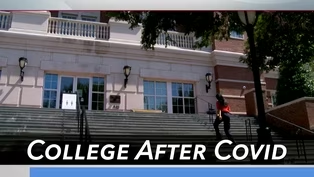
Video has Closed Captions
Clip: S9 Ep26 | 5m 46s | Some students who left college during Covid aren't coming back (5m 46s)
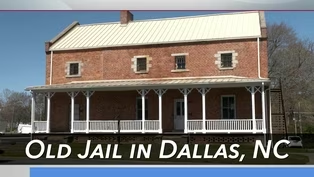
Video has Closed Captions
Clip: S9 Ep26 | 4m 29s | A renovation project of the old jail in Dallas, NC (4m 29s)
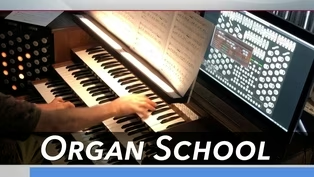
Video has Closed Captions
Clip: S9 Ep26 | 3m 49s | The American Guild of Organists-Charlotte Chapter supports and educates professional music (3m 49s)
Video has Closed Captions
Clip: S9 Ep26 | 5m 22s | Violins of Hope is a project of concerts based on a private collection of Violins of WWII (5m 22s)
Providing Support for PBS.org
Learn Moreabout PBS online sponsorship
- News and Public Affairs

Top journalists deliver compelling original analysis of the hour's headlines.

- News and Public Affairs

FRONTLINE is investigative journalism that questions, explains and changes our world.












Support for PBS provided by:
Carolina Impact is a local public television program presented by PBS Charlotte