
Carolina Impact: May 18, 2021
Season 8 Episode 26 | 28m 12sVideo has Closed Captions
Carolina Impact: May 18, 2021
Carolina Impact: May 18, 2021
Problems playing video? | Closed Captioning Feedback
Problems playing video? | Closed Captioning Feedback
Carolina Impact is a local public television program presented by PBS Charlotte
Carolina Impact: May 18, 2021
Season 8 Episode 26 | 28m 12sVideo has Closed Captions
Carolina Impact: May 18, 2021
Problems playing video? | Closed Captioning Feedback
How to Watch Carolina Impact
Carolina Impact is available to stream on pbs.org and the free PBS App, available on iPhone, Apple TV, Android TV, Android smartphones, Amazon Fire TV, Amazon Fire Tablet, Roku, Samsung Smart TV, and Vizio.

Introducing PBS Charlotte Passport
Now you can stream more of your favorite PBS shows including Masterpiece, NOVA, Nature, Great British Baking Show and many more — online and in the PBS Video app.Providing Support for PBS.org
Learn Moreabout PBS online sponsorship- [Announcer] This is a production of PBS Charlotte.
- Just ahead on Carolina Impact.
- [Jeff] So when the cops make a stop, are they dealing with criminals or customers, or maybe a little bit of both.
I'm Jeff Sonier, you stick around.
We'll tell you about Charlotte Police Training changes and how to avoid the violence.
- Plus we'll take you inside a public and private school to see how they're preparing to have a better year next year.
And we'll meet an artist making a huge impact in the glass industry.
Carolina Impact starts right now.
- [Announcer] Carolina Impact covering the issues, people and places that impact you.
This is Carolina Impact.
- Good evening.
Thanks so much for joining us.
I'm Amy Burkett preparing for the worst, hoping for the best, that pretty much describes the tactical training that Charlotte Police get now.
But that's about to change as the cops mix in a little customer service is all part of a Charlotte Police plan to win back public trust.
After a series of high profile police controversies both here in Charlotte and across the country.
PBS Charlotte's Jeff Sonia takes a look at what Charlotte Police will be doing differently and why.
- Yeah, here at Charlotte Police Headquarters, we don't know all the details of the customer service training yet.
What we do know though, is that the police chief announced the changes for Charlotte Police Training right after the guilty verdict in the George Floyd death up in Minnesota and right after a police shooting up in Ohio of a teen girl with a knife.
Both worst case examples I guess, of what police already trained for now.
- Stay away from me!
- [Police Officer] Ma'am drop the knife.
Ma'am drop the knife.
- [Jeff] We're inside a Charlotte Police Training Simulator.
Learning from our training officer, how cops decide whether to shoot or not shoot.
- [Police Officer] Drop the knife!
- [Jeff] In the same life or death situations we see in the headlines.
- [Police Officer] Drop the knife!
Drop the knife!
Now!
(gun shots) - [Jeff] What we're seeing on the screen is just an interactive training video.
It's not real, but it sure feels real.
(faintly speaking) - We have about 600,000 citizen contacts every year.
And one or two of those that go bad could spark an outrage within the community.
And that's unfortunate.
- [Jeff] But as chief Johnny Jennings told us after last summer's police protests in Charlotte.
Most encounters with police aren't life and death.
- This is not an us against them.
This is how we can be better.
- [Jeff] Which is why CMPD is hiring the same consultant that worked with Starbucks and other big companies.
- They want it to be easy for all employees, to understand, measurable, actionable, trainable.
- [Jeff] To help develop customer service training for Charlotte Police officers.
- It's putting more pressure on Chief Jennings.
He mentioned that if this is not a PR stunt but we feel it is a PR stunt.
- Julian Ortiz is spokesperson for Charlotte's Fraternal Order of Police, which represents the cops on the street.
- [Police Officer] Hey man, let me see your hands.
Let me see your hands.
Let me see your hands!
Put it down!
Drop the gun!
- [ Jeff] And Ortiz says you can't compare customer service at a Starbucks or a department store or a theme park to these high risk situations, that cops in Charlotte face every day.
- [Police officer] Shots fired!
Shots fired!
Shots fired!
- [Jeff] That's why the FOP disagrees with chief Jennings over the $60,000 costs and even the need for customer service training.
- And that's not what we want.
Our officers want to give good service, good community service, engage with our public, be able to be the solution to the problems that are happening in those communities.
That's what will help officer morale.
That's what officers are trained to do.
And they're taught to do even at the Academy level.
If you take the funding out of all of that, you are taking part of your community away because officers are there.
They're the first people that you interact in on your worst day.
- It was just literally him pointing a gun at me and calling 911 saying he had me at gunpoint.
That's not a good way to start a conversation - [Jeff] On Tonya Jamison's worst day, she was out of state, changing the license plate on her newly purchased SUV.
When an off duty police officer pulled his pistol.
- Saw me from across the street and held me at gunpoint because he thought I was trying to steal the car.
Even though I explained to him multiple times that I'd purchased the car and that I had all the paperwork in my bag All communication goes out the window when you come in with that perception.
- [Jeff] Now Jameson is chairperson of Charlotte Citizens Review Board, which investigates police shootings and makes recommendations to the police chief on whether officers acted properly.
- Obviously, we don't want our officers to try and be fuzzy and warm and fuzzy with a violent criminal.
But when your everyday interactions with people in the community, yeah, there needs to be better interaction, better communication.
It's your ability to talk and communicate with people.
And so to have customer service training and say, "Okay, we're going to look at how we interact with the public differently".
- You got to calm down.
- It's okay.
- It's all right.
We got you.
- It's all over now.
- Just calm down and we'll talk.
- [Jeff] Jamison says she supports anything that brings more communication and more compassion to police work whether you're a victim, or a suspect, or just putting a new tag on your car.
- Yeah, being at the other end of a police officer's gun definitely changes your perspective.
And you realize how quick they are to draw.
(gun firing) - I don't think the police have changed.
I think that it is the public's awareness of what is actually going on.
There is that fear now.
And so it's different.
The best scenario is that routine calls and routine interactions with the public with non-violent individuals, just regular routine interactions.
Don't end up with somebody being shot.
(woman screaming for help) It opens the door to look at things in a different way, looking at things to a different lens than you have typically done this before.
And so I say it can't hurt.
- Policing is completely different.
The program just for us, seems a little farfetched.
It's just not going to happen.
If you're breaking the law, the customer is not always right.
(police officer arresting a man) - By the way that whole concept of customer service training for police is pretty new.
In fact, the consultant that CMPD is working with on the project has never worked with a police department before.
Which means, whether the training here in Charlotte succeeds or fails.
A lot of other police departments will be watching, Amy.
- Thanks so much Jeff.
After Charlotte's police protest last summer, CMPD announced it was in compliance with the so-called Eight Can't Wait Program.
A series of eight policies and procedures designed to deescalate violent confrontations between the public and the police.
We've got a link to more information on Eight Can't Wait on our website at pbscharlotte.org.
Well with the school year winding down and the pandemic is still a factor.
How are our schools planning to proceed as they look ahead to the new school year and how can they pivot the lessons from an unprecedented year to close any achievement gaps and come back even stronger.
These are the questions our Barbara Lash explores.
- If you have kids in school like I do or maybe you have nieces, nephews, grandchildren.
You just might be concerned about everything that's happened during the pandemic from an educational standpoint, social and emotional needs.
Well, I would love for you to take a journey with me to two schools, one public, one private to see just how much the teachers, administrators, students and even parents are really stepping up to make sure that we are all set to go when the fall arrives.
- I'll say the word, you say the word and then we're gonna tap out the first sound we hear.
Are you ready?
- [Students] Yeah.
- Big.
- [Students] Big.
- That was good.
That sounded good.
- [Barbara] Good to be back in person to wrap up the school year.
Hidden Valley Elementary School in Charlotte, like most schools, has bounced back and forth between in-person, virtual, and hybrid learning models.
Principal Daniel Gray says "The biggest obstacle through it all has been the relationship building between the teachers and students".
- I have some clips of teachers who went and they stood outside the door and held up a whiteboard.
And wrote out math problems and showed the kid through the door so that the kid would understand and knew what was going on.
- Times three in each.
Is that our equation that we need in this problem?
- [Students] No.
- [Barbara] Third grade Haley Austin recalls some of her visits to student families.
- Anything to get the kids on, to get the kids learning was worth it.
And it really made us know the families more.
I feel like I always have a pretty good relationship with my parents, but this year, I mean being in their houses and they were awesome.
They welcomed us in with open arms.
- [Barbara] Another thriving relationship that surfaced during the pandemic is the one between the school, neighborhood residents, students at the University of North Carolina at Charlotte and UNCC's Charlotte Action Research Project.
They launched a virtual tutoring program that meets every Saturday morning.
The focus is literacy and reading comprehension.
- They're not just talking about just literacy.
They're talking about other issues that excites the children, what interests they have so they're making the relationship, getting the students to talk and the more they talk and then they listen to more intelligent speak coming from those instructors on the UNC side.
Is going to just definitely broaden those students arising.
- I have a kid that I talked to the other day, a student that said "I know all these different people and they all care about me".
And that'll touch your heart.
- [Barbara] Also at the heart of Hidden Valley's approach is not being defined by a title one status or achievement gaps, but rather a mission to Excel by addressing the students' social and emotional needs, as well as the academic ones.
- Camp CMS coming up this summer.
We have won the highest enrollments in the district with our students attending those camps.
And we're trying to get even more of our students in those camps.
And it's not just for students who are struggling, but for enrichment as well.
So when they come back in the fall, they're closer to closing that gap.
- [Barbara] Something else coming back in the fall?
The use of technology, which the teachers and staff learned is a huge asset.
- [Haley] I can tell any kid in my classroom, go to this website, click on this, and do this.
And they're there within two minutes.
And that's never happened before.
- [Barbara] That technological savviness has played a major role at Friendship Day School for the Sciences and the Arts as well.
A private elementary school in Charlotte that conducted the majority of the school year via zoom.
- What I would say, and especially being there with him every day, seeing the virtual learning.
The children have truly excelled.
- The plant traps the bug.
- [Barbara] Angela Rivers' nephew, Amauri, holds the school record of never missing a day since kindergarten whether in-person or virtual.
And he's in the third grade now.
Talk about loving the environment.
My favorite part about FDS is the teachers and the head of school.
- [Barbara] A head of school and teachers who have worked diligently to thrive even in a virtual environment.
- I think It was a combination of several things.
One, our scholars have tremendous support at home.
Their families are wonderful.
And they expect the best for them.
Then here at school, our expectations are very high.
- [Barbara] So is the spirit of competition.
These FDS third graders were in the building for their standardized test.
Only the second time, the entire school year that they've been together in the classroom.
- It is very new to me to be in-person with all my friends, but after a while, it was great.
- [Barbara] Simone, like many of these third graders has been with the school since it started in 2017.
Head of school Linda Calmer says "It took some planning but they were able to maintain all of the unique activities, including mindfulness, Suzuki violin lessons, and Scholar TV, all done virtually.
- We did not want our Scholars just to sit there and have to look at the screen.
There are other things that we can do along with that virtual program.
And so we began to install and initiate those things like physical education.
- [Barbara] Speaking of physical education, to wrap up a week of testing.
These scholars did a multiplication relay race.
- [Teacher] I've learned that making games out of lessons really work with children, everyone was cheering each other on.
They were saying things like "Use your strategies".
"Remember the strategy".
- [Barbara] Strategy is also being used to plan for next school year, including making use of learning apps and tools discovered during the pandemic.
- [Teacher] Also because of spacing in the classroom we will also probably use part of zoom.
We will probably use their breakout rooms for small group instruction.
- [Barbara] Instruction and then some.
- [Linda ] If you don't love them, you can't lead them.
And if you don't serve them, you can't save them.
And so we love our children who are at this school.
- So a couple of the themes that we've seen whether it's hidden Valley Elementary or Friendship Day School, is this idea of really caring for the students and meeting them where they're at.
Whether it's maybe doing a tutoring program, to increase reading comprehension, or just having them get up and move in the middle of the day.
There are plenty of things that schools have learned throughout this pandemic to really propel their students going forward.
So I encourage you, check out your own school, pull back a couple layers and see what nuggets are there that can really help your kiddos get off to a great start as we go into the next school year.
For Carolina Impact I'm Barbara Lash.
- Thanks so much Barbara and welcome to our PBS Charlotte family.
Well, Friendship Day School for the Sciences and Arts which began with just a kindergarten program is now a K through fourth grade school with plans to add the next grade level each year.
Along with the opportunity scholarship offered by the state.
The school offers scholar sponsorships to help with tuition.
Well, a new nonprofit organization in Charlotte is using its fitness programs to bring the special needs community together through exercise.
Sarah Colon-Harris has more on how getting active is helping them transform their everyday lives.
- [Sarah] Great weather, friends, and exercise.
It's the combination that keeps Brent Sessler coming back to rise above fitness week after week.
- I'm glad I'm part of the family here.
I'm glad to be out here and just enjoying myself and just having fun and hearing people, smiling, laughing talking around all sorts of stuff.
- [Sarah] Today's class includes a little jumping ,kicking, running, high fives and even a little dancing here.
Here there's enough variety to keep things interesting.
All while building character and confidence.
- We do a lot of exercises.
We do like pushups and sit ups.
We all like to be funny and act silly sometimes.
And we like to do some dancing, a little bit of dancing.
A little bit of exercises and yoga.
- [Sarah] But unlike other fitness programs, everyone here has special needs.
Including 39 year old Brent who was born with a condition known as Williams Syndrome.
- It's a genetic disorder that makes you happy.
It makes you a friendly.
There are some challenges I faced, but other than that, It's really cool.
- And he's been just a joy to be with.
He lives independently.
Has a full-time job at the hospital working 40 hours a week.
He walks to work.
- [Sarah] For Brent's dad, today's movement is a welcome site.
- Prior to Rise Above Fitness, Brent was relatively sedentary.
Didn't have an opportunity to get out and socialize with friends to be able to exercise on a consistent basis.
So now we can count on Tuesday, Thursday and Saturday for this wonderful opportunity to be with friends and get some healthy exercise.
- And this one is called karate kid.
- [Sarah] The fitness classes are part of the nonprofit organization Rise Above.
- Because we have three key components of exercise socialization and empowerment for individuals with intellectual and developmental disabilities.
So think autism, down syndrome, cerebral palsy even into the TBR.
So the brain injuries.
- [Sarah] Ryan Bost, the fitness instructor says "The idea for the program came to him after volunteering with special needs adults".
- After that first class, I felt phenomenal.
I couldn't sleep.
My mind was churning.
Right after that, two weeks after that, I volunteered at a camp and that just solidified it.
This population has taught me more than anything, is to be present and to live with intention.
- The Rise Above Group meets three times a week, twice here at freedom park, and once on Saturdays at Park Road Park.
They also meet virtually, and the average cost per class is about $15.
- We're going to do some warriors.
So we're going to come with our feet together.
- [Sarah] For Jordan Todd, The program has paid off in big ways.
- My favorite part is pushups.
I feel good.
- [Sarah] Since joining a year ago, the 24 year old has already lost about 30 pounds.
- It is phenomenal to be honest with you, she's just really come out.
And for me, that is like the best feeling in the world just for her to communicate and just be with other people and be with friends.
- Rise Above Fitness, it kind of typifies this whole pandemic experience, which is to not let it get you down, to always stay positive and lift yourself up above whatever obstacles that you have.
And so this is a pretty special name.
It really matters.
Because that's what we're trying to teach this population is to try to not let obstacles be in your way.
- Okay, Hands up.
- [Sarah] For Brandon Burrows coming to the program has not only reaped physical benefits.
He's also seen positive changes in his mental health.
- Where I had a very serious health breakdown.
I had depression.
I had anxiety, but ever since I came to this class, it has died down quite a bit.
I'm a lot better than I was before.
- [Sarah] Sarah Allen is the mother of two special needs children, including her son, Matthew.
- Matthew was born with what's called Toxoplasmosis which is a parasitic infection.
Did damage to his eyes and to his brainstem.
So he's legally blind.
He does have some mental retardation but he also is on the autism spectrum.
- [Sarah] She says the program addresses the need for community after high school.
- Once they graduate high school, they just fall through the cracks.
And so to find something like this, where they can get outside and be around other people and get moving.
Because the majority of them will just sit in the house and look at video games.
This has been just amazing.
He loves coming.
He loves to be outside and be with other people - [Sarah] For Ryan, the executive director, bring the group together has also transformed his own life.
- We provide fitness classes.
They give back to me tenfold, right?
So I live more with intention than I've ever in my life.
- [Sarah] Being present in the space where everyone is free to be themselves.
For Carolina Impact, I'm Sarah Colon-Harris.
- The rise program has served about a 150 people since it started in 2020.
The program hopes to eventually expand into more cities.
Well, imagine for a minute, your child or any loved one being just five years old and being told he or she has a rare form of cancer and given just 5% chance to live.
The news would be crushing.
But here in Charlotte, there is such a person who somehow beat those incredible odds and is now living out his passion through his art.
Carolina Impacts' Jason Terzis shares this incredible story of survival.
- All right.
So there's the clear molten glass.
Roll it through red.
- [Jason] When you think of glass, you likely think of something hard and breakable.
- But it's still like mega hot.
It would burn the heck out of both of us.
Not something soft and meltable.
And this will stay hot at around 2200 degrees Fahrenheit.
- [Jason] But as it's being made, that's exactly what glass is.
There's all these different little moves and steps and teamwork and communication.
And it's like, super dangerous.
- [Jason] Located in the notice section of Charlotte.
Hot Glass Alley is the only hot spot in the area bringing the mysterious art of glass making to the public.
- Beautiful, Stop right there.
Perfect.
You get one shot to really get it right?
When you're out there making it.
- [Jason] For owner Jake Pfeiffer, creating glass masterpieces is a lot like, well, cancer.
It's a one-shot deal.
There's no setting it aside and dealing with it later.
Once it starts, it must be dealt with and either things go well or they don't.
- There is no in-between.
- [Jason] Jake knows this, firsthand.
- Those days are forever embedded in my mind.
He kept waking up in the evening with headaches and during the night, at five years old.
He would wake up and say, "I had a headache.
I have a headache".
- [Jason] At first, doctors thought it was nothing more than a sinus issue, but those headaches, persisted.
- We did CT scans and MRIs, and it turned out he had a very high grade Rhabdomyosarcoma that sat down behind his left eye, but it had fingers and it had already penetrated through the skull and was moving into his brain.
- [Jason] Just five years old, stage three inoperable cancer.
Jake was given just a 5% chance to see his eighth birthday.
- It was horrible.
Because the oncologist told us that he likely would not survive this.
- [Jason] In and out of the hospital for well over a year.
- Felt like forever.
- [Jason] And treated with a lifetime dose of radiation to his head and three different types of chemotherapy.
- They were like, "Oh, well you're like on the good guys, cell team.
And you're fighting like the bad guy cells".
And I just knew I was really sick and I didn't feel good.
And it wouldn't let me go home.
- [Jason] So ill Jake was sent on a Make-A-Wish trip with his family.
They thought the end was near.
- And we made funeral arrangements three times.
- [Jason] While his family worried about him, Jake couldn't help but think about the other kids in the hospital.
All facing the same challenge.
- I remember a lot of them dying.
You know, that was, that's a hard part for me.
It's like these kids, I knew their names and their faces and they didn't make it.
And I did.
So I'm like, why am I the one that may, you know like it's not, it's just not fair.
- [Jason] Slowly, miraculously little Jake's body started responding to the aggressive treatment.
The tumor began to shrink.
- By the time we were finished with the chemotherapy, the tumor had pulled back out of his brain.
- I have to go back like maybe once or twice a month to get checked on.
It would take like all day, do all these crazy tests, CT scans, MRIs.
- Only by the Grace of God and his brilliant medical team is he here.
- When I stop having to do all of that it was kind of when I was like, "Yes!".
- [Jason] At 13, two years before he was officially declared cancer-free Jake went on a family vacation.
- It all started in Bermuda.
- [Jason] When something grabbed his attention.
- Then when he saw glassblowing, I mean it was a sparkle in his eyes.
- Watch these guys literally like just pull this molten material out of this huge thing on the end of the stick.
And then I had all these colors and shape it, manipulate it.
And I'm like, it's just like for real, like this is like something out of like a Sci-Fi fantasy movie or something.
And I just sat there.
I remember asking them like every question under the sun.
I'm sure they were just like "Get out of here".
- [Jason] Jake knew from that very moment what he wanted to do with his life.
- So I felt like it was just like, dude, I got a second chance to do whatever I want.
- [Jason] Earning his bachelor's degree in fine arts.
Jake went to work in the glass blowing industry before opening Hot Glass Alley in Charlotte three years ago - We are beyond thrilled that he was able to find what he loved and that he is now able to do it.
- [Jason] Beating cancer against seemingly insurmountable odds.
It's no wonder Jake has survivor's instincts.
He's passionate about what he does and a perfectionist with his art.
- He will take a piece.
And if it is not what he expects it to be he literally will just dump it.
You know, start over.
- [Jason] Tattooed across his chest and down onto his arm is the Greek mythical bird, the Phoenix which according to legend Rose from the fire and ashes to be born again, it's fitting for Jake.
As it represents all that he's been through.
- It never really died.
You know, like we'll go through like a lot and then it will like come back.
I play with fire all day too.
That's why I can relate to that.
I was able to deal with all of that and like get through it.
It's just always been like a symbol since I was like a kid, after that.
- [Jason] An unlikely survivor, making the most of his second chance while living out his passion.
For Carolina Impact, I'm Jason Terzis reporting.
- Thanks so much Jason, I had a chance to go and visit Jake studio and was in awe of his work.
I think it looks a lot like Chihuly glass.
Jake has been commissioned by a local hospital to produce and install a huge glass project.
It'll be an incredible 18 feet long and nine feet high it's being called the living sculpture and will represent the various seasons of the cancer journey.
I'm excited.
PBS Charlotte is working with Jake to create some exclusive glass pieces just for our PBS Charlotte members.
We hope to have details on that for you in August.
Well, that's all the time we have for you right now.
We always appreciate your time and look forward to seeing you back here again.
Next time on Caroline Impact.
- Good night my friends.
Carolina Impact: May 18, 2021 Preview
Preview: S8 Ep26 | 30s | Carolina Impact: May 18, 2021 Preview (30s)
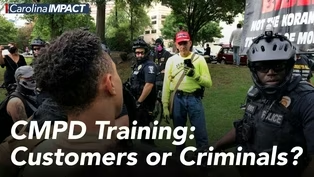
CMPD Training: Customers or Criminals?
Video has Closed Captions
Clip: S8 Ep26 | 6m 10s | Soon, the cops will add customer service training -- to win back public trust. (6m 10s)

Hot Glass Alley: Jake Pfeifer profile
Video has Closed Captions
Clip: S8 Ep26 | 5m 30s | Jake Pfeifer, who overcame childhood cancer to live out his dream (5m 30s)
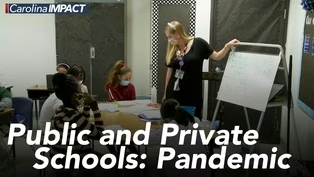
Public and Private Schools Pandemic
Video has Closed Captions
Clip: S8 Ep26 | 6m 41s | Learn how public and privates schools dealt with the pandemic (6m 41s)
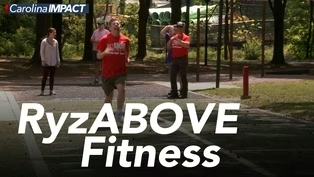
Video has Closed Captions
Clip: S8 Ep26 | 5m 28s | A fitness program to help people with intellectual and developmental disabilities (5m 28s)
Providing Support for PBS.org
Learn Moreabout PBS online sponsorship
- News and Public Affairs

Top journalists deliver compelling original analysis of the hour's headlines.

- News and Public Affairs

FRONTLINE is investigative journalism that questions, explains and changes our world.












Support for PBS provided by:
Carolina Impact is a local public television program presented by PBS Charlotte