
Carolina Impact: May 3, 2022
Season 9 Episode 24 | 27m 38sVideo has Closed Captions
Charlotte Symphony 90th Birthday, Student Designers, Miracle On the Hudson, Comic Books
Charlotte Symphony 90th Birthday, Student Designers and the Charlotte Hornets, Miracle On the Hudson, Comic Book Artis
Problems playing video? | Closed Captioning Feedback
Problems playing video? | Closed Captioning Feedback
Carolina Impact is a local public television program presented by PBS Charlotte
Carolina Impact: May 3, 2022
Season 9 Episode 24 | 27m 38sVideo has Closed Captions
Charlotte Symphony 90th Birthday, Student Designers and the Charlotte Hornets, Miracle On the Hudson, Comic Book Artis
Problems playing video? | Closed Captioning Feedback
How to Watch Carolina Impact
Carolina Impact is available to stream on pbs.org and the free PBS App, available on iPhone, Apple TV, Android TV, Android smartphones, Amazon Fire TV, Amazon Fire Tablet, Roku, Samsung Smart TV, and Vizio.

Introducing PBS Charlotte Passport
Now you can stream more of your favorite PBS shows including Masterpiece, NOVA, Nature, Great British Baking Show and many more — online and in the PBS Video app.Providing Support for PBS.org
Learn Moreabout PBS online sponsorship- [Narrator] Wells Fargo is proud to support diversity, equity and inclusion in our employees, our customers and the communities we serve, as well as through content on Carolina Impact.
- [Narrator] This is a production of "PBS Charlotte."
- Just ahead on "Carolina Impact."
- [Jeff] The Charlotte Symphony Orchestra celebrates a birthday.
I'm Jeff Sonier with the Blumenthal Performing Arts Center.
We show you what it was like when the symphony started playing 90 years ago.
- [Amy] And a Hornets player ups his pregame wardrobe with designs from these middle schoolers.
Plus, as the comic book business evolves, more diverse characters have merged.
Meet an artist creating courageous stories with fresh heroes.
"Carolina Impact" starts right now.
- [Narrator] "Carolina Impact," covering the issues, people and places that impact you.
This is "Carolina Impact."
(upbeat music) - Good evening, thanks so much for joining us.
I'm Amy Burkett.
For 90 years, the Charlotte Symphony Orchestra played our soundtrack in the Carolinas.
From the grand concert halls of Europe, to school auditoriums, it brings great live music into all of our lives.
Now, as the symphony celebrates a big birthday, we're all invited.
"Carolina Impact's" Jeff Sonier and video journalist Doug Stacker take us onstage with the Charlotte Symphony today and backstage with a look back at nine decades of music and memories.
- Yeah, it was 1932, decades before there was a Blumenthal stage here in Charlotte.
Back then, the musicians were all volunteers and the symphony budget was $60 a year.
Today, well, it'll cost you 60 bucks for a symphony ticket.
But that's how far we've come here in Charlotte, both the city and its orchestra, our orchestra.
(lively orchestral music) - [David] Well, this evening is not simply a celebration.
We are not an island.
We're part of this city, part of this world, and I'm so grateful to have you all with us as we celebrate 90 years of incredible music in Charlotte.
Happy birthday to us.
(audience applauds) - [Jeff] Orchestra president David Fisk welcomes this sellout Charlotte Symphony birthday audience and a special birthday guest who brought a special birthday gift.
- This is a painting I wanted to give you all of my grandfather.
- [Jeff] Katherine Roxlo's grandfather is Guillermo de Roxlo, the Charlotte symphony's founder and first conductor, whose orchestra made music headlines then (soft orchestral music) and is still making music history today.
- [Katherine] 90 years ago, my grandfather Guillermo de Roxlo conducted the first symphony orchestra here in Charlotte.
And he came from Barcelona, and it took him seven years to get here.
But once he got to Charlotte, everything changed.
And Charlotte means so much to my family.
Charlotte gave Guillermo a beautiful city to call home, a wonderful rewarding career.
He was symphony conductor and wrote much of the music and wrote by hand all the pieces for the individual players because they had no money to buy music.
Do you guys get paid?
They didn't get paid back then.
- [Jeff] It's interesting.
I saw some of the newspaper clippings.
Literally, he put an ad in the paper, right?
That's how he found his first group of musicians.
- Yeah, and it was community.
It was school teachers and bankers and lawyers and just whoever had an instrument.
- [Jeff] We're talking with Katherine Roxlo from her home in Phoenix where that same family portrait of her grandfather hangs with pride in the background.
- The pride that he had in that this was a community symphony.
It wasn't professionals.
And he said, "I found my place.
Now I know this is where I'm supposed to be."
And they said Charlotte reminded them of home.
They loved the pine trees of North Carolina and South Carolina.
It just felt so good to them.
- [Jeff] Today, de Roxlo's Charlotte Symphony legacy brings feel-good moments to all of us as the symphony performs, not just in Charlotte, but in all of Charlotte's surrounding towns and cities.
Back in the '50s, they started the symphony school concerts that they still play today.
In the '60s came Charlotte's first African-American symphony musicians.
The '70s and '80s brought Charlotte's popular Pops in the Park series.
- You'll have plenty of time to get on the train once it comes.
- [Jeff] And in 1987, the Charlotte Symphony traveled to Germany and Poland for their long awaited and much anticipated European tour.
- [Leo] And there was decided that the cultural borders would be reopened again.
And great idea about this was to bring the Polish Orchestra and the Charlotte Symphony together to perform together the great Beethoven's "9th Symphony."
("Symphony No.
9" by Beethoven) - [Jeff] The past two years of pandemic forced the Charlotte Symphony to scale down with fewer musicians playing smaller socially distanced concerts, often outdoors or online.
- [David] And it's funny because when you've been deprived of something and you then get it back, it sounds even bigger than before, bigger and richer.
And the opportunity for us is to keep welcoming those new audiences.
(dramatic orchestral music) - [Katherine] They are good musicians.
You have so much to be proud of.
And I mean, I was proud to just hear it.
- [Jeff] What would Guillermo think today if he could look down or look back and see this orchestra 90 years later?
I guess he'd be equally proud of what they've become and who they are today.
- Very proud and I feel that he can take a breath and rest at this point knowing what Charlotte has down with what he started.
(audience applauds) - [Jeff] Yeah, and they'll be celebrating the symphony's birthday all symphony season long.
90 years of bringing music to our ears.
Amy.
- Thanks so much, Jeff.
You'll find a link to more Charlotte Symphony history and more great photos at pbscharlotte.org.
After weeks of designing accessories and jewelry using 3-D printing technology, nine middle schoolers at a local STEM academy made their big reveal.
The works of art were designed specifically for Charlotte Hornets player and fashionista Kelly Oubre to wear pregame.
"Carolina Impact's" Jason Terzis shares how the project introduces fashion and design as an alternative career path in STEM.
- [Announcer] Kelly Oubre, welcome to the ball game!
- [Jason] He made his name known to area basketball fans this season, averaging 15 points per game for the Charlotte Hornets.
- [Announcer] Kelly!
(audience cheers) Oh, my!
Six in the corner!
- [Jason] But to many people, Kelly Oubre Jr. is more well known for who he is off the court.
- [Alyssa] Kelly Oubre, if you are not familiar, is a very fashionable avant-garde Hornets player and he's known for his game day looks.
- [Jason] In other words, he's a fashionista of sorts.
- [Kelly] I love to be eccentric and I love the jewelry and accessories.
- [Jason] With nearly two million Instagram followers, Kelly built quite a reputation for his style.
- Every day is a fashion show, man.
- [Jason] Attending fashion weeks in the off-season and even creating his own clothing and jewelry brand, Dope Soul.
- [Kelly] This right here, I was feeling real colorful.
I created these shoes with Converse.
So I wanted to just wear plaid all over.
I'm an artist, man.
I don't like to be categorized.
I don't like to be put in a box.
But at the end of the day, I do like to create art and I like to tie everything into life.
- [Jason] Wanting to combine fashion with education, the Hornets teamed up with Digi-Bridge, facilitating a multi-week 3-D design and printing course for students at Governor's Village STEM Academy.
- Digi-Bridge is an education non-profit that works to prepare students for the digital age in science, technology, engineering, arts and math.
- [Jason] The middle schoolers task, create accessories such as bracelets, chains and earrings for Kelly to wear on game days.
- So I styled their accessories with my swag and I'll rock their stuff to the game and make sure that their stuff is seen by the world.
- Wanted to introduce you to the class that will be designing your game day accessories.
And then, I guess, I think a few of them have some followup questions for you.
- [Jason] To get things started, the class held a virtual meeting with Kelly to learn about his style and inspiration and to get personal details, such as his measurements, favorite colors, materials and fabrics.
- First and foremost, thank you for allowing me to be a part of this.
This is a big deal for me personally and for all of us because we're all artists in this.
- Me and my classmates, when we first started this, we looked up things about him, like his fashion stye, what he wears everyday.
- I looked at websites about him, things like information, like I know he's 6'6.
I pieced together through a bunch of websites a basic thing about him.
- The students have been working on designs.
They've been doing consultations and just failing along the way, because 3-D designing and modeling is really hard, and really proud of their final products because of everything that they've gone through to get to this point.
- It's never perfect.
But every time I see an imperfection, I just know that the next time's gonna be the best time.
You know what I mean?
- [Jason] After a month of trial and error, the students were finally done and presented their finished creations to Kelly during a school visit.
- When you decided what you wanted to do with the chain, how'd you get this material and stuff right here?
(students chattering) - I glued them together here.
I glued it together to fit your hand here, there, separate.
- [Kelly] It looks excellent.
I want you to know it looks really good.
It came out really nice, so thank you for the thought.
And this is definitely one of those pieces you just bet on yourself and your idea and I love it.
I was really at a loss for words, man.
But one thing that I continued to ask each and every student was how did you feel throughout this whole creation process because I was just interested to see the ups and downs that came with it because everything that you do is a process.
It's an ebb and flow.
It's always gonna be good and bad.
- [Jason] For the students, it was a rare opportunity to work with a pro basketball player, and get introduced to the idea of fashion and design as a potential career path.
- We knew that 3-D modeling and designing is a key educational experience that's gonna be really impactful in the future for a lot of different sectors and industries like medical, construction, technology.
And so we really wanted to incorporate fashion and technology together.
- I just love to bring people together for a bigger cause, man.
It's never about me.
It's never about the next man.
It's about the bigger picture.
And for me, the next generation is the bigger picture.
How you doing, love?
How you doing?
- [Jason] To show his gratitude, Kelly invited the participating students to the Hornets final home game of the season.
For many, it was their first time seeing a game live.
- I wasn't even interested in basketball until now, so I didn't really know who he was.
I did know the Hornets team did exist though.
I did know that.
- You did your thing, man.
Thank you.
- Thank you.
- [Jason] They may not have all known who he was before taking on this project, but they certainly know who Kelly Oubre Jr. is now.
For "Carolina Impact," I'm Jason Terzis reporting.
- Thanks so much, Jason.
What an awesome opportunity for those talented young people.
Well, Kelly has one year left on his two year $25 million contract with the Hornets.
13 years ago, Flight 1549 from New York to Charlotte landed in the Hudson River.
All 155 passengers survived that miracle on the Hudson moment.
You, the viewers, voted their stories of survival as our number one story in the "PBS Charlotte" playoffs.
Tonight, "Carolina Impact's" Jeff Sonier and video journalist Doug Stacker take us back to La Guardia Airport in New York City to hear their stories.
- You know, for most travelers, La Guardia is pretty much like every other busy airport.
You check your bags.
You check your phone.
You check the weather out the window.
Another gray day in New York.
Hopefully, better weather back in Charlotte.
But for the 155 passengers and crew members who boarded US Airways Flight 1549 here, well, this is where their typical day at the airport turned into a life changer.
(plaintive music) - [Dave] Nothing extraordinary, right?
About 60 or 70 seconds later, you hear a boom.
- It was explosive sound.
The plane shook.
You could feel the whole plane shake.
- [Jeff] That was the moment.
- It was like a loud noise and heavy turbulence type of thing.
- Imagine an engine going, "Clack, clack, clack, clack, clack, clack, clack."
- [Jeff] The moment these passengers on Flight 1549 New York to Charlotte realized their last day in New York might actually be their last day anywhere.
(horn beeps) - I wasn't supposed to be on the plane.
I was scheduled to be on the 5:00 flight that night.
We got out of work early that day over in Brooklyn, so I caught the earlier flight.
- [Attendant] The safety card in your seat pocket explains the safety features of this airplane, including the location- - [Jeff] The moment they wished they'd paid more attention to the safety announcement.
- It's like a routine and you kind of take it for granted I guess, until something really happens.
- [Pilot] We're out at an hour and 13 minutes with initial cruising altitude at 31,000 feet.
- [Jeff] The moment these strangers on a plane in seat 15A and 20C and 1D and 20A, the moment they all knew that who they were flying with might also be who they were dying with.
- [Ben] As soon as I turned and looked out the window, I noticed the left engine was just shooting out flames, and that was the most terrified I've ever been in my life.
- And all I could see was water in front.
And I said, "This is not good."
- [Beth] I couldn't tell by distance how close we were to the buildings.
So my feeling was that there was no way we were gonna survive this.
You could hear people whispering to each other.
You could hear people praying, saying prayers, some people praying together.
- [Ric] As we're coming down, I had a sense of, wow, dying is not scary.
It's almost like we've been preparing for it our whole lives.
But it was very sad.
I didn't want to go.
I love my life.
- I literally felt like my heart had just sunk and fell on the floor.
I'm like, "This is it.
I'm gonna die."
But that quickly was washed over by this sense of calmness.
- When I was praying, I remember that I wasn't saying, "Please, save us," because I didn't think we could be saved.
I didn't see a chance of us being saved.
I was just thinking to myself, please don't make this horrible for my family.
- [Jeff] But that feeling of fate, that sense of surrender quickly turned to survival as Flight 1549 landed in one piece in the water in the Hudson.
- [Beth] In the back of the plane, we could feel the tail hit.
I still had my head down and I turned to look, and in the aisle of the plane in the back, I could see little fountains of water shooting up through the floorboards.
And that's when I knew, oh my gosh, we must be in the river.
I could feel how cold it was.
It was just frigid cold.
And that startled me, but it also told me I was still alive.
- I remember I was actually looking at my hands and looking at my feet.
I'm like, I'm in one piece.
That's when my hope changed from thinking I was gonna die, to, wow, I think we're gonna survive this.
- [Dave] I knew I was alive, so that's why I climbed back and got behind everybody and started making my way out behind everybody.
But then also, I felt water go up my back.
I'm like, this is like Titanic.
This thing's going down, man.
- Within five seconds, the water was up to my knees already.
And you're jumping out of a window and trying to get into this life raft.
And there's this much frigid water in the bottom of the life raft too.
So people out here on the wings were sliding off into the water.
Some of the stronger men would get into the water and actually push them back up onto the wings.
There were a lot of unsung heroes that day, a lot of people who went out of their way to be totally human and kind and help other people to survive.
(somber music) - [Dave] And there was a picture of me hanging out of the plane waist deep in the water.
And that's when I realized, whoa, I was one of the last passengers off this thing.
And all of a sudden my life's like, wow.
I mean, I was shocked that I saw that on TV.
And that's what opened me eyes.
This is a miracle.
This is really a miracle.
- [Jeff] That miracle for passenger 15C, Charlotte businessman Dave Sanderson... - There's not too many people who've survived a plane crash.
- [Jeff] Is what brings him here year after year to Palisades Medical Center, Sanderson hosting charity events for the hospital, which is right on the Hudson where emergency room staffers got glimpses of Flight 1549 as they prepared for a possible disaster.
- All of a sudden I'm on the fifth floor and I see this shadow go by.
- It's actually a plane going down.
- Yes, at that point, at least we knew there were survivors.
- [Jeff] As some of those who survived 1549 arrived at the hospital, clinical coordinator Zoraida Bautista remembers her patient.
- He was soaking wet and shivering.
He was shivering at that time.
And he actually could not sometimes remember what he's saying.
And he was so afraid.
He was so afraid.
Afraid and also happy that he's actually alive.
- [Jeff] Yeah, that happy-to-be-alive patient was Dave Sanderson.
- [Dave] Hard to explain, but when you're going down, when you're going down, and someone's there just to hold your hand, it means a lot.
- [Ric] I was given the gift of a miracle of not dying that day.
I was given another gift, which was to be able to see into the future and come back and live differently.
- [Jeff] Passenger 1D is Ric Elias, CEO of Red Ventures in Fort Mill, telling his story of Flight 1549 for the first time online with almost a million viewers watching since then.
- I thought about all the people I wanted to reach out that I didn't, all the fences I wanted to mend, all the experiences I wanted to have and I never did.
- [Beth] And the fact was that everybody survived.
- [Jeff] 20C passenger Beth McHugh and 20A passenger Ben Bostic.
- There's so many little tiny miracles that went into making this happen.
- [Jeff] Share their stories of Flight 1549 with groups who come to see the plane in Charlotte.
- Yeah, yeah, like right up in one of those windows is where I was staring out at the engine on the way down.
- [Jeff] Bostic shows us his own photos of that snowy morning in New York before the flight, his business trip to Manhattan ending in a rubber raft, looking at the plane's sinking tail fin with his fellow 1549 survivors, those strangers on a plane who are strangers no more.
- [Ben] I remember actually being humbled to tears when I thought about how I was just for some reason a part of this group of absolutely incredible individuals.
- [Beth] I'm glad you were all here today.
Thanks for coming.
- [Jeff] Meanwhile, Beth McHugh was a regular on Flight 1549, flying home to Charlotte from sales calls in New Jersey almost every week.
Now, McHugh ends every one of her talks about that miracle Flight 1549 the way the flight itself ended.
- Thank you so much.
Thank you.
- [Jeff] With hugs and gratitude for people she's never met before.
It's McHugh's way of sharing that miracle on the Hudson, her own miracle on the Hudson with others.
- Not everybody does believe in miracles, but if you were on this plane, thinking you were going to die in a few minutes, and you didn't, I'll appreciate it.
I will say thank you.
Because I'm alive, I've got a chance to do something.
A second chance is part of our miracle.
- What stories of inspiration.
Thanks so much, Jeff.
Right now, the miracle on the Hudson plane is in storage at Charlotte/Douglas International Airport, as the city breaks ground later this year on a new Carolinas Aviation Museum.
The plane will eventually be back on display to the public.
Well, if you could have a superpower, what would it be?
Maybe the ability to fly or be invisible.
We get to see a lot of our superheroes in comic books and movies, but for years, many fans didn't see themselves represented.
Now the industry and artists are moving to be more inclusive.
Faster than a speeding bullet, video journalist Russ Hunsinger introduces us to a local artist passionate about bringing diversity to the superhero universe.
(light percussive music) - [Chris] All right, so first we've got Harper Harris.
She's the main character here, pulling the costume out of her book bag.
Then we have her mother Lexa.
Hi, I'm Chris Williams and I'm the author and illustrator of the comic series "Soltaic."
It's an ongoing series about a teenage young girl who wants to be a hero, but her mother, a former hero, doesn't want her in the light.
I think what makes this different is seeing women in a light where they are the heroes instead of the supporting characters.
My character Harper is biracial.
Her mother is black.
She's Jamaican.
I'm Filipino and Jamaican.
I wanted to have some of that culture put in the book as well.
A lot of the supporting characters in the book were also diverse.
Her two best friends are a Muslim girl and a young gay child.
I wanted her friends to reflect the kinds of people I grew up befriending in school and also the kinds of people I'm friends with now.
I just felt like the world is made up of so many different kinds of people.
So that should definitely be represented in the stories that we read.
It can't all just look one way.
(heroic orchestral music) - [Troy] This is America Chavez.
She is an LGBTQ character.
It's important just so everybody can be included.
And it's important that everybody's included and represented.
One of the more popular diverse characters is Ms. Marvel.
She's got a TV show coming up.
She's Pakistani.
There's a lot of diverse characters now.
The new Wonder Girl is Latina.
This is why we all fell in love with comics to begin with.
It's something that we can relate to.
And we got to understand it's a global industry and you shouldn't alienate anyone.
So anyone who comes in here to read a book can find something they can relate to.
I always like it when I see a customer come in.
They love finding that book that speaks to them personally.
- [Chris] My father, he saw things in the comic store on his way to work that he thought that I would enjoy, and so he started reading comic books to me at a young age.
And that's how I got into reading.
I grew up with a lot of things that maybe the characters didn't look like me, and I was okay with that until I got older and my son would have those same questions.
And I got to answer that for him.
When he would say, "How come these things don't have characters that look like me," I can answer those questions for him now.
And I felt like, instead of waiting for it, I can create it myself.
What we'll do here, this will be more of a light line.
I love to illustrate stories.
I just do a lot of what's called sequential art, which is the work you see in comics like the panel work.
For an earlobe, we'll put a circle there.
Started teaching on my own and I would teach children and adults.
I think being able to show people different techniques has just allowed me to connect better with people.
Man, if anything, the experiences I have with the youth have helped inspire my writing.
For me, it's just a joy to see kids pick up on different techniques and to watch their development.
- This one was an art project for school this year.
- [Chris] Nice.
And to look back a year or two later and find out that there are these great artists and that I played a part in helping them get there, I think that's pretty dope.
(heroic orchestral music) If you want to be a hero, you don't have to look a certain way to be that.
You don't have to fit a certain mold.
You can just be you.
And the whole theme of my story is a character who's just gonna do what's right.
She's just gonna be her.
And her mother learns from that as well.
And that's what I wanted to convey is that, as the children learn from the parents, the parents can learn from the children as well to hopefully improve in the next generation.
- So much amazing talent.
Thanks so much, Russ.
To see more of Chris's work, follow the link on our website.
You can also email us your story ideas and send some feedback to feedback@wtvi.org.
Thanks so much for joining us.
We always appreciate your time, and we look forward to seeing you back here again next time on "Carolina Impact."
Good night, my friends.
(light upbeat music) - [Narrator] A production of "PBS Charlotte."
- [Narrator] Wells Fargo is proud to support diversity, equity and inclusion in our employees, our customers and the communities we serve, as well as through content on Carolina Impact.
Carolina Impact: May 3, 2022 Preview
Preview: S9 Ep24 | 30s | The Symphony's 90th year, Kelly Oubre Jr's new look, evolution of comics, Playoffs winner. (30s)
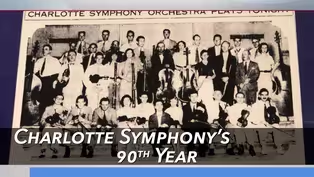
Charlotte Symphony's 90th Birthday
Video has Closed Captions
Clip: S9 Ep24 | 5m 30s | The Charlotte Symphony celebrates its 90th birthday (5m 30s)
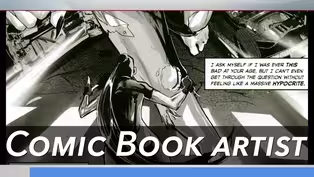
Video has Closed Captions
Clip: S9 Ep24 | 3m 47s | A comic book artist creating diverse comics in Charlotte (3m 47s)
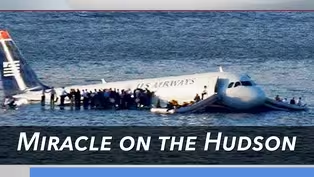
Video has Closed Captions
Clip: S9 Ep24 | 9m 19s | Flight 1549 from New York to Charlotte wound up floating in the Hudson River (9m 19s)
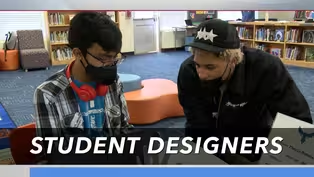
Student Designers with the Hornets
Video has Closed Captions
Clip: S9 Ep24 | 4m 37s | Student designers working with Kelly Oubre Jr of the Charlotte Hornets (4m 37s)
Providing Support for PBS.org
Learn Moreabout PBS online sponsorship
- News and Public Affairs

Top journalists deliver compelling original analysis of the hour's headlines.

- News and Public Affairs

FRONTLINE is investigative journalism that questions, explains and changes our world.












Support for PBS provided by:
Carolina Impact is a local public television program presented by PBS Charlotte