
Carolina Impact: November 1, 2022
Season 10 Episode 7 | 26m 17sVideo has Closed Captions
Metrolina Greenhouses, Irish Dancing, Jack Lawrence, Precious Restorations
Metrolina Greenhouses, Irish Dancing, Jack Lawrence, Precious Restorations
Problems playing video? | Closed Captioning Feedback
Problems playing video? | Closed Captioning Feedback
Carolina Impact is a local public television program presented by PBS Charlotte
Carolina Impact: November 1, 2022
Season 10 Episode 7 | 26m 17sVideo has Closed Captions
Metrolina Greenhouses, Irish Dancing, Jack Lawrence, Precious Restorations
Problems playing video? | Closed Captioning Feedback
How to Watch Carolina Impact
Carolina Impact is available to stream on pbs.org and the free PBS App, available on iPhone, Apple TV, Android TV, Android smartphones, Amazon Fire TV, Amazon Fire Tablet, Roku, Samsung Smart TV, and Vizio.

Introducing PBS Charlotte Passport
Now you can stream more of your favorite PBS shows including Masterpiece, NOVA, Nature, Great British Baking Show and many more — online and in the PBS Video app.Providing Support for PBS.org
Learn Moreabout PBS online sponsorship- [Announcer] This is a production of PBS Charlotte.
- Just ahead on Carolina Impact.
- 50 Years of flower power in Huntersville.
I'm Jeff Sonier outside of America's largest greenhouse, where their business is growing the plants that you're buying.
- Plus, we'll meet an amazing team setting records in the world of Irish step dancing, and we'll sit down with a famous bluegrass guitarist.
Carolina Impact starts right now.
- [Announcer] Carolina Impact, covering the issues, people and places that impact you.
This is Carolina Impact.
- Good evening.
Thanks so much for joining us.
I'm Amy Burkett.
We call Charlotte the Queen City because of its history, or Buzz City because of the Hornets, or maybe Bank Town because of all our big financial institutions.
But how about Flower Town?
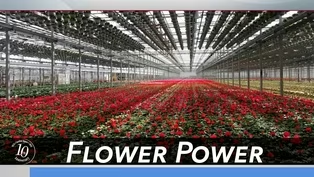
Just outside of Charlotte in Huntersville is a greenhouse that's six times bigger than the Bank of America building with more than 1,000 workers, where they've been growing flowers for 50 years.
Carolina Impact's Jeff Sonier and videographer Doug Stacker take us inside the biggest building you've ever seen, or maybe never seen until now.
- Metrolina Greenhouse, this is actually bigger inside than those hangars where they build the 747s.
It's even bigger than the Pentagon in Washington.
These see-through greenhouse walls, stretching for nearly two miles down a two-lane road.
So how about a 50 year old golden oldie to celebrate the golden anniversary of a success story that's homegrown in more ways than one?
♪ I've got flower power ♪ - [Jeff] If you're picking out plants from Lowe's or Home Depot or Walmart.
♪ I've got flower power ♪ - [Jeff] You're also buying from America's largest greenhouse right here in Huntersville.
♪ I've got flower power ♪ - We were growing about 300,000 mums for the fall, and Lowe's said, do you want to grow one million of them next year?
And we could have said no, 'cause there was a risk in doing that, but we said yes, and now we grow 10 million mums.
- [Jeff] In a building so big, it's not measured in square feet but in square acres.
- From where you see to the end between these poles, about an acre and a half.
This one building is about 50 total acres.
We have about 200 total acres under roof at this facility.
- [Jeff] It all started 50 years ago as kind of a mom and pop flower shop and nursery.
♪ I've got the power, flower power ♪ - My dad, his big goal was hey, could I ever get to 12 acres, I'd be set to go.
♪ Power, flower power ♪ - [Jeff] Today, Metrolina Greenhouses is still a family business, owned and operated by brothers Abe, Michael and Art VanWingerden, plus another brother and two sisters, all following in the footsteps of their Dutch immigrant parents Tom and Vickie, who came to America in 1971 with a green thumb, $5,000 and a vision that transformed their original hot house into a future flower powerhouse.
- You know, our dad always said automate or stagnate.
- He was very big into automation and what can we do to make the the jobs easier for people?
- If you go out in the greenhouse, we're very automated in the things that we do.
- [Jeff] Metrolina Greenhouses invented the original version of this automatic transplanter that nearly every big nursery business uses today, and once those individual plants are growing, they're moved hundreds, even thousands at a time by these overhead cranes to different parts of Metrolina's nearly 9 million square foot greenhouse.
Then of course there's the watering.
(gentle music) - You want to get the maximum pressure, and then we also have the speed control.
- [Jeff] Grower Robin Statham shows us how it's all done with just the push of a button.
- So if I wanted to speed it up and go to 30.
- [Jeff] Today, she's putting water on row after row of these still-growing poinsettias.
The watering system, all computer controlled, and the water itself, every drop is recycled rainfall from these giant greenhouse ponds.
- We pump about a million gallons of water a day on average here at Metrolina in Huntersville, and about a half a million goes back to the pond.
Any water that falls anywhere on the greenhouse, in the greenhouse, whether it's watering plants, parking lots, it doesn't matter.
It goes back to a pond.
- [Jeff] Art VanWingerden is co-CEO of Metrolina Greenhouses, overseeing its sustainability and technology.
But not everything here at Metrolina is automated.
- Really getting that hand on hand contact and taking the plant, looking mostly under the leaves.
- [Jeff] John Mulligan is an assistant grower at Metrolina, and his boss is Chief of Horticulture Ivan Tchakarov.
- I don't think that will ever change, the human interaction with plants and nature.
We still have people that have to go manually check roots, check for insects, and it's growing too fast, it's growing too slow.
So all those things that we are the ones actually doing and making those calls on a daily basis.
- [Jeff] Metrolina Greenhouses is also looking out for those smaller growers in the nursery business, not pushing them out of business, but working with smaller growers to share Metrolina's growing success.
- Like a lot of the mom and pop greenhouses or greenhouses that are 10 acres or smaller, what we've done with them is we find what they're really good at growing.
- [Jeff] Co-chief Operating Officer Michael VanWingerden says they're just remembering their 50 year old roots.
- Some people are really good at growing geraniums, others are really good at growing New Guineas, and we find that and find their niche and let them grow those for us.
- [Jeff] Growing for Metrolina means access to those big box stores that Metrolina supplies, and all those big box shoppers, plus those Metrolina trucks and trailers that transport 70 million plants a year, right from the greenhouse to your garden center.
And if you're shopping for plants on a garden center website at home, well, Metrolina will also ship plants right from the greenhouse to your house.
- At this peak season for mums, we're doing around 2,000 boxes a week.
A lot of the smaller items we ship as multi-pack, so every item goes down the belt here, it gets cleaned, it gets sleeved, it has a soil protector on it, it'll go into an insert and then go into that finished good box to help protect it.
(gentle music) - [Abe] My biggest fear as a gardener is not having success and not coming back next year.
- [Jeff] Co-CEO Abe VanWingerden says that's why Metrolina also has acres of these outdoor trial gardens, where they do what most gardeners do in their home gardens.
No special watering for the flowers here.
Just plant them to see what grows and what doesn't.
- People can buy a nice plant in a pot and we can make it look nice in the greenhouse, but if it really works for a consumer, it's when it works in the garden.
How big is this plant gonna get?
What do I need to do to it?
Is it gonna change colors over time?
- [Jeff] Because here at America's biggest greenhouse, whether it's mums in the fall, poinsettias during the holidays or these spring blossoms when the weather warms, they know that if they grow the best flowers, well, their 50 year flower business will keep growing too for the next 50 years.
- So it's that family business atmosphere we love, and we treat our employees like family.
- We built on, because there's demand for what we're doing.
Our goal is not to be the biggest.
Our goal is definitely to be the best.
(gentle music) - All totaled, Metrolina sells over $350 million worth of plants every year to more than 1,400 stores, and they're building a second greenhouse down in South Carolina.
But every morning at 9:30, the VanWingerden brothers take a break to have breakfast with their mom, who still lives here at the greenhouse in the family house where it all started.
Amy?
- Thank you, Jeff.
To find out more about the history and future of America's largest greenhouse right here in Mecklenburg County, head to our website at pbscharlotte.org.
Well, do you remember Riverdance?
It debuted in 1994 and became a PBS special in '96, and that's when I fell in love with Irish step dancing.
Its history dates back to the 17th century.
Carolina Impact's Jason Terzis introduces us to a CMS student winning international competitions with this beautiful art form.
(crowd cheering) - [Jason] With their perfectly timed choreography and toe-tapping moves, Irish dance sensation Riverdance recently wowed audience members on America's Got Talent in promotion of their upcoming 2023 world tour, and that same Irish spirit is alive and well in the Queen City.
- Watch the left foot there at the back.
Keep it all the way out.
That's it.
- [Jason] From her name.
- Aine.
- [Jason] To her hometown.
- I was born in Cork, Ireland.
- [Jason] To her green shirt and red hair.
- Point them high, now point at the ankles.
- [Jason] Aine Walsh Kelley couldn't be any more Irish.
- And then my birthday is also St. Patrick's Day, so they think that's really, really cool.
- [Jason] Immigrating to the United States in 1994, she settled in Charlotte.
- From the first time I came here I loved it.
- [Jason] In 1998, she opened the Walsh Kelley School of Irish Dancing.
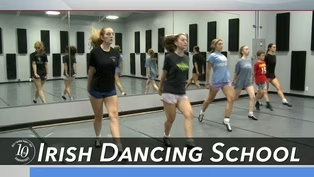
- I probably have about 90 kids, 90 dancers here in Charlotte, and then we also have a location in Greensboro and Wilmington, North Carolina.
- [Jason] Her students have danced in the St. Patrick's Day parade and at halftime of Hornet's games.
- But we also do a lot of community service.
We do a lot of dancing in nursing homes and retirement communities and obviously a lot of festivals.
Keep the heels up now.
That's it.
Heels all the way up, up, up.
- [Jason] Aine's students are, for the most part, teenage girls, but one of them not fitting that specific demographic accomplished something pretty special this past summer.
(shoes tapping) Jack Lucke's road to the Irish Dancing North American Championship began five years ago when he was just four years old while on a family vacation in, where else?
Ireland.
- Cork was where we saw the Irish dancing for the first time at a very small pub that we stopped in.
- Some dancers just went up on the stage and then they started doing some really cool things and I just really liked it.
- Jack just seemed to be mesmerized by the whole thing.
- [Jason] Later during the trip, the family went to another Irish dancing show, this one though, much bigger and more formal.
(energetic music) - Sure enough, you go in, you have dinner, they have dancers.
I mean, Jack was completely mesmerized, enthralled by it all and wanted to go meet the dancers after the show.
(energetic music) - [Jason] For Jack, it was game on.
- That was the end of the trip, so we come home and he just keeps hopping around the house.
- But it's been nonstop ever since he started when he was four.
- [Jason] The vacation may have been over, but a newly discovered passion was only just beginning.
- [Anna] Okay, good job, Jack.
- I was just kind of dancing around the house and wanted to do it.
- He's a little boy, a hyper little boy, and he never liked to stand still.
So instead of standing still, he would just dance.
- He would just keep doing it and trying to mimic what he had seen in Dublin.
(shoes tapping) - I would be talking to Jack and trying to have a conversation with him and he would just be jumping in place doing what he thought was Irish dancing.
And so we thought, I mean, clearly this is not going to end after months.
- I got on the computer and I was like, is there such thing as Irish dancing in the United States, let alone Charlotte, let alone 10 minutes from our house.
- [Jason] That search quickly led to the Walsh Kelley School of Irish Dancing.
- When I started dancing, I just tried to kind of get the hang of just a few basic steps.
- And from the very first day I said, if this kid sticks with that, he's gonna be a champion.
He just, everything I told him to do, he was doing it and following direction really well.
- It was clear to Aine it seemed that he had a little gift for it, so she said early on that he had good feet.
- Jack, keep the feet up, left foot out.
- Learning all those new steps, it's really fun doing all that.
- It's like finding a whole other family, a whole other world of dancing that we had no idea existed.
- So then he went to a performance and everyone's like oh, he's so cute, and then they came and brought, went to his first competition and he loved it, and of course he did extremely well.
- [Jason] After capturing the Southern Region Championships late last year in Greensboro, Jack qualified for the North American Championships this past summer in Montreal, Canada, with more than 3,000 dancers from across the globe.
Each competitor had to perform three dances featuring different styles of Irish dance.
Jack's division had 18 competitors.
- We went in hoping he'd do well.
I mean, we kind of figured he may be in the top half of the group.
- Do you feel like you did your best?
And he said, absolutely.
I left it all out there, and that's all you want.
- I danced my hardest.
- The big countdown, top 10, top five.
- And Jack was still there, and then it was the top three.
- And then from the Walsh Kelley School.
- [Announcer] From the Walsh Kelley School, competitor 108, Jack Lucke.
- Jack Lucke wins, and you're like, are you kidding me?
Did that just happen?
- And it was just incredibly surreal.
- I didn't believe it.
My mind was blown.
- There I am, that parent, yeah, that's my boy.
- Never did we expect this, but it's been truly a blessing.
- [Jason] It's the first time a dancer from Charlotte has ever won a global competition, and just the second champion from North Carolina in any age group.
- You never know what's gonna happen when you travel, and that you might end up with an Irish dancer, but it's just pretty amazing.
- [Jason] And for the Luckes to think it all started with a family trip, one that has had a lasting impact to this day and beyond.
For Carolina Impact, I'm Jason Terzis reporting.
- Wow, that's a pretty impressive young man.
Thank you so much, Jason.
Well, Jack's passion and success has prompted his older sister Harper into taking Irish dance lessons as well now.
Well, if you ever saw North Carolina's Hall of Fame bluegrass guitarist Doc Watson in concert, chances are you also saw Jack Lawrence.
He's spent decades performing side by side with Watson all over the world.
Back in 2019, we profiled Doc Watson in our PBS Charlotte Living History documentary Country in the Carolinas.
And this week, as we celebrate Carolina Impact's 10th anniversary, videographer Doug Stacker reconnects with Lawrence about what it was like sharing the stage with a musical legend.
(pleasant music) - [Jack] I grew up listening to this guitar on record.
♪ Was on the high holy day ♪ ♪ The very best day in the year ♪ - I started playing with Doc Watson in October of 1983.
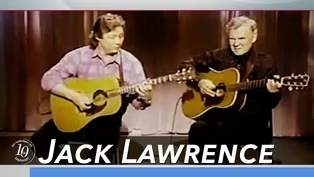
- [Doug] For 27 years, just to the left of Doc Watson, Jack Lawrence was that other guitar picker who was on the road and on the stage with Watson for most of his legendary career.
- Jack Lawrence, he's an outstanding guitar player.
His reputation is very low key.
Most people only know him as having been Doc's accompanist.
(guitars playing) He did everything for Doc.
Leading him around, getting him from one place to the other, and then playing the tar out of his music.
- I grew up in a little community called Croft.
It's between Charlotte and Huntersville on Highway 115.
There was nothing there but Washington Davis General Merchandise, and back then there were still a lot of soybean farms.
(pleasant music) I started listening to Doc Watson around 1965 or six.
My mother says if I went into my room when I was 13 or 14, came out when I was 18 and I could play guitar.
I learned to play from records, just like everybody else, putting that needle back, working on it, putting that needle back and working on it again, over and over.
That's how I learned.
Doc was the one in the mid sixties through the mid seventies.
(guitar picking) He was the guy, he was the one everybody listened to.
After high school, I went with the New Deal String Band, and what that did for me was to kind of open me up to other styles of music.
♪ I've been here a month or more.
♪ - I got a phone call from my friend Merle Watson.
Just go to the airport tomorrow, I'll have a ticket for you.
Go to Chicago and play with Doc for the weekend.
So I didn't really know what to expect.
Evidently something clicked.
He started calling me to fill in, and I just stayed on.
This is a 1945 D-18 Martin guitar that Doc used on his early Vanguard Records in the 1960s.
After I started playing with Doc, occasionally I would stay with he and Rose Lee.
We were coming in off the road.
I got up one morning, went downstairs into Doc's music room.
There was a guitar in the corner, and so I went over and I picked it up and the bridge was half off of it and it had three strings on it.
But I recognized it as the guitar that I had on record covers.
Doc was in the door and said, what in the world are you doing, son?
I found this old guitar back here, and I think there's still some music in it.
I think I can fix it.
One of these days maybe I'll give you this guitar.
I've got a legitimate piece of musical history.
It means my career.
- Jack has gone beyond what Doc taught him and has become his own musician.
- One of my records too, it's called Tough Luck Man.
♪ I hope I'll be lucky some ol' day ♪ - About every day in some way my thoughts go back to Doc.
(guitars strumming) - Thank you, Doug.
On our website pbscharlotte.org, you'll also find a link to our Living History documentary Country in the Carolinas, including our original Doc Watson story featuring Jack Lawrence.
Finally tonight, can you think of something you own that is precious to you?
Perhaps it's a family heirloom, a painting or old doll.
Over time, through age and use, those items that are so very important to us can become worn or broken.
In Matthews, you'll find a business called Precious Restorations, whose specialty is bringing those items back to life.
Tonight we meet two artists, skilled at making what looks old new again.
(exciting music) - [Dana] It's humbling and it's honoring for us.
- [Jack] Most of these pieces we work on are priceless to the individual.
I would say the majority of the pieces we work on are sentimental heirloom pieces.
- We want to make sure that we're giving due respect to the love that the people have for these pieces, but it's fun.
This piece came in Saturday?
- Yeah, Bob brought it in.
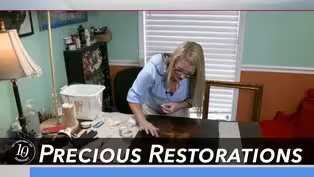
Precious Restorations is an art and antique restoration service where we specialize in paintings, pottery, sculpture, ceramics, small furniture items, religious icons, expensive porcelain pieces.
We really possess a lot of different skills.
We fabricate parts for missing items, work with tile pieces, matching colors, blending colors.
- I do this because I love it.
I love interacting with the people, but more importantly, I love that things aren't so disposable to everybody.
I think when you have an item that has any kind of value to you, whether it be monetary or emotional, it can always be added to or revamped or restored to make it look like something that will fit in whatever you want to have now.
I don't think things should be so disposable.
(playful music) - Most paintings have years and years of nicotine, 'cause everyone smoked years ago, coal, soot, especially if they're antique paintings.
So many people hung their paintings above fireplaces, so we clean the painting and generally there's a stark difference, the before and the after.
What we do is we clean half of the painting and take a picture so you can see contrast.
We work on very expensive pieces.
We work on museum quality pieces.
A lot of museums actually refer us to their clients, and we put it together just like a jigsaw puzzle and we fill in missing areas, cracks, sculpting missing shapes, sand away the excess, and then meticulously blend the colors.
- [Dana] And the materials that we use and the techniques that we use, we modify for every single item, almost.
What one piece may be able to withstand as far as chemicals or techniques, another one may not, so we cater everything we do to each individual piece.
- Quite often someone will come in with a very inexpensive piece and they'll say it's their grandmothers, and I'll pay anything to have it restored.
I'll be honest with them.
I'll say, you could probably buy four of these for the price that I'll have to charge you based on the time involved.
And they just say no, go ahead with it, because the energy is in that piece.
It's not in the new one that I'll buy on eBay.
It's so sentimental to them, and we take it on and they're so happy with the finished product.
(bell ringing) - That is amazing.
I brought in a coat of arms from my mom's side of the family.
Probably about eight, nine years ago it was damaged, it was vandalized.
Turned out awesome.
- I thank you for your business.
- Thank you.
- Your patience.
- You did a great job.
- Some reactions we get from people when they pick up their pieces are amazing.
People tear up sometimes.
They get very emotional, and that's very gratifying, honestly.
It feels better than getting paid for the project.
It really is a nice feeling.
It makes me feel like I'm giving back something in the world.
People are bringing up items from their childhood.
I've had elderly women bring in their dolls from their youth and throughout the ages they've decayed and they want to present them to their daughter or their granddaughter so they need to be restrung or fingers are missing.
- One of the aspects of this business that kind of helped evolve a part of me is just the interesting items that come in.
It gives me a chance to dive into new things all the time.
The painting in front of me is an example.
I've done several of these, but I don't know this artist, so I get to go through the process of learning about them.
We don't just take the pieces, fix them and give them back.
We like to educate ourselves on anything that we're not familiar with.
(exciting music) - I learn something new every day.
What a wonderful business.
Our region is filled with so many great businesses and people doing great things.
We'd love to learn about the people you know who are making a positive impact on our region so we could tell their story on a future Carolina Impact.
Just email us the details to stories@wtvi.org.
Thank you so much for inviting us into your home tonight.
Carolina Impact is funded by viewers like you.
If you've never invested in your only local PBS station, I want to personally invite you to join our family, and when you choose to make a donation ongoing of $10 or more a month, you'll receive our very popular member benefit PBS Charlotte Passport.
It's our on-demand streaming service.
- [Announcer] When you become a member of PBS Charlotte, enjoy the benefits of PBS Charlotte Passport, our member-only video on demand service you can watch any time, anywhere on your favorite digital device.
The PBS Charlotte Passport library currently offers more than 1,000 episodes from popular programs like American Experience, Antiques Road Show, Nature, Nova, Masterpiece and more.
Thank you for becoming a member today.
- Well, that's all the time we have this evening, my friends.
Thanks so much for joining us.
We always appreciate your time and look forward to seeing you back here again next time on Carolina Impact.
Good night.
(exciting music) - [Announcer] A production of PBS Charlotte.
Video has Closed Captions
Clip: S10 Ep7 | 6m 52s | Inside America's largest greenhouse -- fifty years of 'Flower Power' in Huntersville. (6m 52s)
Video has Closed Captions
Clip: S10 Ep7 | 6m 13s | The Walsh Kelley school of Irish Dancing and a nine-year old dancing champion (6m 13s)
Video has Closed Captions
Clip: S10 Ep7 | 4m 24s | Meet guitarist Jack Lawrence, who spent decades onstage with musical legend Doc Watson. (4m 24s)
Video has Closed Captions
Clip: S10 Ep7 | 3m 52s | See how a local business restores cherished heirlooms and works of art. (3m 52s)
Providing Support for PBS.org
Learn Moreabout PBS online sponsorship
- News and Public Affairs

Top journalists deliver compelling original analysis of the hour's headlines.

- News and Public Affairs

FRONTLINE is investigative journalism that questions, explains and changes our world.












Support for PBS provided by:
Carolina Impact is a local public television program presented by PBS Charlotte