
Carolina Impact: November 14th, 2023
Season 11 Episode 1108 | 27m 44sVideo has Closed Captions
CLT Airport: What's Next. CLT Economy. West CLT High Career Programs. And 102 WWII Veteran
More space. Less construction. Faster security. And the return of Queen Charlotte to CLT, A Deep Dive into Charlotte's economy, West Charlotte High offers career programs to help propel students into the workforce, and World War II veteran Coy Shue celebrates his 102nd birthday.
Problems playing video? | Closed Captioning Feedback
Problems playing video? | Closed Captioning Feedback
Carolina Impact is a local public television program presented by PBS Charlotte
Carolina Impact: November 14th, 2023
Season 11 Episode 1108 | 27m 44sVideo has Closed Captions
More space. Less construction. Faster security. And the return of Queen Charlotte to CLT, A Deep Dive into Charlotte's economy, West Charlotte High offers career programs to help propel students into the workforce, and World War II veteran Coy Shue celebrates his 102nd birthday.
Problems playing video? | Closed Captioning Feedback
How to Watch Carolina Impact
Carolina Impact is available to stream on pbs.org and the free PBS App, available on iPhone, Apple TV, Android TV, Android smartphones, Amazon Fire TV, Amazon Fire Tablet, Roku, Samsung Smart TV, and Vizio.

Introducing PBS Charlotte Passport
Now you can stream more of your favorite PBS shows including Masterpiece, NOVA, Nature, Great British Baking Show and many more — online and in the PBS Video app.Providing Support for PBS.org
Learn Moreabout PBS online sponsorship(lively music) - [Announcer] This is a production of PBS Charlotte.
- Just add on "Carolina Impact."
- Preparing for takeoff at CLT where your next flight could be your best flight.
I'm Jeff Sonier with a look at what's new and what's next at the airport.
- Plus we take a closer look at the top industries that are fueling the Charlotte region's economy.
Some might surprise you and honoring our nation's heroes, we attend a Marine Corps Veteran's 102nd birthday to hear about his heroic story.
"Carolina Impact" starts now.
(lively music) Good evening.
Thanks so much for joining us.
I'm Amy Burkett.
Charlotte has one of the busiest airports in the world.
It's a hub for more than 1,400 arrivals in departures every day.
Which means if you're flying out or dropping off or picking up, a trip to the airport usually means a lot of waiting.
But Carolina Impact's Jeff Sonier and videographer Russ Hunsinger show us how long awaited projects aimed at keeping up with all that airport growth are finally coming in for a landing.
- Yeah, Charlotte's always busy.
Douglas International Airport is busiest of all during the holidays and over the summer months when air travels at its peak.
But now, what you'll see here at CLT is an airport with less construction, more space, and a familiar face greeting you as you walk in the airport lobby.
- [Announcer] Three, two, one.
- [Jack] This has been a long time coming.
(audience applauding) - [Announcer] Long live, Queen Charlotte.
- And we're very, very excited to be able to put the queen back in her home.
- [Jeff] Jack Christine says the Queen first came to the airport in 1990.
Now she may be the last thing left from those old airport days.
- [Jack] That lobby was built in 1982, served 2.7 million passengers that year.
- [Jeff] Today, that number of local passengers is 12.7 million and growing.
So Charlotte's airport lobby is growing too.
- The customer experience is gonna be greatly enhanced by just the feel of the building, the layout of the facilities and the way that we can move around, move people around the building a lot more efficiently than what we could do with the original lobby that we had.
The key is growth for the airport means growth for the region, growth- - [Jeff] Christine walks us through the finally finished phases of growth at CLT that started back in 2019 where you can already see and feel the difference compared to the overcrowded older parts of the airport still waiting for their makeover.
- [Jack] Our construction is demand-driven, so as long as we have a demand, we're gonna continue to find projects that help ease that congestion.
- [Jeff] But the guy in charge of construction here at the airport says except for this still unfinished canopy outside the airport terminal, construction is the one thing you won't see as much of anymore.
- [Jack] And even the thick construction that you're gonna see from here on out will be behind construction walls.
It's not gonna be literally for the most part, you're gonna not gonna be in the middle of it where you know, for the last couple years you've been in the middle of it and so you're still gonna see some of those things but not as much.
- Floor pass please.
Thank you.
- [Jeff] For local passengers starting their flights here at CLT, the biggest change is transforming Charlotte's old and slow security checkpoints into something brand new.
- [Lorie] We are here to make it work for you, but also make sure we're not compromising security.
- [Jeff] TSA spokesperson, Lorie Dankers shows us the first of three high speed high tech checkpoints featuring multiple new automated security lines with loading space for five passengers at a time instead of just one.
- Also, once your items are in the bin, you push them forward.
- [Jeff] Each new line processing more than 180 passengers an hour, which is less than 20 seconds per person.
- All right, so this is the area where it will roll down.
Your bin will come, and you'll pull your bags out, your carry-on property out, and then you're good to go.
- We Are gonna be very, very busy, but this checkpoint is a game changer for us because it gives us a consolidated checkpoint with high capacity to help our passengers move through the system as quickly and as efficiently as we can get them there.
(gentle music) - [Jeff] Meanwhile, changes are also taking off out on the CLT airfield.
- After years of planning, we are ready to start the fourth parallel runway.
(plane engine roaring) It's a beautiful sound.
(audience applauding) - [Jeff] Airport CEO Haley Gentry says it's the sound of success.
Those takeoffs and landings drowning out the new runway's VIP groundbreaking ceremony.
- I'll pause for the sound of economic development.
(plane engine roaring) (audience applauding) Lay the groundwork because by every metric, this is one of the most successful airports in the world.
- [Jeff] Charlotte's Airport is also the number one economic driver in all of North Carolina creating $32 billion statewide in economic impact.
- This new parallel runway will allow for additional capacity, meaning that we can get more flights in the air, reduce congestion and all of us would be very proud of this, eliminate the long wait times for us to get to the gate.
That deserves an applause right there.
(audience applauding) - [Announcer] Five, four, three, two, one, go!
- [Jeff] CLT is connecting with non-flyers too through events like the annual runway 5K, sharing the airfield with hundreds of runners, all for a good cause.
- [Announcer] Once again, proceeds from today's event will help fund the airport Opportunity Scholarships with Central Piedmont Community College.
Thank you all for helping me to raise more than $250,000 throughout this event's history.
- [Jeff] But success at any airport is also measured by customer satisfaction.
Nobody likes those higher fares, but lots of flyers do like the rocking chairs and everybody who flies through busy Charlotte is just looking for a little space.
- I saw this and I thought, "Wow, you know, it's unusual to see really comfortable places."
- [Jeff] Comfortable enough for passengers like Susan Singh from Oklahoma to catch up on her reading.
You can even grab a nap or rock that tired baby on your lap.
- I heard it was overcrowded.
- Yeah, yeah, crowded - And to prepare ourselves so yeah.
- [Jeff] But CLT first timers, Madeline and Jerry Jones say they were not prepared for this.
Not here in Charlotte.
What do you think about this?
This space you're taking advantage of?
- Amazing.
- Yeah, this is really amazing.
- I love it.
It's comfortable.
I think this is necessary.
It's quiet.
- I think it's necessary.
- It gives you a time to, you know, decompress.
(gentle music) - One other change here at the Charlotte Airport we didn't show you is the new baggage area bigger and faster than the old baggage area.
Making sure that flying into CLT is just as convenient as flying out of CLT.
Amy.
- Thank you so much, Jeff.
The airport reminds us that even with all the improvements, you should still arrive at least two hours early for your flight.
You'll find a link to more information about what's new and what's next at the Charlotte Douglas Airport on our website at pbscharlotte.org.
Well, the airport's not the only thing bustling in the queen city.
Our economy has diversified.
Once, banking was the main driver, but that's not the case these days.
Carolina Impacts Dara Khaalid and videographer Russ Hunsinger explore how a diverse mix of sectors are keeping our region strong.
(lively music) - [Dara] When you think of Charlotte's economy, financial services like banking immediately come to mind.
For decades, this area has been a hotspot with over a dozen credit unions and banks headquartered here like Bank of America and Wells Fargo's East Coast headquarters.
- We were known as a financial hub.
We still are.
- [Dara] However, financial activities only make up 9% of our region's overall labor force of 1.6 million jobs.
Looking at this pie chart from the Charlotte Regional Business Alliance, you can see the top three sectors with the most jobs are trade, transportation and utilities at 21%, professional and business services at 17% and government at 11%.
Experts say there are some emerging industries that are significantly driving our economic growth due to their investments.
- The first one I wanna highlight is clean energy.
So this is an industry that's growing nationwide.
There's obviously a lot of federal investment into helping to grow this economy, catalyze this industry and we're really seeing it regionally as well.
Hi Rob.
How's it going?
- Great, Anthony, How are you?
- [Dara] Charlotte Regional Business Alliance principal researcher, Anthony Burton keeps a close eye on these strengths.
- On the lithium side, which is a really key ingredient for EV batteries, we've seen it as well.
Albemarle is one of the largest lithium producers in the world.
They're headquartered here in Charlotte - [Dara] Albemarle's 800 acre Kings Mountain production site transforms lithium into items many of us use.
- So your cell phone has a lithium ion battery.
The glass on front in the front of your cell phone actually has lithium because it makes it stronger and more flexible.
- [Dara] The most recent data from environmental entrepreneurs shows that there are 33,692 clean energy jobs in the Charlotte Metro.
Albemarle is already part of that number, but plans to expand even more once they reopen their lithium mine, which is expected to create hundreds of jobs.
- We're looking for those folks that are gonna help us develop the mine here to be able to extract lithium and create that US supply chain.
We're not too far from here in Richburg, South Carolina looking for operators and chemists that are gonna help us convert that raw material into the battery chemistry that we need to make today's batteries.
(upbeat music) - [Dara] Another industry experts say is boosting our economy is advanced manufacturing.
Data from the Charlotte Regional Business Alliance shows that there are over 3,500 manufacturers, 145,000 manufacturing workers, and that 7,500 jobs have been announced since 2020.
- Manufacturing is a really key industry for our region.
For places outside of Charlotte and some of the suburban and rural counties.
It's their largest industry.
- Now that we've seen the effects of clean energy and advanced manufacturing, let's take a look at an additional industry that's fueling the metro.
This one shouldn't come as too much of a surprise, if you take a look behind me, facilities just like these are sprinkled everywhere.
(upbeat music) - [Anthony] Healthcare is really important as well.
A huge employment sector for us as a region.
- [Dara] It's a service we all need.
Burton tells me the healthcare industry provides around 160,000 jobs to the area, which is about 10% of the workforce along with education services.
- Our population is getting older, both, you know, nationally and regionally.
And so obviously, healthcare services are incredibly important as we age.
So I think it's gonna really have an important role in our economy moving forward.
- Nice to meet you, guys.
- Nice to meet you too.
- [Dara] Even though the region has diversified itself beyond being known as just the banking city, we can't ignore the impact banks have had.
- In general, banks help the economy when they lend money.
So for example, you know, you've got a developer or you've got a builder who's building a home so they need financing to build the home.
You've got individuals who then get a mortgage to purchase the home.
You have manufacturing companies, distributors, etc.
who need money to fuel their growth.
- [Dara] In addition to being a resource for the community, financial services provide over 105,000 jobs.
Ted Wolfe, president of Town Bank Charlotte says they've been a part of that number.
- We've more than doubled our employee base.
So with the addition, we now have people in mortgage, people in wealth management, we've got people in insurance.
These are all growth areas for us.
- [Dara] Many people believe our region is at full employment.
- Most people kind of think of full employment, around 4% unemployment.
That's kind of where we are.
So we are at a really kind of tight labor market.
So it's good for workers obviously.
You know, thinking back on previous economic challenging times, unemployment rate was obviously much more elevated.
So it's lower unemployment rate, good for workers and it can be a little difficult for employers - [Dara] Overall, Burton says our economy is relatively strong and we're better equipped to handle swings in the economy.
For Carolina Impact, I'm Dara Khaalid.
- Thank you, Dara.
As various industries contribute to our economy, experts say this gives them confidence about our economic health and the success we'll see in the future as more than just a financial hub.
Next up, we're talking education.
High school career programs have become a bridge between high school and the workforce.
These initiatives are reshaping the traditional high school experience, equipping students with practical skills and offering a glimpse into the world of work long before they graduate.
Videographer Marcellus Jones takes us inside West Charlotte High School where students gain firsthand experience in several industries.
(playful music) - Teaching cosmetology is wonderful.
I love teaching cosmetology, but having the opportunity to teach at a place with such a rich culture and such a rich history kind of adds to the enjoyment to be a part of, you know, these kids' lives.
So your tools should fit in the bottom of your middle section, just like it fits in the top.
So what inspired this program is there's, I'm in what is called the Career and Technical Education Department.
This program has been in existence for about 38 years and it has always been a staple of West Charlotte High School.
(playful music) - When my grandmother passed away about two years ago, I used to always play in her hair, like comb her hair or wash her hair, etc.
ever since I was younger.
So once she passed away, I kinda found it in myself like this is something that I wanted to do and continue to do.
- [Deborah] If they finish with their 1,200 hours, they could take their state board and they would be considered a cosmetology apprentice.
And so their apprentice license will give them the opportunity that again, they can go to CPCC and finish, or they can work under a licensed stylist that you know, for the other 300 hours and take the other part of their state board.
- The most interesting I would say is just learning different hairstyles, how they operate and what to do for each hairstyle.
'Cause it's deeper than just styling some hair.
You gotta learn like about the scalp, the deepness of it.
And the most hardest was just really trying not to be a perfectionist with everything and just understanding like, "I'm not gonna get it a hundred percent all the time, it's gonna take my practice."
(bright music) - When the students here at West Charlotte enter the health science program, the initial course that they would start out would be Health Science one, and that's the course that will provide them information about the anatomy and physiology of the human body as it relates to disease.
(bright music) Once they master that class and move on to health science two, this course introduces them to the structural components of the healthcare where they then can receive certifications such as Stop the Bleed, OSHA certification and CPR certification.
Once they complete that program, then they move to nursing fundamentals and this is the course that prepares them for the basic career to become a certified nursing assistant.
(bright music) - Some things that inspired me to pursue a career in health science is mainly my family 'cause I have a lot of family in healthcare and just seeing how they work and seeing like what they gain from it is just pretty inspiring.
So I wanna pursue a career similar to that.
(bright music) - Thanks, Marcellus.
West Charlotte also offers programs and marketing, entrepreneurship, and software development providing students the opportunity to find their passion and fuel their purpose.
Finally, tonight, here's a quick history lesson for you.
In 1919, President Woodrow Wilson delivered a message to Americans on the country's first ever Armistice Day.
In 1938, Armistice Day.
became recognized as an official US holiday to be celebrated each November 11th.
And in 1954, the word "armistice" was replaced with "veterans."
And it's been known as Veterans Day ever since.
Jason Terzis joins us now with a special look at one of the area's special veterans.
- Yeah, real, really truly is.
Well, Veterans Day of course happening this past weekend, some 16 million plus American veterans being honored and celebrated for their service and sacrifice for our country.
But it's probably safe to say that not many of those 16 million veterans served during World War II, let alone still kicking at the age of over 100.
Well, we have one of them right here in Charlotte, and some of the things this man has seen in person are straight out of a history book.
♪ Happy Birthday to you ♪ Happy Birthday to you ♪ Happy Birthday dear Coy ♪ Happy Birthday to you - [Jason] Saying thank you the best way he knows with a salute, Coy Shue celebrating a milestone birthday.
- Well, it was awesome.
It really was.
- He loves it.
He loves it.
I know he does.
- [Jason] Then again, every birthday is a milestone when you're 102.
- September 24th, 1921.
- We've been having birthday parties for Coy for quite a while.
- [Jason] With 102 American flags in the front yard and a birthday cake fit for a king.
- Not too big, major.
- It's his birthday.
(crowd laughing) - [Jason] And family members from both his own family as well as the Marines, all there to celebrate a man who's more or less a living history book.
- Well, I really never did cross my mind how old I was gonna get.
(lively music) - [Jason] Born and raised in Charlotte during the 1920s and '30s, this picture hanging in Coy's garage shows a Charlotte most of us wouldn't recognize.
(plane swooshing) (explosion) But when 20-year-old Coy saw what happened in Pearl Harbor in December of 1941.
- The United States of America was suddenly and deliberately attacked.
- [Jason] And heard President Franklin Roosevelt's speech in response, he knew right then he had to do something.
- I volunteered.
I talked to my uncle, he was a Marine and I called him up and I said, "Listen, Carl, I want to go to the war."
He said, "Join the Marines."
And that's what I did.
- [Jason] Showing him this photograph of himself when he first joined the Marines, I asked Coy what he remembers most about the strapping young man in the picture.
- He loved the Marine Corps, he really wanted to be a Marine and he did.
- [Jason] But the thrill of representing his country and fighting the enemy soon faded as Coy quickly found himself in battle in the Pacific.
- You didn't know whether he gonna be living or not.
Day after day after day.
I became a squad leader.
Had eight men that I looked after.
I always told my men to dig a fox hole wherever you stop because if a sale comes, you got to find some place to get - [Jason] Of the eight men you were leading, how many were able to come home and how many didn't make it?
- I lost three.
(lively music) - [Jason] It's the most enduring image of World War II US, Marines raising the American flag at the Battle of Iwo Jima, immortalized in pictures and movies.
But the five-week battle took the lives of nearly 7,000 US Marines, including three of the men who raised the flag that day.
Another 20,000 were wounded.
Coy saw it all unfold firsthand.
He was there.
- Iwo Jima was the front there to hell.
It was terrible.
Screaming and hollering and there is gun smoke and the smell of it.
- If you've seen movies and stuff about that, if it's anything close to being like a movie, I don't know how you made it.
- [Jason] Truth is, Coy probably should never have made it out of Iwo Jima if not for the ultimate stroke of good luck or perhaps, divine intervention.
- We heard this shell coming down.
I said, "That's gonna hit us."
And we jumped in a hole and the shell came down and landed right between us.
And I couldn't breathe for a minute.
I was waiting for it to blow me up, you know, but it didn't, it was a dud and didn't go off.
- That's a rarity, one of those freak things, you know, you hear about it and read about it when you know, he did it.
- That's the reason I'm here today.
That shell didn't go off and God was blessed me and I don't know why, but he did.
- [Jason] Upon returning to Charlotte after the war, Coy opened an automotive upholstery business, shoes, automotive, top and trim, which was in business for nearly 50 years.
- And I tried to live a Christian life all the time Tried to raise my family as Christians, went to church, did the things that the people did back then.
(gentle music) - [Jason] By his side all those years.
Wife Doris May, she was there for Coy's 80th birthday party.
90th, even is 100th.
But sadly, she passed away earlier this year at the age of 94, ending a marriage that lasted three quarters of a century, - 75 years.
Doris was an angel.
I always called her my angel.
(laughs) She was super, I can't cry or nothing else about losing her because we had so much together.
- [Jason] But Coy is still surrounded by loved ones, his two sons, grandchildren, great-grandchildren, and of course, the Marines and the bonds of their brotherhood that tie all generations together.
- But I think the other services don't really have the connectivity that many of the Marines have.
- A Marine is a marine.
Period.
- [Jason] Outside his East Charlotte home, the flags of the United States and Marine Corps proudly fly.
Inside his house is loaded with military mementos, with reminders of Iwo Jima just about everywhere.
The question Coy of course, gets asked all the time these days, what's his secret to living a long and healthy life?
- Eat your oatmeal, pray a lot.
That was my secret, - Jason's back and Coy, what an amazing life he has led and lived through and just an extraordinary man.
I'm so grateful you were able to share his story.
- I am, And then there is another part of this story since we went to his house.
So of course Coy's 102nd birthday happened at the end of September.
I was fortunate enough to sit down with him in October for the interview and put this story together in the last week.
And then I just got word that he's passed.
So it just, you know, all this kind of coming together in the way we put our stories together, we're usually working a couple weeks in advance.
So it's sad, shocking all of it.
But like you said, and kinda what he was talking about his wife, you know, he said, "I couldn't be sad because we spent 75 years together."
So he wasn't feeling well over this past weekend and then that was it.
And you know, but 102 years, I feel fortunate, especially for what we do and the stories that we do here at Carolina Impact that I had the opportunity to sit down and really tell his story.
I know other media outlets in town have, you know, celebrated his birthday in the past, but usually it's a quick thing.
"Hey, the World War II veterans celebrating his 100th birthday or whatever."
But to do this on this level and to be able to really sit down and get his story like this, I feel honored to be able to have done this.
- And I know when you told me, unfortunately, that he had passed, you were physically touched by it because you make friends out in the community when you interview these people.
And he was so kind to share his entire life story with us.
And that's an honor and I know how much care you put into sharing these stories with our viewers and we hate to see an amazing gentleman pass, but so grateful that he didn't suffer and so grateful that he lived the extraordinary life that he lived.
- Yeah, and I just feel, you know, it's living history.
You know, we talk about our living history series, the documentaries do, and I feel that Coy, he really was, it was a view into history and to talk to not only World War II survivor, but you know, we see the images of Iwo Jima and we're now at a point where, you know, it's history books, you know, it's kinda like people talk about the legend of Babe Ruth, you know, but no one actually saw Babe Ruth play baseball.
You know, he was at Iwo Jima and to be able to meet him, sit down and talk with him and kind of, you know, give him the respect I guess, that you know, he deserves and you know, for what he did for our country, it was great.
- Grateful you were able to share his story.
- Absolutely.
Thank you.
- If you have an amazing story, an amazing person that you know like Coy, we would love to hear about it and it might make a great story for us to share with the audience here at WTVI.
Send us your stories to stories@wtvi.org.
Well, unfortunately, that's all the time we have this evening.
Thanks so much for joining us.
We always appreciate your time and I look forward to seeing you back here again next time on Carolina Impact.
Goodnight, my friends.
(bright music) - [Announcer] This is a production of PBS Charlotte.
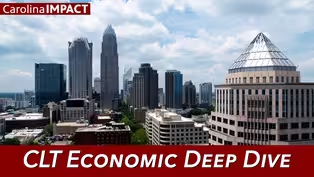
Video has Closed Captions
Clip: S11 Ep1108 | 5m 36s | Learn about the top industries fueling the Charlotte region's economic growth. (5m 36s)
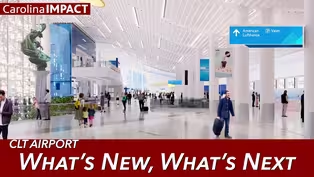
CLT Airport: What's New, What's Next?
Video has Closed Captions
Clip: S11 Ep1108 | 6m 21s | More space. Less construction. Faster security. And the return of Queen Charlotte to CLT. (6m 21s)
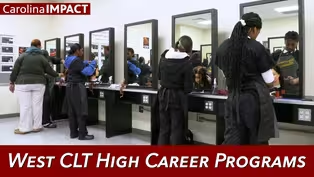
West Charlotte High School Career Programs
Video has Closed Captions
Clip: S11 Ep1108 | 2m 58s | WCHS offers career programs to help propel students into the workforce. (2m 58s)
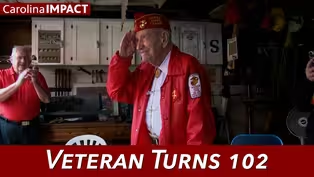
Video has Closed Captions
Clip: S11 Ep1108 | 6m 11s | World War II Veteran Coy Shue celebrates 102nd birthday. (6m 11s)
Carolina Impact: November 14th, 2023 Preview
Preview: S11 Ep1108 | 30s | CLT Airport: What's Next. CLT Economy. West CLT High Career Programs. And 102 WWII Veteran (30s)
Providing Support for PBS.org
Learn Moreabout PBS online sponsorship
- News and Public Affairs

Top journalists deliver compelling original analysis of the hour's headlines.

- News and Public Affairs

FRONTLINE is investigative journalism that questions, explains and changes our world.












Support for PBS provided by:
Carolina Impact is a local public television program presented by PBS Charlotte