
Carolina Impact: October 11, 2022
Season 10 Episode 4 | 28m 14sVideo has Closed Captions
Seniors and rising prices, Haitian food truck, Washington Heights, & Cakeable Charlotte
Charlotte seniors fighting higher prices, and protecting their retirement nest egg, the past and future of the traditionally black neighborhood of Washington Heights, a look at a unique mother-daughter owned food truck, serving Haitian cuisine, and Cakeable Charlotte offers employment to people with intellectual & developmental disabilities.
Problems playing video? | Closed Captioning Feedback
Problems playing video? | Closed Captioning Feedback
Carolina Impact is a local public television program presented by PBS Charlotte
Carolina Impact: October 11, 2022
Season 10 Episode 4 | 28m 14sVideo has Closed Captions
Charlotte seniors fighting higher prices, and protecting their retirement nest egg, the past and future of the traditionally black neighborhood of Washington Heights, a look at a unique mother-daughter owned food truck, serving Haitian cuisine, and Cakeable Charlotte offers employment to people with intellectual & developmental disabilities.
Problems playing video? | Closed Captioning Feedback
How to Watch Carolina Impact
Carolina Impact is available to stream on pbs.org and the free PBS App, available on iPhone, Apple TV, Android TV, Android smartphones, Amazon Fire TV, Amazon Fire Tablet, Roku, Samsung Smart TV, and Vizio.

Introducing PBS Charlotte Passport
Now you can stream more of your favorite PBS shows including Masterpiece, NOVA, Nature, Great British Baking Show and many more — online and in the PBS Video app.Providing Support for PBS.org
Learn Moreabout PBS online sponsorship- [Narrator] This is a production of PBS Charlotte.
- Just ahead on "Carolina Impact."
- [Jeff] Higher prices for gas and groceries, senior citizens have seen it all before, but now they're affected even more.
I'm Jeff Sonier.
We'll take a closer look at facing inflation on a fixed income.
- [Amy] Plus, we'll learn about one of Charlotte's oldest African American neighborhoods.
And we'll discover how a local bakery helps others through a very special program to fill the employment gap.
"Carolina Impact" starts right now.
- [Narrator] "Carolina Impact," covering the issues, people and places that impact you.
This is "Carolina Impact."
(upbeat music) - Good evening, thanks so much for joining us.
I'm Amy Burkett.
Inflation is up, investments are down.
And if you're a senior citizen, well, that's double trouble, which is why so many groups that serve seniors are now offering tax advice, estate planning, and help with picking medical insurance, as more seniors search for more ways to save more money and to protect their retirement nest eggs.
"Carolina Impact's" Jeff Sonier and videographer Doug Stacker have more on how growing old doesn't have to mean going broke.
- Yeah, sometimes you gotta start with the little things, like senior discount day here at the supermarket.
Here at Harris Teeter, it's 5% off every Thursday if you're 60 years old or older.
And at Publix, same discount, different day.
On Wednesdays, it's 5% off for seniors.
And while 5% isn't a lot, well, at least it's something, especially with the cost of groceries and just about everything else putting the squeeze on seniors.
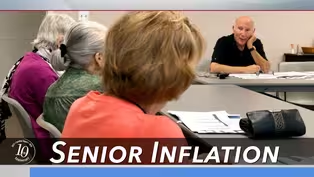
(soft piano music) Once a week here at a Charlotte church, the Shepherd Center brings seniors together for coffee and classes and conversation.
And what these seniors often talk about is inflation.
- I think that any time prices go up dramatically, it affects a lot of people.
- Now it's putting a lot of pressure on people's savings.
- [Jeff] But it's not the first time they've seen costs climb at the grocery store or the gas station, although it has been a while.
- We must whip inflation right now.
(audience applauds) (register dings) - [Jeff] These seniors still remember double digit inflation at the supermarket back in the '70s and lining up for gas that tripled in price at the pump back then to a dollar a gallon.
- Odd/even service, gasoline lines and closed gas stations are becoming increasingly common.
- [Jeff] Plus, there were sky-high mortgage rates that made buying a house in Charlotte in the '70s just as hard as it is today.
- We all recognize the seriousness of inflation, particularly those who have a fixed income.
- I think it is a little bit easier mentally for us as seniors 'cause we've been through this a few times before.
However, we haven't been through it as seniors, and so that's a whole new place to be.
- [Jeff] Jeannie Fennell is 80 years old now and thankful she can still afford living at home on her fixed income.
- Well, your rent's going up $500 next month, and what do you do?
- [Jeff] Telling us about friends losing their homes.
- [Jeannie] One had a nice small rental house, one had an apartment, and all of a sudden, their rent went up.
Well, when your rent goes up several hundred dollars, that's not in your budget, and you don't have any real way to compensate for it, you have to do something else.
So they've had to move.
- I'm not embarrassed to say it because this is my reality.
- [Jeff] Retiree Judith Alvarez Miller had to move too.
She's living in public housing now.
- [Judith] I just got tired of agonizing, my home phone constantly ringing, bill collectors.
And I hated going to the mailbox because I would have a slew of disconnects or we're gonna take you to court if you didn't pay this.
It just got overwhelming.
- [Jeff] But Judith got help from Tonia Frazier, a financial advisor with Common Wealth Charlotte, which manages the city's free Financial Navigator Program, offering advice to all ages.
- We teach clients how to become financially capable.
And we're all in the same boat.
Many of us are a half a paycheck away from homelessness.
- Getting a lot of calls from people and just talking about the expense of their grocery bills at this point.
We've had people calling saying, "Do we have employment services," because seniors are going back to work as a reflection of what's going on in our economy.
- [Jeff] Not because they want to.
Maybe because they have to.
- No, absolutely.
- [Jeff] Executive director Alissa Celek says that's why here at the Shepherd Center, they don't just offer dance classes and art classes and writing classes, but also financial classes.
- We worked hard all these years.
We put a lot of money into the system.
So as we get a little older, it's nice that we get something back every now and then.
- [Jeff] Helping seniors make wiser choices when it comes to the big expenses like medical insurance.
- [Mike] Hopefully nobody in this room is in the position where you have to say, "Well, I need to make a choice this month between my medication and my rent."
It's a shame sometimes that the people who can afford it the least are the people who wind up paying the most.
- [Jeff] Mike Friedman, the personal financial rep who teaches this class says for many seniors these days, it's a balancing act between those retirement investments they depend on.
- Everybody's worried about making sure that their nest egg is gonna last them forever.
- [Jeff] And those everyday things like a cart full of groceries they still have to spend on.
- [Mike] When we started out, it might've cost us $100, and now all of a sudden it's not $100 anymore.
- I learn to substitute when something's high price.
I shift to something else.
- [Jeff] For 78-year-old Kent Johnson, that means fewer steaks in his shopping cart and more fresh veggies, which are better for his health and his budget.
- [Kent] You need to learn to adjust, and it's good to build up savings and be frugal.
That's the way you beat inflation.
- [Jeff] And Jeannie Fennell offers her own inflation-fighting advice.
- You stay off Amazon.
(laughs) - [Jeff] Yep, more old-fashioned common sense from seniors who take old-fashioned as a compliment.
- [Jeannie] People say, "Oh, you're not old."
I said, "I am old and I'm grateful to be old because a lot of people don't get to be old."
- [Jeff] By the way, if you're wondering how inflation today compares with inflation back in the '70s, well back in 1973 and 1974, grocery store inflation was over 14%.
Mortgage rates in 1979, almost twice as much as they are now.
And that dollar a gallon gas back in the '70s, well, if you translate that in today's dollars, that would be almost $4.00 a gallon.
Amy.
- Some great advice in there.
Thank you so much, Jeff.
Check out our website at pbscharlotte.org for more help fighting inflation.
You'll find links to Shepherd Center for Charlotte and to the city's Financial Navigator Program.
When you head to any of our region's older neighborhoods, you can learn about their history.
But for many African American communities, the history was lost during the '60s due to urban renewal, which was designed to get rid of blight, but resulted in the tearing down of Black neighborhoods.
Highway expansions wiped out others.
For those few that remain, the new threat is gentrification.
"Carolina Impact's" Bea Thompson tells us about one of Charlotte's oldest existing African American neighborhoods along the Beatties Ford Road Corridor.
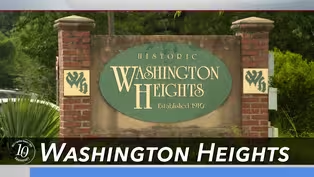
(jaunty piano music) - [Bea] It was 50 years after the end of enslavement, and Charlotte was growing, a growth that included housing for the city's Black residents in a community that would be called Washington Heights.
- [Mattie] It's named in honor of Booker T. Washington, and it dates back to 1910.
That's only about 57 years after "Emancipation Proclamation," which went into law.
- [Bea] For Charlotte's emerging African American middle class, made up of professionals like well-known barber Thad Tate, for whom one of the neighborhood streets is named, the need for acceptable housing for Blacks was rapidly increasing.
But Charlotte, like many towns and cities, used guidelines to keep them out.
- What's going on around 1900 is deed restrictions, covenants written into the new neighborhoods of Elizabeth Meyers Park, Plaza-Midwood, all of that, the new neighborhoods outside of the center city that say this property shall be used only by members of the Caucasian race.
This is the plat map that laid out Washington Heights.
- [Bea] The White Freehold Reality Company teamed up with the local Black businessman C.H.
Watson to plan out the African American streetcar suburb of Washington Heights.
This took place in 1913, just beyond Biddle University, now Johnson C. Smith University.
- Washington Heights was a Black streetcar suburb.
As far as we know, it is the only one in the United States.
- We have a historic survey where we have the history of every lot in this neighborhood.
Historic Landmark Commission did that.
- [Tom] As far as a fully realized neighborhood for African American home buyers and renters as well, Washington Heights is not just special to Charlotte, it is nationally important.
(light airy music) - [Bea] But like many neighborhoods that have been home to minorities and the working class for decades, Washington Heights realized decades ago, its proximity to the center city also placed it in an enviable position for development, prompting the residents to come up with a survival plan.
- [Mattie] We started out with a neighborhood plan that was adopted by City Council in 2002.
It highlights our vision mission for this neighborhood.
It has our rich history.
That history will not go away.
You're not gonna just erase it just that easy.
- [Dawn] The other end of the third house down, there was a duplex.
And in that duplex, we stayed in the one on the left end of it.
I was born and raised on Tate Street.
My family, my ancestors, my grandparents, my parents, my grandparents, all of them was from Washington Heights.
- [Bea] She's lived on this street her entire life, and she's seen the changes, including lots that once held family homes now vacant because they don't meet setback codes for new homes, and existing homes in need of repair.
Residents got involved with community groups, like Hands On Charlotte, to help their neighbors keep their homes.
- We've had quite a few of the homes in the area that they have been remodeling floors, ceilings, heating and air, restructuring, helping them to still stay in place.
- [Bea] They know the possibility that the little G, gentrification, could creep into their community.
Already, they are watching as one so-called monster house is built alongside small bungalows.
But the plan is to make sure Washington Heights does not go the way of other historic Black neighborhoods.
- I refer to our place as third generational, young people that are willing to carry this on.
- The saving factor is the community getting involved.
- [Bea] That involvement helped to bring to reality a community park on the location of the former Ritz Theater, a Black movie house in Washington Heights.
Its perimeter is lined with the words of survival and encouragement from noted African Americans.
And from the activists a simple outline of just how other neighborhoods can protect themselves as change comes to a street that they live on.
- [Narrator] Have meetings, use your resource, roll up your sleeves, get the work done, and don't give up.
Change is the only thing consistent in life, but that change doesn't mean that you have to move out of the way.
- [Bea] So the next time you drive along the Beatties Ford Road Corridor, know that an early 20th century historic neighborhood with national standing has plans to be around long after the newness wears off of the 21st century homes.
For "Carolina Impact," I'm Bea Thompson.
- Thanks so much for sharing that rich history with us, Bea.
Did you know the popularity of food trucks has grown to become a $2 billion a year industry?
National statistics show startup costs are as low as $50,000, and the average annual revenue per truck is about $290,000.
"Carolina Impact's" Jason Terzis introduces us to a mother/daughter team bringing Haitian food to the Queen's City.
(energetic percussive music) - [Jason] The DJs.
- [DJ] Everybody!
- [Jason] The music.
And of course, the dancing.
- [Christina] When you walked in, you could just feel the culture.
- [Jason] With bounce houses for the kids, and a sold-out VIP section for the adults, the second annual Carolina Haitian Food Fest was everything you'd expect in a local street festival.
- There's a Mimosa Festival, there's Cinco de Mayo.
What if we had a Haitian festival that highlighted Haitian businesses, highlighted Haitian food?
- [Jason] From jewelry to earrings to clothing, it was a celebration of all things Haitian.
- We just really wanted to create a platform to lift our community up.
- [Jason] But the highlight of any festival, the food.
- Absolutely, you have two choices of rice.
You have djondjon, and you have rice and beans.
Yeah.
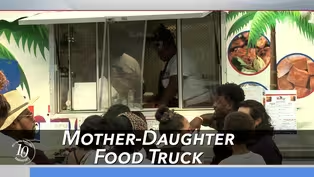
- [Jason] The most popular food truck at the festival, with a long line to prove it, Ms. Didi's Caribbean Kitchen.
- We are known for authentic Haitian cuisine.
That means everything that we make is literally from scratch.
- [Jason] Christina Bowman and Edith Jean-Francois are the mother/daughter combo behind Ms. Didi's.
Growing up in the kitchen with her own mother in Haiti, Jean-Francois's first love was always cooking.
- It has to start with my grandmother.
- So I help her all the time, so I know how to do it.
- [Jason] Growing up, friends called Edith Didi.
She attended chef school, but in order to pay the bills, took a different route when she came to the US.
- I am licensed barber.
I do hair.
But I always cook.
(laughs) I don't like fast food, so I cook all the time.
- We get family and friends that come over, and they're like, "Oh my God, your mom's food, it's just so much better.
It's even better than my mom's food, and don't tell them."
She's just very gifted with her talent, and I just really wanted the world to actually get to see and taste her food.
- [Jason] After finishing college, daughter Christina worked as a flight attendant for American Airlines.
But after starting her own family, she asked her mom a simple question.
- And I literally asked my mom what was her dream, her dream job, or what's something that she wanna do before she dies.
And she said, "Have a food truck."
- When she asked me that question, that was a good question I was waiting for because I was watching the cooking channel all the time, the food truck competition.
I like to compete myself.
- And so when I saw her vision to have this food truck, I had to just be like, I wanna help her create this legacy of my grandmother and her just service and giving people food that makes them feel good and feels like family.
- [Jason] Her mom's response set things in motion, and Christina began the process of purchasing and outfitting a food truck, a task that took nearly two full years.
- We just needed to do the research behind getting a food truck, what that looks like.
- [Jason] Ms. Didi's hit the road in the summer of 2019, offering a menu filled with Haitian staples, each named after a city in the Caribbean nation.
- We have our famous griot, which is our fried pork.
They're kind of like nugget-sized.
They're marinated in our epis, which is our marinade.
It's a Haitian-style marinade.
We deep-fry them to perfection.
- So many people make griot, but there is a secret in the griot, the season.
- It's Ms. Didi's special, you know?
- [Jason] This mother/daughter partnership is working out just fine, with Christina handling business, marketing and social media, while Edith focuses on what she does best, the cooking.
- [Didi] I always tell her that.
Oh, you speak English.
I don't speak English.
(laughs) Because she born here.
I learned English, but she got the language, you know?
So I always tell her you do it.
You do this, you do that.
Me, I do the cooking, so I'm not doing the talking.
- [Jason] Ms. Didi's is open two to three days a week, usually on weekends, rotating between the food truck and the shared kitchen space at City Kitch on Charlotte's west side.
Longterm plans include opening a full-fledged restaurant.
For "Carolina Impact," I'm Jason Terzis reporting.
- Okay, are you just a little hungry after watching that?
I know I am.
Thanks so much, Jason.
To find our where Ms. Didi's Caribbean Kitchen will be in the coming days, be sure to check out our website at pbscharlotte.org.
Next, we take a look at a bakery in Charlotte's Oakhurst neighborhood that's helping fill the employment gap by teaching transferable job skills.
As "Carolina Impact's" Sheila Saints reports, owners of Cakeable Charlotte are creating more than sweet treats.
They're giving opportunities for people with disabilities.
- Hey, Brittany!
- Hey.
- How are you?
- Good.
(fun bouncy music) - [Sheila] Walking into the Cakeable Charlotte kitchen is like walking into a ray of sunshine.
- They're just happy.
- [Sheila] It's a sweet place, full of laughter, lemons and delights.
- In the Nutella brownies, there's Nutella, and powdered sugar and heavy cream.
- [Sheila] With every scoop, measure and mix, they're learning.
- I love baking so much.
My grandmother taught me.
- Go ahead and measure out your flour.
- [Sheila] Renee Ratcliffe co-founded the nonprofit to offer baking classes and job training for people with intellectual and developmental disabilities.
She works side by side with students, employees and volunteers.
- [Renee] Because in Charlotte there exists a substantial employment gap for those individuals because there aren't as many vocational opportunities or training options.
So we want to stand in that gap by equipping our students and employees with transferrable job skills.
- [Sheila] According to recent labor statistics, persons aged 16 to 64 with a disability had a labor force participation rate of only 35.2%, compared to 76.5% for people without a disability.
- [Renee] So they're also learning the kind of skills that they will need in any kind of job situation.
They're learning how to be professional in the environment here.
They're learning how to communicate well with me as the manager.
They're learning how to work as a team, to follow directions, to be on time, to dress appropriately, to follow all the kitchen regulations.
You got it.
- [Sheila] Renee came up with the idea for Cakeable in 2019, combining her love of baking with a background in special education.
She was having trouble finding a commercial kitchen when something remarkable happened.
COVID restrictions in 2020 forced Sweet Spot Studio to postpone classes, and they offered to rent their kitchen space to Cakeable.
- [Joselyn] It has been incredible having Cakeable and Renee in here.
Watching them grow, she is moving mountains, and it's just been incredible to watch.
- [Sheila] Because Renee envisions a community which employs people of all abilities, like Kendal, who went from being a student, to an employee.
(soft upbeat music) - [Kendal] I make brownies, I make lemon loaves.
I make all the baked goods.
- [Renee] She loves connecting with customers in person, and she also just loves sharing the heart of Cakeable.
- [Sheila] The students make more than just delicious baked goods.
They also make gift items, such as candles and sugar scrubs and bath bombs.
It all ties into them learning crucial job skills.
- [Renee] So we felt like it was time for us to expand some of our skills, and also provide products that customers might be interested in year round.
And then Melissa joined us recently to do the greeting cards.
So it gives our students a different level of expression.
- [Melissa] They give me so much more than I could ever give them, as far as just teaching me joy.
I mean, it's just joy.
- [Sheila] As Cakeable grew, they brought on a pastry chef and began selling products at the uptown farmer's market.
- [Renee] And then when we go out to the markets, they're learning how to work with customers and how to serve them.
They're learning how to count money and use those kinds of skills as well to do point of sale.
So they're learning a lot of different skills that will serve them well working with Cakeable or to serve them in other working environments.
- [Sheila] Each week Cakeable Charlotte makes a deliver to Julia's cafe and bookstore.
The students interact with the public and see their products on display.
- [Katie] The customers went crazy just for the products alone.
And then we were finally able to incorporate Cakeable's message and the idea behind Cakeable a little bit more into the products.
A lot of people have found interest in the idea of their nonprofit.
- It makes me feel grateful and happy and just warm to know that people are learning about what we do.
- [Kendal] Happy.
I like to bring people together, and that is my job.
- [Sheila] One day, Kendal hopes to open her own bakery.
- [Kendal] I like to fix all the recipes for myself.
I want to be independent, be an independent baker.
- [Sheila] Kendal's father says Cakeable has given his daughter a chance to reach her full potential.
- [Ken] And we're eternally grateful.
We, my wife and I, Sue, have tried to look at possibilities, not limitations.
And we have tried to put Kendal in a spot to maximize her God-given potential, no matter what that is.
We didn't want to set a ceiling.
We just wanted to have high expectations.
And Cakeable has come alongside of her and helped her develop that potential, whether it was social, intellectual, skill-wise.
Happens to be baking.
You cannot measure that, nor adequately describe it in words.
It's priceless.
- [Sheila] Because Cakeable Charlotte develops not just opportunities, but also a sense of confidence and independence to carry these capable students through life.
Now that's a recipe for success.
For "Carolina Impact," I'm Sheila Saints reporting.
- Thank you, Sheila, for such an inspiring story.
Cakeable Charlotte keeps growing.
They hope to open a coffee shop in uptown Charlotte in 2023.
Finally tonight, last spring our "Charlotte Cooks" show held a cooking competition, inviting people across our region to bring their culture to our table and share their family twist on a classic southern recipe.
The winner got to be a guest chef on this season's show.
The community voted and selected Dominic Hawkes.
Let's meet him now.
- [Dominic] Give it a click.
All right, you're on.
(bright music) - [Dominic] My name is Dominic Hawkes, and I'm the culinary arts instructor at Lancaster County School District Career Center.
I've been the culinary arts instructor for four years.
My genius art teacher wife actually saw the link, and she said, "Hey, why don't you sign up for this competition?"
I was like, "Well, I don't know if I have time.
Let me see."
And when I looked at it, I said, "Well, they're asking for some videos."
So it was actually a video that I made during the pandemic because my students, they all had to go home, as we all did for months on end.
And so how can I get my students to carry on doing things?
So I started making videos on my YouTube channel.
Just by having that whole library of different videos that I have now, I thought, what a perfect thing to have.
We had the collard greens that had the real southern flare to them, and so that's what I entered in, and worked out fantastically.
I'm working as a culinary arts instructor.
It's amazing because I get to take those students who, some of them literally have no experience at all in the kitchen.
Some of them even told me that their mothers won't let them in the kitchen.
And we're like, "Well, okay, let's change that then.
Let's give you the skills and the knowledge to get it to where you're at least safe in the kitchen."
But maybe we can make something big happen.
Don't be scared of it.
It's all good.
- He's always open, friendly.
He's always showing us how to do things the right way, make sure we're doing it right, safely.
He's really, really good at what he does.
- [Dominic] We now have the ability for students to get up to five certifications.
Our students will go with letters after their name.
They'll have the CFC certification, their certified fundamentals cook.
And this is just the start.
But they start ahead of everyone else now because they already have that first level done.
- [Bill] He's invaluable.
We can't say enough about him, his knowledge of culinary.
He will take an average student and turn them into a great student.
And the kids absolutely love him.
- You can come in.
You learn all types of recipes, all types of new tricks.
He's really passionate in what he does.
- [Dominic] I really encourage our students to bring their own family's heritage to the classroom as well.
I get to really get to know the students, which is great 'cause I get to know them and their families on a more personal note.
And so we literally have them delve back into their family heritage, and then we can make our course more relevant to those students so they can actually look at their background.
We can start researching some methods and recipes that may be from their family heritage.
Or even better is when they bring me a recipe.
- [Kennisha] I enjoy this class a lot.
I've learned a lot, I've made a lot of friends, and I just enjoy, especially my teacher.
Thank you, Chef Hawkes.
(laughs) - What an amazing chef.
So glad that we were able to meet him.
Well, that's all the time we have this evening.
Thank you so much for joining us.
We always appreciate your time and look forward to seeing you back here again next time on "Carolina Impact."
Good night, my friends.
(upbeat music) - [Narrator] A production of PBS Charlotte.
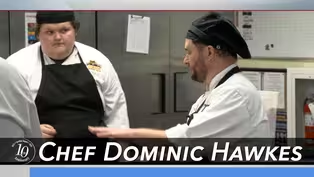
Charlotte Cooks Contest Winner Dominic Hawkes
Video has Closed Captions
Clip: S10 Ep4 | 2m 42s | Meet Dominic Hawkes, the Carolina Classic Cook-Off Winner (2m 42s)
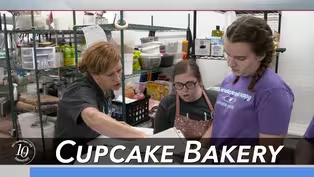
Cupcake Bakery for Disabled Workers
Video has Closed Captions
Clip: S10 Ep4 | 5m 41s | Cakeable Charlotte offers employment to people with developmental disabilities (5m 41s)
Video has Closed Captions
Clip: S10 Ep4 | 3m 54s | A look at a unique mother-daughter owned food truck, serving Haitian cuisine. (3m 54s)
Video has Closed Captions
Clip: S10 Ep4 | 6m 29s | Charlotte seniors fighting higher prices, and protecting their retirement nest egg. (6m 29s)
Video has Closed Captions
Clip: S10 Ep4 | 5m 31s | The past and future of the traditionally black neighborhood of Washington Heights (5m 31s)
Carolina Impact: October 11th, 2022 Preview
Preview: S10 Ep4 | 30s | Seniors and rising prices, Haitian food truck, Washington Heights, & Cakeable Charlotte (30s)
Providing Support for PBS.org
Learn Moreabout PBS online sponsorship
- News and Public Affairs

Top journalists deliver compelling original analysis of the hour's headlines.

- News and Public Affairs

FRONTLINE is investigative journalism that questions, explains and changes our world.












Support for PBS provided by:
Carolina Impact is a local public television program presented by PBS Charlotte