
Carolina Impact: October 31st, 2023
Season 11 Episode 1106 | 28m 25sVideo has Closed Captions
Saving Siloam School, Car Accident Miracle, Hickory's Great Honor, & the Whirligig Park.
Education, segregation, and restoration -- at a century-old Charlotte schoolhouse. A remarkable story of the human spirit, the fight for survival and a second chance. We show you why Hickory was named the most beautiful and affordable place to live. And we explore the Vollis Simpson Whirligig Park in Wilson and learn about the artist behind the whimsical kinetic pieces of folk art.
Problems playing video? | Closed Captioning Feedback
Problems playing video? | Closed Captioning Feedback
Carolina Impact is a local public television program presented by PBS Charlotte
Carolina Impact: October 31st, 2023
Season 11 Episode 1106 | 28m 25sVideo has Closed Captions
Education, segregation, and restoration -- at a century-old Charlotte schoolhouse. A remarkable story of the human spirit, the fight for survival and a second chance. We show you why Hickory was named the most beautiful and affordable place to live. And we explore the Vollis Simpson Whirligig Park in Wilson and learn about the artist behind the whimsical kinetic pieces of folk art.
Problems playing video? | Closed Captioning Feedback
How to Watch Carolina Impact
Carolina Impact is available to stream on pbs.org and the free PBS App, available on iPhone, Apple TV, Android TV, Android smartphones, Amazon Fire TV, Amazon Fire Tablet, Roku, Samsung Smart TV, and Vizio.

Introducing PBS Charlotte Passport
Now you can stream more of your favorite PBS shows including Masterpiece, NOVA, Nature, Great British Baking Show and many more — online and in the PBS Video app.Providing Support for PBS.org
Learn Moreabout PBS online sponsorship(upbeat music) - [Announcer] This is a production of PBS Charlotte.
- Just ahead on "Carolina IMPACT."
- [Jeff] Sometimes saving a piece of Charlotte history means moving it.
I'm Jeff Sonier.
We'll show you how this move is giving new life to a century-old Charlotte School.
- Plus, it's a story of survival.
We'll meet a woman who turned her hardships into a way to help others.
And we'll take you to what "Travel and Leisure" named the most beautiful and affordable place to live in the country.
And it's just down the road.
"Carolina IMPACT" starts now.
(upbeat music) Good evening.
Thanks so much for joining us.
I'm Amy Burkett.
- Here in Charlotte, the days of the one room schoolhouses are long gone.
But a few of those hundred-year-old schools are still standing, including one that's being rescued from ruin and restored to what it used to be.
A place where lessons are learned about our history.
And about overcoming challenges.
"Carolina IMPACT's" Jeff Sonier and videographer Russ Hunsinger are outside Charlotte's historic Siloam School with more.
- Yeah, back in the 1920s, this is what a rural African American school looked like here in Charlotte.
There was no electricity.
There was a fireplace for heat.
And there were kids of all ages, all learning together in one big room.
Now you can read about these schools in the history books.
You can see the pictures too.
Or you can come here to the Charlotte Museum of History and see the old Siloam School for yourself.
(nostalgic music) - Yeah, so right here what we're looking at is some handwriting on the wall here.
- [Jeff] Historian Nolan Dahm gives us an inside peek at the school that opened near Mallard Creek 100 years ago.
- And we know that there were lots and lots of children in here.
So whether it was an elementary student, you can just see somebody who came over this wall and practiced their ABCs right here.
- [Jeff] Memories from a century-old classroom, held together today by these temporary timbers for now.
- When the school was originally constructed, this would've been a bay of windows, large windows.
You can see the outlines there.
Huge windows here letting in a ton of natural light.
- [Jeff] But at least Siloam School is still standing.
- It was a big challenge.
- [Jeff] Fannie Flono is chairperson of the Committee to Save Siloam School, which is on the National Register of Historic Places despite being neglected for years, unprotected from trespassers and mostly affected by all of today's growth so close to the school's original 1920s location.
- That building sat in an area that was obscured from the public, was behind an apartment complex, and it was deteriorating every day.
And it was in danger of not only being destroyed by development, but also by the elements or anybody who come could come by and just light a match inside.
Having something on the national register is a good thing, but it doesn't guarantee that it's gonna be preserved.
So it could have been torn down at any time.
- [Jeff] Instead, the developer of nearly 200 acres surrounding Siloam School, Tribute Companies, offered to save the school by moving the school.
(compressor rumbling) And that's when the real work began.
- We hadn't done anything, but pick it straight up.
- [Jeff] Contractor Mickey Simmons and his crew underneath the school are using heavy-duty hydraulic jacks.
(compressor rumbling) How's it look for a hundred-year-old schoolhouse?
- I've moved worse.
(Jeff laughs) Lots worse.
It's pretty solid.
This is good wood compared to today's wood too.
Howard, I'm gonna bring you up just a hair more, buddy.
- [Jeff] To gently lift this century-old building- - [Howard] Wait, you wanna go up?
(compressor rumbling) You goin' up.
- [Jeff] off its century-old brick foundation.
(nostalgic music) (compressor rumbling) - We've got rough cut 2 by 10 pines.
This is all rough cut, Park Pine Sawmill lumber.
- [Howard] Whoa, right there.
- [Jeff] Those original floor joists supporting the school now resting on the back of a flatbed tractor trailer.
(truck rumbling) (air hissing) Creeping down a steep hill to begin the nine-mile trip to Siloam's new home.
(engine rumbling) Not during daylight, but after midnight (nostalgic music) (truck rumbling) before finally arriving here at the Charlotte Museum of History.
(truck rumbling) - And I gotta tell you, when this building was actually moved here, I breathed a sigh of relief because what was historic about it and what were the lessons that we could learn from a building like this about education of Black people back in those days, about the quest for equality, and how people of different backgrounds can come together and join forces to do something that is good for the community.
- [Jeff] Flono explains that back in the segregated 1920s, the county only paid for the school's land and its teachers.
Free blueprints for the school came from the Rosenwald Fund, which built rural African American schools all over the South.
But money for Siloam School came from the families in Mallard Creek's own black community, volunteering the materials and labor, too, for a school that really was built by them and for them, and also built to last.
- This building is great.
Not a lot of rot, not a lot of wood we need to replace.
Really good stuff and surprisingly so for a building that has essentially been abandoned for a few decades.
But in fact, this building has a an air pocket behind this wood that helps it breathe.
The wood expands and contracts, right.
- Historians restoring Siloam School say that's why they're following those original 1920 school blueprints today, keeping the wood, the paint and almost everything else original too.
- When you walk in, what would it have felt like to walk in 100 years ago?
If you want an answer to that question, it's gonna be right here.
And we're gonna show you why it's important to take care of buildings like this.
(nail gun bangs) And while workers prepare the Siloam School to tell its own story of education and segregation and restoration, Alfreda Barringer has stories too.
- Walking up the stairs, going inside be in a clean space.
I remember a kitchen and food and conversations and just feeling a lot of love like today how it makes me feel to see that it's still here.
- [Jeff] For Alfreda Barringer's family, Siloam wasn't just a school.
- That my uncle James Young was a student here at the school.
- Wow.
Siloam was also home sweet home.
- The schoolhouse that the family made a home.
My mother, Gertrude, actually lived in the house.
- [Jeff] These family photos show Alfreda on the right with her mother and brother and sister and her grandfather, Nelson Young, who bought Siloam School back in the '50s for $550, living there with his family until the '70s when Alfreda's uncle turned the old school into an auto repair shop.
An entire family tree with its roots in Siloam School.
- Not all of them lived in this building as a home.
But the tight-knit family that they were and that we still are is important.
The things and the lessons that they taught us, the kind of life that they lived and things that they wanted for their children, the values that they held.
I'm just really proud that my family had a role in saving this historic building, and I'm grateful for those lessons.
- Yeah, those family memories, the old photos and the schoolhouse itself, all combining together to remind us that even in a high-tech world like we live in today, we can still learn something about how it was 100 years ago.
Amy.
- Thank you so much, Jeff.
On our website, pbscharlotte.org, you can click on links to find out more about the Salome School and other Rosenwald schools here in the Carolinas, including the actual plans from the 1920s they used to build those original one-room schoolhouses.
Well, you never know when it might happen.
A life-changing event or news that alters the course of someone's life.
How that person deals with it is another story.
"Carolina IMPACT's" Jason Terzis joins us now with an amazing survival story and the human spirit.
- Amy, it truly is.
Well, imagine for a moment being in a car accident, one that left you confined to a wheelchair.
How would you react?
How would you then approach the rest of your life?
We're about to introduce you to someone who faced that very challenging question.
But instead of possibly sinking into a depression and viewing the accident as something that happened to her, she says it's something that happened for her.
(upbeat music) - Yeah, because he ball just came back because we had a side out, okay?
- [Jason] From the moment you meet her, you could feel her energy.
- And you're gonna get your paddle up, and you're gonna spread your feet.
That's right.
Hold your paddle up and get ready.
- [Jason] An unwavering positive outlook.
From 1:00 to 3:00 on Wednesdays, we get to come out, laugh and just have a good time.
- She is a dynamic woman.
That, you know, sees an opportunity, sees something that she wants to do and goes and gets it.
- [Jason] And a can-do spirit.
- There was nothing in me that told me to give up.
- [Jason] Nevermind the fact that she's confined to a wheelchair.
(paddle slaps) - Come on, hit it.
- Woo-hoo-hoo.
And I began to realize that my life was full because of the accident.
- [Jason] Admittedly, Twila Adams was not an athlete growing up.
- Music, church, played in marching band, student council, Beta Club, whatever was available, but not sports.
- [Jason] She joined the military in 1980, serving her country in the army for 11 years.
- I was at Fort Campbell a couple of times, Korea a couple of times, lived in Turkey.
My job was transportation management, so I was in charge of moving assets, including people.
(dramatic music) - [Jason] But three years after coming home to Charlotte in 1994, Twila's life forever changed.
- Was making a right turn.
I looked to my left.
I saw a lady continuing through the light, and I swerved to miss her and bumped the front end of a car at the light.
And at that moment, when I opened my eyes, I knew that there was something wrong.
I'd been told that I broke my neck, C4, C5, which controls extremities, which from the neck down, I was paralyzed.
- [Jason] The news, devastating.
Even after surgery, Twila's prognosis wasn't good.
- That I would always be in a wheelchair.
I would not be able to live by myself, and they weren't sure if I would be able to go back home.
- [Jason] But for Twila, that's where the unwavering positive outlook and can-do spirit kicked in.
- I said, "Don't tell me what I can't do.
Let's talk about the possibilities."
He said, "Well, you're gonna need a wheelchair."
And I said, "Okay, then we'll get a wheelchair."
And he said, "I talked to my parents."
He said, "I don't think she understands."
And my dad looked at him and me and he said, "If she said she's gonna get up, she's gonna get up."
That's where the tenacity comes from, from my parents.
Because there's no reason for me to stay in a place of pity and shame.
My goal is I'm still here.
I'm still alive.
So if I'm still alive, there has to be some reason for all of this.
Let it go, let it go.
let it go.
Out.
- [Jason] Over the last nearly three decades, Twila has regained use of her arms and some use of her legs.
She's able to stand and walk short distances and load up her car with her gear.
And she turned that same can-do attitude of life towards sports.
- Come on and hit it.
It opened up a whole brand new world.
I look at sports from a different level.
To be an actual competitive athlete on the level that I am now is absolutely amazing.
- [Jason] She does everything from tennis to kayaking, shooting, fencing and her new fave, pickle ball.
- One.
Hit it hard like you did before.
- [Jason] A participant in the Met County Senior Games and National Veterans Wheelchair Games, Twila also teaches others how to play the games she enjoys.
- You got another point.
Look at you.
You gonna be hot shot in a minute.
Get over there.
- She's got the heart of gold that just wants to get everybody doing what they love to do.
- Twila has always been the hardest working lady I've ever known.
Her story resonates with everybody.
- [Jason] Twila is also an active participant in Atrium Health's Adaptive Sports and Adventures Program, or known simply as ASAP.
- The Adaptive Sports and Adventures Program has been around since the mid 1990s.
It started with some basketball and some water skiing.
And through the years, it's continued to grow and add sports.
- It's amazing.
It touches a lot of lives.
It really, really keeps, it kind of brings you out of the shell if you're in kind of a self-esteem issue or kind of whatever you're dealing with.
- [Jason] The program features roughly a dozen sports and activities, helping hundreds of adults and children around the area get out and have some fun.
- I'm proud.
I'm proud to be a part of it.
I'm proud to see it, the growth.
The athletes definitely provide an opportunity for me of introspection and opportunities for me to grow as a person, as a therapist, and as their leader as well.
- You can really find yourself in the game, playing out here, having fun but being active.
It's a workout in disguise, you know.
You're in the elements, yeah.
But you're working your butt off too by pushing your chair.
You gotta get there with your arms.
So it's a big, big workout.
- I'm living out my purpose.
If I do nothing else, I'm just so satisfied with the fact that I get to share and help other people feel accomplished in something that they really wanna do.
It just makes my day.
- Jason's back with me now.
What an amazing story.
And that Adaptive Sports Program has been around over 30 years.
How do they keep it going?
- They've been around a long time, and it's interesting how they're able to keep this going.
Well, amazingly it's funded solely through fundraising efforts.
And they just had their big annual event called Cycle to the Sea.
It was held on the weekend of October 19th through 21st.
Riders departed Atrium's Union Hospital in Munro on hand cycles and tandem bikes.
They covered more than 180 miles and went all the way down to North Myrtle Beach.
Veteran riders are paired with new riders to help build camaraderie.
Other fundraisers include a tennis tournament and a triathlon for kids.
So they really- - Wow.
- they're really trying to support this program.
And it's something I didn't know about until just a couple weeks ago.
- You know, that's the fun I love of the stories that you bring us because we're always learning something new about this beautiful area that we get to call home.
Tell me about Twila.
- Twila, so one thing, I think the thing I enjoy most about what I do here at PBS Charlotte and my career in media is meeting people.
And you come across different people from all walks of life all the time and, you know, trying to tell their stories, getting to know them.
You know, it's like I'll go into people's homes you know, for an hour and talk with them and, you know, interview them.
But every once in a while you're really struck by someone with their personality and just their approach towards life.
And Twila, especially with what she's been through, she's one of those people.
She just has this amazing, she just has that light.
You know, you meet people that they just have that light on and just this tremendous outlook on life.
Like, everything's gonna be good.
- Everything's gonna be good.
Thanks so much.
Well, oftentimes when we think of award-winning destinations, nice beaches or large bustling cities come to mind.
For the small city of Hickory with just over 43,000 residents, they're proving that doesn't have to be the case.
They hold the number one spot.
"Carolina IMPACT's" Dara Khaalid and videographer Marcellus Jones show us why Hickory is worthy to be named the most beautiful place to live.
(upbeat music) - [Dara] Whether they're walking, sitting with friends, or riding by, the people of Hickory we met say they always find a way to enjoy what the outdoors has to offer.
- I like to be outside, and Hickory's kind of a place that's built and continuing to be developed as a place where you can really appreciate being outside.
- [Dara] When You're downtown, you'll find fashionable boutiques, places to eat, modern apartments and the City Walk, which attracts tourists and locals alike.
- I can come downtown, like on the days that I am working, at lunchtime, I go sit over there in the square and eat my lunch.
And, like, right here I do at this sometimes.
- [Dara] The small quiet town is nestled in the Blue Ridge Mountains.
And even though there aren't any skyscrapers to view, residents say there's something else special that catches everyone's eye.
- People are waving at you all the time and stuff.
And part of that is that pace of life again.
It's just everybody's not so busy that we can't say, "Hey," give a smile, exchange- - [Dara] Most days you'll find Charlie Brown zooming by on his one wheel, keeping up the friendly tradition by waving at everyone in sight.
Brown grew up in Hickory and moved away a few times for work, but he tells me he could never stay away too long.
- 'Cause time is our most valuable asset.
And so Hickory is a place where you can invest your time wisely.
I think that it, again, it goes to that pace of life and just being able to kind of approach things more reasonably.
- [Dara] Right on Second Street Northwest, there's someone who knows all too well what it means to invest time wisely in Hickory.
- I used to take a daily walk from where we lived up to the coffee shop.
I just kind of became aware of the fact that the guys who owned it were losing interest.
And so I said to them, "If you guys decide to sell, talk to us first."
And about a year later, they said, "You remember when you told us to talk to you?"
- [Dara] Now 12 years later, Scott Owens is the co-owner of the coffee shop, Tasteful Beans, where he comes in every morning at 4:30, working alongside his employees, preparing frappes, coffees, and connecting with his customers.
- We're willing to pause and talk for a little while and lets you get to know them.
It's not quite the same as something that's on the highway where you pull in, you get what you want, and you pull back out and you go on your way.
Here it's a different kind of pace.
And I enjoy the interactions that we're able to have.
- [Dara] Owen says Hickory is also been a great atmosphere for another passion of his, poetry.
One that allows him to express his inner thoughts and love for the city.
I have a poem about the trees of Hickory.
I have a poem about the fact that Hickory is on the river and what that means historically.
I feel like I enjoy life more when I'm surrounded by history and art and poetry and nature.
- [Dara] And when you hear of wonderful amenities like that, you often associate it with a large price tag.
But according to "Travel and Leisure" magazine, who named Hickory the most beautiful and affordable place to live in the country, the city has a median home price of $161,000.
That's $264,000 less than the $425,000 median price of a home in Charlotte.
- Hickory's not full of things that are too ostentatious, and that can make it more affordable.
It's a pretty place, but it's not a place with palaces and mansions.
In the old communities, like Oakwood where I live, or Kentwood over here, or Claremont, they're just, like, moderate-sized family homes.
- Well, let's go back in time to when this city looked much different.
(folk music) - It started as a stop-over for people going from Salisbury to Morganton in the days of wagons.
Around 1784, there was someone who built a cabin as a lodge, and it was named Hickory Tavern.
And throughout the early 19th century, it was a place that people spent the night, had a few drinks, came in for a meal as they were on their way, either to or from Morganton on their their way to Salisbury.
- [Dara] In 1870, Henry Robinson and Dolph Shuford established the Town of Hickory Tavern.
Then in 1873, the name was changed to the Town of Hickory.
And in 1889, it became the City of Hickory.
Because we had the railroad coming through here, it was a center of commerce.
And Hickory was different than a lot of towns in that it didn't have an old family tradition.
So they just welcomed anybody that had an entrepreneurial idea to come here.
- [Dara] One of the people they welcomed was Daniel Schuler.
- He built the the first Hickory bank, and it also was a beautiful bank full of marble and chandeliers and frescoes.
He also was responsible for bringing the Elliot Opera House to town.
It had seating for 750 people.
Now Daniel Schuler's other significant thing that he brought to Hickory was the Hickory Inn.
And it was built in 1888.
- [Dara] However, his work didn't stop there.
The Harper House on North Center Street was one of Schuler's creations too.
- It only took one year for him to build it.
It was beautiful hand-carved wood, all kinds of adornments all over the house.
- [Dara] Mata tells me the home is a top destination spot for people of all ages when they visit.
- Spent around $1.5 million to restore this home, to make it that crown jewel of Hickory.
I like to call it Hickory's Biltmore.
- [Dara] So whether you're learning more about its history, hiking through the mountains or trotting along City Walk, the country's most beautiful and affordable place to live is always ready to welcome you in.
For "Carolina IMPACT," I'm Dara Khaalid.
- Thank you Dara.
The Harper House is open three days a week on Thursdays, Fridays and Saturdays.
Well, finally tonight, through the ages, we've used wind to propel sailboats, pump water from the ground, and more recently generate electricity.
But in the town of Wilson, there's a more whimsical way a local artist used this force of nature.
Producer John Branscomb, takes us to the Vollis Simpson Whirligig Park.
(whimsical music) - It's incredible.
When you stop and actually look at each one and you go back, you're finding more and more details.
I just had to come and see it.
- I've seen people just come up and just take pictures and stare at 'em for hours.
- [Carol] We're downtown Wilson at the Vollis Simpson Whirligig Park and Museum.
- [Kimberly] It is a home for Vollis' 30 kinetic whirligigs, which are just amazing sculptures.
(whirligigs rattling) - You can spend hours here and not see all the full details of each of these whirligigs.
They're just absolutely incredible.
- They're whimsical, they're happy, they're fun.
(slide projector clicks) My dad was a very hard worker who came up in Wilson County.
(slide projector clicks) - The end of the week he wanted to go to a metal scrap yard, and he would walk along and he'd say, "Pick me up one of those.
Pick me up two of these."
And he'd throw it in a pile, and it would eventually find its way up onto a windmill just spinnin' in the wind.
- He used his creative side to use the things he had to enjoy.
- [Mike] He meticulously cared for it, greasing it and prepping it, touching up paint and stuff like this.
(slide projector clicking) (nostalgic music) - Young people in town would go out to his farm at night.
but he would cut up old highway signs which shined, you know, when your headlights went on 'em.
And I mean, when the wind was blowing, I mean, it was just a kaleidoscope of colors.
- [Mike] In advanced age up around 90, he was unable to climb ladders and stuff, and it was gradually deteriorating.
- And there was a group that realized we needed to save the whirligigs, and that if we were able to purchase the whirligigs from the Simpson family and restore them or conserve them and put 'em in a public park in downtown Wilson, they could become a vehicle to drive development in the downtown area.
(slide projector clicking) (whimsical music) - Some of 'em were easy.
They just lifted off with a lift, and we made a stand to put 'em on on a trailer to come back.
Some of 'em 27-feet wide, didn't go on anything very well.
And some of 'em had to be taken apart.
Some of 'em was in very bad condition.
We had some that we had to completely redo.
- In the renovation process, he was in awe of the newer materials used to renovate the whirligigs.
As he got older, I think he understood the concept that they could also take a new life in Wilson.
(slide projector clicks) (whimsical music) - The park has truly, truly been a catalyst for the redevelopment of historic downtown Wilson.
We have seen properties around downtown being purchased, renovated, businesses opening up in these properties, residential units being created in these properties, most of which were completely boarded up and unused before the park.
(upbeat music) (whirligigs clattering) - [Kenneth] I think it gives people a reason to come to Wilson.
- [Kimberly] We have all sorts of concerts and theater events.
Things are happening in this park all the time that are programmed by the non-profit.
- As he neared the end of his life, I think he really captured the idea that he had been doin' something super creative and that others enjoyed it.
And I think as he went to his glory, he understood that other people considered him an artist.
- [Beth] For me, art is a gift, and it's a gift that needs to be shared.
Bring the kids, bring the family.
It's just a beautiful spot to take a moment and unwind and unplug and enjoy it.
- Okay.
That's the most whirligigs I've ever seen in one location.
Thanks so much, John.
Throughout his art career, Vollis Simpson received several commissions, including creating custom whirligigs for the 1996 Olympics in Atlanta.
And in 2013, the State Legislature named his whirligigs the official folk art of North Carolina.
Well, if you have an amazing story idea, we'd love to hear about it.
Email us the details at stories@wtbi.org.
Well, that's all the time we have this evening.
Thanks so much for joining us.
We always appreciate your time and look forward to seeing you back here again next time on "Carolina IMPACT."
Goodnight, my friends.
(upbeat music) (upbeat music) - [Announcer] This is a production of PBS Charlotte.
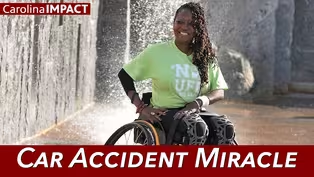
Video has Closed Captions
Clip: S11 Ep1106 | 5m 40s | A remarkable story of the human spirit, the fight for survival and a second chance. (5m 40s)

Carolina Impact: October 31st, 2023 Preview
Preview: S11 Ep1106 | 30s | Saving Siloam School, Car Accident Miracle, Hickory's Great Honor, & the Whirligig Park. (30s)
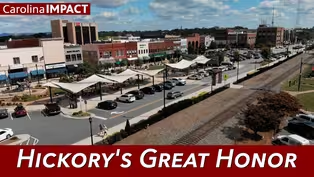
Video has Closed Captions
Clip: S11 Ep1106 | 5m 58s | We show you why Hickory was named the most beautiful and affordable place to live. (5m 58s)
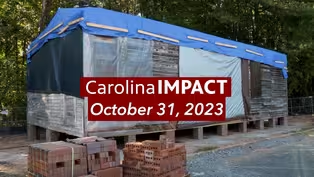
Video has Closed Captions
Clip: S11 Ep1106 | 7m 1s | Education, segregation, and restoration -- at a century-old Charlotte schoolhouse. . (7m 1s)
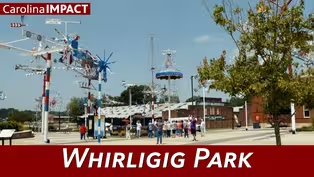
Video has Closed Captions
Clip: S11 Ep1106 | 4m 15s | Explore the Vollis Simpson Whirligig Park in Wilson, NC and learn about the artist. (4m 15s)
Providing Support for PBS.org
Learn Moreabout PBS online sponsorship
- News and Public Affairs

Top journalists deliver compelling original analysis of the hour's headlines.

- News and Public Affairs

FRONTLINE is investigative journalism that questions, explains and changes our world.












Support for PBS provided by:
Carolina Impact is a local public television program presented by PBS Charlotte