
Carolina Impact: October 3rd, 2023
Season 11 Episode 1103 | 27m 56sVideo has Closed Captions
Kure Beach Pier, Cody's Kitchen Crew, Mecca of Digital Arts, & Charlotte Sports Foundation
A century of fishin' tradition at Kure Pier, built and owned by one family since 1923, After losing her son, Lori Hawes now uses her organization to inspire recovering addicts, The Harvey B. Gantt Center has a new project that explores the world of digital arts, & An inside look at the Charlotte Sports Foundation, who they are and what they do.
Problems playing video? | Closed Captioning Feedback
Problems playing video? | Closed Captioning Feedback
Carolina Impact is a local public television program presented by PBS Charlotte
Carolina Impact: October 3rd, 2023
Season 11 Episode 1103 | 27m 56sVideo has Closed Captions
A century of fishin' tradition at Kure Pier, built and owned by one family since 1923, After losing her son, Lori Hawes now uses her organization to inspire recovering addicts, The Harvey B. Gantt Center has a new project that explores the world of digital arts, & An inside look at the Charlotte Sports Foundation, who they are and what they do.
Problems playing video? | Closed Captioning Feedback
How to Watch Carolina Impact
Carolina Impact is available to stream on pbs.org and the free PBS App, available on iPhone, Apple TV, Android TV, Android smartphones, Amazon Fire TV, Amazon Fire Tablet, Roku, Samsung Smart TV, and Vizio.
Introducing PBS Charlotte Passport
Now you can stream more of your favorite PBS shows including Masterpiece, NOVA, Nature, Great British Baking Show and many more — online and in the PBS Video app.Providing Support for PBS.org
Learn Moreabout PBS online sponsorship(upbeat music) - [Announcer] This is a production of PBS Charlotte.
- Just ahead on Carolina Impact.
- [Jeff] It's the oldest fishing pier on the Atlantic Ocean, and it's right here in North Carolina.
I'm Jeff Sonier, stick around, we'll show you where they've been reeling in the big ones and the little ones for a hundred years.
- [Amy] Plus, we'll show you how a local mother is using the devastating loss of her son to help others dealing with drug addiction.
And a new digital art exhibit in Charlotte makes an impact with young people.
Carolina Impact starts right now.
(upbeat music) Good evening, thanks so much for joining us, I'm Amy Burkett.
For most of us, beach season is over.
After all those summer vacations, we're all back at work or back in the classroom, but it's always fishing season at the Atlantic's oldest fishing pier now celebrating its hundred-year anniversary.
Carolina Impact's Jeff Sonier and videographer Doug Stacker take us out to the pier at Kure Beach for a little North Carolina fishing history.
- Yeah, so how does this fishing pier last a hundred years when so many other fishing piers have been washed away?
Well, you can thank the family that built it back in 1923, the same family that's been rebuilding the pier year after year ever since (peaceful music) It's dawn at Cape Fear, another sunrise in the skies beyond Kure Pier.
A century of fishing history here, where every day still starts the same way, at first light, lines tight, waiting for that first bite.
(upbeat music) - He's right there.
Tom.
- [Jeff] But Tyrone Powell will tell you, after 27 years of fishing the Kure Beach Pier, this is the day he'll remember.
- I'm trying to get him to go back left.
(upbeat music continues) - [Fisherman] Get him, Ty, get him.
- If I can get him to go back left.
- [Jeff] Hooking a 90-pound tarpon from Kure Pier on his 12-pound line, too big to pull up, so as a crowd gathers below the pier to watch, well, that's where Powell is headed too.
- That's a good thing, he's going past that sand bar.
- [Jeff] And then after fighting the big fish for almost an hour comes that feeling of finally reeling it in.
(crowd applauds) On the beach, cheers, and back at the pier, - God bless, good job.
- [Jeff] Handshakes to celebrate his biggest catch ever.
- Nice tarpon.
- And as Powell heads out the door to fish some more, well, maybe he's hooked on Kure Pier too.
(relaxing music) - 777 feet from the road, 632 feet of it sticks out over the water.
- [Jeff] Owner Paul Robertson knows every inch of Kure Pier from the bottom up.
- That's a six by 12.
- Every brace, board, and beam below this pier deck, every post and pylon propping up the pier for decades.
- And where the pilings step out, you can see all the old stubs that are still left out there, but it's not pretty, no, but it's strong.
You don't need to make everything pretty.
This tells a story.
(relaxing music continues) - [Jeff] The hundred year story of Kure Pier begins with Robertson's great-grandfather, L.C.
Kure.
- So L.C.
was the first originator of the pier.
He had some background in building ship wharves.
- [Jeff] But the pier that L.C.
built that grew so popular through the 1920s, and '30s, and '40s was no match for Hurricane Hazel in 1954.
So it was Robertson's grandfather who rebuilt Kure Pier after Hazel.
In 1984, when Hurricane Diana made 400 feet at the far end of the pier disappear, Robertson's father rebuilt it a second time.
And in 1996 when a one-two punch from Hurricanes Bertha and Fran left the Kure Beach Pier in ruins again?
- [Paul] They say they don't make 'em like they used to.
- [Jeff] Well that's when Robertson's dad rebuilt the Atlantic's oldest fishing pier again, even taller, raising Kure Pier from its original 18 feet to today's 25 feet above the water.
(relaxing music continues) (waves roll) - When you have the storms now and you're sitting out here and I come down during the eye and then look out the back door and go, whew, you know.
You can see the ocean spray come up through the cracks.
They're just touching the bottoms of the boards, but they're not getting on top of the pier to be able to cause havoc.
- But you kept on building back, your family, storm after storm, year after year.
- I mean, that's our livelihood.
This is what we do.
- [Jeff] Kure Pier hasn't changed much over the years.
They do sell souvenirs now and t-shirts here in a much bigger pier store.
The old Kure Pier store from the '30s is now a restaurant across the street.
And during the summer months, the family that founded Kure Beach and built Kure Pier still welcomes other families to vacation here.
- Great grandparents, grandparents, parents, and the kids, they all say they would never go anywhere else.
And then they go and they eat in the restaurants for dinner, and then they come out on the pier and they get their ice cream, and then they walk the pier because it's free to walk out.
It warms my heart with all the love that other people have for it, as well.
- [Jeff] But after Labor Day, when the shadows on Kure Pier get longer and those vacations at Kure Beach become summer memories, well, that's when this pier that's famous for fishing gets back to its hundred-year tradition.
- We call it the September flip.
You go from the tourist to the fishermen.
The tourists are here enjoying themselves and doing their thing.
But spring, fall when the fish are moving, this is 100% a fishing pier and fishing town.
- There's no fussing, no beer, no drinking on this pier.
It's a family pier.
- [Jeff] 90-year-old Tom Harty is part of that fishing family, so is 79-year-old Mark Arthur.
- And it depends on how the fish is biting, but most of the time we fish about eight hours.
- [Jeff] Yep, every Wednesday all year, you'll find Tom and Mark here on the Kure Beach Pier next to the rest of the regulars, all at the rail with rod and reel, along with a pelican named George, who's just looking for a free meal.
(relaxing music) What's the biggest fish you ever caught on this pier?
- I caught a 10-pound, two blue.
- One day, it's good, and one day you can't catch anything.
- [Tom] But you know what, the fellowship is worth it all.
We made a lot of friends over the years.
- You've got a responsibility.
- Yeah, keep it going.
- Keep this open.
- Absolutely, absolutely.
It means everything to me, but it means so much to so many people.
(relaxing music continues) - [Jeff] And come hurricanes or high water, Paul Robertson promises they'll always have a Kure Pier to come back to no matter what.
- [Paul] And if they another one comes and knocks it down, we're putting it back.
For it to be here for a hundred years, obviously we're doing something right and we're not going to change it.
(relaxing music continues) - By the way, if you're planning a visit here at the Kure Pier, well, no reason to circle any special dates on your calendar because this pier is open 365 days a year, 24 hours a day.
Even during the winter months when the pier store is closed, the pier itself is still open.
Just don't forget your rod and reel.
Amy.
- Thank you, Jeff.
The family that still owns Kure Pier after a hundred years isn't sure what the cost was to build that first pier back in 1923.
But the price tag for the rebuild in 1996 after Hurricanes Bertha and Fran was around $450,000.
We have more information and historic photos on our website at pbscharlotte.org.
On to a much more serious topic.
It's every mother's worst nightmare, losing a child.
According to the Centers for Disease Control, drug overdoses too often make that nightmare a reality.
In 2021, there were over 106,000 drug overdose deaths in the US, and in North Carolina alone there were more than 3,500.
One local mom is part of those statistics.
Carolina Impact's Dara Khaalid and photojournalist John Branscum show us how she turned her pain into purpose by working to save others.
(melancholic music) - [Lori] This is the book that I gave to Cody when he graduated from high school.
- [Dara] As Lori Hawes flips through a scrapbook of her son Cody Mogensen.
- These are birthday parties.
- She's still dealing with the heartbreak of losing him at just 32 years old.
- Cody was sweet, kind, smart, very talented.
He could fix anything.
- [Dara] She finds comfort helping others get to know her son who died more than a year ago.
A terrifying incident during high school changed Cody forever.
- He was delivering pizza and was attacked by what the cops believe, a gang, it was a group of guys.
He was beaten with a hammer.
It was horrific.
- [Dara] Little did she know at the time, this was only the beginning of a long road of pain.
- First thing I asked before the surgery is what about brain damage?
And they said, we just have to go in.
And he recovered.
He recovered, but he didn't recover because he got addicted.
And then when he couldn't get any more pain meds from the doctor, he went to heroin.
- [Dara] Hawes says this contributed to her son making other poor decisions that landed him in trouble with the law.
- We found out with a call from the jail, we were thinking, oh, he's got pot.
We pulled it up on the website and it was horrible.
I literally fell on the floor because it said heroin.
- [Dara] And after the cycle continued for a while, Hawes says it was time for an intervention.
- We brought him to a two-year rehab.
He was not happy.
I didn't get a hug goodbye, he was furious.
But he stayed there for two years and it did help him.
(peaceful music) - [Dara] It helped him so much that Cody even picked up a new hobby, one that captured the beauty of life.
- He bought a really nice used camera and just started taking pictures, amazing pictures with no training.
- [Dara] But this newfound passion wasn't enough to keep dark days away.
And like many who are recovering from drug addiction, he relapsed.
- He was left alone in the house they had lived in for years.
His dog died a week later.
It was just the whole summer, he got evicted.
- [Dara] As life got harder, so did the ability for Cody to stay away from drugs.
This time he wasn't eating properly and was rapidly losing weight.
- That's when I tried to get him committed up in Asheville, which didn't work.
I tried what I could try.
And it's just hard because you see him at that point, it was bad.
- [Dara] After 14 years of this heartbreaking cycle, which at times included homelessness, Hawes says her worst nightmare came true in spring of 2021 when Cody died of an accidental drug overdose.
- For a year, I went to work and then I came home and sat on my couch.
I didn't walk my dog, I didn't do my yoga, I literally just went to work and came home.
Grieving is very lonely and it's exhausting.
- [Dara] But after that, Hawes asked her support group the life-changing question, how do I survive this?
And volunteering was one of the top answers.
- I called Charlotte Rescue Mission and I started Cody's Kitchen Crew.
Cody was a chef and we started volunteering in the kitchen.
- I lift him up to you.
- [Dara] One of those volunteers is Hawes's coworker Teri Perna.
- She was starting this to deal with the passing of her son.
I was dealing with the recovery of my daughter's addiction.
My daughter was, is a recovering meth addict.
We both were in this at the same time.
- [Dara] Perna tells me she understands firsthand many of the struggles Hawes faced and that encourages her to continue volunteering.
- I felt like this was a honor to go in and work with these men who were passionate about their own recovery.
- They don't just come and serve.
They serve and they interact, sit down, and their presence is felt and known.
And some of the guys knew her son Cody, so it's special for her to hear some of those stories from guys that were here with her son.
- [Dara] Every month, Charles Hite, who works at the Charlotte Rescue Mission, gets to witness just how impactful Hawes and her crew are to the men recovering from drug addiction.
- I've been in their shoes, been to eight rehabs, in and outta jail, psych wards, suicide attempts.
- [Dara] But spring 2021 also delivered a wake-up call for Hite.
- [Charles] I was found on Selwin and Queens Road West by a firetruck.
And woke up a couple days later off life support.
I didn't know what had happened, 'cause blacked out, but my dad was on my left and said, you overdosed and died.
And that was one thing I said would never happen.
- [Dara] And as these men learn to navigate recovery, Hawes says she's committed to their success and will continue to honor the life of her son through helping them.
For Carolina Impact, I'm Dara Khaalid.
- It's so nice to see how she's making a positive impact after that horrible situation.
Thank you so much, Dara, for sharing her story.
Statistics show that overdoses remain a leading cause of injury-related death in the US.
If you're interested in helping Cody's Kitchen Crew, head to pbscharlotte.org for more details.
Well, no matter where you go in the Queen City, you're sure to find art and creativity.
A new digital art exhibit at the Harvey B. Gantt Center is capturing the attention of many.
It intertwines bold visuals with technology.
Videographer Marcellus Jones gives us a closer look into the mecca of digital arts and how it's providing opportunities for young people.
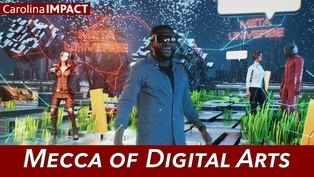
(gentle music) - MODA stands for mecca of digital arts.
It's a state-of-art innovation lab and production studio powered by the Harvey B. Gantt Center.
We are so fortunate to have the cutting-edge equipment ranging from IMAX cameras, iPads, VR headsets, DMX lighting controls, and graphics software.
(gentle music continues) - When I initially came here, we came back into this empty classroom space and envisioned what the possibilities were and also kind of looked at our community a little bit to determine where there were needs.
So the inspiration behind MODA really stems from that, what we felt like was lacking in our community and where we could really change this space to meet what needs that we saw.
- Today's class is just an intro to augmented reality.
So I'm gonna have students using Adobe Aero, which is Adobe's premier AR product, as well as Adobe Mixamo, where we're gonna teach students how to animate those models and we'll be using Michael Jordan and LeBron James prefab models.
On the top left corner, there's a button that says preview.
Hit preview.
You should be bouncing the ball.
All right, you got that.
Virtual reality users tend to have on a helmet, augmented reality users tend to have a phone or tablet in their hand while having the experience.
If you're creating your own 3D models, having access to really powerful computers matter.
Spaces like the MODA help level the playing field for the community to get started.
- MODA is more than just a space, it's a community.
We forge partnerships with local organizations, educators, and businesses to ensure that our impact extends far beyond our walls.
Through these collaborations, we foster mentorships and educational programs and opportunities that elevate future innovators and industry leaders.
(upbeat music) - I wish I could say I knew about MODA prior to.
We had gone to the Harvey B. Gantt Center before and some time passed during our summer camp programming where the team puts together so many activities that they go.
So we had been to the building.
Our push, again, is for pro-social and interest-based initiatives.
And so we're harping that at every turn we can get.
And so we were fortunate to have a member of the Juvenile Crime Prevention Council local in Mecklenburg County who made mention of this possibility if that's something we were interested in.
And I was like, yes, these are the right-up-our-alley deals.
- It was cool, it was like more into the future.
I ain't never think you could get something off your computer and then they'd just be right in front of you, you know what I'm saying?
Yeah, that's the future, man.
- The interesting part was learning about the people on the computer and they use your phone and they be popping up in real life and stuff like, that was interesting 'cause I ain't never, I just know about that on Snapchat, but I don't be seeing it on Snapchat no more.
But that was just interesting, I ain't know nothing about that.
- We see a world where every kid gets an opportunity to get connected with positive people and places.
That if they have a dream and aspire to do something, that if we can connect them to people and places where those resources exist, they may be more inclined to pursue or continue pursuing their dreams.
So the vision is that part in connecting the dots to those resources.
- When I met the coaches and the teachers here, they made me feel really comfortable and they told me a lot of stories that made me feel like I wasn't alone.
I love this place, it's like a second home.
- Art in any form is valuable, but digital art, in addition to, I think, could be the beginning of an exposure to incredible career paths and all things being technology driven, youth inspired by, in addition to whether it's your Mac or whatever it is, having an ability to get in a space where they can see that creativity come to life.
And then, oh by the way, apply it to some potential for seeing the visualization of this is a real career path.
This is an incredible opportunity and I know it's going to inspire some of these young people to want to get connected and I'm looking forward to figuring out ways how we can continue that collaboration.
- Thank you so much, Marcellus.
Those young people have great futures ahead of them.
There are several programs and events coming up at the exhibit that will teach young people even more about creating digital art.
Well, finally tonight, college football season is here and I'm sure we all remember the recent Battle of the Carolinas that kicked off in Charlotte, North Carolina taking on South Carolina in front of nearly 70,000 fans and millions more watching on TV.
Would you believe the team putting the game together consisted of just eight people?
Carolina Impact's Jason Terzis joins me now with more.
- Yeah, getting a look at it, thanks, Amy.
Well, I spent plenty of time uptown with the crowds that weekend to bring you this behind the scenes look with the Charlotte Sports Foundation to see how this small crew puts a big game together.
(pounding music) North Carolina, South Carolina.
- You have red versus blue.
- [Jason] Cocky, Rameses, Sir Big Spur, the bands, the cheerleaders, and the dance teams.
(crowd cheers) - You have North versus South.
- [Jason] The spectacle, colors, and pageantry that is college football.
- You have two fan bases that are, might as well be, brother and sister.
They're so closely aligned.
- [Jason] The Gamecocks and Tar Heels kicking off the season in the Duke's Mayo Classic.
- It's great publicity for Charlotte and well deserved publicity for Charlotte.
- [Jason] But games like this don't just happen.
What you see on TV or from the stands is just the cherry on top.
- I am not the only one in charge, but I am one of many.
- [Jason] In the hour leading up to kickoff, there's a beehive of activity.
- Hi, it's nice to meet you.
I'm glad you guys made it.
- [Jason] Cadie Koppenhaver is the director of operations with the Charlotte Sports Foundation.
Her job on game night, dealing with people.
- Owen's going to get him at the south gate.
- [Jason] People like the on field game host.
- Yeah, so you'll be set up at midfield for that first house welcome.
- Okay, great.
- Game officials.
- They're not here yet?
- Well, Darius is over there getting ready.
Eric's on his way over here.
- Okay.
- You're not late.
They're late.
- [Jason] National anthem singer Darius Rucker.
- Do you know Darius?
- Yeah, Rucker.
- Yeah, you wanna say hi?
- [Jason] Even South Carolina Governor Henry McMaster.
- We're gonna have you on camera soon.
We got a camera right here, so we're gonna recognize you.
(crowd cheers) (driving music continues) - [Jason] Cadie is sort of like an air traffic controller.
- Oh my god, can I have some water?
- [Jason] Dealing with people, not planes, although there is that, too.
- So we had to send the flyover.
(crowd cheers) Amazing.
- [Jason] Her game night task, making sure everything happens when it's supposed to happen, every detail down to the minute.
- So I work with the venues to make sure that everything is running smoothly.
- [Jason] Cadie is one of just eight full-time employees working with the Charlotte Sports Foundation.
The 501(c)(3) nonprofit was created a decade ago with one simple goal.
- Bring high-profile sporting events to Charlotte that have economic impact and add to the quality of life.
- The way I describe it and the way we like to see our events are as what are the things that put Charlotte on TV?
What are the events that Charlotteans are proud to go to?
And then what also are the events that help our hospitality industry from tourists coming to town to spend their money, to hotels, restaurants, Ubers, all that.
We want the events that have a great impact for the people who live here and the people who work here and then also the people who visit here.
- [Jason] At the Foundation's South Park offices, a dry erase board hangs in Cadie's office filled with all the things that need to be done to pull off a major event like this.
And it takes months of planning.
- Well, one of the lovely parts of my job is setting up the hotel contracts, doing that contracting process, making sure the teams have all of the rooms they need, the meeting space requirements, check in, check out.
All of that stuff is one of my duties.
(engine whirs) - [Jason] It's all those little details that you'd likely never think about, like making sure the field gets painted, equipment trucks, locker rooms, and team arrivals.
- Kind of all that backend work of making sure the venues are set up, the teams are ready to go.
- So whether that's scheduling, whether that's getting all your vendors, getting all the little bitty details in place, 'cause the little bitty details, that's what matters the most.
- [Jason] Leading the way at the Foundation is executive director Danny Morrison, a man who spent his entire career working in athletic administration, including a nearly decade-long stint as team president of the Carolina Panthers.
- Well, I've been blessed.
I've worked in high school, I've worked in small college, I've worked in major college, conference office, in the NFL and every step along the way, I've had great bosses, great experiences, and now to a certain extent, being here with the Charlotte Sports Foundation is a culmination of all of those experiences.
- Danny Morrison's a great friend and he's done such a tremendous job.
We have so many friends in Charlotte.
(crowd cheers) - [Jason] The Kickoff Classic drawing even more attention as ESPN's popular "College GameDay" program with its 100-member crew broadcasted its weekly three hour pregame show live from Romare Bearden Park.
- You can't pay for the amount of publicity that your university and the city of Charlotte and the game's gonna get for GameDay.
- Over two million people end up watching the show.
When they come to your respective city, it is like the Good Housekeeping stamp of approval.
- We've got a great relationship with the Sports Foundation.
Just being here over the years, really turned to them for a lot of promotion and they're great partners in just helping us spread the word that we're obviously in town and everything that we have to offer.
So it's been very beneficial for us.
- [Jason] As for the game, it was a 31-17 North Carolina victory.
(crowd cheers) Once the stadium cleared out and things calmed down, the Foundation team held a little postgame huddle.
- Credit to all of you, execution was great, we were on time for everything.
It's a testament to attention to detail, planning, staying on top of things, having the strategy and executing strategy throughout.
Great job, y'all should be proud.
I mean, great job.
(group applauds) - [Jason] The Kickoff Classic may be over, but the foundation's work never is.
On November 9th, Virginia Tech and Iowa, two teams from last year's women's basketball Final Four, will meet in the Spectrum Center in the first ever Ally Tipoff.
- It's gonna be the marquee basketball game to help start the season.
- We think it'll be a sold-out crowd.
- [Jason] Then on December 19th and 20th, back-to-back men's and women's basketball doubleheaders at the Spectrum and the second annual Jumpman Invitational.
- North Carolina, Michigan, Florida, Oklahoma, the original four Jordan brand schools for both football and basketball.
- [Jason] Then coming right on the heels of the Jumpman, the Duke's Mayo Bowl game, featuring teams from the Atlantic Coast and Southeastern Conferences.
- This year, our bowl game is on the 27th, so we're expecting teams to come in on the 23rd.
So we'll have a one-day turnaround from our Jumpman Invitational to our bowl week experience.
- I plan and coordinate all of our ancillary events around our games, so that's all the player events, all of the coaches and spouses events when they come to town.
- [Jason] If the goal is to bring high-profile sporting events to the Queen City that enhance the quality of life and have significant economic impact, the Charlotte Sports Foundation is certainly achieving its mission.
- Well, generally, our events have somewhere between 70 and $95 million economic impact for the year.
- The harmony that exists in Charlotte is unmatched compared to other cities our size, and that's kind of the secret sauce.
From the stadiums to CRVA, county, city, Center City Partners, we have incredible support and we have an incredible board that supports our vision of Charlotte being one of the best, if not the best, sports town in America.
- Jason's back in the studio to tell us even more is going on, as I understand.
- Yeah, so this small crew putting together these major football games and now these basketball games, but there's even more going on.
The Sports Foundation is in the process of creating a running event called The Mech Mile, which will be modeled after the popular Fifth Avenue mile run in New York City.
The event coming up this spring in May at Memorial Stadium on the campus of Central Piedmont Community College.
Again, another event to bring people to uptown than try to create some excitement around a sporting event.
- And that sense of community, thanks so much for sharing.
Well, before we run out of time, I wanna invite you to share your story ideas with us.
I know our region is filled with amazing people and places, and we'd love to shine the spotlight on them.
Email your ideas to stories@wtvi.org.
I'd also like to extend a heartfelt thank you to our longtime producer, videographer, editor extraordinaire Doug Stacker.
He's retiring and I just want him to know how much I'll miss him and our entire crew wishes him the greatest joy in this next chapter of his life.
Thanks for all your hard work and commitment to excellence, Doug.
Well, that's all the time we have this evening.
Thanks so much for joining us.
We always appreciate your time and look forward to seeing you back here again next time on Carolina Impact.
Goodnight, my friends.
(upbeat music) (upbeat music continues) (upbeat music) - [Announcer] This is a production of PBS Charlotte.
100 Year Pier |Carolina Impact
Video has Closed Captions
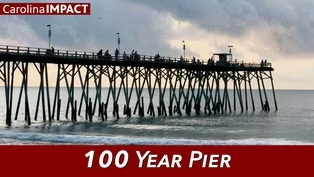
Clip: S11 Ep1103 | 6m 29s | A century of fishin' tradition at Kure Pier, built and owned by one family since 1923. (6m 29s)
Charlotte Sports Foundation | Carolina Impact
Video has Closed Captions
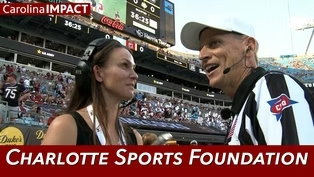
Clip: S11 Ep1103 | 7m 4s | An inside look at the Charlotte Sports Foundation, who they are and what they do. (7m 4s)
Cody's Kitchen Crew | Carolina Impact
Video has Closed Captions
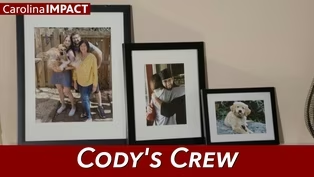
Clip: S11 Ep1103 | 5m 2s | After losing her son, Lori Hawes now uses her organization to inspire recovering addicts. (5m 2s)
Mecca of Digital Arts | Carolina Impact
Video has Closed Captions
Clip: S11 Ep1103 | 4m 9s | The Harvey B. Gantt Center has a new project that explores the world of digital arts. (4m 9s)
Carolina Impact: October 3rd, 2023 Preview
Preview: S11 Ep1103 | 30s | Kure Beach Pier, Cody's Kitchen Crew, Mecca of Digital Arts, & Charlotte Sports Foundation (30s)
Providing Support for PBS.org
Learn Moreabout PBS online sponsorship
- News and Public Affairs

Top journalists deliver compelling original analysis of the hour's headlines.

- News and Public Affairs

FRONTLINE is investigative journalism that questions, explains and changes our world.












Support for PBS provided by:
Carolina Impact is a local public television program presented by PBS Charlotte