
Carolina Impact: October 4, 2022
Season 10 Episode 3 | 28m 23sVideo has Closed Captions
Nursing shortages, Wilkesboro Speedway revival, Lisa Leake, Mount Olive Pickles
Nursing shortages, Wilkesboro Speedway revival, a profile on Lisa Leake, Union county mom and NYT best seller, a look into Mount Olive Pickles
Problems playing video? | Closed Captioning Feedback
Problems playing video? | Closed Captioning Feedback
Carolina Impact is a local public television program presented by PBS Charlotte
Carolina Impact: October 4, 2022
Season 10 Episode 3 | 28m 23sVideo has Closed Captions
Nursing shortages, Wilkesboro Speedway revival, a profile on Lisa Leake, Union county mom and NYT best seller, a look into Mount Olive Pickles
Problems playing video? | Closed Captioning Feedback
How to Watch Carolina Impact
Carolina Impact is available to stream on pbs.org and the free PBS App, available on iPhone, Apple TV, Android TV, Android smartphones, Amazon Fire TV, Amazon Fire Tablet, Roku, Samsung Smart TV, and Vizio.

Introducing PBS Charlotte Passport
Now you can stream more of your favorite PBS shows including Masterpiece, NOVA, Nature, Great British Baking Show and many more — online and in the PBS Video app.Providing Support for PBS.org
Learn Moreabout PBS online sponsorship- [Narrator] This is a production of PBS Charlotte.
- Just ahead on "Carolina Impact."
We explore the nationwide nursing shortage, and learn how it's impacting our region.
Plus.
- New life for an old race track.
I'm Jeff Sonier in North Wilkesboro, outside the speedway where there's a race track revival.
- And we'll meet a Union County mom, who found her passion through an unusual twist of fate.
"Carolina Impact" starts right now.
- [Narrator] "Carolina Impact," covering the issues, people and places that impact you.
This is "Carolina Impact."
- Good evening, thanks so much for joining us, I'm Amy Burkett.
If you're looking for a high demand, high paying job, you should think about getting your registered nursing degree.
According to the U.S. Bureau of Labor Statistics, we're expected to see openings for about 200,000 new nurses every year for the next decade.
There was a nursing shortage before the pandemic, but that has made it even worse.
The Department of Health and Human Services has urged the country to declare the current unsustainable nursing shortage a national crisis.
That demand has given many in the field plenty of options, from traveling nurses crossing the country to students graduating with multiple job offers.
As Bea Thompson explains, those dynamics are changing the way the healthcare system and nurses view the profession.
- [Bea] There is a motto for nursing that says with great power comes great responsibility.
- It's something I'm, again, very passionate about, and it's my calling.
- [Bea] She watched her grandmother, a lifelong nurse, and she knew it would be her life as well.
- You are taking care of people, you have lives that are in your hands.
- [Bea] As a healthcare technician, she cared for an Alzheimer's patient until she passed.
It made her certain that she wanted more, to become a nurse.
Yet those on the front lines of healthcare say they've reached a breaking point.
- I don't think everybody was aware of the struggle that the nursing staff, our faculty, or on the units were experiencing.
- [Bea] For this generation of new nurses, their instructions and the entire healthcare industry, the COVID pandemic placed their workplace under a spotlight, not just for the shear number of people fighting to live, but for those professionals who wondered if they could continue, and just how to do it.
- We saw a change.
People were leaving because of the need to take the COVID shot.
Others were making decisions to stay home with their family if they had someone that was immunocompromised.
- [Bea] The need for those nurses meant Charlotte hospitals would have to shell out millions to keep their facilities staffed.
It promoted the expansion of a career option for many in the healthcare field called traveling nurses.
National statistics show they're are more than 1.6 million traveling nurses.
84% of all traveling nurses are women.
15% or so men.
The average age of an employed traveling nurse is 44 years old, and the most common are traveling nurses who are Caucasian, about 70%, followed by African Americans and Asians.
Traveling nurses are paid an average annual salary of more than $83,000, and their starting salary around $53,000.
- We've been very intentional of making sure that we had a good mix, a good staffing model so that we had appropriate patient, patient ratios, which again requires us to bring in traveling talent, but absolutely never took our eye off of taking care of our own team.
- [Bea] According to statistics from NC Nurse Cast, a workforce model developed by UNC Chapel Hill says that within the next decade North Carolina could face a shortage of more than 12,000 nurses.
Both Atrium and Navant Health are offering signing bonuses.
Yet those who travel, and those who decide to stay must work together, many times leading to floor politics.
- There's a little bit of a stigma with it because you have a little bit of rub between staff nurses and travel nurses because one's making more.
So you just kind of have to learn to work through that, and work together as a team.
(upbeat music) - [Bea] Each year around 200 students enter Central Piedmont's nursing program.
As classes like these gear up to meet that need the traveling nurses are filling the gaps, and changing how many see their profession.
- We're seeing more students come in our nursing program that are talking about travel nursing, where before they weren't talking about it, but they didn't know about it.
- But I'd eventually love to get into traveling 'cause there's so many opportunities.
Pick anything under the sun, and they have a job for it.
- Traveling, yes, there's more money to be made in traveling.
But it's also about the availability.
So if somebody is up for it, great.
But for me and my situation right now, I think I'm gonna stay put.
- [Bea] She has a family and children in school, but she's concerned that the interest in traveling is having a ripple effect on hospitals.
- The main concern for me is about the shortage, and also with working short staff, 'cause when there' a shortage, it means you get on the floor to work, and there's not that many people, you don't have enough help.
- We've invested nearly $500 million in taking care of our team members in many different roles here at Novant Health.
Rapid hiring.
How quickly can we do an appropriate, but thorough interview process?
Rapid interview, centralized interviews, mass hiring.
- [Bea] It's not just nursing positions, but respiratory therapists, lab technicians, someone to check the patients in, translators and more.
- Well shame on us if we haven't learned lessons from the pandemic.
What we've learned is the value of looking at talent across the spectrum.
What is the value right now, and how do we take full advantage of the five generations that are currently in the workforce?
- [Bea] For everyone involved, the bottom line is the same, improving healthcare for patients, and the overall health of the staff.
- I think there needs to be more people in it because that's what you wanna do, you wanna help people, and you wanna be there for people in their time of need.
- So it's not just about the money that you're making, it's also about having the love to care for people.
- [Bea] For the ones in the nursing industry, the bottom line is better healthcare.
For "Carolina Impact," I'm Bea Thompson.
- Thank you, Bea.
National statistics show 87% of nurses say they're burned out, and 80% report their hospital units aren't adequately staffed.
Well, it's race week at Charlotte Motor Speedway, NASCAR brings the stars, the cars, and a big boost in business for local hotels, restaurants and bars.
So imagine if it all just disappeared.
That's what happened 26 years ago up in North Wilkesboro.
But now, North Carolina's original NASCAR track is back.
Carolina Impact's Jeff Sonier and videographer Doug Stackard are at North Wilkesboro Speedway with more on its history and its future.
- Yeah, you see the new red sign on the old track marquee calling it a race track revival.
But inside the old North Wilkesboro Speedway, it's more like a resurrection.
This old track has been pretty much dead for decades.
They haven't had regular racing here since 1996.
But what never died in all that time was the dream of those determined to bring this track back to what it used to be.
(upbeat music) In these hills and hollows of Wilkes County there's a history you can hear on log cabin porches where flat pickers still play.
- Here's one we learned from doc.
- [Jeff] Just like the local music legends they learned from on old blue grass stages that sometimes feel more like scrapbook pages.
But there's another history here in Wilkes County with its own legends, a long racing history that's been silent for too long.
- [Narrator] The picture you're watching is live.
It's what's happening at this moment.
- [Jeff] On an old track that's finally making its way back.
- [Narrator] The North Wilkesboro Speedway in North Wilkesboro, North Carolina.
This is a big day for the people of this tiny cross roads.
It's the day of the Grand National stock car race.
- [Jeff] This is NASCAR from the '70's, when Dale Curry was still in his 20's.
- The first race I remember, the guy that won it was driving a '56 Oldsmobile.
- [Jeff] On the old Speedway that's the same age as he is.
You literally saw that track grow up as you grew up.
- I did, I did.
A lot of miles on the bicycle out there.
- [Jeff] Built on his family's old chicken farm.
- The old chicken office there on the South side has a chicken house.
My dad raised chickens there, and it was mostly red clay, trees.
(gentle music) - [Jeff] Curry shows us the yellowed newspaper, the black and photos of this legendary NASCAR track his family founded.
- My dad, Lawsom Curry, and this is Charlie Combs, who's my uncle, Enoch Staley and Jack Combs, another uncle.
(gentle music) This is a 1950's photo of cars there on the track.
Look at most of the grand stand that was there at that time, still dirt.
The track was paved, I think, around '59.
- [Jeff] North Wilkesboro's history is Curry's family history.
From these old guard rails he used to build his barn to the race track's red painted victory lane, with its famous checkered flag roof.
- Put the car up on top.
- And you worked on that in construction.
- I built it.
Yeah, yeah.
- [Jeff] For little North Wilkesboro, that was a pretty big deal, wasn't it?
- It was.
It surely was.
The restaurants, motels, everything around here.
It really, twice a year, it was a really big deal, really big deal.
And it hurt the economy in a really big way.
I really hated to see 'em leave.
And I can see at that time the big tracks were the thing.
♪ Life ain't fair ♪ ♪ Saddle up boys ♪ - [Jeff] Yeah, that last checkered flag in 1996 definitely didn't seem fair, but it did seem final.
Maybe the occasional music video, or photo shoot here on Old Victory Lane since then, but no more thunder in the hills.
North Wilkesboro Speedway becoming just another rusted relic in racing's rear view mirror.
♪ Life ain't fair ♪ ♪ Saddle up, saddle up ♪ - [Jeff] Beyond the No Trespassing chain link fence though came these we want you back billboards and banners.
Everybody with stickers urging the speedway to stick around.
And window signs at these left behind Wilkes County business.
- Tell somebody in Wilkes County that they can't do something, watch what happens.
- Brad Luty is the co-owner of this downtown drugstore turned restaurant in North Wilkesboro's oldest building.
- I've got people coming in all the time asking where do you get the signs.
And it shows you the folks that have done this, that have started that campaign, and pushed and pushed and pushed, and worked hard at it, when we work together as a community, things seem to happen, it might take a minute, but they come together eventually.
(gentle music) - There's a spirit, there's an aura of this place.
There's a reverence that this place has.
There's no track that deeper roots than this.
It is where it all started.
- [Jeff] Charlotte based speedway motor sports has a plan to grow those racing roots here in North Wilkesboro into a racing future.
- Seeing the potential in this place, and not seeing an abandoned facility, but seeing what it could become.
- [Jeff] Their vision is a new racetrack that restores and preserves the best of the old race track, with modern upgrades not just for racing, but also concerts and other big events that the whole community can benefit from.
- One more time, are y'all ready to race?
(crowd cheering) - [Jeff] But first, how about one last goodbye.
A few more nights of racing at North Wilkesboro the way these fans still remember.
The sign's fading but not the excitement.
The faint feeling, but still that feeling of finally coming home.
- We're back.
- [Jeff] And if these new drivers need tips on how to handle this old speedway, well just ask Dean Combs.
That's him down there on his riding lawn mower off turn three, near his home off turn three.
- These here is basically my championship trophies.
- [Jeff] When he was a driver, Combs won 60 races, including 15 checkered flags here at North Wilkesboro.
Of course that was after he did a few months jail time for running Wilkes County Moonshine.
- And when I got home, the first race I ran was North Wilkesboro, and I won it.
(indistinct) I was always good at that track.
There's a few thousand people in the stands to 30,000 people in the stands.
I would just say listen people (indistinct).
- By the way, the biggest change that fans will see here at North Wilkesboro Speedway eventually is the track itself.
Plans are to repave the entire track with a new surface that could pave the way for future NASCAR events here as well.
Amy.
- Thank you, Jeff.
The first of those big events will be NASCAR's May all star race that used to run in Charlotte, now moving to North Wilkesboro in 2023.
You can learn more about it at our website, PBSCharlotte.org.
Well there's an old adage that states finding the best job career for someone is at the intersection of their passion and talents.
Problem is not everyone knows exactly what they're truly passionate about, or if it can ultimately pay the bills.
As Carolina Impact's Jason Terzis shows us for one Union County mom finding that passion took a little twist of fate.
- [Jason] The pots and pans clang, peppers chopped up, onions too.
Lisa Lee is hard at work preparing dinner.
- I am making chicken burrito bowls.
- [Jason] With a butterfly hanging around the family garden out back, husband Jason picks a ripe jalapeno.
It then gets sliced up, and so too does the chicken.
- [Lisa] It's not really the prettiest right now.
- [Jason] When daughters Sydney and Sienna get home from high school- - [Lisa] Hi girls.
- [Jason] they jump in to help.
Lisa is just another parent making dinner for her family.
Well not exactly.
- I mean I never imagined in a million years I would be a cookbook author.
- [Jason] Growing up on what you might call the standard American diet.
- Macaroni and cheese out of a box, and Doritos and all of that.
- [Jason] After meeting future husband Jason while at Clemson, Lisa began working at a catering and event planning company, paying close attention to what her co-workers were doing.
- And so I'd go home and experiment with recipes, and I thought it was a lot of fun.
- [Jason] But her entire approach to cooking all changed one day while watching "Oprah."
- Isn't it amazing how we have more access than ever before, and yet we're unhealthier than we've ever been?
- Yeah, we have access to lots of healthy food, and the American diet is now a catastrophe.
- And she had Michael Pollan on there talking about where our food comes from, and I realized that I had no idea, and that might be a problem.
So I went on to read his book "In Defense of Food," and it was a huge wake up call.
- Way too many calories, too much processed food, tons of refined carbohydrates.
- Refined carbohydrates, what do you mean?
- White flour, things with white flour in it, sugar, soda.
- It was kind of like the curtain got pulled back, and she was like oh.
- It really kept me up at night, what am I gonna feed my children if Goldfish and fruit snacks are no longer options.
- [Jason] Lisa and Jason made a pledge to see if they could 100 days without any processed foods.
- I basically had to relearn how to food shop and cook.
- She literally was giving food away to our neighbor from our pantry like now this is no longer good enough for us, you take it.
And they're like sure.
- And that's sort of what led to me starting a blog to share all this research and work I was doing to figure out how to change our diets.
- [Jason] Starting the blog in 2010, it quickly gained a following.
- She was putting so much time in, and she was getting some really decent traffic.
And I was thinking "You need to be compensated for that."
- I wasn't really making any money off of it, and that was never my goal.
- [Jason] So Jason left his job in corporate America, and the two went to work together.
- I'm kind of the operations manager, if you will.
- [Jason] As the blog continued to grow, Lisa noticed another place where she could help.
- Michael Pollan's book that I read tells you the why behind making all these changes, but it does not tell you what to send your child for school lunch that they're actually gonna eat.
- [Jason] So Lisa wrote a 50-page book proposal which a literary agent took to publishers in New York City.
A bidding war ensued.
- I was at Target shopping with my little children when I was getting these phone calls from my agent about what was happening.
And I was walking around Target like an idiot, with the biggest smile on my face.
I couldn't even believe it was happening.
- [Jason] Between writing, revisions, pictures and publication, it took about two years for 100 Days of Real Food to hit book shelves.
Between pre-orders and first week sales, it shot onto the New York Times Best Sellers list.
- You're waiting for that phone call to see if it hit the list, and so it was a very exciting moment for sure, I couldn't believe it.
- [Jason] Since then, Lisa has written three more cookbooks.
- The second book is Fast and Fabulous, which is all very quick and easy recipes, 'cause that's definitely my target audience.
- [Jason] Then came 100 Days of Real Food on a Budget.
- Every single recipe is under $15 to make in the book.
- [Jason] All of this lead to write ups on Yahoo, appearances on local, as well as national television shows like "The Doctors."
- Welcome Lisa.
(audience cheering) - Thank you.
- [Jason] And even an appearance on "Good Morning America."
- And this morning we've got cooking tips for college students.
Chef Lisa Leake, author of 100 Days of Real Food on a Budget.
- I just went on, and cooked some recipes with Michael Strahan.
And it was really exciting.
- [Jason] For now there are no plans for another book, but with 130,000 Instagram followers, one and a half million on Facebook, plus their own email and blog lists, there's still plenty to do.
And having a cookbook author mom that's also active on social media does have its advantages.
- She's not the anti-social media moms.
She's like "Help me make a Tik Tok" instead of "What is Tik Tok?
"What is that?
"Put it away."
- Our daughters are little foodies now.
- It's different from my friends who can barely cook anything, or cook a microwave meal, I just feel like I can cook anything, recipe or not, and I think that's special.
- [Jason] Living a life they never imagined, with useful and health-conscious ideas for everyone.
- Neither one of us would ever think this is where we would be, and its taught me that you can only plan so far ahead, you kind of see over the next hill, and then see what it looks like from there.
- I always tell people you can start small when it comes to making these changes, it doesn't have to be all or nothing, 'cause I would hate for people to get so overwhelmed that they give up altogether.
So you just have to remember any small change is better than none.
- [Jason] One modification at a time.
It changed not only how one family eats, but not countless others.
For "Carolina Impact," I'm Jason Terzis reporting.
- Thanks so much Jason.
Lisa says with the exception of rice, flour and spices, it's usually best to stick to the outer edges of grocery stores because all the processed foods are usually in the middle aisles.
And even better she suggests shopping at local farmer's markets whenever possible for the freshest fruits and vegetables.
Well did you know pickles have been savored for over 4,000?
Next we're taking you on a little road trip down east.
North Carolina's Mt.
Olive Pickles have become the largest privately owned pickle company in the United States.
Jason Terzis returns to help us learn more.
(upbeat music) - [Jason] Welcome to Eastern North Carolina, and a town with a name found on grocery store shelves nationwide.
- I was born and raised here in Mount Olive.
It's a great town to grow up in.
Anywhere you go you can find somebody that has a connection with the pickle plant.
- [Jason] The Mt.
Olive Pickle Company, in business nearly a full century right here.
- Well today we are standing at the corner of Cucumber and Vine.
We relish the opportunity to talk about pickles in Mount Olive.
Mount Olive, at the turn of the last century, the early 1900's, was a really small commercial center that served a really broad agricultural area.
So farmers would bring their crops into town and sell it to some of the produce brokers, and it would ship up to markets up north by train.
- [Jason] They say necessity is the mother of invention.
Lynn Williams, the company's public relations manager, says in the 1920's the town found itself, in well, a pickle.
- There were cucumbers, bumper crops of cucumbers that grew well here, but there wasn't much of a market.
So the local business people reasoned that if they could create a new market for farmers that the whole town would benefit.
So in 1926, this group of business people came together and established the Mt.
Olive Pickle Company for the purpose of packing and selling pickles.
In the very beginning it was a small operation.
By the 1930's, we had maybe 15 employees.
And for many years we operated as a good regional brand.
But all of our lids said Mt.
Olive, and there was a newspaper survey about different products in South Carolina, and the number one brand of pickles was Mt.
Olive, but there wasn't a Mt.
Olive brand.
So then the folks here realized we might be on to something.
So we began to consolidate all of those different brands into one Mt.
Olive brand, and today we're the number one brand of pickles, peppers and relishes in the country.
- [Jason] She says paying attention to consumer demands paid off.
- We've not been around for 95 years because we didn't pay attention.
We've added a lot of items over the years to appeal to different consumer interests and needs.
- [Jason] The company packages everything in Mount Olive and employees around 1200 people year round.
- We're actually procuring about 240 million pounds of fresh cucumbers and peppers in a year's time.
Our year starts in May, and we're in the Georgia crop.
In North Carolina, we're in June.
We're gonna buy a third of everything we buy in a year's time pretty much in the month of June out of North Carolina.
Then we're in the eastern shore of Maryland and Delaware, we're in the Midwest by July and August, we go into Canada.
And then in the winter months we're getting out of Florida and Texas and Mexico and India.
We get some pepperoncini from Greece.
We get a roasted red pepper product that's actually grown and packed for us out of Peru.
It's pretty much a global thing to keep us going year round.
- [Jason] Most of those fresh cucumbers get washed and sorted.
Come get packed whole while others get sliced and cut.
- It goes to the packing room, and the product is actually placed in the jars, the fresh product.
We add pickle juice, the good stuff that gives it the flavor.
We seal the jars, it goes through our pasteurizer.
On the other side we're adding the label, the production code information, we're putting it in the trays, wrapping the trays, building the pallets.
And from there it goes to one of our warehouses here in Mount Olive.
- [Jason] But not every cucumber makes it into a jar right away.
- The fresh product actually are our kosher dills, the bread and butters, all those peppers that we love, those are good.
Probably 70% of our product line is fresh packed.
But the other kind we packed is processed.
Remember I told you we get 50 million pounds of fresh cucumbers in the month of June, well we can't possibly pack all that.
So we put our excess in our brine tanks.
We have about 1200 of those brine tanks on our tank yard, and when they're full that's 40 million pounds of cucumbers that's floating around in that brine solution outside.
But we make relishes and salad cubes out of that, our sours and our sweets.
- [Jeff] From the brine tanks, the pickles make the same journey through the packing as the fresh packaged products.
Williams grew up right here in Mount Olive, and says her hometown company keeps the community in mind.
- Our goal has always been, number one, to have a quality product, 'cause you gotta make money to do what we do.
But we also have a commitment to our community, and to our region, and to make sure that the original vision for the company continues.
That we continue to help make this a better place.
And so that's been a part of our traditions and our values, and our brand since the beginning.
- [Jason] One of those traditions makes Mt.
Olive look like the Big Apple with the annual pickle drop to ring in the new year.
Then each spring the North Carolina Pickle Festival takes over town, celebrating all things pickle.
The event is complete with fried pickles, a pickle eating contest, and a chance to meet the official Mt.
Olive pickle spokes pickle, Ollie Cucumber.
Mayor Ken Talton says the festival pays dividends for this small eastern North Carolina town.
- It helps to showcase the people.
Showcase the pickle company, showcase businesses, civic organizations.
It's just a great opportunity for Mt.
Olive to share with the world how special our community is, and why it is so special.
- [Jason] The company's impact on the town goes beyond fun traditions.
- I think over the years the Mt.
Olive Pickle Company has provided a level of stability.
We've helped generations of folks come to work, buy their houses, send their kids to college and retire comfortably.
And that's a huge thing in the small eastern North Carolina town.
We don't make rockets for NASA.
We make your burger better.
And I think we've also helped generate a lot of sense of community pride.
I mean you can go anywhere in the country, and go walk in a grocery store, and find a jar of Mt.
Olive pickles on the shelf.
- Mount Olive would not be Mount Olive without Mt.
Olive Pickles.
And we value what they have done for our town and its people.
- [Jason] For "Carolina Impact," I'm Jason Terzis reporting.
- Thank you, Jason.
Here's a fun little piece of pickle trivia for you.
It's said that Cleopatra, Julius Caesar and Napolian all had a passion for pickles.
Well, do you have an interesting story idea for us?
Please email them to stories@wtvi.org, and we'll see if we can turn them into great features to share here on "Carolina Impact."
That's all the time we have for this evening, thanks so much for joining us.
We always appreciate your time, and look forward to seeing you back here again next time on "Carolina Impact."
Good night my friends.
(gentle music) - [Narrator] A product of PBS Charlotte.
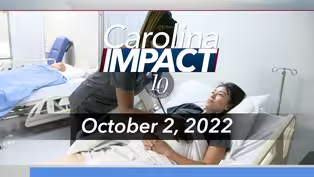
Carolina Impact: October 4, 2022 Preview
Preview: S10 Ep3 | 30s | Nursing shortages, North Wilkesboro Speedway, Lisa Leake, Mt. Olive Pickles. (30s)
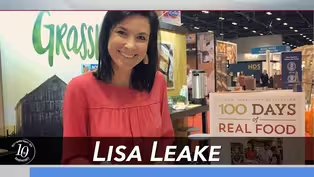
Lisa Leake: Mom, Best-selling author
Video has Closed Captions
Clip: S10 Ep3 | 5m 44s | How Union County mom Lisa Leake went from blogger to New York Times best sellers list (5m 44s)
Video has Closed Captions
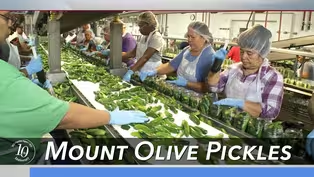
Clip: S10 Ep3 | 6m 13s | A look in to Mount Olive Pickles and their history (6m 13s)
Video has Closed Captions
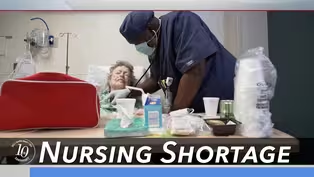
Clip: S10 Ep3 | 5m 24s | A look at how health care providers are dealing with the shortage of Registered Nurses (5m 24s)
Video has Closed Captions
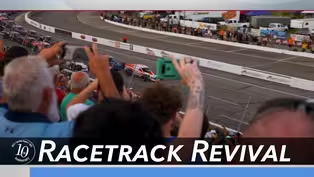
Clip: S10 Ep3 | 6m 53s | Racing returns to North Wilkesboro.The history and future of NC's original NASCAR track. (6m 53s)
Providing Support for PBS.org
Learn Moreabout PBS online sponsorship
- News and Public Affairs

Top journalists deliver compelling original analysis of the hour's headlines.

- News and Public Affairs

FRONTLINE is investigative journalism that questions, explains and changes our world.












Support for PBS provided by:
Carolina Impact is a local public television program presented by PBS Charlotte