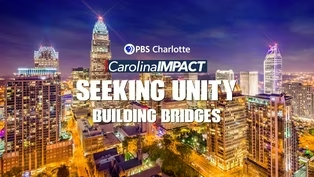
Carolina Impact: Seeking Unity - Building Bridges
Season 10 Episode 1 | 27m 18sVideo has Closed Captions
Seeking Unity:Building Bridges brings panelists together to find ways to unite people.
Seeking Unity:Building Bridges brings a diverse group of panelists together to explore options to bring people together despite their differences.
Problems playing video? | Closed Captioning Feedback
Problems playing video? | Closed Captioning Feedback
Carolina Impact is a local public television program presented by PBS Charlotte
Carolina Impact: Seeking Unity - Building Bridges
Season 10 Episode 1 | 27m 18sVideo has Closed Captions
Seeking Unity:Building Bridges brings a diverse group of panelists together to explore options to bring people together despite their differences.
Problems playing video? | Closed Captioning Feedback
How to Watch Carolina Impact
Carolina Impact is available to stream on pbs.org and the free PBS App, available on iPhone, Apple TV, Android TV, Android smartphones, Amazon Fire TV, Amazon Fire Tablet, Roku, Samsung Smart TV, and Vizio.
Introducing PBS Charlotte Passport
Now you can stream more of your favorite PBS shows including Masterpiece, NOVA, Nature, Great British Baking Show and many more — online and in the PBS Video app.Providing Support for PBS.org
Learn Moreabout PBS online sponsorship- [Narrator] This is a production of PBS Charlotte.
- At PBS Charlotte, we're committed to building bridges through our Seeking Unity Series.
So far, we've tackled issues including affordable housing, mental health, and education equity.
Today, we're talking about bridging the racial divide.
Research shows the public sees progress when it comes to all Americans having equal rights, but they also say more needs to be done.
We're asking how as a community can we come together?
Our special "Carolina Impact Seeking Unity" starts right now.
(upbeat music) [Narrator] - PBS Charlotte presents a special "Carolina Impact Seeking Unity".
(upbeat music) - Good evening, thanks so much for joining us.
I'm Amy Burkett, seeking unity takes courage and intention.
It's also a community effort.
That's why we've assembled a diverse panel of community members to share their stories and discuss how we can forge a path forward.
Let's go ahead and introduce our guests.
We'll begin with Willie Royal.
He grew up in a small segregated town near St. Louis during the civil rights movement.
He's a first generation college graduate and father of two.
Willie spent half of his career as a math teacher and the other half running a medical practice with his wife.
I met Willie a few months ago when he came to the station for one of our coffee and conversations.
Willie, talk to us a little bit, where do you feel we are when it comes to racial tensions?
- It seems to me that what comes to mind is Dickens, "A Tale of Two Cities", it's the best of times and the worst of times, summer of hope and the winter of despair.
We are in the best shape that we've ever been and the worst shape that we've ever been.
And those two complex realities coexist right now at this time and space.
- Thank you, Willie.
Appreciate you being here.
Well, Elizabeth McHenry grew up in Garner just outside of Raleigh.
She's been a hair stylist for 16 years and runs her own business, ERMc Hair Stylist.
Elizabeth happens to be my stylist.
And I wanna hear Liz tell us a little bit, do you think we've made progress towards unity in our region?
- So during 2020, at the beginning, I was thinking that we were, 'cause communities were coming together.
People were willing to help each other.
And then I just feel like now that things are going back to quote unquote normal, we've kind of gone back to some old ways where people forget about communities and helping each other.
And there's a lot of I see like bigotry where people say that race doesn't matter and that they're open to different minorities, but excuse me, they don't want to interact and get out of their bubble to get to know people's stories and understand people.
They'd rather just sit back and judge people.
So it's kind of like what Willie said.
It's like we've come so far, but yet we're still going backwards.
And why are we still going backwards in 2022?
- Thank you Liz for being here.
Dr. Shante Williams is a Charlotte native.
She's the CEO of Black Pearl Global Investments, a healthcare venture capital firm.
Her mission is to create access for black business owners by providing capital without so much red tape.
She's also Chairman of the Black Chamber of Commerce.
Dr. Williams, have you seen progress in creating equity since the pandemic?
- Yes and no.
I've seen more people become aware of the problems.
I've seen institutions kind of step up and then easily retreat back to their same patterns, but I've seen new players enter the market like Black Pearl, other players that didn't think that they were really supposed to be the ones that had to create access that have now decided to build their own networks, to build their own tables, and create opportunities for other people.
- Thank you so much for being with us.
We appreciate it.
Our final panel is this evening is Hector Vaca Cruz.
He moved from New York city where he was born to Lexington, South Carolina at age 12.
He's a community organizer with a nonprofit, Action NC and uses his photography to shed light on racial justice issues.
Hector, you told us before we started that you believe we're making progress, but again, similar to what we've been hearing, we're one step forward, one step back, what's your perspective?
- I believe we're making a lot of progress.
A lot of people are waking up to the inequities that we're seeing in our community.
I'm finally starting to see the black and the brown community as well as all the communities come together 'cause the way I grew up, since we live in the south, a lot of people, when we talked about race issues, we only talked about it in terms of black and white.
So I'm seeing progress and now we're being more inclusive of other cultures, other nationalities and actually having a conversation about how we can all find equity together.
So yes, so I am seeing change, but at the same time, as Willie mentioned best at times, worst of times, I'm also seeing more of a divide between the younger generations and the older generations with the passion of the young and in my opinion, the complacency of the older generations, but even through all that, we're starting to finally move forward.
- So I'm grateful you're all here, but I'm gonna stay with you Hector then for a second and talk a little bit of that.
You're seeing a divide between the younger generations and older generations, how do we meet in the middle?
How do we understand each other a little bit better?
Do you have any ideas, possible solutions?
- Well, I think that the younger generations could stand to learn something more from the older generations who've had a lot of the experience who've gone through the civil rights struggle as well as other struggles but at the same time, the older generations need to remember their passion, need to remember what it was like to actually care about something.
Because as we get older, we start becoming what a lot of people just been calling pragmatic.
We start thinking about how we need to just work within a system that already exists, because it's too hard to change the system and start thinking about how we need to change the system itself to something that actually benefits people of color or BIPOC people, black indigenous people of color, so that we're working to change the system to something that will work for everyone versus trying to work within a system that's designed to hold much of our population down.
So both sides need to come together, talk to each other and learn from each other.
- Great.
Thank you so much for sharing that.
Well, so much of our perspective is shaped by our upbringing and experiences.
I wanna start with Willie this time, you grew up during a time that you had three jobs to help you get through college.
- Yeah.
- You have two master's degree in the STEM field.
You attended a segregated high school where the majority of the students were white.
What did you observe about the difference in the schools?
- Went to high school, Kinloch Public Schools, which is all black, Kinloch's an all black city.
And to get away from that, it was very, very impoverished and so I did that all the way through freshman year high school.
Then I went to North County Tech Vocational School, which was predominantly white.
And so it was a culture shock because I'd never been around white.
And so during that period of time race relations were, I just didn't have the sophistication to understand race relations but what I did see is just the profound differences and resources.
I mean, our textbooks were 20 years old.
It reminds me of Jonathan Kozol's book, "Dealing with Boston Public Schools".
And he's a very prominent white researcher.
He teaches in Boston Public Schools during desegregation, and he talks about those differences.
And I got a scholarship to go to a very prominent, rich middle school.
And I saw first hand, these people had cameras, not quite like this because it was the 70s, but it was like I was living on a different planet.
And those were racial that was overall- - And how far away from home was it, just on the other side of town?
- Clayton, Missouri was about five miles away.
But as I said, in terms of resources, it was another planet.
- [Amy] Interesting.
- And that's when I began to internalize the differences between races and opportunities.
- Thank you.
Next up, Elizabeth grew up in a middle class, mostly white neighborhood.
She went to a magnet school where she told us was more of a minority magnet school, more than half of her classmates were black.
Was there a particular moment at that time that you realized were different?
How did you feel and how did you bridge that gap of connectedness?
- So my mom is raised in a community... Well, was raised in a community that was all white.
Like they say, there's minorities somewhere, but I've not seen one.
So she made a point that she wanted her kids to grow up in a diverse school and friends.
So my preschool, I was actually the minority and I was surrounded by all black kids.
And matter of fact, it was Halifax Court in Raleigh that now no longer exists.
And so going to elementary and middle school where you're around every nationality, it was nothing to me.
So then going to high school and it was like a four year brand new school and it was a STEM school.
So I started as the majority because people wanted their kids to do the science technology.
Well, that was not my path.
I was the artsy kid.
And so on top of the school was surrounded by black neighborhoods, nothing bad, just that's just what it was.
So they had to start accepting kids because that was their homeschool.
So then as time goes on, I started to become that minority.
So to me it was what it was.
And so I didn't think much about it, but around that time, I did start to see how if I hung with these people, or if I did this, partly from where I'm from, and I would go to a county over that was really rural then extra I got the, why are you hanging with these people?
Or throwing out words that I just wasn't raised around.
And so then it was like, oh my God, like race really was an issue.
But to me, I'm like, who cares?
Like why is this such a big deal?
- I Wanna get back to that in a minute.
- Okay.
- Liz, there's so much to dig into.
But I hate that time's passing so fast.
So we're gonna pick up with that in a little bit.
Dr. Williams, your parents were teenagers when you were born.
You told us a teacher recognized you were academically gifted, which changed the trajectory of your life.
And you have a PhD in biomedical science.
What was the significant about your interaction with that teacher that set you on a different path?
- Well, Mrs. Davis, my kindergarten teacher actually was a black female teacher.
And studies show that when you have a black educator, as a minority student, anytime in your formative years, it can be transformational to your educational journey and they can set your path.
So for me, Ms. Davis looked out for me because as a product of the Charlotte Mecklenberg School system, I was bused to a school where there weren't very many minority students.
So she absolutely probably saw me as a child that didn't have a lot of peers.
She saw me as a child that may have had some special talents.
And ultimately she said I'm going to make sure that those talents are nurtured.
And so her watering those talents very early helped me get into at the time academically gifted program, which put me into the IB program, which then put me into the STEM field and then so on and so forth.
But if she hadn't recognized that early, who knows how far along I would've gotten before anybody recognized that or those AP classes would've become available for me.
- Appreciate that story.
Well, Hector, you're half Puerto Rican, half Ecuadorian, born in New York.
You also speak Spanish.
And you told us you struggled with your identity after moving to the south because everyone was either black or white.
And you say, you didn't really find your voice until you went off to college.
Talk to us a little bit about that and help us understand you are saying, even as a minority student, the minorities broke into different minorities and it made it hard for you, help us understand that better.
- Well, when I was in New York, all my friends were from other countries.
All my friends were black, brown, all the colors of the rainbow, and we just saw each other as equals.
Then again, it could be also the innocence of elementary school children, but we saw each other as equals.
We didn't really acknowledge color.
And then we moved to the south and all of a sudden I went from being a Puerto Rican Ecuadorian US citizen, born in New York to all of a sudden becoming an undocumented Mexican because in the south, all of us LatinXs are somehow Mexican, no matter what country we're from.
And when I played with the white kids, the black children will make fun of me.
When I played with the black kids, the white children and vice versa.
So I had a hard time finding identity.
It was years before I finally found another LatinX person.
So I can start finding my culture again, finding myself again.
Then when I went to college, I joined a group called Students Association for Latin America, where I met children with parents from Latin America, but also who were born in Latin America.
And I started recovering my culture, started realizing that it's okay to speak another language.
It's okay to actually feel... Because I finally found family.
I finally found a community.
And then I started discovering that I could speak Spanish again, because I started losing it for a while.
So that's when I started finding myself again.
But sadly things are going back in that direction.
- Again, we're gonna explore all this as we move into the next segment.
The Pew Research Center surveyed just over 10,000 US adults in 2021, from all racial backgrounds, the results show the split among Americans on equity.
When asked if more is needed to ensure racial equality, 15% said nothing at all, 34% said a little, and 50% believe a lot more is needed to ensure racial equity.
Now, out of those 50% half say the changes in equities can be made by working within our current system.
While the other half say US laws are so biased against racial and ethnic groups that laws and institutions need to be rebuilt.
Let's dig into this friends.
This is hard stuff.
I wanna hear, I wanna start actually with you Hector, this time.
Let's talk a little bit about what do you think needs to be done?
How can we move forward?
- Honestly, I feel that we need to have honest conversations, frank conversations with each other, where we understand each other better.
What I would like to envision is maybe a talk series where one week someone representing the black community talks about their issues, and then what it's like to grow up black.
And then the rest of us, our job is not to say, I feel you, our job is to say, to sit there and listen and ask questions and the following week, something similar with a different ethnic group or racial group so that we can actually hear each other.
That's the problem, we need to hear each other, rather than trying to empathize.
We need to listen and actually understand each other and then find the common ground.
'Cause my vision is kind of like the Stokely Carmichael vision of unity, where he basically said that we need to acknowledge each other's differences.
Not say that we're friends, just because we all face the same struggles, but actually acknowledge each others differences and our commonalities and then come together and create unity off of that.
So that's my vision.
- Dr. Williams, help us understand what do you think needs to be done to help us move forward?
- Oh, well I don't think there is one solution and I think that's been the problem.
I mean, I think conversations are great, but I think we've identified a lot of things over the last 70 years.
The current commission told us what needed to happen then and those same conversations have been happening.
I think it's very scary for people to have to give up things.
So for me, I think if we're going to work within the system, we have to be willing to do radical experiments.
And I do mean- - [Amy] Example?
- An example.
Okay, well, let's hire as many folks that actually just want a job in finance.
Let's get rid of the underwriting process altogether in banking.
If you want to start a business, let's make $350,000 available for anybody who wants to start their business.
If we really want to spur entrepreneurship, let's make that capital available.
I don't care what your credit score is.
I don't care what kind of business you're starting.
We're gonna make that capital available.
You have a business plan, there's money available.
We will de-risk it so that you can get started.
That's a radical plan.
$350,000 in an industry that has trillions of dollars is a drop in the bucket.
That's a radical shift that will, it's an experiment.
We aren't willing to experiment in order to shift things because everybody's afraid that, I don't know what we're afraid of.
Maybe it'll work.
I think sometimes we're afraid that well, if we do that for these folks, these people will feel like yada yada, yada.
I mean, if we think about things like the GI Bill, that was a mass experiment on how do we reintegrate soldiers coming from World War II.
That was an experiment, right?
That's how do we make sure that they have opportunity?
That's something that we aren't willing to do now.
We're nibbling around the edges, all of the low hanging fruit, all of the easy things are gone.
We have to be willing to do multiple things, pull on multiple levers and ultimately put a lot of capital at risk and be willing to say, "We tried it, some people it worked, some people it didn't work."
- Thank you.
Liz, you have an interesting perspective that you are dating a black man and you alluded in your first segment that sometimes you'll see that at a restaurant and you'll see signs of racism.
So that mixed race relationship that you have going on, what do you see?
What can be done better to help that not happen in the future to you and to your boyfriend?
- I raised by Northern parents in the south so that within of itself comes with layers.
So to me, it's like it's taught behaviors.
And then for whatever reason, people just want to hate.
It's like in their blood to just want to hate somebody for whatever reason.
So being in an interracial relationship, I get looked at as, well, okay now that I've dated black guys, white guys, not all, but certain white guys are like, "Well, I will never date her.
She's like a lost calls at this point."
I've gone through the things that people talk about.
Like just by association, can't get into a restaurant or get bad service or whatever, all because I'm with a person of color.
At the end of the day, we're all humans.
We want love.
We want companionship.
We want respect and we want kindness.
So why does a skin color determine any of it?
And that's where I feel that people need to get out of their box to not only have the hard conversations, but to truly understand what minorities go through.
And I think it is a fear.
It is a change because people are scared that they're going to like, I don't know, whatever minority is going to like take over, it's a fear of certain people are gonna be left behind.
Nobody's gonna be left behind.
It's about adding to.
- Okay, Liz.
Willie, I wanna get you in on this.
Do you think the system can work with what we have in place moving forward and tweaking it?
Or do you think we need to blow it up and start over?
And do you have an example either way?
- That's a great question.
One of the programs I did in the masters programs was dealing with systems theory and that sort of thing.
What comes to mind when we're talking about Dickens, the best of times and worst times, the best of times is that the manner of discussions that we're able to have now are more direct.
And so for instance, I think that if all people who have racism in their hearts and that's difficult to describe if all that went away, 90% of the problems that we're having with race would persist.
And why is that?
It's because, I'll give an example.
When Third Reich was getting going, Hitler sent teams of scholars, legal scholars, all over the world to gain... And this is at a time when Germany was winning prizes all around the world in terms of its technic product society, very advanced.
He settled on when it came to inspiration for our building, his legal code of racism, he settled on the...
He sent his legal scholars to the University of Arkansas, Fayetteville because... And this is the most technocratically advanced country on the planet.
He did that because we were setting up black codes and Harvard and all the advanced institutions were building a powerful foundation for scientific racism.
And they inculcated this into all of our systems.
And if you go to Wikipedia and look at and- - Out of time, Willie.
- Okay.
So those things have been built into our systems and institutions and they do the work of racism on behalf of white supremacy.
- Thank you for sharing that.
Well, again, we're running out of time, way too quickly for this conversation, but since the pandemic, many organizations have shifted towards more diverse and equitable inclusive cultures.
According to Forbes Magazine firms are 33% more profitable when teams represent a mix of cultural and ethnic minorities and they're hiring more diverse professionals to help shape the post pandemic workforce.
So let's talk about practical ways and I'm gonna call this the lightning round.
And if we could keep our answers very quick, like I'd like to try X and Y.
And I know it's hard 'cause it's such a complex issue, but I'm gonna begin with Dr. Williams, please.
- What can we do practically?
Again, willing to experiment.
Let's hire people that have some curiosity and aptitude and expand what we think about as the right characteristics for a job.
- Liz, what can be done practically today?
- Oh man, it is such a layered question.
I say, instead of just like fearing people because of what they're wearing or where they live or whatever, just be nice to people.
It's not like they're just gonna come up and do something to you just because they're wearing a hoodie or they sag it or whatever, I don't know.
So just be nice to people and just try to understand people.
- Willie, your turn, one practical thing.
- Power sharing.
And so an example is Serena William's husband who is white, gave up a seat on a very powerful board of directors and gave it to a black person.
And so altering the power dynamics so that whether you're black, white, Hispanic, Asian, or whatever, you have equitable opportunities to advance.
- Thank you, Willie.
Hector, your thoughts?
- I think we need to go higher up than just businesses.
I think we need to actually radically change the way our system works.
Sadly, it's a system that works to empower and benefit the white community.
We need to ensure that we have a system that we actually have a real change that will empower all communities and also working on changing the language we use because I feel a minority is disempowering.
We should talk about black indigenous people of color or talk about where you're from versus using the word minority which belittles us.
- Promoting understanding is what we want.
And we're so incredibly grateful for each of you.
Is there one word that you say, and we've gotta make this quick, one word that you think we can all show each other that would lead towards a better world?
And I'm gonna start with Liz.
- I can't say one word, (laughs) if you can ask yourself this, would I trade places with someone of another color?
Would you say yes or if would you say no?
If you say no, why is that?
- Okay.
It's a little more than one word.
So we'll go from there.
Willie, can you give me one word.
- I'm gonna stick with real power sharing.
- Okay.
Dr. Williams.
- You know what impact.
Impact.
- Hector?
- Decolonization.
- Love it.
- Thank you.
Thank you.
Thank you.
Again, we're just scratching the surface, but your willingness to share your perspectives is so important and we're so grateful for your time.
Thank you to our guests for sharing their stories and thank you for sharing your time so that we can all promote understanding of each other.
We hope this conversation has provided insight into how we can all work together and come together as a community seeking unity.
If we wanna see change, we must all do our part, doing something, staying informed, staying engaged, and we will continue to create a space for transparency and authentic conversation here on your public television station, PBS Charlotte.
Thanks much for joining us.
Goodnight my friends.
(upbeat music) - [Narrator] A production of PBS Charlotte.
(upbeat music)
Carolina Impact: Seeking Unity - Building Bridges Preview
Preview: S10 Ep1 | 20s | Seeking Unity:Building Bridges brings panelists together to find ways to unite people. (20s)
Providing Support for PBS.org
Learn Moreabout PBS online sponsorship
- News and Public Affairs

Top journalists deliver compelling original analysis of the hour's headlines.

- News and Public Affairs

FRONTLINE is investigative journalism that questions, explains and changes our world.












Support for PBS provided by:
Carolina Impact is a local public television program presented by PBS Charlotte