
Carolina Impact: September 27, 2022
Season 10 Episode 2 | 28m 13sVideo has Closed Captions
NC beach restoration, a classic NC brand, a local motorcycle Museum, & World Hunger drive.
Why some Carolina beaches are better prepared than others for the next big hurricane, Mrs. Hanes Moravian Cookies is a family owned company making Moravian cookies here in North Carolina, St. Matthew Catholic Church in Ballantyne holds its 20th annual World Hunger Drive, and Wheels Through Time in Maggie Valley is a museum featuring rare and vintage motorcycles.
Problems playing video? | Closed Captioning Feedback
Problems playing video? | Closed Captioning Feedback
Carolina Impact is a local public television program presented by PBS Charlotte
Carolina Impact: September 27, 2022
Season 10 Episode 2 | 28m 13sVideo has Closed Captions
Why some Carolina beaches are better prepared than others for the next big hurricane, Mrs. Hanes Moravian Cookies is a family owned company making Moravian cookies here in North Carolina, St. Matthew Catholic Church in Ballantyne holds its 20th annual World Hunger Drive, and Wheels Through Time in Maggie Valley is a museum featuring rare and vintage motorcycles.
Problems playing video? | Closed Captioning Feedback
How to Watch Carolina Impact
Carolina Impact is available to stream on pbs.org and the free PBS App, available on iPhone, Apple TV, Android TV, Android smartphones, Amazon Fire TV, Amazon Fire Tablet, Roku, Samsung Smart TV, and Vizio.
Introducing PBS Charlotte Passport
Now you can stream more of your favorite PBS shows including Masterpiece, NOVA, Nature, Great British Baking Show and many more — online and in the PBS Video app.Providing Support for PBS.org
Learn Moreabout PBS online sponsorship- This is a production of PBS Charlotte.
- Just ahead on Carolina IMPACT's 10th anniversary.
- Save the birds or save the beaches?
I'm Jeff Sonier with the Carolina coastline, where one beach town's plan to rebuild its beach before storm season is stalled because of where they're getting their sand.
- [Amy] Plus, we'll take you to a community outreach event helping feed thousands locally and abroad.
And we'll learn more about a third generation Tar Heel cookie company that'll make you hungry.
Carolina IMPACT starts right now.
- [Announcer] Carolina IMPACT, covering the issues, people, and places that, impact you.
This is Carolina IMPACT.
- Good evening.
Thanks so much for joining us.
I'm Amy Burkett.
Welcome to Carolina IMPACT's 10th anniversary season.
It's been such an honor sharing stories about the issues, people, and places, that impact our region.
We've got an issue for you right now.
Our Carolina beaches are a favorite summer destination for lots of visiting vacationers across our region.
But once summer's over, no beach wants a visit from a hurricane.
We've all seen the damage done by past storms, but are the beaches better prepared for the next storm?
Carolina IMPACT's Jeff Sonier and videographer, Doug Stacker, take us to the coast near Wilmington for a closer look at what the beaches are doing, and what they're not doing, to get ready.
- Yeah, North Carolina's most popular beaches are always prepping for the next tropical storm or hurricane.
Every coastal county and beach town has its own plan, but this storm season, well, it looks like some beaches are more ready than others.
♪ On the beach ♪ ♪ That's where I wanna be ♪ - [Brandon] So this beach is where we're standing here was much lower and on a higher tide, this water was all the way up to the dunes almost.
♪ On the beach ♪ - [Jeff] We're walking this breezy beach, just south of Wilmington with Brandon Dooley from the U.S. Army Corps of Engineers, just finishing up their beach rebuilding project.
♪ Come a, come a, come on ♪ - [Brandon] So they started working in February.
- [Jeff] Where months of construction and miles of pipe earlier this year brought in more than 2 million cubic yards of new sand.
♪ On the beach ♪ - From offshore for Carolina Beach, Kure Beach.
(bulldozer beeping) - [Jeff] With bulldozers then reshaping that new sand into bigger, better beaches.
And how much higher and wider is it now than it was before you started?
- So here, where we're standing, we built to about elevation six foot and then uh, the 50 foot storm berm.
And then about another hundred foot construction berm So 250, 250 feet in, in some sections.
It varies though.
- You can see the difference here at Kure Pier in this video from Memorial Day weekend for more than five miles, everything on the shore side of the pipeline.
Well, that's how wide the beach used to be.
Everything on the surf side of the pipeline is all new beach and they're not just creating more space for you to get a tan or for kids to dig in the sand either.
- [Brandon] You know, a wider, bigger berm provides more, more protection.
And so storm surge, wave action, we're protecting all the important coastal infrastructure here on pleasure island, Carolina Beach, Kure beach, hugely important to the region.
- Coastal Carolina.
It is variety vacation land within itself - [Jeff] Here in new Hanover County.
They've been renourishing these beaches that support North Carolina's vacation land economy for decades.
This black and white photo of bulldozers on the beach was after hurricane Hazel in 1954.
(bulldozer beeping) But this year's Build Back The Beach's Project was the first, since the damage we showed you from hurricane Florence in this story four years ago.
But then came to storm surge.
Well, there went the sand two or three feet of sand, now missing.
Gone.
These dunes disappearing overnight, back in 2018, washed away by the same wind and waves that damaged or destroyed so many homes here.
- While I've lived through two hurricanes here where we had water, I had a foot of water in my house.
They built up the beach and God willing, you know, it'll last.
So see what happens during the hurricane season, I live a hundred yards from the edge of the water across the street, and I'm cautiously optimistic.
You know, Mother Nature being what it is.
- I mean, Mother Nature's Mother Nature.
She, you can't beat her, but we do.
We do try and meet her at least halfway.
- [Jeff] Layton Bedsole is the Shore of Protection coordinator for new Hannover County, where they use technology now like GPS.
Measuring these beaches before and after every renourishment project.
Because widening these beaches helps protect and grow the dunes, which Bedsole calls the last line of protection for the homes, and the businesses, and the jobs, that the beaches provide.
- Well, it's a successful example of the Coastal Storm Damage Reduction Projects.
It's our bread and butter.
Up and down the coast barring the worst of the worst, Carolina and Kure are in good shape, going into the season [Inaudible].
- [Jeff] Which brings us to Wilmington's other big beach Wrightsville Beach.
Which was also overdue for new recycled sand this year.
Until a lawsuit by the Audobon Society stopped what it calls 'destructive dredging of coastal barriers' that the lawsuit claims are needed to 'protect important bird habitats' at Wrightsville Beach.
- It's a challenge.
There's no question.
Now.
- The County argues that they've been using the same sand from this same inlet to rebuild the beach at Wrightsville for 50 years, with no harm to the birds at all.
- I hate to use this phrase.
If it's not broken, why are you trying to fix it?
- It's gonna be a little tight on the high tide.
- [Jeff] Matthew Johnson's family owns Johnnie Mercer's Fishing Pier.
Where you can watch the beach disappear as the tide rolls in.
The County calls, the Mercer's pier area an erosion hotspot.
Other hotspots in Wrightsville Beach include Raleigh Street to the south and the Sunspree Resort to the north.
All places in Wrightsville, where the waves wash all the way back to the dunes, even when there's not a storm.
- The tides and the super tides and all that are gonna cause some problems may get some drainage.
Keep my fingers crossed on the storm part that that's stuff you just can't control.
It's kinda like rolling dice I'm in paradise, but it all has a price.
I mean, it would hurt me, but it would what it would do to the houses and to everyone else.
The other, it would be devastating.
- [Jeff] For now though, Johnson adds that Wrightsville's eroding beach and his beach business are both okay.
Even without the renourishment.
- It's not bad.
It ain't great, but it's not bad.
- [Jeff] But the businesses and the beach goers, and even the birds, all have a shared interest here.
In protecting Wrightsville Beach from the storms they know are coming.
- The people you see here, the reason they're here is because of the beaches, the tourism, the tax dollars, that allow us to take care of this beach.
It's the tide that rises and lift all boat.
I think the birds deserve a fair shake, but I also think the rest of us deserve a fair shake and to figure out how to, to work it out and get it done.
- Okay.
So who pays for all this?
Well, the high cost of those Beach At Risk Renourishment projects are usually split between the feds who do the planning and the beach towns that get the benefit.
In the case of Kure Beach and Carolina Beach, We're talking about slower erosion, up to eight times slower after a project is finished.
That's the benefit that Wrightsville Beach won't be getting this year.
Amy.
- Thank you, Jeff.
For more on storm season at the Carolina coast, check out our website, PBScharlotte.org.
You'll find a link to the National Hurricane Center's interactive storm tracker, where you can follow the path of every major tropical storm and hurricane.
Well, when was the last time you heard some good news?
You see and hear negative news everywhere on television, on the internet, all over social media, it sometimes makes you forget that there are still so many good people doing doing so many good things throughout our community.
As we embark on our 10th anniversary season, we'll continue bringing you uplifting stories, too.
Carolina IMPACT's Jason Terzis, has one now on how many in our community came together to help those in need recently.
(upbeat music) - [Jason] The DJ playing the music, the kids showing off their best moves, and the gym packed.
- The music and the vibe.
Everybody.
It just makes it so much fun to do.
- [Jason] But this isn't a dance.
- The World Hunger Drive is a once a year big deal event.
- [Jason] So big St. Matthew Catholic Church in Valentine has been doing this for two decades.
Packing non-perishable food to help the poorest of the poor.
- It is a massive process.
The meal packing itself is a massive one day project, and that takes 1300 volunteers.
- [Jason] Named in honor of longtime Pastor Monsignor John McSweeney.
The process and scope of the World Hunger Drive has evolved greatly since its inception 20 years ago.
- Back then we're shipping in banana boxes.
- [Jason] Nowadays it runs like a well-oiled machine with church donations helping to purchase huge bags of rice and other supplies.
- We'll buy directly from the growers in Missouri, which gives us a much better rate.
- [Jason] On the annual packing day.
It's a beehive of activity, 30 tables, 10 volunteers each.
All the ingredients, rice, soy protein, dehydrated vegetables, and vitamins go into a funnel, which is then bagged below.
It's then weighed, sealed, flipped into a pile, and boxed.
- One of those little bags that you saw in there.
That's six meals.
- Obviously the reason why we're doing it to feed other people, but it is just, it's so fun.
It's so fun.
I love doing the scooping.
- [Jason] Boxes are then loaded onto dollies and wheeled outside.
Some adorned with personal messages from church Parishioners.
They're then loaded onto pallets, wrapped up, (forklift beeping) and taken away by forklift to be shipped out.
- Carly is ringing the bell.
You know what that means?
This shift alone we've hit 50,000 meals.
(crowd cheers) You guys are doing a great job.
Keep up the good work.
- [Jason] This year's World Hunger Drive totaled more than 311,000 packed meals.
Averaging out to just 17 cents per meal.
Some of it will stay in Charlotte to help local food banks, but the vast majority of it is going to Haiti.
The poorest country in the Western atmosphere.
- The poverty down there is just grinding.
An 80% of the population lives on two or $3 a day.
Infant mortality is, is just crazy.
Like one in 15 or 16 kids does not live to age five or six.
- I've been to Haiti multiple times.
I've led mission groups.
I've taken my daughter to Haiti.
I've been there.
I've seen these bags emptied into a pot, cooked for the school children, and for those who truly need these meals.
Literally not a grain of rice is lost in this effort.
- Because the meals are all non-perishable.
They can last down there for months and months and months.
- [Jason] Every dollar donated and meal created goes directly to helping those in need.
- It is not like you're sending a check to some big organization and you wonder, where does it go?
And how much gets spent on executive salaries and marketing and promotion?
None of that is, is in our case, a hundred percent of the money we get goes to doing the work that we do.
- But we're also putting into place education, infrastructure, sustainability projects.
This is a multifaceted effort that extends well beyond food.
- [Jason] St. Matt's works with Missionaries of the Poor to help with food distribution.
They also help fund sustainability projects like freshwater wells and multiple church leaders are involved in another group called Hands for Haiti, which subsidizes education efforts of students at St. Mark's school.
- That school originally was just for like first and second grade.
Well, when the second graders graduated, they needed a third grade.
And so we added a grade.
And so each year for the last 10 years, we've added a grade.
And so now St. Mark's school has from pre-k all the way through grade 13, finishing secondary school.
And this coming year, we'll be opening a trade school.
We're under construction now with the trade school to try to teach people some job skills.
- And it's incredible that we started with probably a dozen students back years ago.
And we now have 370 enrolled students.
It's, it's a community effort.
- We're permanent boots on the ground there.
We've got a Haitian staff of over 60 people.
And so we're able to see kids go through school, get an education, be able to get fed, get nourished, get a job, and just make a permanent lasting impact on the lives of people.
- [Jason] Whether it's through education, sustainability projects, or simply providing nutrition.
The World Hunger Drive remains at the heart of the St. Matthew Catholic Church family.
- Through the church, through our Parishioners.
They embrace it and they understand the, the Christian message.
We gotta do the will of God.
We gotta serve the poor.
- There is a lot of goodness that's being done in Charlotte in this country and around the world.
It's just not promoted.
But when you look at the totality of an event like this many hands make light work, you can make a difference.
- [Jason] 20 Years of serving those most in need.
The next one should be even better.
For Carolina IMPACT I'm Jason Terzis reporting.
- Thank you, Jason.
It's so great to see our community come together to help others.
Through its 20 years, volunteers of the World Hunger Drive have accounted for more than 44,000 service hours and packed nearly 3.5 million meals.
Well, speaking of food, I'll confess to having a sweet tooth.
I can be a cookie monster sometimes.
Cookies come in all shapes, sizes, and textures, but near Winston Salem, a third generation family owned business produces a thin and crispy cookie.
That's most popular around the holidays.
Jason Terzis is back to help us learn more about Mrs. Hanes, Moravian cookies.
(cheerful music) - [Jason] Welcome to Old Salem.
(cheerful music) A unique historic district in Winston Salem.
(cheerful music) Originally, established by a group of European settlers, known as Moravians.
Today, the Historic District operates as a museum where visitors exploring centuries old buildings get a chance to witness traditional crafts.
Such as pottery, woodwork, and blacksmithing.
At Old Salem, there's another Moravian tradition on display, Moravian cookies, thin cookies often made around Christmas time.
It's a tradition passed down from one generation to the next Evva Hanes learned to make the cookies from her mother and turned it into a business.
Welcome to Mrs. Hanes, Meridian Cookies.
- [Mrs. Hanes] And we had a small dairy farm mother made cookies to supplement the farm income.
She asked me to help.
And so I helped.
And so that's how I got in the business.
- [Jason] She paid close attention and learned from her mother.
- [Mrs. Hanes] I really loved to bake the cookies.
I really did.
I thoroughly enjoyed it.
I learned quickly how to handle the dough.
I'm a time and motion expert.
- [Jason] Once in business, Mrs. Hanes got very efficient.
- [Mrs. Hanes] Whenever I was making nothing but sugar cookies, I could make a hundred pounds a day.
- [Jason] Her husband, Travis, says her business plan was pretty simple.
- She said, you make the dough, I'll make the cookies and said, you sell the cookies.
Now I always add this last part.
She says, that's not true.
She always said, give me the dough.
- [Jason] Mrs. Hanes started as a home based business, selling cookies simply by word of mouth.
But that all started to change in the 1960s.
- [Mrs. Hanes] We were invited to the Christmas show in Charlotte and to the State Sair in Raleigh, and the Village of Yesteryear.
I'd show how the cookies were made there and we'd give out samples.
And that's how the mail order business got started.
Then we'd hire about every other year.
We'd have to hire somebody extra because we needed more cookies.
- [Jason] The couple's efforts paid off over the decades.
And today another generation is carrying on the family tradition, meet Jedidiah Templin.
- So Mrs. Haynes is my grandmother.
So that would make me the third, but my great-grandmother developed a sugar cookie recipe.
So that would make me fourth.
I'm also a ninth generation Moravian in the area.
- [Jason] But one thing hasn't changed.
- [Mrs. Hanes] It's still done by hand, you can just determine how much flour you need to add to make it roll good and cut the cookies out good.
That's the secret of it.
- [Jedidiah] We do it all.
Everything, you know, arrives here as flour, sugar, and molasses.
And then we do the production, and all the, the customer service, and then taking the orders.
And it's, it's very much a hands on business.
It's not just made by hand.
- [Jason] Jedidah says the company employs about 40 people year round, but demand for their cookies is high around Christmas.
- Come Christmas season, I have to bring in another 20 people.
But our ginger cookies, we're able to make year round.
We have to make cookies year round in order to have enough to sell at Christmas.
And so the ginger cookies, there are no eggs, no milk in the recipe.
And they have a very long shelf life.
(upbeat music) - [Jason] The staff at Mrs. Hanes produces a staggering amount of cookies.
- [Jedidiah] Every year, we're able to make over a hundred thousand pounds of cookies all by hand.
It takes a lot of work.
A lot of people.
About 20 people currently rolling and cutting cookies year round.
About half of it gets turned into ginger cookies.
That's, that's our biggest seller, most popular.
That's the flavor that you think of when you think of a Christmas cookie.
We'll do about 30,000 pounds of sugar cookies and about an even split for the rest of the flavors.
- [Jason] The process all starts in the mixing room.
- [Jedidiah] The dough here is made in fairly large batches, 500 pounds or 700 pounds at a time, about three times a week, it's then chilled and brought into our production area, we're taking about 20 pounds at a time to a table, to then hand roll and, and, and hand cut.
Goes through the oven in the same room, and to our bakers, who then take it off the pans by hand, pack it into bags by hand, or to be stored for packing later into our, our red tins.
Our gift tins also by hand.
- [Jason] The most physical job at Mrs. Hanes goes to their team of skilled rollers.
- Rolling process itself.
Yes, is, is a, a type of physical training.
We actually just had somebody start this week, who, their second day here, they mentioned, I'm a little sore.
Each of the rollers has their own unique cookie cutter that we call a miniature and that's their signature for each pan of cookies that they make.
And so they'll make a pan of hearts and then one signature cookie of a crown or teddy bear, something like that.
So that way the pan goes through the oven and to the bakers and the bakers are taking them off the pans.
And if they notice there's something wrong with these cookies too thick, too thin, too much flour, too little flour.
I know who made this pan of cookies because it's this miniature on the pan.
It's an art, but it can be, can be learned.
- [Jason] At one time they explored bringing in cookie cutting machines.
- I frankly did not want to go through the process of having to adjust how much flour to use and how to do this.
I was getting rather up in age.
And so we just kept on making them by hand and hiring a few more people.
- [Jason] Locally, you can stop by the factory to buy your cookies, but most people order online.
- [Jedidiah] We ship them in seven ounce tubes, or 14 ounce, or 28 ounce tins.
The tins themselves are hand packed.
Little stacks of cookies wrapped in either wax paper or a napkin.
We ship all over to all 50 states and every year I'll have about 50 to a hundred packages go internationally.
One of our favorite customers is actually Quincy Jones, who sends cookies Valentine's day to lots of folks.
And after the difficulty of 2008, one of the things that really got us back working was Oprah Winfrey mentioned us in her O magazine saying.
You know, it wouldn't be Christmas if my pal Quincy Jones didn't send me Mrs. Hanes's cookies.
We were like, oh, well, that's very nice.
Thank you.
- [Jason] We asked Mrs. Hanes, if she ever imagined that a simple family cookie recipe would bring such success.
- Not in my wildest dreams, no.
No, never, ever imagined.
My husband and I, we worked hard and I can just imagine what my mother would say.
The Lord has blessed me all these years.
I mean, he has.
- We could never imagine this would turn into what it has turned into, but we've just been blessed all, all of our life, even with the business year, we've had so much good help and good support.
The only thing we've had here better than the cookies is those people in there making the cookies.
- [Jason] In the end for the Hanes, it all comes back to family.
- Well, it makes me feel good that there's, it's still going on and still handled well.
So heading it down to this, my next generation, then the next generation and doing a fantastic job.
- Being able to work with my wife as a partner, the same way my grandparents were partners, be building together and adding on to a legacy of, of a family business.
You know, this business, now going into the third and, and hopefully the fourth generation, it just means that I'm a caretaker of it.
You know, it's humbling, but it's also inspiring to, to have that kind of responsibility, to, to be a caretaker of that kind of history and that kind of tradition.
- For Carolina IMPACT, I'm Jason Terzis reporting.
- Okay.
I'm totally hungry now.
Thanks so much, Jason.
Well, here's a new one, from pleasure riding to racing.
America has a long love affair with motorcycles.
Did you know, you can visit a museum in North Carolina with over 350 American made vintage motorcycles?
Strap on your helmet and let's ride to the Wheels Through Time Museum, in tonight's One Tank Trip.
(motorcycle engine roaring) (rock music playing) - Being on a motorcycle, there's no feeling like it.
It's an adrenaline feel.
It's a connection with the road feeling.
- The freedom, the air, wind therapy, makes you happy.
- We're here at Wheels Through Time Museum in Maggie Valley, North Carolina, one of the world's premier collection of rare American motorcycles.
The museum here is known as the museum that runs.
Everything inside the building cranks up and goes.
You can see it.
You can feel it, and you can hear it.
Wheels Through Time was started about 50 years ago.
My dad, our founder, Dale Walksler, started collecting bikes when he was a kid.
And really just chased his passion.
(motorcycle revving) There's about 375 motorcycles here.
Big focus on the first half of the 20th century.
It's where a lot of the development was.
It's where a lot of the rarity is, bikes with character, bikes with personality, bikes with great stories.
That's what makes this place what it is.
- Must see.
Any motorcycle enthusiasts must see this.
It's great.
All the old bikes.
That people that are around here are very informative, telling you about the different bikes.
You get to hear 'em run.
See 'em run.
- The reason it's important to keep the bikes running is, is kind of multifaceted.
You know, there's the transportation history part.
And it's important to have more than just a display piece.
For us, having the bike running gives such a deeper glimpse into the usefulness, the capabilities, and the purpose of the bike.
And here at the museum, you know, is we've kind of redefined what the term museum really means.
When people come in here, they hear motorcycles run.
- I bought my first Harley in 1974.
I've been riding them ever since.
I just love the freedom.
- We tell people that we were coming here for our honeymoon and they're like, take pictures, take pictures, let us know how it is.
Let us, 'cause it's a destination a lot of our friends want to hit.
(upbeat rock music playing) - People from all over the world, come to visit.
We get about a hundred thousand visitors a year.
So this place has grown and grown and grown.
We've been featured on all sorts of television shows.
- We saw this on TV.
I think there was an interview on British TV.
There was an interview with Dale and we thought that's it.
We have to come.
We have to come and see.
So we had to come and see it and it is something else.
It is amazing.
I love the sound and just the history of them.
- We're motorcycle fans, bit old for them now.
So we don't ride anymore.
It's a must see isn't it?
Not even if you're into motorcycles, the way this is put together is incredible.
- Really, when you get inside the building, you realize there's a lot more than just motorcycles.
You know, this is American history.
It's really kind of first pop culture.
If you will.
You know, over 30,000 artifacts in here.
Tons of racing stuff.
You know, North Carolina big racing state.
There's advertising.
There's the clothing.
There's the gear that people wore.
We've got choppers, and hot rods, and military machines, prototypes.
- The passenger would actually sit in front of the rider.
- One of the most important things here at the museum is our interaction with the visitors is that when people come in this door, we realize that they've traveled here to see this place.
It's incredibly important for us to help their experience be the best that it can be.
- The amount of vintage bikes that are here.
Is just mind boggling.
- We wouldn't be here without our visitors.
And as much as we love motorcycles and love collecting, the museum itself is driven by the people that come here.
And that's the most important part.
(intense rock music) - Thank you, Russ.
If you go to the museum, you can see what is called the rarest bike in the world.
The 1916 Traub Motorcycle, there's only one known to exist.
You can learn more about the Wheels Through Time museum at pbscharlotte.org.
Before we run out of time, I wanna invite you to share the good story ideas that you know, with us, so that we can turn them into future Carolina IMPACT stories to share with our region.
Email your ideas to storys@wtvi.org.
Well that's all the time we have this evening.
Thank you so much for joining us.
I look forward to seeing you back here again.
Next time.
Good night, my friends.
(outro music playing) - A production of PBS, Charlotte.

Video has Closed Captions
Clip: S10 Ep2 | 6m 56s | Why some Carolina beaches are better prepared than others for the next big hurricane (6m 56s)

Carolina Impact: September 27, 2022 Preview
Preview: S10 Ep2 | 30s | NC beach restoration, a classic NC brand, a local motorcycle Museum, & World Hunger drive. (30s)
Video has Closed Captions
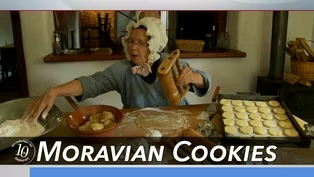
Clip: S10 Ep2 | 8m 2s | Mrs. Hanes Moravian Cookies is a family owned company making moravian cookies here in NC. (8m 2s)

Video has Closed Captions
Clip: S10 Ep2 | 3m 47s | Wheels Through Time in Maggie Valley is a museum featuring rare and vintage motorcycles. (3m 47s)

Video has Closed Captions
Clip: S10 Ep2 | 5m 15s | St. Matthew Catholic Church in Ballantyne holds its 20th annual World Hunger Drive. (5m 15s)
Providing Support for PBS.org
Learn Moreabout PBS online sponsorship
- News and Public Affairs

Top journalists deliver compelling original analysis of the hour's headlines.

- News and Public Affairs

FRONTLINE is investigative journalism that questions, explains and changes our world.












Support for PBS provided by:
Carolina Impact is a local public television program presented by PBS Charlotte