
Carpet Booth Studios
Clip: Season 17 Episode 13 | 13m 25sVideo has Closed Captions
Carpet Booth Studios is a recording and production studio near Rochester founded by Zach Zurn.
Carpet Booth Studios is a recording and production studio near Rochester founded by Zach Zurn in 2017. Driven by a lifelong passion for music and production, Zurn built the studio with the belief that artists do not need to live on the East or West Coast to succeed in the music industry.
Problems playing video? | Closed Captioning Feedback
Problems playing video? | Closed Captioning Feedback
Postcards is a local public television program presented by Pioneer PBS
Production sponsorship is provided by contributions from the voters of Minnesota through a legislative appropriation from the Arts and Cultural Heritage Fund, Explore Alexandria Tourism, Shalom Hill Farm, West Central...
Support provided by:


Carpet Booth Studios
Clip: Season 17 Episode 13 | 13m 25sVideo has Closed Captions
Carpet Booth Studios is a recording and production studio near Rochester founded by Zach Zurn in 2017. Driven by a lifelong passion for music and production, Zurn built the studio with the belief that artists do not need to live on the East or West Coast to succeed in the music industry.
Problems playing video? | Closed Captioning Feedback
Where to Watch Postcards
Postcards is available to stream on pbs.org and the PBS app.
Providing Support for PBS.org
Learn Moreabout PBS online sponsorship- Welcome to Carpet Booth Studios.
Come on in.
Yeah, my name's Zach Zurn and I'm a producer and the owner of Carpet Booth Studios, which is a recording and production studio in Rochester, Minnesota.
Cool, so we got two levels up at Carpet Booth.
Downstairs, I'll show you first.
We have this big lounge, full kitchen and a couple bedrooms for artists that are from out of town.
I fell in love with music at a really young age.
Growing up in Texas, we had magnet schools and I went to one with the fine arts emphasis.
There was a moment in about fifth grade where we got to have somebody come show us how these little cassette tape recorders worked.
And I got to layer kind of like four tracks on top of each other.
And at that point I kind of fell in love with the idea that, oh, I could manipulate audio and take these little silly songs I'm writing around the house and capture them.
And that kind of set my trajectory towards the goal to make records one day.
Got a couple bedrooms in here that folks stay in.
- [Producer] You Got puzzles.
- Yep, we got puzzles.
We try to do that.
This one's too big.
We bit off more than we could chew I think.
And then we've got a studio B here.
So it's our second studio.
It's a much smaller kind of simpler studio, but for the budget conscious or kind of beginner to intermediate musician, this is where they may work with my other engineers on the team and our interns and such.
And then we keep this great sounding vocal booth and just isolation booth down here in Studio B as well.
And then we can head back upstairs.
When I started Carpet Booth in 2017, it kind of all happened by accident.
I had moved to Rochester the year before and needed space for me to do some mixing and some writing and some production.
And it snowballed slowly but surely into what Carpet Booth is.
And so I outgrew that initial space pretty quickly and after a search stumbled across this former church building, which was kind of in the industry a dream for any engineer and producer.
'Cause there's a built-in acoustics and it's a large space, obviously I'm biased that the space is really cool.
And speaking of that, this is our lobby for upstairs.
We've got this really cool big mural painted by a really cool late muralist and tattoo artist named Luke Austin.
He did an amazing job on this.
And this leads us into Studio A, which is our kind of our main flagship studio.
And here's some Polaroids of a bunch of folks that we've worked with over the years.
And then, yeah, this enters into studio A. And so in here you can see a bunch of the vinyls of records that we've worked on, some of our certifications for projects that have had some industry success.
And it leads us into the control room here.
The roles I've played in the music industry have been pretty diverse.
You know, for the last several years it's been really focused on being a songwriter and a producer and an audio engineer as well.
And so that's, you know, in layman's terms, just helping a band or an artist make their record and capturing the sounds, mixing it, providing creative vision.
But yeah, I've also played in bands.
I played in a indie rock band called Author for about seven years and I decided to leave that band last year just to be able to focus on making records with other people, which I love.
This is a cool trio led by a guy named Mike Munson outta Winona.
When it comes to the final product of what you hear on a released song or record, there is a lot of kind of undercover work that goes into that.
Whether that's reverbs, which is kind of like an ambulation of a physical space, or there's kind of extra textures with like a synth or some sort of keyboard that's really tucked in to the mix.
And that can kind of provide some depth to the sound.
One thing I'll say pretty often is, this element that I want to add is gonna be more felt than heard, you know, and it's when you mute it or you take it away, that's really when you start to think, I did not know we needed that or I wasn't even cognizant it was there, but now that it's gone, this feels boring or doesn't feel as inspiring or emotional.
And those are the kind of things that with my nerdy brain and my music obsessed brain that get me really hyped and excited to do these things that you might only pick up on, on the third, fourth, fifth lesson, little Easter eggs.
(gentle music) And when we had this designed and built out, we worked with a studio designer and I really just asked him to help me design the rooms according to the workflow I wanted to work with.
And so I wanted to be able to sit at the console, look out into the live room, which is the large tracking room, and then also have an ISO booth on my left in my right.
And all the rooms are treated with different types of treatments to get different sounds within the rooms.
ISO West has these wood chunks when sound kind of bounces around this room, it hits the random angles and kind of evenly disperses.
And so it creates just a really nice balance of a brighter, more vibrant room.
It's not super, super dead or anything, But then our carpet booth over here is just a shag carpet from floor to ceiling and so it doesn't disperse as much.
It kind of just gets absorbed into the walls.
And then the live room, for example, a large open room has a natural room reverb, a room decay to it.
Yeah, so part of my role as a producer is to ideally know the space I'm working in really well.
One of the luxuries and benefits to me having an amount of space is I know how every corner of every room kind of responds to sound and performances.
(gentle guitar chords) One thing I find really unique and that I'm really grateful for is being able to work and live in Minnesota.
I feel pretty strongly that I'm able to rave highly about Minnesota because Minnesota is one of these states that respects and prioritizes the arts, especially comparatively to other places.
It is genuinely from my experience, one of the best spots to be a creative individual that is endeavoring to do their creative medium professionally.
And you know, with most people in my position, if you think of kind of the big names or the big dogs, they're living in LA, Nashville, New York.
But most of the work, the vast majority of the work I do is right here in my studio in Rochester, Minnesota of all places.
And I'm lucky enough to have people willing to travel here to work with me and my team.
And in this space I am in love with the fact that I get to work on some like really top 40 style pop one day and hip hop.
And then the next day I'm working on some punk band that you know, has five people show up to their shows.
But it's just the coolest thrashist stuff and anywhere in between, you know?
One other quirky thing that a lot of people you know point out about our space is all the different gnomes.
We have, I think over 50 gnomes in the studio and it started with one specific one right here that I got from my grandma who passed away when I was young.
And so this gnome has always kind of sat next to my production computer on my production desk for as since I was like 11 or 12 or whatever.
And then when I was in tour, I was on tour with my band in Europe in 2019 and found this really cool gnome in Freiburg, Germany and thought, you know, this guy needed a little buddy.
Yeah, I guess I'm a gnome collector now, which is crazy to say out loud, but there's a lot of them around here.
There's a cool Paul Bunyan one from Minnesota.
Skeleton guy.
Great, so I'll take you down the hallway here into the rest of the space.
And so this is the live room, which is the largest room that we have in our space here.
And most of the time we'll have a full band recording all at once in here.
And then it leads into some other isolation booths over here.
And so we have a traditionally treated ISO booth here.
It's kind of just a auxiliary room.
And then on the other side, this is a baptismal tub that was in the church.
And so if you were to step in here and you know, do a vocal performance or put some amplifiers in here or microphones during a drum recording, it's a wild kind of pingy sound.
One of my parents was a pastor in this small denomination.
I guess it is kind of intriguing that I've returned back to my roots in a way of working in a church building.
That is one thing about this space that I really enjoy and I kind of prioritize is, although this is no longer, you know, a congregational meeting place, I love to keep church candles and old hymnals and even the original Marion Church of Christ brick sign out front to be able to commemorate like what the past was and what the history of this building was.
It's just important to me.
And yeah, super, super cool.
This old fiberglass is such a unique surface for sound to kind of bounce around inside.
Alrighty.
So we'll show you just a couple more things here.
We try to keep a lot of unique instruments around the studio.
This was actually used in a classroom, you know, so that the teacher could kind of see which notes somebody's playing.
(gentle piano music) Yeah, so lots of keys, lots of drums, lots of amps.
And then this is the actual carpet booth.
So when I was in high school, we had a closet in my parents' basement.
We went to one of the local carpet stores here and stole a bunch of carpet scraps out of the dumpster and nailed them up and tacked them up inside of this little tiny closet.
And so I needed a name and it felt like I could kind of pay homage to my origins by doing it that way.
So when we decided to build this spot, we thought we might as well have something similar to what I used to have.
And this is a nicer version of what I used to have, but it's a great room and obviously you can see right into the control room.
But yeah, that's mainly, that's our studio A and that's Carpet Booth up and downstairs.
(gentle music) This whole studio ends up being one of the most vulnerable emotionally open spaces I've ever been in because some songs are about losing a brother, you know, or you know, loss of love or the joys of, you know, a summer or whatever it may be.
And so we get to have extremely deep conversations here where it gets really real and it kind of expedites the relationship growth as well with the artists I work with where sometimes I'm only with this artist for a week or two, but they leave and it's as if we had spent a whole summer together sharing stories and experiences and pretty raw and real sometimes.
And so how does music make me feel?
It makes me feel everything.
I know that's kind of corny, but I'm very thankful for the experiences music has given me to kind of grow as a person as well.
(gentle music)
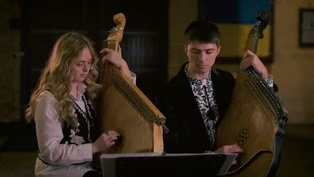
Video has Closed Captions
Clip: S17 Ep13 | 5m 26s | Meet Angelika and Justin Mehes, Ukrainian siblings who perform as Bandura Duo. (5m 26s)
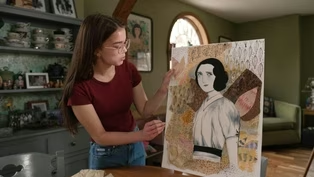
Carpet Booth Studios, Evelyn Johnson, and the Bandura Duo
Preview: S17 Ep13 | 40s | Audio engineer Zach Zurn works at Carpet Booth Studios and Evelyn Johnson's art honors people. (40s)
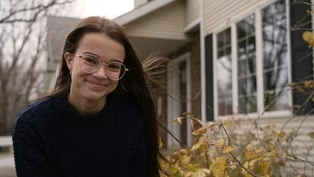
Video has Closed Captions
Clip: S17 Ep13 | 10m 20s | Meet 18-year-old artist Evelyn Johnson of Willmar who creates expressive portraits of women. (10m 20s)
Providing Support for PBS.org
Learn Moreabout PBS online sponsorship New Episode
- Arts and Music

Innovative musicians from every genre perform live in the longest-running music series.
 New Season







 New Episode
 New Episode

Support for PBS provided by:
Postcards is a local public television program presented by Pioneer PBS
Production sponsorship is provided by contributions from the voters of Minnesota through a legislative appropriation from the Arts and Cultural Heritage Fund, Explore Alexandria Tourism, Shalom Hill Farm, West Central...