Un-Wine'd
Casanel Vineyards & Winery: Norton Grape
Season 3 Episode 4 | 26m 47sVideo has Closed Captions
America's oldest wine-producing native, the Norton Grape, is making a comeback.
America's oldest wine-producing native, the Norton Grape, is making a comeback at Casanel Vineyards & Winery. Un-Wine'd host Tassie Pippert selects three wines to pair with recipes: Cheese Log with Sweet Pickle, Beef Roulade with Cream Sauce, Flourless Chocolate Cake.
Problems playing video? | Closed Captioning Feedback
Problems playing video? | Closed Captioning Feedback
Un-Wine'd is a local public television program presented by VPM
Un-Wine'd
Casanel Vineyards & Winery: Norton Grape
Season 3 Episode 4 | 26m 47sVideo has Closed Captions
America's oldest wine-producing native, the Norton Grape, is making a comeback at Casanel Vineyards & Winery. Un-Wine'd host Tassie Pippert selects three wines to pair with recipes: Cheese Log with Sweet Pickle, Beef Roulade with Cream Sauce, Flourless Chocolate Cake.
Problems playing video? | Closed Captioning Feedback
How to Watch Un-Wine'd
Un-Wine'd is available to stream on pbs.org and the free PBS App, available on iPhone, Apple TV, Android TV, Android smartphones, Amazon Fire TV, Amazon Fire Tablet, Roku, Samsung Smart TV, and Vizio.
Providing Support for PBS.org
Learn Moreabout PBS online sponsorship>>On today's show, we'll visit with Katie and Nelson at Casanell Vineyards.
We will pair up some amazing food with some of their delicious wines.
So go grab that glass.
It's always time to "Un-wine'd."
>>Production funding for "Un-wine'd" was made possible in part by.
(gentle jazzy music) (upbeat jazzy music) >>So today we'll visit with Katie and Nelson and talk about their amazing Norton wines.
(upbeat jazzy music) Norton really came to its own when it was featured at the World's Fair and won the top prize, way back when.
Since then Norton has come a long way, and Katie and Nelson really have a great way of growing those grapes and producing amazing wines with delicious food, including this cheese log that's made with sweet pickle in the center.
Don't forget that N Squared, that beautiful Norton, that will pair up with a lovely beef roulade.
And then the Full Nelson, deserves this gorgeous flour-less cake.
So go grab your glass, let's head to the kitchen, and we'll make some delicious food.
(upbeat jazzy music) So Norton grapes are the focus of today.
And the first one we're going to talk about is a sparkling Norton wine.
And it goes great with these traditional Virginia flavors.
So country ham, a little bit of sweet pickle, peanuts.
I hope you will love it with this wine.
So what we're gonna do is start off with eight ounces of cream cheese in our food processor.
I want to add a little bit of Dijon mustard.
Oh, a teaspoon to a teaspoon and a half.
You can even go two teaspoons if you like the flavor.
I'm gonna go about a teaspoon and a half on this.
And then I wanna add just a little bit of Tabasco or your favorite hot sauce.
About four drops will do it.
And a little bit of cayenne.
You know, me, I love my spice.
So I'm gonna use between a quarter teaspoon and a half teaspoon.
Again, based on what you personally like.
Now let's take a little salt and pepper and just throw in there.
I like, oh, about a half teaspoon of salt and pepper mixed.
And then I'll go back and check it and make sure I have enough at the end.
We're just gonna process this for a second.
All right, that's nice and smooth and creamy.
Let's just scrape it down.
Make sure it's all mixed together.
Yeah, one more little hit on that will be perfect.
The next thing I wanna do is take all of these great flavors.
I'm gonna take a little bit of lemon juice.
The juice of about a half lemon works great.
Make sure you catch those seeds as it goes in.
And I like to put this in first, so it's not on top of all of my other fillings.
It's kind of in the cream cheese part, but also it's not mixed through all the way.
I want to kinda get a little brightness occasionally in this cheese log.
(upbeat music) Now I have everything chopped up.
I've got my pickle cut 'em in slices.
What I've done here, I've taken the ends off of four pickles because I'm gonna use that straight to the center for my log and a little bit of scallion and some parsley.
Oops, got a little drops there.
That's okay.
And I just wanna pulse this through.
Mmm.
One more pulse.
There we go.
That'll do it.
Now, the next thing we wanna do is to put this on some wax paper.
And wax paper really works best for this, unless you're using it as a ball.
You can always use this as a cheeseball and just put it onto a plate and sort of form it.
But I really like to do the cheese log because it's pretty, it looks a little bit different, and I can add that sweet pickle to the center that then continues to season this log.
And also this really freezes well.
So if you wanna do this for the holidays, you can do it in advance.
Just stick it in the freezer.
It's wonderful.
All right, so let's just spread this out, and I want a little rectangle here on my wax paper.
I just wanna spread that out.
You can use your spatula or you can use an icing spatula, which is what I'm using right here.
Just makes it easier for me.
And we're gonna press it out, oh, three quarters of an inch or so thick.
There we go.
I kinda like to make it squared up a little bit so that as I roll it, it's not thicker in one place than in the other.
And then I wanna take those great pickles and just kinda put down the center.
You'll see what I'm doing here in a second.
Cheat them a little bit toward you so that as you roll then you're getting them right into the center.
There we go.
Just kind of pull back, then pull forward a little bit.
And then you wanna roll that up.
Now stick this in the refrigerator for about an hour and then put your peanuts on another piece of wax paper, roll this right through, and then you can store it in the refrigerator for up to a week and in the freezer for up to two months.
Now we're going to serve this with Red Spark, this delicious Casanel Norton Sparkling.
Now this is aged on the lees.
It's brute, so it's really dry.
Now, anytime you're taking that little cage off of your sparkling, six twists exactly is what takes off the cage wire.
Now let's just pour this beautiful sparkling Casanel.
This is really an acidic wine.
It's fun to work with Norton, because Norton doesn't have a lot of tannic acid to it, but it has tremendous citric acid to it.
So it's just really, really nice, really nice malic acid.
So as you taste this, this beautiful acidic wine with this extremely creamy cheese, it just comes together so beautifully.
(upbeat whimsical music) So I'm here at this beautiful winery called Casanel in Leesburg, Virginia, and I'm joined by Katie Henley, who is the winemaker here.
And Katie, you do some amazing things with Norton, and I can't wait to have you tell us a little bit about your grapes.
>>Thank you very much, Tassie.
It's an honor to be on this show.
We've been long time watchers of the show.
So it's always fun to have a chance to speak about what Virginia can do, especially in a regional setting, and kind of explain where we come from.
So very happy to talk to you about all things Norton, all things, Virginia.
>>I love it.
Well, whatever possessed you to plant so much Norton?
>>I guess if you wanna blame somebody, I would definitely play my father, and of course Jenny McCloud from Chrysalis.
If you know, Jenny, if you know Chrysalis, she is the Norton guru.
She's the one who really brought Norton back and kind of gave it a place in Virginia history, especially in a wine sense.
So very happy to have her on our team and definitely being supportive about growing Norton and showcasing it right up there with the viniferas, like Cabernet Sauvignon and Petit Verdot.
It does deserve a shot, a chance.
>>It's amazing.
And you not only do it one way.
So we've got the still wine here, the N Squared, but you also really take advantage of the Norton grape and create some interesting profiles in other ways.
>>It's very versatile.
If you've ever grown Norton, it's very, let's just say a little bit easier to grow than your favorite viniferas like Chardonnay and Cabernet Sauvignon, et cetera.
But for Norton, if you know the history of Norton, it is a native species, it's a cultivar of aestivalis, of Vitis aestivalis.
So it's kind of built for this weather.
It's built for humidity and freak rainstorms and overcast weather.
(Katie laughing) As we usually have in Virginia.
But it's just, it's kind of a survivor.
It's always the first one to kind of ripen and come in right where you need it to be.
Whereas sometimes the vinifera lags a little bit behind, and it's a little bit harder to get better numbers from the vinifera, but yes.
We do have kind of a different approach in our portfolio.
We make two different sparklings, one that's a little sweeter, one, that's a little dryer.
the N Squared, which is our still red wine Norton.
We actually do a barrel fermentation, which is kind of fun, on that.
And then we also make the port style Norton, which is one of our specialties.
The Full Nelson.
>>I love that.
I love the way that you've named these wines.
>>So I was kind of mentioning that to you before we started rolling.
And one of the things that I grew up doing in the wine industry was working behind the bar.
I wasn't always making the wine.
I kinda started as the dishwasher.
I was the crystal technician for lack of a better word.
So being a little bit younger, starting around 17, 18, I was not as well versed as some of these very storied tasting rooms.
You know, Barbersville, things like that.
So when I started talking about wine it was very much kind of down to earth and slide the tasting sheet.
What do you think about it?
And one of the things I learned about Norton is that it's very love hate.
Either you love it or you hate it.
And people are very vocal about that.
So in a marketing sense, I kind of figured if we're gonna be doing Nortons, let's give them a unique name, something special.
Casanel's actually named Casey and Nelson, after my parents.
So a little combination.
So we figured let's give it a unique name and then see if people can figure out if it is Norton or not.
And then let them be the judge, unbiased.
>>I love it.
I love that.
And then you also create different variety of varietals.
So with the sparkling and then with the port, and it's just fascinating to me to do a tasting just of the Norton and see the variation that you have there.
It's again, I think it kinda comes with the territory.
With everything going on in the world today, you're always trying to figure out what can we do next?
What can we do sustainably?
What can we do to better the environment?
And one of the things about Norton is you don't really have to spray it.
It's kinda set it and forget it.
It's also pretty zombie proof, again, with the rain.
In 2015 we had Hurricane Joaquin, dumped buckets of rain on us for two days.
The only thing we could really salvage was the Norton at that point.
It came in at like 24 bricks, regardless of the rain.
So it's kind of that little silver bullet you need in your portfolio.
But what happens is a lot of people just treat it like a hybrid.
They just kinda, whatever, it's not the star of the show.
It's not cab sav, it's not Petit Verdot.
Then it becomes lost.
So what we do at Casanel is every wine is individually made, but it's also made within the grouping.
So we have to figure out what kind of Norton is dad gonna drink?
What kind of Norton is mom gonna drink?
What kind of Norton am I gonna drink?
And then you start to look at your demographics.
And some people really like sweet wine.
Some people really like dry wine.
And it's just, again, that versatility of being able to kind of take this grape, make it four different ways, but make it in a way that it appeals to everybody, which is the accessibility of wine.
>>Well, that is incredible.
And what you do with it, from vine to glass- >>Thank you.
>>Is incredible.
>>I have a lot of help, Tassie.
I have a lot of help.
(laughing) >>Well, to you, Katie, it's amazing.
>>Thank you very much, cheers, cheers.
>>I love a beef roulade with this lovely N Squared.
It is an incredible Norton.
And I hope you'll like this recipe with it.
Now to get started I want to take about a quarter inch of the skin off of a zucchini.
Or you can just core it out.
However you wanna do it.
Whatever's easy for you.
And then I wanna make some strips, because I'm gonna use these as filler for my beef.
So just some nice little strips, oh, about quarter inch to a half an inch wide.
You don't want them too big, because if you have them too big your meat will get too dry before they are ready.
And then I wanna take a little bit of carrot.
And for this, I'm going to do more of a smaller julienne for this because the carrot is hard and it takes a little while for it to be ready.
So more like strips kinda like this, like a really super skinny French fry.
And then I wanna take a little bit of onion.
And for this, I want to go kind of from North Pole to South Pole, I cut from the top to the bottom.
And then I wanna just make a couple of wedges like this so that they're not slices, but they're little wedge pieces.
So let's talk a little bit about our beef.
This is a London broil, and it's about three pounds.
Now from this, you'll be able to serve at least six, probably eight people.
Just depends on how big you want these rolls to be and how big your servings you want.
So what I did was I have a little slicer here at home and I wanna slice the beef, not down slicing like this, like you'd serve it, but I want a nice big piece of beef that I can then lay out and stuff.
So I have some meat here and that's what we're gonna do.
So you wanna lay that meat out flat like this so it can get all of your filling.
And then what I wanna do is spread it with just a little bit of Dijon mustard.
Not a whole lot.
You just wanna give it a little bit of flavor.
And this is just the perfect little bite to it.
Now in your recipe, you'll see that the Dijon is divided.
That's because everything that's left, after I've spread my beef, is going to go in my sauce.
So just spread like this.
Oh, about halfway to two thirds from bottom to top.
After you've got it sprinkled really well with salt and pepper, and remember you want this light, you've got a lot of flavors going on here, and then you're going to have a sauce as well.
I'm going to sprinkle it a little more liberally with some smoked paprika.
And I love this flavor.
It really makes the wine pop.
And it's just right For this recipe.
And just put a little bit of that bacon right on there.
This is another really important flavor.
And you're going to use probably two slices of bacon for five to six pieces.
And then you're gonna use a little bit more in your sauce.
So this has great bacon smoky flavor.
Now here's where those vegetables come in, and they're delicious.
First I wanna use some spinach.
So I'm gonna take some leaf spinach, just some baby spinach here, and I'm gonna spread that out, starting in the middle.
Okay, so we've got our spinach on.
We've got our bacon, our mustard, and our delicious smoked paprika, along with just a little bit of salt and pepper.
And now I wanna add some of our vegetables.
So let's just go through and add a piece of carrot or two at the end of every one.
A piece of zucchini.
And I actually like to kind of overfill mine.
I like more vegetable than less.
So I'll go back and put a little more.
And the last flavor component I want is a little bit of artichoke.
I love the artichoke with this.
And the artichoke is always so difficult to pair with a wine.
But with this one, it's just perfect.
And you only get a little bit of that artichoke flavor, but it's just enough that really enhances the wine.
And now we roll.
So starting at that end, where you put all those vegetables, just start to roll this up, and they're gorgeous, just like this.
Now I'm gonna pop these on a cookie sheet that's been sprayed with a non-stick release, and then I'll bake them at 325 degrees for about 20 to 25 minutes.
You don't want to over bake because you don't wanna dry out the beef on the outside.
If you really like a braised beef and you want it to go longer, then put a cup of red wine and a cup of beef stock in a little deeper pan.
Let these braise after they've baked for about 10 minutes, then pour that over it, let them braise for about a half an hour.
There'll be fabulous.
(upbeat jazzy music) So here's this beautiful roulade.
It is so delicious.
And I made a scrumptious cream sauce for on it.
And we're going to serve this with the N Squared.
This is so good.
It is silky, velvety.
It's just an amazing Norton.
You would not know that you were drinking Norton.
If you're not a Norton fan, try this one.
If you are a Norton fan, you'll love this one.
It's absolutely incredible.
Aged 22 months on neutral French Oak.
Delish.
(upbeat jazzy music) There's nothing quite like chocolate with this Full Nelson port style Norton.
It is absolutely delicious, with a flowerless chocolate cake that I'm going to make for you right now.
So we've started off with 12 ounces of chocolate chips, and you can use a bittersweet chocolate chip.
That works best.
So bittersweet is usually 60 to 65%.
And then I wanna just put that in my bowl.
Now to that I added a quarter cup of butter.
So it all melted together.
Now with my mixer on, I want to add a cup of sugar.
Now this is a great recipe that you can create with regular sugar, monk fruit sugar, if you like.
So it's adaptable.
No flour in it.
So it's pretty much no fail.
One egg at a time, five eggs at room temperature.
Now, remember anytime you're using eggs you wanna do these one at a time, and I'm trying to incorporate each egg separately.
So one at a time, give it a little time so that it mixes through thoroughly.
Now, the next thing I wanna add is about a quarter teaspoon of salt.
You don't need a lot of salt in this, but you do need the salt to just bring out that real great cocoa flavor and about a teaspoon of vanilla.
Now I wanna turn my mixer up to a medium high and let it mix for about three minutes until this is really silky smooth.
So I have a pan that I've buttered.
This is a nine-inch cake pan, and I have a round disc of parchment paper.
What I wanna do is just put my pan right down in the center.
And I made the parchment disc, oh two, two and a half inches bigger than the pan itself.
There we go.
And I can kind of see my lines.
If you can't see your lines, go back and just give it another little swipe, and just cut this in wedges.
Just to line.
Don't go past the line, but just sort of like a little flower.
All the way around.
And I usually make these about an inch and a half apart at the circle.
So just cut down to the circle.
Don't go any farther.
Now, let's just go around and fold those in.
One overlapping the next.
Now, do you have to go to all this trouble?
No, actually you can use a disc in the bottom, and you can use a thin strip around the edge, but this really works best, and it keeps your cake from sticking on the edges.
So then just lay that right down in your cake pan and then lift that side up.
Because you've already buttered it, the strips will stick right to that butter.
Here we go.
So all the way up the sides of the pan.
And if it's not sticking, you can stick a little butter in between.
There we go.
It won't hurt your cake at all.
Now let's take a little bit of our softened butter, about a tablespoon, and just rub that all the way around.
Make sure that you press out any little lumps and bumps from your paper so that you have a nice smooth cake bottom and sides.
Be sure you get all of it because we're gonna put a little bit of cocoa powder on it.
And if we don't get it all, we have to go back and fix those little spots.
Now, the last thing I wanna do is to take a couple tablespoons of our nice cocoa powder and put that in the bottom of the pan.
Let's tip it all the way around so that we get all of the bottom, and then over a sink or a trashcan you just want to go around the edges.
There we go.
Now we have all of that excess out.
Now we still have our beautiful cake going and I'm going to add a little bit of cocoa powder to that.
All right, we've got that nicely mixed in.
And now we're ready to put our cake in the pan.
Now this is a really thick, rich batter.
It almost looks like brownies.
The key to this cake, once it's all done and you have the glaze on it, make sure you cool it, but don't chill it all the way before you cut it.
Because this is a flour-less cake with that wonderful ganash topping, it tends to crack as you cut it if it's too cold.
So always make sure you cut it at room temperature.
And I just suggest cutting it before you ever chill it.
Now this cake is ready to go into the oven, preheated at 300 degrees for about 40 minutes.
It's going to be really soft when it comes out.
Don't be alarmed.
Don't over bake.
Once it comes out, I'm going to take another six ounces of chocolate chips, another three tablespoons of butter, and four tablespoons of heavy whipping cream, and I'll melt that in the microwave for about 30 seconds, stir it, and then continue to melt 15 seconds at a time, and I'll top it.
And I'll show you what it looks like at the end.
It's an incredible cake you won't wanna miss out on.
(gentle music) So you can see this beautiful ganache on top of the cake.
Just let the cake cool.
Put that warm ganache on top and then let it all cool down before you slice it.
And I love to serve mine with a little bit of whipped cream and some raspberries.
But most of all, I love to serve it with the Full Nelson right here from Casanel.
This is an incredible wine.
It is just one of the best dessert wines I've ever had.
It's rich, it's creamy, it's velvety.
It goes perfectly with this dessert, and I hope you'll enjoy it.
(light jazzy music) So Nelson and Katie, thanks so much for a delightful time at Casanel.
I love the architecture, I love the wine, and I loved the company.
So from this delicious spark, which is full of acidity and just great flavor to this delicious N Squared silky smooth, wonderful Norton, to this amazing dessert wine, the Full Nelson, I hope you enjoy all of the recipes I prepared with these wines.
And until next time, go grab that glass.
It's time to "Un-wine'd."
>>Production funding for "Un-wine'd" was made possible in part by.
(gentle jazzy music)
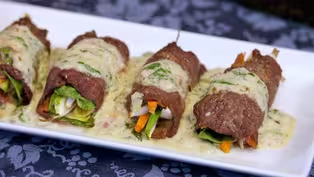
Beef Roulade with Vegetables and Cream Sauce
Video has Closed Captions
Clip: S3 Ep4 | 5m 54s | Easy weekend dish, filled with vegetables, roulades can almost be meals in themselves. (5m 54s)
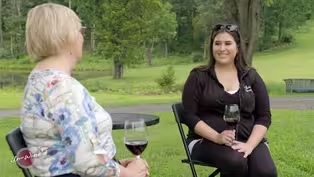
Casanel Vineyards and Winery Winemaker Katie Henley
Video has Closed Captions
Clip: S3 Ep4 | 5m 41s | Winemaker Katie Henley and her love of Norton grapes creates a huge array of Norton wines. (5m 41s)
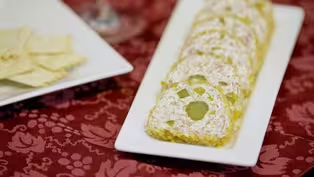
Cheese Log with Country Ham and Sweet Pickle
Video has Closed Captions
Clip: S3 Ep4 | 5m 48s | This cheese log is highlighted by pickles and the saltiness country ham & peanuts. (5m 48s)
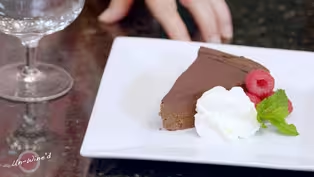
Flourless Chocolate Cake Made Easy
Video has Closed Captions
Clip: S3 Ep4 | 6m 25s | This flourless chocolate cake is rich and dense, perfect for any time. (6m 25s)
Providing Support for PBS.org
Learn Moreabout PBS online sponsorship

- Food
Christopher Kimball’s Milk Street Television
Transform home cooking with the editors of Christopher Kimball’s Milk Street Magazine.






Support for PBS provided by:
Un-Wine'd is a local public television program presented by VPM