
Celebrating AAPI Heritage Month: “Food Roots,” Asian American Identity, Japanese Incarceration
Season 10 Episode 45 | 26m 46sVideo has Closed Captions
One Detroit is celebrating Asian American and Pacific Islander Heritage Month.
In celebration of Asian American and Pacific Islander Heritage Month, we’ll preview the PBS documentary, “Food Roots,” which focuses on the culinary heritage of the Philippines and sit down with the restaurateur featured in the film, Billy Dec. Also, we’ll feature a couple’s story about navigating life in Michigan after immigrating from South Korea and Taiwan. Plus, a local Japanese American man
Problems playing video? | Closed Captioning Feedback
Problems playing video? | Closed Captioning Feedback
One Detroit is a local public television program presented by Detroit PBS
Celebrating AAPI Heritage Month: “Food Roots,” Asian American Identity, Japanese Incarceration
Season 10 Episode 45 | 26m 46sVideo has Closed Captions
In celebration of Asian American and Pacific Islander Heritage Month, we’ll preview the PBS documentary, “Food Roots,” which focuses on the culinary heritage of the Philippines and sit down with the restaurateur featured in the film, Billy Dec. Also, we’ll feature a couple’s story about navigating life in Michigan after immigrating from South Korea and Taiwan. Plus, a local Japanese American man
Problems playing video? | Closed Captioning Feedback
Where to Watch One Detroit
One Detroit is available to stream on pbs.org and the PBS app.
Providing Support for PBS.org
Learn Moreabout PBS online sponsorship- Coming up on "One Detroit," we're celebrating Asian American and Pacific Islander Heritage Month.
We'll preview the PBS documentary, "Food Roots," which focuses on the culture and culinary heritage of the Philippines.
Plus we'll talk with the restaurateur featured in the film, Billy Dec.
Also ahead, a couple talk about navigating life in Michigan after immigrating from South Korea and Taiwan.
And a local Japanese American shares his memories of learning about the Japanese incarceration.
It's all coming up next on "One Detroit."
- [Announcer 1] Across our Masco family of companies, our goal is to deliver better living possibilities and make positive changes in the neighborhoods where we live, work, and do business.
Masco, a Michigan company since 1929.
Support also provided by the Cynthia & Edsel Ford Fund for Journalism at Detroit PBS.
- [Announcer 2] The DTE Foundation is a proud sponsor of Detroit PBS.
Through our giving, we are committed to meeting the needs of the communities we serve statewide, to help ensure a bright and thriving future for all.
Learn more at DTEFoundation.com.
- [Announcer 1] Nissan Foundation, and viewers like you.
(light upbeat music) - Just ahead on "One Detroit."
May is Asian American and Pacific Islander Heritage Month.
We'll hear from an Ypsilanti couple about the challenges and culture shock they experienced after moving to the United States from East Asia.
And a local man talks about growing up in Ann Arbor as a second generation Japanese American.
But first up, Detroit PBS will premiere the documentary "Food Roots" on Wednesday, May 13th at 5:00 PM.
The film follows restaurateur Billy Dec as he travels to his mother's native Philippines to explore his family's traditional recipes and reconnect with his Filipino heritage.
"One Detroit's" Chris Jordan spoke with Dec about the documentary, the importance of food in Filipino culture, and his new downtown Detroit restaurant, Sunda New Asian.
Here's a preview of "Food Roots" followed by the conversation with Billy Dec.
- Billy Dec.
- Billy Dec.
- We love you.
- We love you.
- You don't know where you're going unless you know where you're from.
I booked a flight to the Philippines.
This is sort of going back in time.
You said this is a secret recipe?
- [Elder] Hmm-mm.
- [Billy] Where are the family recipes?
Amazing herbs, plants, fruit.
But I always felt guilty that I never learned these things, especially being a restaurateur who serves Filipino food.
(upbeat dramatic music) - Tell me about the documentary, about "Food Roots."
- Yeah, you know, it started just completely organic in a really unique way.
I always loved the food that my lola, who's grandma in the Philippines, raised us on.
But, you know, as we grew up going back and forth to the Philippines or just growing up in a household with Filipino food cooked 24/7 and Tagalog spoken, I began to push away from it.
When I was in middle school, high school, there was a lot of bullying and other things, pressures to make you fit in.
Today, it's a little different, which I love.
But back then, it was a little tough.
And as I kind of, you know, grew up and tried to make it in the world where everyone says, you know, go to college, go to law school, or go to go to Harvard, get on TV, or act, or work for the White House like I was, I did all that.
I was trying to do all those things, but I still wasn't happy.
And in my mind, I just knew that I always wanted to go back to the Philippines to learn those recipes that I wasn't ever there for.
You had to be present.
They're not written down, they're story.
And so, one day, two of my last three elders died on the same day, and I dropped everything 'cause I only, I knew there was one last remaining elder of that generation, and I just went to go search that out.
And I actually asked these shooters and editors, could they come with me so that I wasn't writing things down, I wasn't consumed with documenting.
I just wanted to be present and they could capture it.
And who but a Detroit native, Doug Blush, who's a three-time Oscar-winning executive producer and editor, saw the footage, and he was like, "We can make something really wonderful about this."
Especially with this new director who's an Emmy-winning Filipino director named Michele Josue, that had done Matthew Shepherd's "A Friend of Mine," and "Happy Jail "and some other really wonderful things.
They were like, "Listen, there's something going on that you're not talking about as we look at this footage, there's something you're skating around."
And it was just that they had saw some things I'd been wrestling with from, you know, family and emotion and darkness and you know, things lost.
And they said, they started talking to me and my chef and my sister, you know, my family, and captured all of this story that starts with food, but then it dives down to your roots, your culture, your heritage, your story, your lineage, your identity.
They're just a master storytellers and they knew how to take what was really there and create something meaningful for all.
And then we went on the film fest kind of tour because we wanted to get it to communities.
We didn't wanna just put it out there and then it would be over because we felt like there was discussion that needed to happen, especially with respect to identity, mental illness, other challenges.
People were laughing and crying and course hungry afterwards.
But, like, it was a human story.
It was a story that maybe people needed to see and hear and feel.
- Your newest restaurant is the Detroit location of Sunda, which has just recently opened.
Why did you end up picking Detroit as the new location for Sunda?
- The foundation really is that so many Michigan folks have been in Chicago for good portions of their lives.
And then so many went back to Detroit or the suburbs of Detroit especially.
And they were constantly hitting me up to tell me I needed to come to Detroit.
And again, I just always wanted to go to cities where I felt it was on the up and up.
Like, we get offers to go to New York, LA, Miami, Vegas, but there are other offerings there.
And we watched the data points of what we thought was gonna pop and Detroit was off the chart.
It was like, you know, all of the signs were there, the city was like us against everybody.
Everyone's supporting.
Everyone's so supportive.
I've lived there for like months building and getting it ready and training and I've just fallen in love with the city.
People couldn't be kinder.
And I love taking them on these explorations throughout Southeast Asia I grew up on, back and forth to the Philippines my entire life to visit family.
And you always stop in China and Japan, Thailand, Vietnam, Singapore, Laos, Cambodia, you name it.
And it's just cool to take them on that journey through the menu.
- How would you describe Filipino food and what makes it so unique as a cuisine?
- The most amazing, distinctive characteristic of Filipino food is that it's always evolving.
There's 7,641 islands in the Philippines.
And that has been, you know, influenced by so many different cultures and countries, whether, you know, it's Spain, or China, or Mexico, Japan, India, Malaysia, the US, Africa, you name it.
I think the Kamayan feast is like one of the best examples of a Filipino food experience because you're literally getting on a banana leaf-lined table.
Sometimes we do 'em on these tables behind me, the 40 foot table of banana leaf, and then all the procession, the chefs come out with all the, you know, dozen or so pieces that create this gigantic island feast.
But we also do it on a nice butcher block at your table customized with this big, of course, the foundation of the culture and the genre of food is the rice.
And then we put the crispy pot there, confit pork shank, my favorite right in the middle.
And then street food is really popular throughout Southeast Asia, especially in the Philippines.
And then, so you'll have like skewers of garlic, shrimp, and, you know, chicken inasal, and all of these, which is a great lemongrass achiote type grilling chicken that is one of my personal favorites.
And then you have longaniza, which is the sausage that you saw in the documentary as well.
And lumpia, this Chinese inspired lumpia Shanghai, which is this Chinese inspired Filipino egg roll with pork, shrimp, you know, vegetables, all the things that my lola used to make for us as afterschool snacks.
And it's just a feast.
And the story, again, it's all about story, was that when the Spanish, you know, occupied and colonized the Philippines for 400 plus years, one of the things that they did was they instituted that it was mandatory to use silverware.
And that was tough because the culture ate with their hands, like most of our ancestors did at some point.
And the Kamayan meal to this day is really special because you're usually having it with your friends and family.
Kamay means hand and we're eating with our hands, this Kamayan meal.
And it means from the stories that we're told that when the day ended and the doors closed, we could go back to the ways in which our ancestors ate on the banana leaf with our hands.
And so, very often in Detroit, I did this, the first day of training, 100 people from all different backgrounds throughout Michigan came together to be part of this concept called Sunda.
And what do we do?
We shut the doors, we close off the outside world and we say we are family now.
This is a trust moment where we're together and we will, once again, like our ancestors, doesn't matter where in the world you are from, be connected through food.
And it's a really special spiritual kind of cool thing that people can now enjoy at Sunda at their table.
- And you can see the extended version of Billy's interview at onedetroitpbs.org.
Let's turn now to our "One Detroit" AAPI story series.
We start with a conversation between an Ypsilanti couple who immigrated to the United States from South Korea and Taiwan, Kyunghee Kim and her husband, Leo Chen, have supported each other through challenges while chasing their dreams.
The couple reflect on their experiences navigating life in the United States, along with their memories around food and family relationships.
- How much of a culture shock was it for you?
So you mentioned coming couple days prior to Halloween, and then obviously coming from Korea when you were eight to Michigan of all places.
What was that like for you with school?
What was that like for you with just growing up without the diverse population of other Asians?
- It was shocking, you know, because my sister and I were not the only Asian American or Asians, but we were the only, I think minorities in our elementary school, at least, I don't recall middle and high, but definitely in elementary.
And so, it was really hard.
If it wasn't for my EL teacher, Ms.
Demiko I still remember her name till this day.
If it wasn't for Ms.
Demiko, and she was half Japanese, part Japanese, if it wasn't for her, I don't know how I would've survived, because somehow I learned English with her help.
She was with me in the classroom several hours a day.
And so, I picked up the language really quickly as kids do.
So language wasn't as hard as the culture because culture is the way that you move, the way that you speak, the way that you behave.
And those things, I think something that you can't, a teacher can't teach you in a notebook, right?
Like, you watch, you observe, you take in, you just kind of put the pieces together, you know, and think, "Okay, this is how I'm supposed to behave.
This is how I'm supposed to talk."
And so, that was the hardest for sure.
And my sister and I we were best friends and we just stuck by each other, you know?
And so, school was a terrifying place for us.
- Yeah.
Well, thank goodness for Mrs.
Demiko.
- Yes.
- Wherever she's at, you know?
- No, totally.
- Yeah.
So then that meant you spoke Korean at home, then?
- I spoke Korean at home because my parents knew that I would pick up English no matter what.
And they were so worried that I would forget Korean.
And so, I mean, I didn't like that for the longest time because I wanted to practice my English at home.
- Sure.
- With them.
But they said, "No, it's only Korean because you'll have plenty of opportunities to speak English."
But home is where, you know, we are Korean people still.
And I'm grateful because I can speak fluently, read and write still.
And it was because of my parents.
So they sacrificed their English, though.
- Yeah.
- Right?
So that we could keep the Korean at home and their English was only enough for them to run their dry cleaning business, literally just to get by.
But beyond that, you know, they didn't learn more because they just felt like my children need to, you know, have their Korean in them.
So did you speak like Taiwanese at home or English?
- So I grew up speaking with grandma, Taiwanese.
- Oh right.
- And when I came to the US, my parents, even though my dad spoke Taiwanese, my mom didn't.
So ended up losing Taiwanese dialect, which I'm really sad about.
But we spoke Mandarin Chinese at home and then at school spoke English.
And honestly, because I was so young, I don't remember if there was, like a someone like a Mrs.
Demiko in my life.
But somehow- - Oh you don't remember going to EL school?
Okay.
- Yeah, somehow I learned English.
- What were the years you were in Oklahoma?
- Oklahoma was 1985.
- Okay.
- To 1988.
- Okay.
Well, those are primitive years.
Like, five years old to eight-years-old.
- Yeah.
- Right?
- Yeah.
- Wow.
And so, how was school for you in those years?
Like elementary school, do you remember?
- I don't remember.
All I remember is this.
So my parents were, when they came over, they didn't bring very much money over, their parents didn't have very much money either.
So they came with suitcases and then maybe a few $100 and that was it.
And so I just remember staying in these kind of like section eight homes where it's subsidized, and basically, the closest grocery store was the gas station around the corner.
Other than that, just remember a lot of other families around that were international families.
So families from India or Korea or Japan.
- It's interesting when you say that, you know, where you guys were living in Oklahoma, that the section of homes that there were lots of international, primarily maybe international families and possibly there for the parents to study.
And you were kind of exposed to various cultures and languages even.
How did that make you feel as Asian?
Although, I don't know if you had those thoughts right, at that age, but do you remember feeling like, "Oh, there are all different cultures here.
This is a little bit different than where we were."
Do you remember feeling, I don't know, some sort of like solace, you know, with people that you were living near or still felt different?
- I think one of the things that was really impactful for me was food.
So the reason why I share that is because a lot of the different people that live in that, in those apartments, there's such a variety of ethnic foods that was available.
And I think early on that was something that I really took notice into is just that, you know, there's such a difference in the food that people eat, but in the sense of the togetherness, having that shared connection, food is just such a language that connects everyone together.
What about you?
What were some moments for you with food?
- With food?
So many moments.
I know when I talk about growing up in Utica, Michigan, it's a lot of stories of feeling isolated, feeling different, feeling small.
And while that is true, there were little moments of me feeling accepted.
So one of those moments is, you know, my neighborhood friend Rachel.
- Yeah.
- And so, you know, and she's white and her parents were wonderful.
They were the ones that drove my sister and I and Rachel to school every single morning, picked us up every afternoon 'cause our parents worked late every day.
So Rachel's mom or dad would always take us.
On the weekends, we would go each other's home 'cause my parents would work on Saturdays as well.
And I remember as a teenager, we were watching "Beverly Hills, 90210" sitting down and we were eating ramyeon, but not like a soup noodle.
But back in the day it was a really cool thing to eat raw ramyeon.
Like, you crush it up and then you sprinkle the seasoning on it and you eat it like a snack.
So we did that with Rachel, because Rachel was so fascinated, "Oh, what's that?
I wanna try it."
So she would sit there eating and we're eating this Korean snack, watching this very American show.
And I remember feeling like maybe I can be both, right?
Maybe I don't have to just be American.
Maybe I can also be Korean.
And to share that with my friend who's not Korean or Asian was very powerful.
And that actually got her into eating ramyeon, like real ramyeon.
And so that is a memory that I hold that I don't wanna forget because yes, it was hard living in Utica and have everyone mispronounce my name and all of that stuff.
But there are also those small good moments too.
- In our next AAPI story, we meet Shinji Takahashi and Mary Kamidoi, both are second generation Japanese Americans.
Takahashi's family moved to Ann Arbor in 1978 where he attended Pioneer High School and the University of Michigan.
In this excerpt, he explains how he first learned about the history of the Japanese incarceration during World War II.
He also shares though he was well into adulthood before he began to explore what it means to be Japanese American.
(light upbeat music) - This area, there's a bookshop called Ulrich's Books that was definitely a part of the old Ann Arbor character.
So I still have a lot of roots in terms of friends, classmates that are still in this area, not just Ann Arbor, but they've kind of moved around southeastern Michigan as well.
I would describe myself as having a typical Midwestern suburban white experience.
I haven't been exposed to Japanese American communities until about the last 10, 15 years.
I've now really kind of focused on trying to learn more about the Japanese American community to kind of learn how to become Japanese American.
It's my senior year of high school yearbook at Pioneer High School, the Omega.
Clever, right?
- So when you heard about our evacuation, were you in the States or?
- I heard about the evacuation when I was a student in the Ann Arbor public school system.
So that was about in 1980, that was my first exposure to the internment or evacuation.
- Did you have any problems at school?
- In terms of problems, no, I think discrimination was there, but at that time, you know, when we moved to Ann Arbor in 1978, and when I heard about internment in 1980, Ann Arbor as a city or a town is a little bit different than the suburbs of Detroit because it is a university town.
So the diversity was still better than it was in 1980 in Detroit.
So I feel that I didn't experience that much discrimination.
Of course, there was a little bit.
I never felt like I needed a strong community of Japanese Americans.
At this age in my 50s, you know, I am now getting to a point where I can find a Japanese American community to now bring that into my own friend network.
I told you, I'm a Nisei as well, second generation, my older brother in Tokyo, in Japan, he was suffering from asthma because back then Tokyo was industrializing very fast.
They just finished the Tokyo Olympics in '64.
I was born in '65.
Because there was so much air pollution because of the traffic, my father, he decided that he wanted to have the family relocate somewhere in North America, right?
He's always had an interest in trying to live and work in the United States or Canada.
However, the Immigration Act of 1965, you know, better known as Hart-Celler, although it did open up a lot of immigration to non-Western countries, the quota for Asia or Japan in this particular case was still quite small.
So he wasn't able to get a visa right away, not immediately.
So the alternative best at the time was to go to Canada.
So we did spend some time in Ontario, Canada, which happens just to be the Canadian car capital in that area.
And he's always been associated with the car industry being a mechanical engineer trained.
So I did spend some time in Windsor, Canada.
However, his final goal was to always try to have the family be raised in the United States.
So when I was about 12 years old in about 1977, '78, he was able to get a job in Ann Arbor, Michigan.
Again, very much car associated, and that's how we were able to finally plant some roots in Michigan.
And that's where I continued my education.
And at that point in Ann Arbor, the public school system, when I was in ninth grade, a civics teacher or government teacher just happened to one day have a picture on the podium of the internment or the incarceration where little children were tagged.
And she just wanted to kind of expose the class as to this part of history about executive order 9066.
And just to kind of say, this is a little bit of dark history that people need to know about.
And at the time, I didn't know why she was bringing it up.
But in hindsight, after doing a lot of studying as an adult, 1980 is when President Jimmy Carter at the time had signed legislation about trying to investigate and understand the causes leading up to why in 1942, President Roosevelt had signed executive order 9066.
So that exposure kind of led me to start thinking, I need to know more about this.
And coincidentally, within that same week, one of my best friends, his stepfather was studying at the University of Michigan to get his PhD.
He asked me the same thing, "So what is your opinion on internment?"
Thinking that I might have had family history just looking the way I do, but I had to explain, it's like, "Well, I don't have any family history" because we immigrated post 1945, right?
But I think the general public, that little bit of nuance is kind of lost until a more in-depth explanation can be made.
Because, again, I am a Nisei, which is second generation, and you are also a Nisei, second generation, but we are of a different generation, probably 35 years apart.
It just kind of important that I make that explanation very clear because some people will just naturally assume that there might be some kind of history in my family.
(light upbeat music) - And you can see more of our AAPI stories at onedetroitpbs.org.
That'll do it for this week's show.
Thank you for watching.
Head to the "One Detroit" website for all the stories we're working on.
Follow us on social media and sign up for our newsletter.
- [Announcer 1] Across our Masco family of companies, our goal is to deliver better living possibilities and make positive changes in the neighborhoods where we live, work, and do business.
Masco, a Michigan company since 1929.
Support also provided by the Cynthia & Edsel Ford Fund for Journalism at Detroit PBS.
- [Announcer 2] The DTE Foundation is a proud sponsor of Detroit PBS.
Through our giving, we are committed to meeting the needs of the communities we serve statewide, to help ensure a bright and thriving future for all.
Learn more at DTEFoundation.com.
- [Announcer 1] Nissan Foundation and viewers like you.
(light upbeat music) (soft piano music)
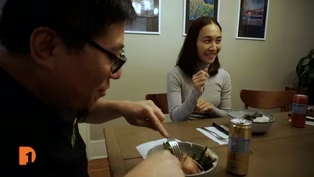
AAPI Stories: Kyunghee Kim & Leo Chen talk about navigating life in the United States
Video has Closed Captions
Clip: S10 Ep45 | 8m 33s | The couple reflect on their experiences navigating life in the United States. (8m 33s)
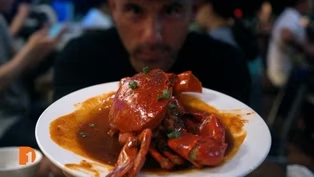
Restaurateur Billy Dec’s Filipino “Food Roots:” New PBS documentary and Detroit restaurant
Video has Closed Captions
Clip: S10 Ep45 | 8m 2s | A preview of “Food Roots” followed by a conversation with restaurateur Billy Dec. (8m 2s)
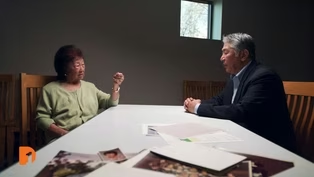
Two Nisei, two histories: Shinji Takahashi on learning about the history of Japanese incarceration
Video has Closed Captions
Clip: S10 Ep45 | 5m 49s | Shinji Takahashi shares how he learned about the Japanese incarceration. (5m 49s)
Providing Support for PBS.org
Learn Moreabout PBS online sponsorship New Episode
- News and Public Affairs

Top journalists deliver compelling original analysis of the hour's headlines.
 New Episode
- News and Public Affairs

Today's top journalists discuss Washington's current political events and public affairs.

 New Episode

 New Episode
 New Episode


 New Episode
 New Episode
Support for PBS provided by:
One Detroit is a local public television program presented by Detroit PBS