Roots, Race & Culture
Celebrating Queerness and Race
Season 5 Episode 2 | 27m 35sVideo has Closed Captions
Explore the challenges and successes of being a queer person of color in Utah.
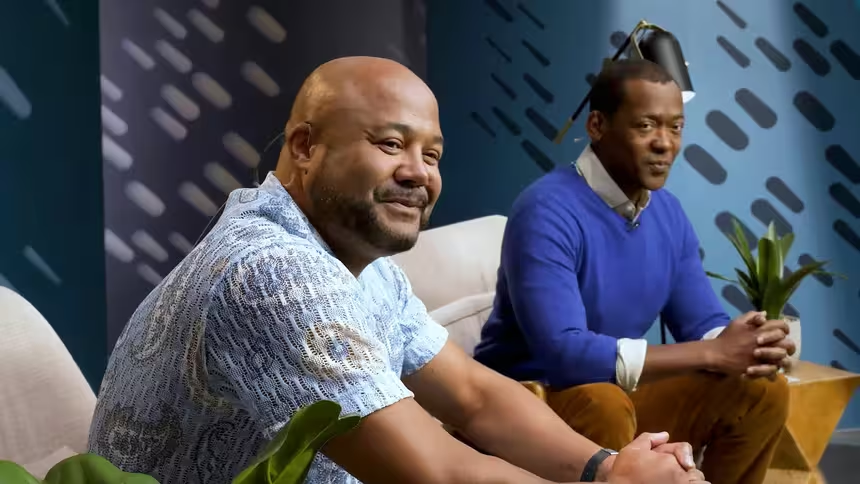
Explore the challenges and successes of being an LGBTQ+ person of color in Utah. How can we make inclusion intentional to accept and celebrate our differences? Special guests Olivia Jaramillo and Harry Hawkins join in on a comprehensive discussion on the realities of being LGBTQ+ in the BIPOC community in Utah.
Problems playing video? | Closed Captioning Feedback
Problems playing video? | Closed Captioning Feedback
Roots, Race & Culture is a local public television program presented by PBS Utah
Roots, Race & Culture
Celebrating Queerness and Race
Season 5 Episode 2 | 27m 35sVideo has Closed Captions
Explore the challenges and successes of being an LGBTQ+ person of color in Utah. How can we make inclusion intentional to accept and celebrate our differences? Special guests Olivia Jaramillo and Harry Hawkins join in on a comprehensive discussion on the realities of being LGBTQ+ in the BIPOC community in Utah.
Problems playing video? | Closed Captioning Feedback
How to Watch Roots, Race & Culture
Roots, Race & Culture is available to stream on pbs.org and the free PBS App, available on iPhone, Apple TV, Android TV, Android smartphones, Amazon Fire TV, Amazon Fire Tablet, Roku, Samsung Smart TV, and Vizio.
Welcome to Season 7
Bold and honest conversations tackled with humor, insight, and empathy.Providing Support for PBS.org
Learn Moreabout PBS online sponsorship(gentle music) - [Announcer] Funding for "Roots, Race, and Culture" is provided in part by the Norman C and Barbara L Tanner Charitable Support Trust, and by donations to PBS Utah from viewers like you.
Thank you.
(lively music) - Hey everyone, and welcome to "Roots, Race, and Culture," where we bring you into candid conversations about shared cultural experiences.
I'm Lonzo Liggins.
- And I'm Danor Gerald.
Being LGBT+ in Utah can come with its challenges and successes.
Being a person of color in Utah can also come with plenty of peaks and valleys, but what are the challenges and successes of being an LGBTQ+ person of color?
American writer Audre Lorde, who described herself as a Black lesbian feminist, socialist mother warrior, and poet once wrote, "It is not our differences that divide us.
It is our inability to recognize, accept, and celebrate those differences."
- Yes, I love that quote.
So recently, Danor and I spoke to a group of BIPOC and LGBTQ students at La Europa Academy, a local private boarding school.
When we asked them about their concerns, they said the following: "Being heard without judgment, being valued for who they were, losing stories and books about people like them."
And some just simply wanted to be humanized and not politicized.
So in the words of Audre Lorde, let's recognize, accept, and celebrate some differences.
And we have two amazing guests today to help us do just that.
Welcome.
- Nice to have you here.
Olivia, welcome to the show.
Thank you for joining us.
- Thank you so much, Danor.
Lonzo, it's so great to be here with the both of you.
- Oh, thank you.
- And we would love for you to introduce yourself.
Tell us a little bit about you.
- Oh, where do I start?
(laughs) There's so many facets to who I am, but my name is Olivia Jaramillo and I'm the director of public outreach and training at Equality Utah.
And I'm also the host of a radio show on KRCL 90.9.
So it's really cool.
I love what I do.
I love entertaining, but at the same time, I love advocating for all of the communities that I come to, I identify as, be a part of, and also hopefully, raise some understanding around.
So I was born in Central Mexico.
I immigrated to the United States when I was 14 years old.
I lived in El Paso, Texas for just a little bit, and then I went active duty.
I joined the United States Air Force, and I did 20 years of active duty service.
That was a great adventure.
That's how I always describe it.
And I served tours in Iraq when we were in that conflict 20 years ago.
So don't Google how old I am, please.
(everyone laughs) But, yes, and then once I retired, you know, I kind of continued wanting to do some more advocating because I was very, very privileged to be one of the first members in 2016, I think it was the fourth or fifth, DOD wide, to be able to take advantage of some policies that were enacted by the Obama Administration.
I was able to transition from male to female while still serving on active duty.
And that really showed me that when we understand each other, when we know each other beyond just knowing one facet of who we are, we really come to understand those things that we feel may divide us.
- [Lonzo] Awesome.
- Or that we feel we may not know of.
- I wanna get your story in a second because I love your story, but I wanna introduce other guests here, Harry.
Harry, tell us a little bit about yourself.
- Well, hello, everyone.
Great to join you.
Lonzo, Danor, thank you for having me on.
My name is Harry Hawkins.
I am the former director of the LGBT Resource Center at the University of Utah.
I've been doing this work for over a decade now, and many of you are probably like, "Where is this voice from?"
I am originally from the state of Mississippi, so yes, yes.
- A Mississippi fan here.
- I'm from there too.
- You know, that's why we're on this side.
(everyone laughs) So doing this work as an LGBTQ person has been very impactful because growing up in places like Mississippi, you didn't always see, like my perspective, expressed or seen.
I started this work when I was at Mississippi State University as a student and my university at the time didn't have any type of LGBTQ infrastructure.
So that was really where this whole advocacy bug first bit me.
I had the opportunity to go work at the Human Rights Campaign, which is the nation's largest LGBTQ nonprofit as a community organizer and a lobbyist.
So working on these issues at the macro level, legislation doing the politics thing as well, has been very fulfilling.
But after 2016 and that election, I very much wanted to take a step back from community organizing.
And I was like, "What can I do?"
I went back to my first love, higher education, working with this next generation of students.
It excites me and working specifically with our queer students, very exciting.
And I've had the opportunity to do that for the last eight years.
- Tell us about your work with Equality Utah.
- Our organization, we are the state's premier LGBTQ rights and advocacy organization and we've been working on Capitol Hill now since 2001.
And one of the things that we're so fortunate to have been able to do is that Utah is now one of the most conservative states in the country with the most protections for the LGBTQ community.
And not a lot of people know that, because we do hear about a lot of the challenges that we're still facing.
We hear so much about that, but we don't focus sometimes enough on the positive things that we have been able to do in the state.
And, you know, one thing that people, whenever we tell them we had non-discrimination protections in the state of Utah for the LGBTQ community, for race, ethnicity, religious minorities, five years ahead of the national curve.
That's really wonderful to see that that happened right here in Utah in 2015.
That was a really important moment for what lay ahead and it really showed us that there is a Utah way that we can work together.
- That's great.
Now I have a question for you, Harry.
That's pretty good news, right?
But, you know, as we've discovered talking to people on this show before, there's always a risk of things sort of sliding back.
And so how do we keep the gas pedal going to keep that positive energy happening?
What do you think is good to make that happen in Utah to continue to progress?
- Absolutely.
You know, we all have the pleasure of being in an election year right now, right?
And I think what we are seeing, especially over the last month, which has felt like a decade, is civic renewal.
We're seeing people get engaged again.
There is excitement, there is this desire to have hope and joy.
Yeah.
And so I would say like, what was working in 2015?
Clearly Utah was doing something right in 2015.
There has been some backsliding.
And so how can the state get back to that energy of saying, how can we look forward to accepting all, working with all, welcoming everyone here.
I mean, the state is gonna host the Olympics again.
- Again.
That's right.
- That's right.
- And so these are values that are going to have to move back to the forefront again.
And so I think right now, in Utah and as a country, we're looking around saying, "Maybe we've taken our foot off the pedal.
Maybe we're letting folks represent us who don't have the best interests of everyone at heart.
And how can I get re-involved again?"
That would be my message of just saying, look at your elected officials.
Say, "Are they really speaking for me?
Is this the tone that I want?
Do I want folks being attacked?"
Not necessarily.
And I think Utahns can agree on that.
- And that's a national issue.
I agree 100%.
- So I wanted to talk about specifically being, you know, LGBTQ+ and a person of color.
'Cause there's this article from Dr. Amir Ahuja on psychiatry.org.
It's called "Understanding the Barriers of Coming Out for LGBTQ+ People of Color."
So in the article, I'm gonna paraphrase just a few keys of it.
It says that research has shown that Black, Hispanic, and Asian youth are far less likely to come out based on their families and cultures, strong beliefs.
Some of it's like, really strict religious beliefs, rigid gender roles.
And then of course, you know, we both know, you know, from being Black and Hispanic, there's, you know, a sense of machismo sometimes in our communities.
Do you have any thoughts on that?
Do you guys wanna speak on that?
Do you wanna speak on that, Olivia?
- Well, there definitely is a machismo aspect to these cultures.
I remember growing up in Mexico and just as my life has evolved in the way, where I've ended up being where I live now, and the time that I transitioned in my life, I was an adult with a career.
And I had that opportunity to do so that I could support myself financially.
That I was in a different state, mental health wise, that I was stronger.
I can't even imagine what I would've gone through had I tried to come out, transition when I still lived in Mexico.
Mexico is considered one of the most dangerous countries for transgender people when it comes to the homicide rate.
It's second only to Brazil.
- Wow.
That's something.
What about you, Harry?
Mississippi.
I mean, that had to have been a unique experience down there that had to have been a little bit of a challenge at times.
- Yeah, two things come to mind when we're talking about, especially with culture and these aspects.
One, in Mississippi, telling my own story, of telling my mother on a veranda.
It was the most southern set you could think of ever.
It was in the middle of the summer.
And I told her, and it was the most nonchalant answer ever.
I mean, she was just like, "Okay, cool.
And moving on."
And then, you know, made a joke about, "You asked for Elton John's greatest hits one year.
That was kind of a hint."
(everyone laughs) I was like, "Thanks, Mom.
Love you, Mom."
- At least she was paying attention.
- She was paying attention, and she accepted me.
And she talked about being raised Buddhist in Thailand and saying, you know, these are not exactly the values that we place, we just look at people as a whole.
And that was important.
And so I'm very fortunate 'cause that's not, you know, that's not the story always for others.
- So, Olivia, my question for you is, what is the Utah experience like being a trans queer person and living here?
- When I first came to Utah, what brought me to Utah was the military.
When I was active duty, I was stationed up at Hill Air Force Base.
That's what brought me to Utah.
So I've always, when I started experiencing Utah, even before I transitioned, I always had this shield, this armor, per se, of being active duty.
And we have a pretty high respect.
We we're a pretty patriotic country.
- Yeah.
- So it's very respected to be a member of the military.
So I've always had the shield that, even as I transitioned and people would see me in public, they would see my uniform.
So I always had this shield that would kind of soften the blow, if you wanna say, or that it would actually give people a different perspective on what trans people can do and that we're just human beings that love our country, that can serve in the military.
- I'm really interested in this.
So like, what is your experience like then as a trans person in the Utah Mexican community?
- It's very interesting.
Whenever I do go on air in some of the Hispanic radio stations or TV stations, one of the things that they always angle at is that they wanna provide that exposure.
Because very much like we spoke of earlier, there is a culture that, it is frowned upon to transition, to come out as gay, to do anything that is related with the LGBTQ community.
And you do tend to find that, you do tend to find that there is a bit of an isolation of people that do come out, especially as immigrants.
You already have one status that is, let's say, counting against you.
But you may not speak the language and now you're coming out as part of the LGBTQ community.
- In that article that I was talking about, psychiatry.org, one of the things that they said is LGBTQ+ people of color can take steps to heal the mental stress by finding spaces with people like them in order to feel less alone or isolated.
Now Harry, you could definitely speak about the value of the LGBTQ+ groups 'cause you have been in that world before.
So tell us about the value of that.
- It's very much valuable.
I was thinking about this.
I was talking to some students yesterday, and you know, I was talking about when I was a college student, when dinosaurs were on the planet and I was explaining to them of like, what it was like to go meet other people like me or meet folks like Olivia.
I was like, it used to be you would go to a bar back in the day and the students had this look on their face, like, "Why would you have to go to a bar?"
And I said, "Because there was no smartphones."
The internet was still, it was there, but you know, you were in chat rooms or things like that.
So having these spaces has always been that sanctuary for our community.
- Can I add to that?
- Of course.
- And I love what you mentioned because a really good friend of mine who's also a part of our education program at Equality Utah, his name is Stacey Harkey.
We went to train in New York City.
We went to do some presentations out there.
And on one of our days that we didn't have anything to do, we went and walked around the Bronx and Brooklyn.
We were just walking around and we both felt this ease of: "Why do we feel so comfortable here?"
And it wasn't until like we really started noticing, "Oh, we can see ourselves absolutely everywhere."
And it wasn't intentional, but you could see Latinos, Latinas, Hispanics, you could see the Black community everywhere.
And it was, it was so wonderful to just kind of release that tension.
And I'm not saying that it's bad in Utah.
There are wonderful people here.
There's wonderful allies.
But that is that one point that we always try to get others to understand of us.
- You know, a lot of these groups, 'cause I grew up here, and it was just so nice to be able... 'Cause people think that you can just walk up to another person of color, you know, or whoever, and just walk up and just start chatting with them, you know, and they're uncomfortable.
Like, that's how you just meet people.
But a lot of times, there's shyness, there's an uncomfortable facet to that.
So having these groups makes it so that the ice is broken.
You know?
There's just such wonder to having that.
And I want to talk about the elephant in the room that's been happening recently, which is HB2 61.
For those that don't know, HB2 61 is basically the bill that is the anti DEI bill.
It bans the words "diversity, equity, and inclusion" and any diversity groups from Utah public education and government.
I would love for you both to speak on that.
Do you wanna start with that?
- The first thing, it's the law now.
As of July, it is the law here in the state of Utah.
And the thing that I'm very concerned about, and we were talking about the spaces and the weight being taken off of us.
The other thing these spaces do, not just that social and belonging, resources as well.
Like if you ever need anything as an LGBTQ person, maybe you're having issues at home, maybe if you're a trans person transitioning, connecting folks to those resources was one of the important things that these spaces did.
And so, as we've seen the climate on campus over the past year has been rough and these are things that the public can go look at online.
The first line of, I guess you could say defense, or really support for those students when we would have incidents like the F word being written in a residence hall, or a gentleman driving through campus yelling at Muslim students while having a swastika on his truck.
I mean, these are things that happened this past school year.
Our centers would step in and support those students in any way.
And sometimes students would say, "I'm okay.
I'm all right."
But sometimes students would say, "Hey, I just need to be amongst my folks right now to process what just happened to me.
Where are those spaces?"
They're gone.
I'm scared.
I'm very scared for those students.
- And not just University of Utah, any university and the state as well.
- Absolutely.
- This is statewide banning.
- The other thing to clarify, and I've seen some discussion of this online, our favorite place, right?
Is there's a misunderstanding going on where folks are saying, "Well, the legislature said they had to do this."
No, the legislature didn't say that the University of Utah had to close these centers.
The University of Utah went a further step in doing that.
- I think there's probably, you know, another side to the story.
I think a lot of people, at least, this is me playing devil's advocate, are saying that they feel that white students were being left out of these groups and that white students weren't allowed.
Which I don't think is the case.
And whenever you're in any space where there's either, you know, LGBTQ people or people of color, have you ever been in a situation where people were told that whites weren't allowed in that situation?
Olivia?
- I have not personally been involved in any situations or instances where we've excluded anybody.
I feel like one of the biggest things for me is that the LGBTQ is a community of love and acceptance.
And we accept everybody.
And even furthermore, and the work that I do, and I think that we both do, is we don't look to exclude anybody.
For us, creating belonging includes everybody.
And that is really how it should be.
I think a lot of these setbacks that we're going through in the state of Utah are due to fear.
A fear that life as we know it, per se, is gonna go away.
Whatever our culture that we thought was here will be surpassed or replaced with DEI or anything that it brings with it, and that is absolutely not it.
It's one of the biggest things for me is that we start with the work of: How do we understand minority communities?
How do we understand those struggles?
And that doesn't mean that we're not gonna talk about other issues.
It simply means we're focusing on what is important for some communities that have historically gone through some issues.
- So, Harry, what are your thoughts on what we can do to remedy, obviously, other than change the laws, what we can do to remedy the treatment for young LGBTQ students who are, let's say, coming to Utah for the first time and they wanna feel comfortable here.
What could the state do to change that?
- I think the first thing I think about, business owners, the business community, your places and your spaces, making sure that they're welcoming for folks, knowing that these types of centers are gone from the university campuses.
But however, you know, the Utah Pride Center is very much still here in the state of Utah, just downtown in a new location.
They are still there to provide amazing resources.
Olivia's group, Equality Utah, are out here as well doing this fantastic work.
And so there are still resources there.
- You mentioned community and that's really exciting.
We have a clip, a community event is happening, and we have a clip from Russell Roots who works with Utah Film Center for a film festival that's coming up very soon.
So let's take a look at that clip.
And then I want to ask you guys, we have Black joy.
I want to hear about queer joy and what it's like to get together for things like this.
So check this out.
- I am Russell Roots, the director of film exhibition with the Utah Film Center, the Black, Bold & Brilliant program manager.
And the festival director for the Utah Queer Film Festival.
The Utah Queer Film Festival is a film festival celebrating queer stories from around the world.
And this year really focusing on local filmmakers as well.
The Queer Film Festival in Black, Bold & Brilliant are opportunities to look at marginalized communities and find allyship by looking at stories that you can identify with.
The festival will take place at the Rose Wagner Performing Arts Center in downtown Salt Lake, and it will be in person October 25th through the 27th.
We've got international films celebrating queer diversity.
We've got local films.
We really put some intention into finding local films this year.
Films about music, films about family-friendly topics, films about seniors in the golden years and the specific topics they have to deal with.
So we've got an opportunity to really just showcase stories that don't get the opportunity elsewhere.
- Right here in Utah.
(laughs) - Right here in Utah.
So tell us, what is some of the joyful experiences?
Obviously, that festival's gonna be a lot of fun and there's lots of other things happening.
What are some of the joys, the things that you love about your community?
- My reaction from hearing about that film festival is I was like, "Our ancestors dreamed."
Our ancestors dreamed about a lot of things, but they dreamed of a day where we're having a film festival sharing our stories.
And imagine talking to a queer person in Utah from maybe 20, 30, 40 years ago.
And now it's like we're having this film festival.
It's beautiful and it speaks to that progress and it's so important to share those stories.
When I see things like that, I just, I go for joy and I think our ancestors dreamed.
And the dream's alive.
- Olivia's just a joy to be around you.
We're around her for five minutes and you're already laughing.
So, you know, tell us about some of the great things that you're doing and like, you know, some of the good experiences that you have.
- Well, one of the things that's so wonderful...
I love what you said, Harry, and we don't realize sometimes that we're going through a lot of hardships, but this is still the best time in history to be part of the LGBTQ community.
And it's so important that we never forget that.
We may be going through challenges, we may be going through setbacks, but this is still the best time to transition.
There is more information out there about what that experience is like.
There's more help for individuals that identify as gay, lesbian, bisexuals.
We have centers, we have so many things that bring us joy.
- I hope it stays that way too.
I think that, you know, when we were talking to some of the students at La Europa, they really were centered around gender.
That's like a big deal among young people today, is this idea of gender.
Is there any way you guys could speak on that and just tell us what your thoughts are with that?
Like what would you say to a young person who was, you know, having issues with that in their school?
Start with you, Olivia.
- Well, I think very much it, it goes with what I just spoke about, that now is the best time because there is so much information, so many resources out there.
If there is somebody out there that is looking, for example, at this episode, I hope that they're able to see that there is a road ahead, that, you know, we do suffer great numbers or higher rates when it comes to mental health issues.
When it comes to depression within the LGBTQ community, specifically the trans youth community, goes through a lot of mental health issues and even suicide rates.
You do see that those suicide rates tend to be higher within LGBTQ youth, specifically transgender youth.
So whenever they see somebody that is a little bit further down the road, hopefully that gives them a path forward.
I can have a career, I can do things with my life, and we need to start addressing that more.
We need to start humanizing trans people more.
We need to start talking about this issue of gender in a way that it's not just talking about it.
I always talk about, we need to speak to trans people more about other issues than just transgender issues.
We need to simply normalize a conversation with a trans person about anything.
- Right.
Yeah.
That's great.
I love that.
- So I have a question for you, Harry.
What are some ways in which people can be better allies, more supportive to the LGBTQ+ community?
And can you give us maybe some resources for people who may have lost a little something?
- See humanity first.
We're all human beings.
We share this planet.
Seeing humanity first.
I always say start there.
Secondly, when we talk about our allies.
Ally is an action, it's not a title.
It's also not an end point.
It's something that you do.
And I hear that many times with allies when they say, "Oh, I heard something.
I wasn't sure how to respond.
I didn't know what to do in that moment."
I always say, "Remember, it's an action."
And it's never like, you get to this one spot, I got my ally sticker, I'm good now.
You have to continually keep learning.
There are many, many resources out there for folks who want to know more.
I say with parents, always looking at PFLAG or GLSEN, Glisten, as we call it.
GLAD is another one that looks at media representation.
Anything that Equality Utah is putting out is going to be exceptional.
Along with the human rights campaign.
There's many, many resources out there that folks can access if they want more information.
I know the internet can be a little interesting at times, but there are things out there for allies and just going back to how I started, remember, it's an action.
- Do you mind if I add something to that?
- Yeah, please do.
- One thing that I love about allyship, and it very much goes with what you said, I feel like we're just going off of each other today, which is great.
But being an ally doesn't mean that you need a rainbow T-shirt or you need a pride flag and that's what makes you an ally.
Very much what you said, an ally requires action.
And that doesn't mean going to a protest or rally.
Sometimes, something as simple as listening to somebody, listening to understand them and being that that person that is there for them, that is the biggest thing that an ally can be.
Anybody watching the show can literally become an ally in an instant by simply listening to understand to somebody that they may feel they don't understand very well.
- I love that.
I love that.
And listening for understanding.
I mean, that pretty much is what our show is all about, honestly, and I absolutely love the fact that you guys have been able to give us and people who are here in our audience, in the state of Utah and beyond, the show is in other cities as well, a chance to listen and understand.
So, you know, from all of us here at PBS Utah, thank you for joining the conversation for listening to understand.
As always, other episodes and extended conversations can be found on our website, PBSutah.org/roots or on the PBS Utah YouTube channel.
- And if you have any feedback or ideas for other episodes, be sure to give us a shout out on social media.
Until next time, for "Roots, Race, and Culture," y'all, we are out.
(lively music) - [Announcer] Funding for "Roots, Race, and Culture" is provided in part by the Norman C and Barbara L Tanner Charitable Support Trust, and by donations to PBS Utah from viewers like you.
Thank you.
(lively music continues)














Support for PBS provided by:
Roots, Race & Culture is a local public television program presented by PBS Utah