
Center for English as a Second Language – Part 2
7/20/2022 | 26m 46sVideo has Closed Captions
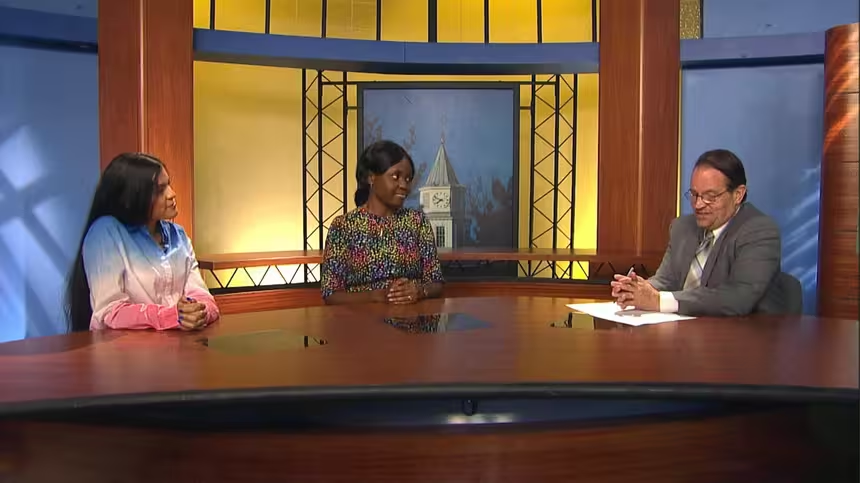
Fred Martino interviews Linda Montilla, Venezuela & Benit Mutombo, Republic of Congo.
The Center for English as a Second Language at Southern Illinois University Carbondale has resumed in-person learning. In this episode, host Fred Martino interviews two students of the immersive English language program: Linda Montilla from Venezuela and Benit Mutombo from Republic of Congo.
Problems playing video? | Closed Captioning Feedback
Problems playing video? | Closed Captioning Feedback
Eye on Education is a local public television program presented by WSIU
Center for English as a Second Language – Part 2
7/20/2022 | 26m 46sVideo has Closed Captions
The Center for English as a Second Language at Southern Illinois University Carbondale has resumed in-person learning. In this episode, host Fred Martino interviews two students of the immersive English language program: Linda Montilla from Venezuela and Benit Mutombo from Republic of Congo.
Problems playing video? | Closed Captioning Feedback
How to Watch Eye on Education
Eye on Education is available to stream on pbs.org and the free PBS App, available on iPhone, Apple TV, Android TV, Android smartphones, Amazon Fire TV, Amazon Fire Tablet, Roku, Samsung Smart TV, and Vizio.
Eye on Education
Eye on Education features interviews with people making a difference in all facets of learning. From Pre-K through higher education, we highlight efforts to prepare students to become the world's future leaders in every discipline.Providing Support for PBS.org
Learn Moreabout PBS online sponsorship(soft music) (soft dramatic music) - "Eye on Education."
I'm Fred Martino.
The Center for English as a Second Language at Southern Illinois University, Carbondale has resumed in-person learning.
Today, we're talking about an eight-week program that enrolls students from across the globe.
It's one of the oldest certified intensive English programs in the United States, and it's been offered for more than 50 years.
Today, we have two people benefiting from the program, Linda Montilla is from Venezuela, and Benit Mutombo comes to us from the Republic of Congo.
Thank you both for being with us today.
- Thank you.
- Thank you.
Thank you, Fred, for having us.
- It's so good to have you here today.
And Benit, I wanna start with you.
Tell me a little bit about yourself and your decision to apply for this program which is just amazing, so fantastic.
- Exactly.
Once more, thank you.
My name is Benit Mutombo.
I come from the Republic of Congo in Central Africa.
It is a very diversified country and with very welcoming people.
And I've been selected for this program called Fulbright.
First of all, because of English.
And secondly, because of my project.
I intend to study international environmental policy.
And I've always wanted to get the scholarship because I think it's a unique opportunity the U.S. government is offering to many students around the world.
We have students in Congo who have great projects, but don't necessarily have the means to accomplish their projects, maybe pursue their studies.
And this was just a golden gift to me, to also those who were selected in my country because we are three this year.
So yes, I'm really excited about this, amazing.
- Well, we're excited to have you here and it's a gift for us to hear your story and the stories of so many Fulbright scholars who are benefiting from this program and then telling us as well about their graduate work that is to come that will be enhanced by this program, learning and growing in English, which is just amazing.
Linda, how about you?
Tell me a little about yourself and again, your decision, how you decided to be involved with this program.
- Well, I am from Venezuela, beautiful country in Latin America.
I am a mechanical engineer with more than 10 years of experience in the social area because I am a social activist in my country.
I am the CEO of a non-profit organization called Tachira Project, one of the most important non-profit organization in my country.
I decide to apply to the CESL English Program and also to the community engaged program because both program offered me a great opportunity to improve my English skills but also to be part of the community and to know the American culture, the amazing culture that you have in this country.
So we are part of something important.
We are meeting with social leaders, with community leaders, we are meeting different organizations through this program.
And that is something important for us.
- And relates to your life, because you said that while you're going to be doing graduate work in engineering, you described yourself as a social activist in Venezuela and doing work and nonprofit work in Venezuela.
Tell me about that.
- Yeah, in my nonprofit organization, we are working to reduce the gap of the opportunities of entrepreneurs in my country through innovative programs in higher education.
So something interesting about being part of this program is the...
Yesterday for example, we met, we visited incubator here in Carbondale that includes entrepreneurs in Carbondale to develop new ideas, to create new project, new solution for the needs of the community.
And that gave me a lot of idea that I can implement when I return to my country.
When you mix the engineering and the social part, you can find incredible solution to help other people.
- So your nonprofit really advances opportunities for education for folks who wanna start businesses, entrepreneurs.
- Yes.
- Very interesting.
As you mentioned, Linda, you have been volunteering in this community, that's part of this intensive English program.
Tell me about one thing that you did, in terms of volunteering, that really stood out to you.
- Well, the last week we received the project senior living and we make our activities with a senior that lived there.
I will never forget the face of one of the old ladies there because Iam, one of my friend in the program, decide to paint the nails of that old woman.
And she was so happy.
(Fred laughing) She felt special.
And I remember that I said to her, "Well, you will receive today a special a spa day from international students."
Although, if she may not remember my name, I know that when she looks her nails, she will remember that special moment that we shared together.
- That must have felt wonderful, to help the seniors in that program.
Benit, how about you?
A particular volunteer experience that stood out to you?
- We had a lot of experience.
First of all, we went to Herrin House of Hope and this was my first time to be a server.
And it was a unique experience because it was out of the campus context.
It was a real life matter and a community challenge you have here.
And I mean, to be honest, this, you are so gifted because people who are hungry here, still have a community which can support them, which can help them get some food, get some free clothes, and even free bicycles offered by organizations, such as Herrin House of Hope.
And this is just amazing.
And all that is supported also by the community around people who donate, the churches.
What I've learned is that you also have this spirit that, this creating like a connection between people.
And it has just remind me that nobody's alone.
Like, we can all serve people, we can all bring something to the world.
And this is a real life lesson that I've taken and I can bring to my country too.
- Very inspiring.
And you put it so well.
We had some other Fulbright scholars who enjoyed going to Herrin House of Hope and to really to be able to give back in that way during their experience here in this area.
This program also really relates to sharing that hope, in not the language of your home country, but in English and gaining that intensive English experience and being multilingual is such an incredible benefit.
Benit, tell me how it's helped you.
How would you say that being multilingual has been important in your life?
- I'm here thanks to English and I don't think...
I mean, maybe it's I'm lucky because I understood the importance of English when I was still in high school.
And I started going to English clubs by myself.
I was so passionate.
I wanted my level to improve actually.
And I didn't know that this would've paid me so well.
And it's something really important, that opens people doors, having a language, such as like speaking English.
It is not only an academic language, but it's also a business language.
And if you have English, you can go anywhere you want, you can start everything you want, even on internet, access the knowledge you want.
And this is just amazing for us.
And we are still learning with our professors, such as Mr. Colin Ruthers here.
- [Fred] Yeah.
- Yeah.
- Linda, how about you?
- Yeah, so Benit say, speaking other language help you and give you a lot of opportunity.
Speaking other language, in this case English, is something that expand the frontiers of the knowledge for me and can unleash my potential.
In my personal case, speaking Spanish, also English, give me a unique opportunity to give an international reach to my project.
For example, two years ago, I consolidated the first academic program in my country to have the support of the Massachusetts Institute of Technology, MIT.
This achievement was possible because, among other things, I can speak English and I could present my idea, my proposal, and discuss it with the MIT boards.
I mean, if I did not speak English, this would not be, this would not have been possible.
- I guess that was incredibly important for you in terms of the work that you were doing there and may have encouraged you then to apply for this program to see the opportunity to have an intensive experience for weeks here in Illinois.
What has it been like for you?
How has it helped you grow your skills?
- Well in different ways.
First of course, I am improving my communicating, English skills, but also this program helping me to improve my leadership skills.
Now, I am more confidence about myself, about expressing a different language, but also I learned about how to be a better person, not just a better professional, but this kind of program helped me to develop soft skills that are necessary to be a successful professional, also have a better career.
- Yeah.
How about you, Benit?
Tell me about this program in particular, being here for several weeks in Illinois, always speaking English, and how that's helped you.
- This has helped me a lot.
First of all, my TOEFL score has increased and this is a practical result that this program is helping me a lot.
And I've also learned how the academic system works here in the U.S. You have something, for example, in writing, Americans tend to be more practical, more direct more than French speakers, because I'm a French speaker too.
You know, in French, we tend to, you know, turn around the bush (laughs) (Fred laughs) before saying something, which is not the case in English.
And I think it's an important skill to succeed here.
And apart that, we also have some grammar lessons, which is really, really important.
We had some quizzes every week, which were really challenging for us because we had to memorize those words.
Not only memorize them, but use them for not forgetting them too.
So I have gained a lot and I think I can say now that I'm ready for my academic journey.
- Well, I'll be excited to hear more about it as it continues.
I know you're gonna be going to California and studying, as you said... - International environmental policy.
- International environmental policy, very important stuff.
Not everyone, of course, has an opportunity in school, growing up, or a teacher growing up who encourages them to become multilingual.
For folks who are watching today, I'm curious about your opinion on what you think parents or guardians or other influences can do to encourage children to learn a second or third language?
- Okay, I've been really thinking on this issue, because first of all, I have noticed something that it is more easier for children who have, let's say the father is speaking English, and the mother speaking Spanish, to speak both languages because they can speak one of the languages to one of the parents.
But it's more difficult for children who are learning, for example, French, to speak it with parents only speaking English.
So I think one thing that parents can do in order to help their children is to learn with them.
While you are learning with your kids, you are creating this daily routine for him to speak, to speak the language he's learning.
And this is really helpful, because in my case, I found the support out of my home.
My parents didn't speak English.
So I had to find a club like an English club, which was my community in order to practice the language.
So I think this is the first, too, and the second one will be put the programs that are in the language that the kid is learning.
And, you know, buy books or books, I mean... - Apps on the phone is very popular now, as well.
I know that having that, if you have access to that technology, that can be helpful.
Linda, I wanna ask you the same question 'cause I think this is really important.
Your thoughts on how parents, guardians, other folks who influence children can encourage them to learn a second or third language?
- My parents, in my personal case, I remember that they encouraged me to listen music in a different language.
- Ah, music.
Okay.
- Yes, yes.
I was the fan number one of Backstreet Boys.
(Fred chuckles) I remember that my father told me one day, "If you can sing a song, an entire song in English, I will give you to a concert of the Backstreet Boys."
- Oh!
- And I learned my first English song because of that.
- You had an incentive, you wanted to go to the concert.
- Yes.
Also, my parents sometimes give me some story books in English.
That was a good idea because they incentivize me to learn new vocabulary in a different language.
I think that another useful strategy that can apply parents are decide to learn a new language alongside with their children because they give you the opportunity to learn something new together and to share amazing moment also.
- Okay.
Benit, of course, we grow in other ways through travel and through cultural exchange, in addition to language.
Tell me how you have benefited from visiting other countries?
- Hm.
I think the first thing I've benefited from visiting other countries is that it has opened my mind to several cultures.
Apart from the US, I have been to some countries in Africa too, like in Ghana, Togo, and DRC.
So it also helps us discover that, as we say, the things that gather us are more powerful than the things that separate us, because we have stereotypes shared all around.
But when you are there physically, you can talk to people.
You can hear the stories, eat the food.
You have your own picture, you have your own experience, and you can tell something which is true, you know?
And I'm benefiting right now from the American culture.
I'm learning new ways to do, for example, when I first came in Carbondale, I found the transport system really different from mine.
Yes.
(chuckles) So, for example, taking a taxi, you have to call an Uber.
If you wanna take a bus, you have the app.
And so it was a really learning and exciting thing because I was into the culture, I was into the system, and I was learning by myself.
I got lost with my friend Siti (laughs) one time.
And I mean, and we just end up turning around and visiting, so until we found our way.
So I think this is just amazing.
- It's better to get lost with someone else, right?
Not by yourself?
Yeah, okay.
Linda, how about you?
Thoughts on the growth that you've gotten from this travel, this cultural exchange?
- When you travel, you can discover new heritage, new cultural heritage, and you can nurture your perspective with the knowledge, with the experiences of people that have a different background from you.
As Benit say, that opens your mind, you can see the different ways in which other countries are developing its society.
You can learn the best practice that you can put, that you can learn, can implement in your own own country.
Also, I believe that when you travel, you learn about the needs, about the realities of other person, and that can help you to create a better sense of empathy.
- Yeah.
You have more empathy for others.
Linda, tell me your thoughts on how programs like this also encourage folks to pursue additional educational opportunities.
I mentioned that you and Benit are both going to pursue additional graduate work.
And that was something you planned before coming to this program.
But it occurs to me, and in talking with folks who do this kind of work, many more folks are encouraged to pursue additional formal education after going through intensive English work like this.
Tell me your thoughts on that.
- Program like this give you a lot of advantages, professional, academic, personal level.
Being part of a program with a high level of teachers that always take care of your experience is something that really makes a difference for me and in my education.
Also, this program helped me to be more prepared to my future master's degree here in USA, because now I know what is a day in the life of an American students.
I know how a university in United States works, and I know how to access to the services.
I know how to access to tutoring.
My fear about become a graduate student in United States is disappearing because I have more experience now.
- That's great.
Your thoughts, Benit?
- Taking this program is really important and I think everybody should do this actually, because I'm talking about the case of international students, because when you come first in the U.S., you have to understand how it works.
And this program has given us this opportunity.
I got the scholarship.
I told you we are three in my country and the two other people will be coming in August.
And I know they won't have what I've had.
They might start with what they know, but taking this program could have helped them better understand what they will face, how the exams will look like, what will be their grading system.
So this is really a beneficial program because we don't only have the academic aspect, but we also have the supporting community aspect, and this is part of building our personality, and this is what makes us.
- And I'm guessing that support includes some good friends 'cause you've all been through this together.
- Yes, we have been.
And we won't forget each other.
(Fred chuckles) Yeah, I'm sure we won't forget all the moment we've spent here through every visit.
And if I forget something, I will call Linda later.
"Oh, do you remember this?"
(laughs) - (laughs) Well, I have enjoyed very much meeting both of you and some of your colleagues who were in this program and your professor and am honored to be part of the experience with you here as Fulbright scholars, working and learning at Southern Illinois University, Carbondale.
Thank you both for being here.
- Thank you.
- Thank you for this opportunity.
- Thank you.
- Thank you.
And thank you at home for joining us.
That's "Eye on Education."
I'm Fred Martino.
For all of us at WSIU, have a great week.
(dramatic music)














Support for PBS provided by:
Eye on Education is a local public television program presented by WSIU