
Center for English as a Second Language - Part 3
7/6/2023 | 26m 46sVideo has Closed Captions
Center for English as a Second Language - Part 3
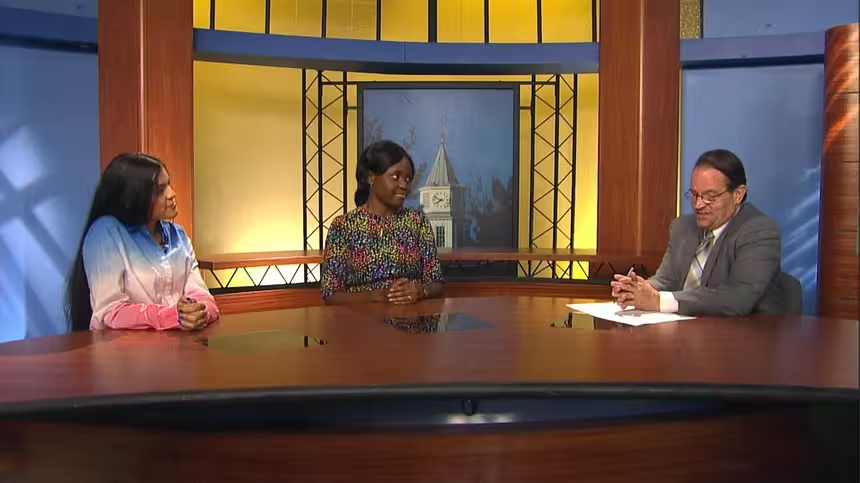
The Center for English as a Second Language at Southern Illinois University Carbondale has an active immersive learning program that welcomes scholars from across the globe. In this episode, anchor Fred Martino interviews Samuel Bello and Francisco Moreno, both from Colombia.
Problems playing video? | Closed Captioning Feedback
Problems playing video? | Closed Captioning Feedback
Eye on Education is a local public television program presented by WSIU
Center for English as a Second Language - Part 3
7/6/2023 | 26m 46sVideo has Closed Captions
The Center for English as a Second Language at Southern Illinois University Carbondale has an active immersive learning program that welcomes scholars from across the globe. In this episode, anchor Fred Martino interviews Samuel Bello and Francisco Moreno, both from Colombia.
Problems playing video? | Closed Captioning Feedback
How to Watch Eye on Education
Eye on Education is available to stream on pbs.org and the free PBS App, available on iPhone, Apple TV, Android TV, Android smartphones, Amazon Fire TV, Amazon Fire Tablet, Roku, Samsung Smart TV, and Vizio.
Eye on Education
Eye on Education features interviews with people making a difference in all facets of learning. From Pre-K through higher education, we highlight efforts to prepare students to become the world's future leaders in every discipline.Providing Support for PBS.org
Learn Moreabout PBS online sponsorship(bright music) (bright music) (intense music) (intense music) - "Eye on Education."
I'm Fred Martino.
The Center for English as a Second Language at Southern Illinois University Carbondale has a program that enrolls students from across the globe.
It's one of the oldest certified intensive English programs in the United States, and it's been offered for more than 50 years.
Today we have two students benefiting from the program, both from Colombia, Samuel Bello Ulcue.
and Francisco Moreno.
Thank you both for being with us.
- Thank you so much, Fred.
- Good to have you both here.
- Thank you.
- Samuel, let me start with you.
Tell me a little bit about yourself and your decision to apply for this program.
- Well, first of all, thank you for this space.
It's really important for me to share a little bit of my experience in life.
And my name is Samuel Bello.
I am from Colombia, in the southern part of Colombia.
I was born in a small town called Totoro.
It's a pretty cool town, but it's pretty nice.
I studied my bachelor degree in Basic Education with an emphasis in Spanish and English.
And after that I worked with some Indigenous communities as a leader in my country.
And then I earned the Fulbright Scholars to study my master here in the United States.
So, to begin with this journey as a Fulbright, I have to enhance my English skills.
So that's why I decided to study here at Southern Illinois University at the CESL program because they may help me to enhance all those skills for academic purpose in the future.
- And this has a really powerful meaning for you, this program, I know, because your master's degree that you're about to embark on in the fall is going to be in English, right?
- Yes.
Yes, that's true.
Actually I have found some difference between how the English is taught in Colombia and how it's taught here in the United States.
Of course, this is a English country.
You can practice your English every single time, everywhere.
So that's amazing.
The CESL Program, actually, they are enhancing all the academic purpose, how to write it properly, how to speak in front of a great audience, how to manage your time, even.
So many, many advantages that you can get from the CESL Program that I hope to apply during my master's degree.
- That's fantastic.
Francisco, how about you?
A little bit about yourself and why you decided to apply for this program.
- Thank you, Fred.
I'm really happy for being here.
For me, my first opportunity speaking in English in an interview, so it's really challenging and fantastic.
Thank you very much.
Fred, I'm from Colombia.
I'm a pharmacist and study in the University of Antioquia in Medellín, my pharmaceutical chemistry.
And then I moved to a different city in the southwest of Colombia.
It's called Cali.
And there I was working as a pharmaceutical coordinator in validation process.
So I was there practicing, learning, having different opportunities with a multinational company that is called Sanofi producing generics.
But maybe my idea as a pharmacist now being here in the United States is learn about technologies, innovation, industry, and how can we use that technologies in our countries, because my passion is medicine, especially generics.
Do you know about that kind of medicines, Fred?
Maybe?
- Well, I know a little bit about it.
I mean, the first thing I thought about, Francisco, when you said that your field of study is pharmacy, I know there's an enormous demand for pharmacists in the United States.
In fact, some pharmacies have had to reduce hours because they don't have enough pharmacists.
So you're in a field where there's great demand.
- It's true, it's really true.
We have a big demand here in the United States and around the world, and especially in generics medicines.
It's my field of study.
So the idea of being here, learning in English, is that.
And CESL is a good program and help me accomplish that goal in my life.
Learn English, coming from a family without resources.
My family, my mom was abandoned in 1952, so I'm the first generation that write in Spanish and now that write in English.
So that's really awesome, and thanks for this opportunity.
And also my passion to be a pharmacist is help people in Colombia in my same situation to accomplish the goals in health.
For example, a kid that, his name is Nicholas, he has heart transplanted in Colombia, multimedicated, taking 20 pills per day without the resources to get that pills.
So my idea as a pharmacist is bring opportunities to my people in Colombia, too.
- That's wonderful.
That is really wonderful.
And of course, learning more in English, another advantage you would have in the United States, as you're aware, there are many people in the United States who only speak Spanish.
So you will have that advantage of being bilingual to be able to speak to folks who only speak Spanish, as well as folks who may only speak English or are bilingual as well.
- That's true.
- And speaking of this, you've been getting a chance to interact, I know, with a lot of people here in the United States.
One of the strengths of this program at Southern Illinois University Carbondale is it has the opportunity for students in the program to volunteer in the community.
Tell me about that.
- Yes, that's true, Fred.
I was volunteering in a program that is called Community Engagement Program from CESL.
It's a interesting program for everybody, because I was there in Herrin House of Hope, for example.
I was working with different people.
In that place I was a server.
As a server, I help people with dignity, because being in the United States you can understand their reality.
And it's part of the program, that we are facing difficulties, especially after the pandemic.
So serve in that places volunteering and helping people is something amazing.
Then we went to a kids' corner activity with my friend Samuel, especially, we present a poster about Colombia, and there we shared about our culture, because sometimes it sees some misperceptions about our cultures, especially as a Colombians, maybe believe Colombian is only drugs, terrorism, or violence.
But when we share with that kids, their emotion, their faces talking about the biodiversity, we are the potency in birds.
Colombia is especially because we have the Amazonia.
So we can share different resources and we can share and change- - That is so great.
- The misperceptions.
- And I'm sure folks enjoyed hearing about Colombia.
Hearing all about your country.
Samuel, tell me about your experience with this volunteering aspect, getting a chance to volunteer in the community and talk to people in English, get the chance to practice English, but also meet other people and tell them about your culture.
- Yes, for sure.
It was an interesting experience here in the United States.
We are in the same course of CESL, but we separate of groups.
So he was in B.
- Group B.
- Group B, and I was in group A.
So we have different experiences, but I think that it was interesting, not only because of the volunteering itself.
It was interesting because I could tell to people they were aware, they have some concerns about the society here, and they are doing something else, something to give solutions, to get solutions.
That's really amazing.
For example, I visited the Giant City Park, and they are trying to maintain and keep the forest healthy for the future.
Because the families want to get that contact with nature.
That's something interesting for me, because since I'm come from an Indigenous community, the contact with nature is pretty important for me.
And I will love that all the people around the world can have the same connection, because it's really important to value our home.
So that's what I like.
- Well, I'm glad you get to see Giant City State Park.
You have to go to Fern Clyffe as well, if you haven't been there, and some of the other state parks in the area.
- I have visited many places here in Southern Illinois.
- There are very many beautiful parks, state parks and local parks as well.
As I mentioned, Samuel, being multilingual is such an incredible benefit in work and in life.
Tell me how it's helped you.
- Well, that's a really good question for me, because I really think that being multilingual help you to increase your intelligence in different ways.
First of all, as a linguist, they create some ties in your brain that help to see the world and see the solutions faster than anyone.
So, that's interesting.
Since I grew up in a country, we do have multicultural country, we have plenty of languages.
So, we have that possibility to have that exposure to those languages, or not.
So, as a teacher, I always say to my students, "Please learn another language "because it might help you in your work," of course.
Because nowadays the world, how it works today, is connected all with people.
So you can have your profession in your country, but if you want to make a great impact in the world you may have some relationships with other people from different countries.
And you know that English, for example, is a universal language.
So, everybody, I think, that wants to make some difference in the world, they speak English.
So, that's the way that you can communicate your ideas, get some feedback, work together, and solve problems.
So that's amazing about being multilingual.
- Absolutely.
Francisco, tell me what it's meant for you being multilingual.
- I think when you're multilingual, according to my field, you can discover how to apply scientific knowledge in our daily life.
For example, ideas coming from different countries to improve process.
And maybe you join that ideas with American ideas, and you can create something new that is important for our society.
But also, I think in a personal way you can break your misperceptions.
You can be open to understand that when you learn a new language also you learn how to relationate with the world, with the nature, because language support that idea that we learn about others, and we connect with the nature, we connect with emotions.
For example, when you say goodnight in English, in Spanish says is buenos noches.
But the meaning is completely different, even if the words or the translation is literal, because the emotion of the culture.
So I think when you learn a new language also you get the knowledge, you get that history, and it's important for you.
You can learn something new and you can apply it.
- I like that, that's very true.
When you think about, we've already talked about some of the benefits of the program at Southern Illinois University.
When you think about it, what really stands out to you about how it's helped you grow your skills?
- I think the program in CESL helped me to be more comfortable living in America.
Understand the culture.
Maybe understand how words the Americans in our daily life.
When you're an international student, you need to understand that.
You need to be part of the culture and respect that culture, the history.
So when I came here to CESL, for example, with Mr. Robinson, that is one of the best teachers around the world.
(Fred laughing) I learned about poetry, American poetry, about history, because it's important to understand where we are.
And also grammar, to speak more fluently.
Ms. (indistinct) is a teacher there explained to me about the importance of be concise and precise.
In Spanish, for example, we try to use long sentences, but in English, in an academic work, it's short sentences.
And we need to understand that in order to communicate our ideas in a better way.
- That's very interesting.
I never thought about that before.
So many great examples.
What stands out to you the most, Samuel, about how this has benefited you?
- Well, it has been challenging most of the time.
I think that the first month that I started with this program, Francisco just said is that the Spanish is completely different to the English in the academic world, because in Spanish we tend to offer plenty of ideas at the same time.
Get to the point too late.
So English is pretty specific.
It's direct.
They don't waste their time.
(laughing) So that's really interesting.
And I'm still working on it, because I have been working in Spanish so many years together, so now I am doing this in another language.
So it's kind of challenging, but at the same time I am getting the wisdom in this.
So that's what I like.
CESL help you to increase the, or to enhance your skills in writing, reading, listening, and speaking.
So this is really great, because at the same time you are creating ties with people from different countries.
We have friends from Vietnam.
We have friends from Togo.
We have friends from different countries, and we are speaking with the same goals, like changing the world.
So at the same time that we are learning we can create ties, we can create friends here.
And that's really, really a strong, so that's a great advantage that I really enjoy here in CESL.
So that's why- - As you probably know, many people who grow up in the United States with English as their first language never really go beyond high school classes in another language, so they don't become multilingual.
Tell me about your experience in becoming multilingual.
I know in other countries it's very common for young people to learn English, their first language, and then an even a third language.
- Yes, in my experience, I would say that I decided to learn English because I love languages.
I love learning languages.
And when I have my first experience with my English teacher in high school, I was really impressed how she could communicate different ideas in using words really strange.
So I decided to learn English and understand.
In the path of becoming bilingual I understand that it might help me to see the world in different ways, and for all my classmates also.
It was really interesting.
- So this started young for you.
- Yeah.
And actually in my country we have the English in our educational system as mandatory for all the people.
But the problem is that we have some weaknesses in our way how we teach English.
Because we don't have the meaning for that.
It's like you have to learn English, but you don't know why.
- And you need the practice.
- Yeah.
- Which is so important.
Like what you're getting here to have this immersive experience.
- The immersive experience is really important.
We have some programs, of course, that can offer some experiences like this in Colombia because some people from the United States, of other English speakers countries, they visit our country and create those programs and may have the same experience.
But for a short period of time, like one week, two weeks.
But it's helpful.
But now, of course, the experience here is different.
So, that's one of the advantages that you can travel and you can know a different place, like this country, which is amazing.
- Yeah, absolutely.
Francisco, how about you?
I mean obviously this started early for you as well.
- I think Samuel did a good summary about the education system in Colombia and the English in our curriculum.
But I think I met English during my activities being a pharmaceutical coordinator in Sanofi.
So it was really challenging, because I had to do it by myself, to challenge myself, to try to speak English fluently, and sometimes I didn't do it.
- That must have been a push for you to come to a program like this.
- Yes, for the reason I'm here, because I try to share my ideas in maybe not a precise way.
And it's challenging.
It's challenging when you don't have the specific way to share your knowledge.
- I wanna get your advice on something and then your advice as well on this, too, Samuel.
What do you think parents can do to encourage their children to learn another language?
- I think parents have an important duty now, sharing for example, YouTube, using technologies, social media in order to share cultures.
It's important that new generations understand that we have common goals, especially sustainable development goals, the agenda 2030, that we need to face together.
For the reason parents have to apply that in their houses, in their homes.
They need to use social media.
They need to share posts, because the kids mainly use their time in social media, in their iPads, in their cell phones.
But we need to use it in a correct way.
- How about you, your thoughts on this?
- Well, I think that I already mentioned what are our weaknesses in our country about the English teaching.
But I must say that we are working on a different way to encourage people to learn English.
So, it involves families and parents, of course.
And the way that we are involving them is like we encourage the parents to learn English also, to become an example for the kids.
If I know the language, I can practice with my kids at home.
It will be a great idea.
But if you cannot do that, most of the institutes in Colombia can offer different programs to different age with different states.
So they may practice English at the same time we are learning in the school.
They're bilingual institutions, so we have plenty of options to do that.
And those days, nowadays, the English are taking more importance in the families, in the world, because every single profession in the world can need English, because at the master levels all the texts are gonna be in English.
So- - Well, I think both of you have really helped folks who are watching this show be more encouraged to become multilingual, even if they don't have a parent who's encouraged them in that way.
You have done that through sharing your real life experiences.
Of course, we grow in other ways, through travel and cultural exchange, in addition to language.
Tell me how you've benefited from visiting other countries.
- Yeah, of course we have plenty of benefits, especially because you can meet a different culture, different ways of society.
Because if you spend your time always in the same context, in the same environment, you may have some thoughts restrict.
And you cannot be flexible to find solutions to some problems, because some other cultures can find solution to any problem in a different way.
And we can learn about this, how they work in that.
So for example, here in the United States something that I really admire is how you, or the people in general, find solutions pretty in a smart way.
You don't want to spend too much time finding the solution, but they're always thinking in a effective solution.
And that's what I like.
So, in our country, we don't have that system, but I want to take that the behavior from you and apply with myself first and then teach that way.
The discipline, how you manage your time, it's really, really interesting, because that's one of the biggest difference between our countries.
You are very punctual.
Our country, most of the time, and not all the people, but our culture is not- - That's very interesting.
I mean, I think we learn something from each and every place we visit and the sharing of culture is so important.
Francisco, your thoughts on this?
You've already talked about it a little bit, but when someone were to ask you that, what really stands out to you about how you've benefited from visiting other countries, including the United States?
- Yes, when I visit other countries I think we can share ideas, we can share the knowhow, is the name.
So I think it is the way that we can know each other.
For example, thanks to my previous experiences I visit Spain and I was in La Alhambra.
We joined the culture of Arabic culture and Arab culture.
And you can enjoy how the cultures join and enjoy the marvels of the world.
And also I went to Brazil.
The pleasure of the samba, the industry, innovation in South America.
But when you came here to the U.S., to cities like New York, you can learn how entrepreneurs can change the world and how globalization, the immigrants also contribute to a better society.
So I think it's important when you are open to the world it's something that I like from U.S. - Well, I have liked very much getting to hear both of your stories today and wish you the very best of luck.
You're continuing your education in Mississippi.
You're continuing it right here in Illinois, right?
- Yes, in another Illinois university.
- Yes, well, I wish you both the best of luck, and thank you for sharing part of your journey with us here at WSIU.
- Thank you so much, Fred, for having us here.
- It's been great.
- Yeah, thank you so much for the opportunity.
That's really important for us, and I think the university also.
- Thank you so much.
And thank you for being with us.
That is "Eye on Education" for all of us at WSIU.
I'm Fred Martino, thank you for being here and have a great week.
(gentle intense music) (gentle intense music)













Support for PBS provided by:
Eye on Education is a local public television program presented by WSIU