
Central Kentucky's Regional Competitiveness Plan
Clip: Season 4 Episode 122 | 11m 2sVideo has Closed Captions
Commerce Lexington is spearheading a brain trust of public and private sector leaders.
To help grow the central Kentucky economy, Commerce Lexington has convened a brain trust of public and private sector leaders to develop ideas and initiatives for a regional competitiveness plan.
Problems playing video? | Closed Captioning Feedback
Problems playing video? | Closed Captioning Feedback
Kentucky Edition is a local public television program presented by KET
Central Kentucky's Regional Competitiveness Plan
Clip: Season 4 Episode 122 | 11m 2sVideo has Closed Captions
To help grow the central Kentucky economy, Commerce Lexington has convened a brain trust of public and private sector leaders to develop ideas and initiatives for a regional competitiveness plan.
Problems playing video? | Closed Captioning Feedback
How to Watch Kentucky Edition
Kentucky Edition is available to stream on pbs.org and the free PBS App, available on iPhone, Apple TV, Android TV, Android smartphones, Amazon Fire TV, Amazon Fire Tablet, Roku, Samsung Smart TV, and Vizio.
Providing Support for PBS.org
Learn Moreabout PBS online sponsorshipdemand at KET dot.
It's been called a roadmap to increase Jobs and improve quality of life in nine central Kentucky counties.
Commerce Lexington, a local chamber of commerce organization, has coalesced a brain trust of public and private sector leaders to come up with key initiatives and approaches to grow the economy and lift up communities.
I talked with leaders with Commerce Lexington last week about the regional Competitiveness plan that is centered around three main pillars economic development, workforce and policy.
More in tonight's Business Beat segment.
Andy Johnson, who was chief policy officer and director of regional engagement for Commerce, Lexington.
And General Greathouse, who was Commerce Lexington's executive vice president of economic development.
Thank you, ladies, for being with us.
>> Thanks for having us.
>> So I know this is your jam economic development.
Let's talk about regional collaboration, which has been an emphasis of the Commerce Lexington for a long time.
But now you have this new 2025 Regional Competitiveness Plan.
How is this different than previous iterations and what are the main goals of it?
>> Well, we have been working together regionally for a long time.
Jen and her team, the economic development professionals in the region, have been working regionally for over 30 years.
Really, since Toyota has been in the region, we've been focused on through the chambers of commerce, through leadership development, public policy, economic development, really just trying to figure out how we can leverage our advantages together to attract more jobs and people to the region.
But what we started noticing, really, you know, around the time of the pandemic, is that the cities and the regions with the most momentum that were attracting jobs and attracting people were really thinking about regionalism on an elevated level.
They were having intentional plans to market themselves as a region to better compete for those people and jobs.
So three years ago, we did a strategic planning process.
We brought together leaders from all nine counties.
So our nine county economic development region includes Fayette County and the surrounding counties that touch us, including Franklin and Montgomery.
And so we worked through a process to look at our strengths and our challenges, our weaknesses.
What did what did we want to be in five years from now?
And we came up with a strategic, intentional plan.
It's the first time we've really put a plan on paper to say, what are some things that, if we work on these things together, could be mutually beneficial for all communities?
When it came to attracting jobs and people?
And that is the regional competitiveness plan.
It's a five year plan for about halfway through it now, and we've really seen some success in what we've been doing to just get more awareness of this nine county region as a place to live and to work.
>> Well, if we think about what Lexington is, which is more of an urban center, as opposed to maybe Montgomery County or the other counties that can be more rural, are there different considerations based on the populations and what those populations represent?
>> So what we're finding is that we are more successful in terms of attracting people and jobs if we market our assets as a unit.
So when you look at the region as a whole, we've got more housing opportunities, more job sites, more educational opportunities, more quality of place.
We're stronger when we message all of those assets together than if we each individually try to tell our story.
So some people may be looking for a more rural environment.
Some people may may be more looking for that downtown urban feel.
So if we market those assets together, we're giving people more options and we're more attractive to more people.
>> Yeah.
So what does this mean for you, Jenna, and someone who's been doing a lot of job recruitment and company recruitment for, what, 30 years now?
At least?
>> At least.
At least.
>> Yeah.
What do you hope to get from this and what kind of industries or key sectors of our economy do you really think you can recruit?
>> We're focusing.
So we have a focus for Fayette County and the surrounding counties on growing our biotech industry, advanced manufacturing, business and professional services, marketing, logistics, and IT.
And so right now, after the third year, we third or two and a half.
>> This is what we're starting the third year.
So we finished two.
>> After two years.
We've seen our biotech industry jobs grow 52%.
So I think that's very impressive given the quality of the companies that are here and that are growing and expanding.
And now we're participating in quite a few events and educational summits where we're out meeting with consultants, learning from what the trends are, what we need to be doing to be a better region for biotech, advanced manufacturing.
And it's working.
So this year, our team touched 135 consultants.
Some of them were multiple touches at different events, but we're there telling them what greater Lex and Lex can be.
>> Well, and look at the all of the higher ed institutions you have right in this area that can really build the case for you've got a natural talent pipeline.
Is that part of the recruitment pitch?
>> Yes, that's part of the recruitment pitch.
There's ten colleges and universities within about a 30 mile radius.
And interestingly enough, we did some research last week.
There's actually 26 colleges of engineering within 200 mile radius.
So we're able to go out there and promote.
We want you to get our students from the University of Kentucky.
But if we can't find as many as you need, let's talk to the colleges and universities within 200 mile radius.
>> Yes.
And so I'm sure they're loving that in order for them to recruit those prospects into to their universities, well, what's the path to get there?
Right.
When you talk about a strategic plan, it's sometimes it's easier to put those goals on paper than it is to get there.
And even to know like that, you're doing it right.
So what's the path, Andy?
>> So at a high level, the the strategy is about trying to increase the workforce here in the nine county region for all of the communities in the region to increase jobs and our GDP and our wages.
Those are those high level benchmarks that we're watching year over year to see if they're moving in the right direction.
But at a tactical level, the regional leaders identified seven specific action items that they felt if we worked on these things as a region, we could really see momentum in, every community could benefit.
And so we break those into three buckets.
So one area is talent attraction and retention.
And so for the first time ever, we have created a regional brand, a new talent attraction website.
Look at com that really provides a digital entry point into the nine county region.
It's a one stop shop for live work, play resources so that anybody that's thinking about Greater Lex as a place to live or work can find information in one place.
So if you're a student or you're alumni or you're a visitor, we want you to look there.
And so the first phase of this is a digital marketing campaign to get more eyeballs on the website.
And so we've started with warm audiences.
And what that means is we're targeting visitors that have come to the region or are thinking about visiting the region.
Students.
Alumni of the ten colleges and universities serving them, with content about Greater Lex as a place to live and work, with hopes of keeping them here or attracting them back home.
Because what we found is that through the data that people just do not know about the job opportunities in the greater Lex region, they do know about quality of place.
Our tourism partners have done an excellent job of sharing that message, but we really just need to lean in to both of those assets because we've got a tremendous story and message to share.
Just more people need to know about it.
>> Yeah.
Anything you want to add on that, Jenna?
>> Yeah, I mean, we're doing we've redone our website.
So if you go to locate in lex.com, it pairs very well with look at Lex.
We have elevated our website in addition to our marketing.
So right now what we're doing is spending our time and focus on more digital marketing.
So we started in in March and as of December 9th which was yesterday, we have 29 million impressions.
Wow.
Between all three different arms that were going through LinkedIn, social media and others.
And it's serving a much different audience.
So we're targeting C-suite decision makers.
So we will use will geofence a conference and get the data from the people who are there and then serve them a unique group of ads and advertisements.
And they're very unique and fun.
So, yeah, so we're doing it a little different.
Our talent team is looking at to bring people here.
We're looking to bring businesses here.
But it all ties together.
>> Yeah.
>> And we just finished the first year of the the talent attraction, the digital campaign.
And so over 14 million impressions hitting those warm audiences, 6 million unique people have received an ad about the Great Lakes region.
And that's resulted in over 60,000 people visiting the Greater Lex website.
The look@lex.com.
And so the next phase is trying to learn more about those 60,000 people that have been on the site to try to to translate them into potentially moving or relocating.
>> It's all about the conversion, the conversion, the conversion.
That's the result.
It's to get those impressions, to get to actually people who are moving and doing the action you want them to do.
So what does success look like when you look at the end of the five years or even ten years down the road?
Like, how do you know that you've done it right?
>> You want to.
>> Go, you go ahead.
Okay.
>> Like I said before, for us, it's we want to increase the jobs that are coming here in those in all those sectors.
So biotech was by far the largest.
And even when you go all the way down to the others, they're all over 20% increase in the number of jobs.
Success for me would be let's see another biotech company locate in our region.
So whether it's Lexington or Clark County or Frankfort Kentucky, we would love to see growth in those in that market there.
>> Yeah, yeah.
What does it look like for you?
>> I think success, of course, those big metrics are we helping grow our workforce, the right kind of workers that meet our industry needs?
Are we growing jobs?
Are we raising awareness about this region as a place to live and work through those marketing metrics?
I think the other piece we haven't talked about is just the internal collaboration of what we've seen.
This effort is supported 2 to 1 business to government, over $1 million investment in the private sector behind this type of united marketing initiative.
But we've also got investment from our local governments within the nine county region.
And so that's been tremendous to see those leaders come to the table and see value in marketing ourselves as a unit, as opposed to each individual community and looking beyond those county lines, because that's really how businesses and people see us.
They see us as a region, not necessarily individual communities.
So just continuing to have that level of collaboration internally within the region is also something that I think would be a metric of success.
>> Yeah.
Well, thank you so much, Andy Johnson and Jenna Greathouse.
It's good to have both of you.
Thanks so much.
Thank you.
Continue to better together.
>> That's our mantra.
>> Better together.
That's it.
>> That's it.
We're better together.
>> That's a good one.
Thank you ladies.
Thank you.
And health
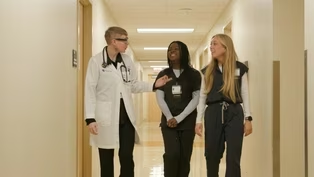
Giving Students a Peak Into the Medical Field
Video has Closed Captions
Clip: S4 Ep122 | 3m 14s | A UK internship program allows students to spend time with clinical teams all year. (3m 14s)
Providing Support for PBS.org
Learn Moreabout PBS online sponsorship
- News and Public Affairs

Top journalists deliver compelling original analysis of the hour's headlines.

- News and Public Affairs

FRONTLINE is investigative journalism that questions, explains and changes our world.












Support for PBS provided by:
Kentucky Edition is a local public television program presented by KET