State of Affairs with Steve Adubato
CEO of NJ TRANSIT on preparing for the FIFA World Cup
Clip: Season 10 Episode 3 | 15m 6sVideo has Closed Captions
CEO of NJ TRANSIT on preparing for the FIFA World Cup
Kris Kolluri, President and CEO of NJ TRANSIT and Executive Director of the New Jersey Turnpike Authority, joins Steve Adubato to discuss the opening of the new Portal North Bridge, ongoing rail infrastructure repairs, and preparations for the FIFA World Cup.
Problems playing video? | Closed Captioning Feedback
Problems playing video? | Closed Captioning Feedback
State of Affairs with Steve Adubato is a local public television program presented by NJ PBS
State of Affairs with Steve Adubato
CEO of NJ TRANSIT on preparing for the FIFA World Cup
Clip: Season 10 Episode 3 | 15m 6sVideo has Closed Captions
Kris Kolluri, President and CEO of NJ TRANSIT and Executive Director of the New Jersey Turnpike Authority, joins Steve Adubato to discuss the opening of the new Portal North Bridge, ongoing rail infrastructure repairs, and preparations for the FIFA World Cup.
Problems playing video? | Closed Captioning Feedback
How to Watch State of Affairs with Steve Adubato
State of Affairs with Steve Adubato is available to stream on pbs.org and the free PBS App, available on iPhone, Apple TV, Android TV, Android smartphones, Amazon Fire TV, Amazon Fire Tablet, Roku, Samsung Smart TV, LG TV, and Vizio.
Providing Support for PBS.org
Learn Moreabout PBS online sponsorship[INSPRATIONAL MUSIC STING] - Hi everyone, Steve Adubato.
We kick off the program with a man who has tremendous responsibility for moving people and goods all over the place, from New Jersey, New York, back and forth.
He's Kris Kolluri, President and CEO of, you've heard of New Jersey Transit, and also the Executive Director of the New Jersey Turnpike Authority.
Kris, good to see you.
- Good to be with you, Steve.
- Let me disclose this before we move forward.
That New Jersey Transit has come on board as an underwriter of our programming, particularly and connected to the FIFA World Cup Initiative over in the Meadowlands area, which is gonna be interesting, Kris, we'll talk about that in a second.
But let's do this.
I saw you on an interview you did with our colleagues at NJ Spotlight News with Joanna Gagis, our former colleague here.
You talked a lot about, the word infrastructure was used a lot.
You were talking about the Portal Bridge, the fixing of the bridge.
We're taping this on St.
Patrick's Day, the 17th of March.
Make infrastructure real for people so it's not some sort of government engineering jargon, but is real in people's lives as it relates to New Jersey Transit and fixing what needs to be fixed, and has been ignored for an awfully long time.
Loaded question, I know.
- That's okay.
Steve, I know we use words like infrastructure, mass transit, that may or may not mean much to people, but let me say this.
New Jersey has a quality of life that has been cherished for as long as the Republic has been around.
If the Republic is going to continue surviving, and New Jersey is gonna be on top of that pyramid, economic pyramid, we need for people to be able to get from home to work on time and in a reliable manner.
That's what the entire mission that I have and the agencies are driven to make sure they meet that objective.
That's it.
Plain and simple.
If you want the quality of life in New Jersey to continue, we have to make sure we can get people from point A to point B on time.
- But here's the thing.
I keep thinking, you're fixing, you come in, you knew the mess that was there when you came in.
You're not surprised.
You've been involved in government, in quasi-government entities like this.
You formally headed up the Gateway Corporation, did you not?
- I did.
- Got a little project going on, getting people back and forth from New York, New Jersey.
You knew what you were going into.
And here's the thing I keep thinking about.
These repairs, to me, repairs equal improvement/delays.
To what degree do you believe most people, who dependent upon, or depend upon transit back and forth, particularly mass transit, understand that there's a direct connection between repairs and delays?
- Well, I think when people went through the Portal Bridge this Monday, actually on Friday, I should say, two days before schedule, I think they got to see for the first time what it means to have a reliable service.
And look, the number of emails and text messages and Instagram posts I get of people sometimes being frustrated, they are late for their child's baseball game or theater class.
This is what it's about, Steve.
It is nothing more than that.
And there's another point.
We're about to celebrate America's 250th anniversary.
I look at America's greatness.
We are a country that builds big things.
Not because they're pretty, but 'cause they mean something to where we are as a nation and as compared to the rest of the world.
We are the most important builders of mega projects and there's no reason why we shouldn't continue.
We're doing that so people can have a better quality of life.
- But at the same time, communicating to the public what's going on, why it's going on, what the impact will be, including delays for future progress is critically important to New Jersey Transit.
How would you rate the job that New Jersey Transit has done to date communicating with commuters in an honest, timely, effective fashion?
- I started communicating about the Portal Bridge Project four weeks before the project even started.
- You did?
- I've done more television interviews, radio interviews, and press interviews on that project than anything else, including the strike I went through last year.
I think it is imperative our residents know real-time information.
Our work is not done yet, Steve.
I think we have a long way to go, but the fact that people like me are out there, telling our residents and our riders what's happening every day, every minute, every second, needs to continue to happen.
- But Kris, here's the thing.
No doubt that you've been doing that.
But before you got in there, and again, I know it's not appropriate to criticize the previous leadership, but by any reasonable standard, Kris, there was not that level of communication.
So therefore, here's the question I keep asking myself about you in this role.
Are you playing catch up right now, with commuters and communicating?
- There's no doubt that the company as a whole is playing catch up after 45 years of basic neglect.
This isn't a one year, two year neglect.
I think what Governor Murphy started, and what Governor Sherrill about to finish essentially in the next eight years is a road to recovery on making sure our basic repairs happen.
Our basic rail fleet is modernized.
Steve, I mean, it is shocking to me.
It's almost malpractice that 60% of our rail cars are from the 1970s and '80s.
How is that even possible?
It makes no sense.
- How is that, Kris, sorry for interrupting.
It's not a rhetorical question.
How is that possible?
Because those cars have to be taken out, new ones put in, a lot of money and a lot of time that it takes to do that and a lot of work.
And thank you to all the folks who are out there working every day, the laborers.
Kris, how the heck does that happen?
- It happens because over the 45 years, for 20 out of that 45, basically we had the kind of disinvestment that has resulted in where we are right now.
It is shocking to me, but it is also not surprising, because this is a concerted effort that you have to be committed to day in, day out, morning hour, rush hour, evening rush hour.
That is, it is a day-to-day, hour-by-hour fight to get the system back.
And that's what the governor has tasked me to do.
- Connect it back to Governor Sherrill.
We are doing this on the 17th of March.
It'll be seen later.
By the way, we're also recording a full half hour with Governor Sherrill today.
And trust me, transit will be a part of that conversation, because it has to be.
But Kris, I'm curious, in her budget address, she was very specific about a whole range of things, including the investment in New Jersey Transit.
First, is New Jersey Transit a state agency?
Or is it an entity, a corporation with its own board, its own governing process, that somehow is connected to the state and somewhat dependent upon the state for funding?
Which one is it?
- Look, I'm a lawyer, so I respect the Supreme Court.
- I know.
I respect the Supreme Court's recent case and decision.
- Yes.
- In saying that New Jersey Transit is an independent body.
I happen to disagree, but look, there is the highest court of the land, and their ruling holds, we will deal with that.
But I think there's no doubt, practically speaking, forget legally for a second.
Practically speaking, we are of an instrumentality of the state, meaning we are in the state of New Jersey, and operated by the state of New Jersey.
Most of my funding comes from the state of New Jersey.
So forget legal stuff for one second, but practically that's where we are.
This governor, other than Governor Murphy's attempts over the last eight years, this governor is the first governor in recent memory who has basically increased the New Jersey transit budget by 11%.
That's at least in her proposal, that is what it requires.
That is what is needed, I should say, to make sure we can keep up with the cost.
Steve, just this year alone, material cost, because of supply chain and tariffs went up by $50 million.
That is more than the fare increase last year.
So this is the only way we can do it.
It's an important service we provide to the residents of New Jersey, and the governor recognizes it and I'm so grateful for her for doing it.
- And real quick, give us 30 seconds or less on the Turn- the other job you have in your spare time.
You're heading up the Turnpike Authority.
How are you juggling that, Kris?
- I think the governor's lenses on this is exactly right.
We should be less worried about what mode people use to get from point A to point B. We should be worried about making sure they get from point A to point B. So regardless whether I run the toll roads, or the transit system, my singular objective is focused on moving people efficiently and safely, regardless of what choice they use.
- Let's talk about the FIFA World Cup.
- Yep.
- Well before you're at New Jersey Transit, let's just say there was, was there a Super Bowl?
I seem to remember Kris, at some point?
And there was some issues, let's say, - That's right.
- About moving people.
- Yeah.
- That's right.
- So what is, A, New Jersey Transit very involved in this initiative?
We'll be doing extensive programming around the FIFA World Cup this summer.
Part of that's gonna be happening over in the Meadowlands at MetLife.
Here's the question.
What are the top two or three challenges you face?
A and B?
Why are you confident you'll be able to address them and move people how they need to be moved, when they need to be moved to get where they need to get to in an incredibly busy time in our region?
- Absolutely.
Steve, I think it's important to first understand the context.
This is a security event that happens to have a soccer game in the middle.
That is truly what is about to happen.
The eyes of the world will be on FIFA, and our job is to make sure we are working within the security apparatus that is gonna be established.
Our objective is to move 40,000 people per game.
We've been planning for this for three years.
What I can assure you is things that are within our control at the Turnpike and at Transit and at Port Authority, I think we'll handle.
But things outside our control, weather, acts of God, obviously, and any other security issues are outside our control.
So I feel fairly confident based on the preparation that we have things within our control in a good place.
- Before I let you go, Kris, let's do this.
You understand the Gateway Tunnel Project better than most.
You headed up the Gateway Corporation a while back.
Explain to folks who just hear Gateway, they don't really know what it means.
I'm not being critical, folks.
It's hard to follow all the minutiae of it.
What is Gateway, and why is it so critically important to New Jersey and this region?
- There are two tunnels that currently connect New Jersey to New York that were built over 100 years ago.
If we don't repair or replace those tunnels, we will have one day, an absolute crisis that will literally stop the entire Northeast train travel for months, if not years.
So we started this journey well over three decades ago to try and build a brand new set of tunnels under the Hudson River to replace and to make a redundant system for the riders.
Basically, Steve, this goes back to the very first question you asked me at the interview.
Our job is to make sure people get from point A to point B safely.
The current tunnels are fine for now, but sooner or later, they have to get replaced.
And that is what we are doing with the building of the Hudson Tunnel Project.
No one but the governor has been a bigger champion of this project.
The fact that she fights for it to make sure it's fully funded is a testament to how she recognizes how important this is for New Jersey.
- But Kris, the governor fighting is not just for the tunnel.
The governor is also fighting directly with the Trump White House, who at times, has made it clear that they're attempting to stop the project because it's overrun, DEI, whatever it is, they're arguing.
This cannot be done.
And if I'm wrong, push back, Kris Kolluri, this project cannot be done with state money alone, with Port Authority money alone, it has to be with the Feds as well, correct?
- But when I was CEO, - And the Amtrak, whose money, is it Amtrak?
- Federal government and state's.
- Not the Port Authority.
I made that mistake.
Not the port- - The Port Authority is in there too, so... - Okay, but I'm sorry, Kris.
- The state of New York, Port Authority, Amtrak, and the federal government are biggest contributors to this.
Look, all the arguments, Steve, that the federal government has used, not one person, including the president, has said that the project itself is not meritorious.
They fought about other things that are unrelated to the merit of the project.
Not one person, including the President of the United States, has said this project is not worth doing.
That is the most important thing to remember.
And I, again, America is built on great projects, whether it's the Hoover Dam, whether it's the first set of tunnels, you name it.
This is part of that legacy.
And I'm telling you, this will get built.
- Kris Kolluri, President and CEO of New Jersey Transit and Executive Director of the New Jersey Turnpike Authority.
Kris, also on the ROI Influencers List of 2026.
He's on a lot of other lists too, as a top influencer and policymaker.
Kris, thanks so much for joining us.
- (Indistinct).
- You got it.
Stay with us, we'll be right back.
- [Narrator] State of Affairs with Steve Adubato is a production of the Caucus Educational Corporation.
Funding has been provided by Seton Hall University.
PSE&G.
New Jersey Sharing Network.
Garden State Initiative Holy Name.
New Brunswick Development Corporation.
The Port Authority of New York and New Jersey.
Eastern Atlantic States Regional Council of Carpenters.
And by United Airlines.
Promotional support provided by ROI-NJ.
And by Meadowlands Chamber.
- Are you looking to be a part of a dynamic, forward-thinking business service organization?
At Meadowlands Chamber, every day we connect, collaborate and innovate, helping to drive business and economic growth in the greater Meadowlands and New Jersey.
I invite you to visit our Meadowlands Chamber headquarters, an open office facility with access to resources for our members' businesses and networking needs.
Together, we will build the chamber of the future, and the next generation of leaders.
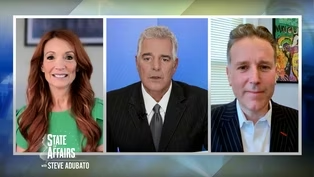
Political strategists discuss the Sherrill administration
Video has Closed Captions
Clip: S10 Ep3 | 11m 46s | Political strategists discuss the Sherrill administration (11m 46s)
Providing Support for PBS.org
Learn Moreabout PBS online sponsorship
- News and Public Affairs

Top journalists deliver compelling original analysis of the hour's headlines.

- News and Public Affairs

Today's top journalists discuss Washington's current political events and public affairs.












Support for PBS provided by:
State of Affairs with Steve Adubato is a local public television program presented by NJ PBS