
Cera Program/Eyes on the Prize
Season 49 Episode 14 | 26m 46sVideo has Closed Captions
Cera Program/Eyes on the Prize | Episode 4914
There’s help available for tenants behind on their rent due to the pandemic. We’ll get the details on financial assistance and the extended ban on evictions. Plus, a landmark 1987 history series about civil rights in America is making a comeback. We’ll talk about the return of “Eyes on the Prize.” Episode 4914
Problems playing video? | Closed Captioning Feedback
Problems playing video? | Closed Captioning Feedback
American Black Journal is a local public television program presented by Detroit PBS
Cera Program/Eyes on the Prize
Season 49 Episode 14 | 26m 46sVideo has Closed Captions
There’s help available for tenants behind on their rent due to the pandemic. We’ll get the details on financial assistance and the extended ban on evictions. Plus, a landmark 1987 history series about civil rights in America is making a comeback. We’ll talk about the return of “Eyes on the Prize.” Episode 4914
Problems playing video? | Closed Captioning Feedback
How to Watch American Black Journal
American Black Journal is available to stream on pbs.org and the free PBS App, available on iPhone, Apple TV, Android TV, Android smartphones, Amazon Fire TV, Amazon Fire Tablet, Roku, Samsung Smart TV, and Vizio.
Providing Support for PBS.org
Learn Moreabout PBS online sponsorshipComing up on "American Black Journal," there is help available for tenants who are behind on their rent due to the pandemic.
We're gonna get the details on financial assistance and the extended ban on evictions.
Plus, a landmark 1987 history series about civil rights in America is making a comeback.
We're gonna talk about the return of "Eyes on Prize."
Don't go anywhere.
"American Black Journal" starts now.
Announcer 1: From Delta faucets to Behr paint, Masco Corporation is proud to deliver products that enhance the way consumers all over the world experience and enjoy their living spaces.
Masco, serving Michigan communities since 1929.
Announcer 2: Support also provided by the Cynthia & Edsel Ford Fund for Journalism at Detroit Public TV.
Announcer 1: The DTE Foundation proudly supports 50 years of "American Black Journal" in covering African-American history, culture, and politics.
The DTE Foundation and "American Black Journal" partners in presenting African-American perspectives about our communities and in our world.
Announcer 2: Also brought to you by AAA, Nissan Foundation, Ally, Impact at Home, UAW, solidarity forever, and viewers like you.
Thank you.
♪♪ Welcome to "American Black Journal."
I'm Stephen Henderson, and I'm glad you've joined us.
The Biden administration has extended a federal ban on evictions for renters who have fallen behind on payments during the pandemic.
The moratorium, which was scheduled to end on March 31st, now runs until the end of June.
The protection was put in place last year to keep families from losing their homes and potentially spreading the coronavirus by moving into crowded shelters or into the homes of relatives or friends.
Meanwhile, here in Michigan, financial support is now available through the COVID Emergency Rental Assistance Program.
I spoke with the heads of two Detroit nonprofits that are implementing the program: Ted Phillips of United Community Housing Coalition and Tasha Gray from the Homeless Action Network of Detroit.
It was really great news when we heard that they were gonna extend the eviction moratorium to the end of June.
I think a lot of people were really worried about what would happen if that expired at the end of March, but it still says that in July, and then into the summer and fall, we're likely to have a real issue.
Talk about what should happen then.
What should we be prepared for, and what should we be doing about it?
Well, what we should be doing about it is like right now, and we are.
And so there are cases coming to court every day.
There's a lot that we have been working on since the first of the year.
The new federal funds in the SARA Program have finally been released, so we're gonna be in a position to take care of the backlog and hopefully between now and the end of June get caught up so that anyone going forward is gonna be in better shape than they are right now.
We were very worried because there were a number of people that had filed the applications for the extended time to March 31st, but there's no way of anyone could know who those people were.
There was no records really with the court.
It's not something you filed with the court.
So we were very concerned that there was an unknown number of cases that could have been April 1st or 2nd, facing being set out.
But the main thing right now is to be able to be proactive with the funds that we have, be on top of the cases, and working with them.
And, Tasha, I wonder if you can give us a sense of what the last year kinda has looked like for your organization and the people you advocate on behalf of.
We were really concerned when the pandemic struck, and we were concerned about particularly how it was gonna impact this population, people who are experiencing homelessness, whether they're in shelters or out on the streets.
And surprisingly enough, we really were able to weather that storm, sometimes even better than how the general public has weathered the storm.
It was a ton of great partnerships that came together, both public and private.
The city did a great job assisting shelters, make sure that they were doing social distancing, providing places for folks to go if they tested positive or even had symptoms.
And so we were really able to weather the storm, and I think we learned a lot about our system as a result of the crisis and just pulling together.
And what are you anticipating sort of going forward as the world comes back together, as the eviction moratorium eventually falls.
What are we gonna be contending?
Yeah, so one thing that has been an interesting phenomenon, and we're hearing about this across the country, one of the things that we have noticed is that it just seems to be harder now to get someone into housing, especially those who are experiencing homelessness.
And what we have been hearing is that it's because people are not being evicted.
So oddly enough, I mean, it makes sense when you think about it, but evictions were causing turnover, and with turnover, there were units that are available.
And so now what we're finding is that it's just much harder to house people, and we anticipate that that might keep up for a while.
So I think one of the things we're faced with is really getting creative with how we outreach to our landlords and our private market.
And then also just thinking about how we can more be innovative in solutions to finding housing for people experiencing homelessness.
Yeah.
Ted, I have gotten a number of emails or Facebook messages from landlords and their advocates who have said that they feel like their concerns and their interests haven't been addressed sufficiently during the pandemic.
I would imagine that you're familiar with those arguments as well.
But I wanna give you a chance to address that.
I mean, landlords have to make money just to maintain the units that they provide for people, even low-income people, and a lot of them have been going without a lot of money over the last year.
Where should that problem rank in our consciousness?
I think it should rank pretty high.
I just wanna piggyback a little bit on what Tasha had said.
The other issue with finding housing is landlords' reluctance to take people who are unemployed, getting unemployment, have had a recent past problem paying rent.
So there's a combination of things, but it is a real serious problem.
But certainly we've seen a lot of landlords that have been hurt by the pandemic, as have just about every business that you can think of.
I mean, one of the other ways of looking at it from the previous program, the Eviction Diversion Program last fall, is that this was a program that was paying 90%, requiring the landlords to take a 10% hit on their rent.
And we had a fair bit of pushback on that.
But I would say to them, "The businesses that I shop at, the bakeries, the restaurants, or whatever, places that I go other than the supermarket, I'd ask the folks there, 'What's been your hit?
Would 90% of your profits for the last year, would that have been okay?'"
You know, "Of course, of course."
So we've all been hit.
You know, everybody's been hit in a really bad way, and certainly landlords have too.
I know there's some that have advocated for sort of the free rent thing, and I said, "We've not been hounded on that.
We need to find ways to help tenants who are struggling to pay the rent because it's the right thing for them, but it's also the right thing for the landlord as well."
But there's gonna have to be some sort of a loss that everyone's taking and sharing it equally.
And now the new program that's coming in is much more generous than the last one.
It can go back with, for some tenants, as much as 12 months and pay fully, and for a little bit higher income, it can go up to 10 months.
But there still may be situations where landlords need to take a little bit of a loss.
There are tenants that owe even more than that, but if a landlord could get the last 12 months worth of rent and they have to forgo a month or two, that doesn't seem like that's unfair given what everyone has gone through.
Yeah.
Yeah.
Tasha, I am curious about what you think learned in the last 12 months that might fundamentally alter the way we think about these issues going forward.
I've been talking to people in lots of different sectors about the sort of accidental discovery of emergency.
You know, crisis creates all kinds of innovation, and sometimes there are innovations that we say, "Hey, that actually works better."
I wonder if you've seen things in homelessness or housing that would fall into that category.
Absolutely.
I think we've learned some things about funding, for example.
We often relied a lot upon our government partners to be able to provide the funding that was necessary in order to move people into housing or to keep people in their housing.
And we've known for a long time that there are some shortfalls to that.
There are a lot of people who may be screened out because of different criteria and things of that sort.
And so what we saw during the pandemic, though, was really an interest from the private market, from the foundations and even corporations, really coming to the table in a way that they had not come before and being able to provide resources that were more flexible.
Ted talking about the program that they're implementing right now, we used to only be able to see people with area median income of, at most, about like 50%, and this goes up to like 80%.
So just seeing different resources that are coming to the table that are allowing us to more fulsome meet the needs of the household.
I would say that that's one thing we've learned.
I also think that we've learned that it's just no longer acceptable, and it never should have been, but homelessness is just no longer acceptable.
We can't just work on it during a pandemic and provide all of the resources in a pandemic, and then once that's over, kinda go back to the same way of thinking, right?
If it was a priority then, it has to be a priority going forward because it's humanity.
A new generation of viewers can now watch the iconic history series "Eyes on the Prize."
The 1987 documentary on civil rights in America is being rebroadcast every Sunday at 9:00 p.m. on Detroit Public Television's WORLD Channel.
The relaunch of the series comes as the nation marks 53 years since the death of Dr. Martin Luther King, Jr.
Here's a preview followed by my conversation with WORLD Channel executive producer Chris Hastings and Judi Hampton, who is president of the production company Blackside Inc. and the sister of the series' late creator, Henry Hampton.
The fear that had shackled us all left suddenly when we were together.
(crowd screaming) (somber music) If you can't vote, you ain't free, and if you ain't free, well, then you're a slave.
NARRATOR: It might seem like ancient history.
He said, "Why don't you stand up?"
I said, "I don't think I should have to stand up."
All you niggers, get up from the lunch counter, or we're gonna arrest you.
NARRATOR: But the stories still resonate for us all.
There was not a Black face in sight.
We might as well ask for complete desegregation.
Segregation in the North is dynamic.
It's real, blatant, ugly, violent.
What you want is the nation to be upset when one of us is killed.
NARRATOR: "Eyes on the Prize," the landmark series which takes you back to see and hear the stories that created a movement.
Movement method.
Finally we were encountering on a mass scale the evil that had been destroying us on a mass scale.
Chris Hastings and Judi Hampton, welcome to "American Black Journal."
Thank you.
Thanks for having us.
So, Chris, I'm gonna start with you.
Talk about why now is the right time for us to re-air "Eyes on the Prize" and why is it the right time for America to watch "Eyes on the Prize" again?
At WORLD Channel, we have this sorta understanding that we wanna make sure that public media is a reflection of itself.
And as we look at what we're going through, from the pandemic to a year of racial reckoning, we wanted to make sure that America understands that the things that we're going through, this great change, this conversation about race, that we've been through this before, and the best way to sort of articulate that is through media.
"Eyes on the Prize" has been one of those groundbreaking series that really, really captures America's history when it comes to civil rights and how we have had to fight for inclusion in this country.
As we sort of were talking amongst ourselves at WGBH Boston and at WORLD Channel with PBS, after George Floyd's death last year, we've really wanted folks to have "Eyes on the Prize" in front of them as we all sorta deal with this change that we're going through.
And so we thought now would be a good time to put it back out into the public space so that people can learn from the experience of everyday leaders of the '50s and '60s and how they try to create change in this country.
Yeah, yeah.
So in the summer of 1988, I was a freshman in college at the University of Michigan, and I had an English teacher who set aside a couple of class periods for us to watch this.
And I remember it quite vividly.
He was only able to show us a few chapters of it, but I went and found a way to watch the rest of it.
But I distinctly remember after the first time we saw, the first part of it that we saw, after the class and everyone was kind of walking out, I mean, there was just this dead silence among us.
I mean, it was so powerful, and it made such an impression on us.
It's hard to overstate, in fact, I think, the power of the content here.
This is America's story, but it is Black America's story in a way that little other material that I can think of quite rises to that level.
Mm-hmm, I agree.
I agree.
When you think about the stories that are captured in "Eyes on the Prize," everything from Emmett Till's death and the repercussions, those moments are things that every young person should know about so that they know how to deal, how they should respond to the ongoing oppression that happens in this country.
And I can remember seeing it when I was a young person, and, in a lot of ways, it's a lot of reasons why I'm in public media, is that media has this power to give us a reflection, to be a tool for us to learn how we should respond to things that are happening in everyday life.
And so I think what you experienced as a college student, we wanna make sure that young people today, they have it so that they can too be grounded in knowing that there's a roadmap for change.
There's a roadmap for leading.
There's a roadmap of folks in our history who can guide us through these hard times.
Yeah.
Yeah.
Judi Hampton, I wonder if you can talk about the journey your brother took to making "Eyes on the Prize," what inspired him and how did he get to the space to be able to share this with the rest of our nation?
Well, when Henry was in the Selma March, he looked around him and he saw a television.
He said that he thought that story should be told on television, and it was unfolding in front of him.
And he was, he and his producers, wanted people to know about the unsung heroes we don't meet, all the ordinary people that you don't necessarily know their names.
And with all due respect to the Martin Luther Kings and these other great leader, there were people whose names that you did not know.
And so if you look at "Eyes on the Prize," it focuses on those ordinary people and what they did, the people before Rosa Parks who sat down on the bus, the people who went there and protested and took the life in their hands.
I was blessed to be a civil rights worker in the '60s, so Henry and I came at it from different ways, and I can't see "Eyes" without being reinspired.
I always tell people that I love it because it, to me, it is about three extremely important things.
First, leadership.
We have lots we could talk about on leadership now, lots of we have to do.
Grassroots, which just put this election where it went.
And understanding how powerful grassroot...
I mean, we have technology now.
The woman who printed up the flyers behind the boycott, and she's in "Eyes."
You know, we're busy texting, and so the woman, she was sitting up all night, running her fax machine for 30,000 notices to go to people that wanted to be in the movement, wanted to help.
So the last thing is personal sacrifice, and that's huge, and that was certainly covered in "Eyes."
So I think in those three areas, it's become a study book thanks to teachers and others.
Yeah, so you have also tried to continue the work that your brother started in his production studio.
Tell us what that work looks like today.
Yes, I've had lots of help too with the "Eyes on the Prize" team from here to there and we worked on with Washington University in St. Louis that carries the archives.
For all, "Eyes" is a great place for people to go to look at interviews in that aspect.
I wanted, after Henry passed, really wanted to get this back out there, so we spent, oh, I don't know, almost eight years or so raising money to clear the rights to "Eyes," and it just became a priority for me.
I know if Henry was still with us.
it would be a priority for him and his producers, yeah.
Chris, I wonder if you think the message resonates differently in 2021 than it did in 1987.
I mean, I can remember what was going on in 1987.
It was, in some ways, a quieter time in our country.
Now, of course, we're in the middle of, I think, a pretty significant transition again.
Will this land differently on people's eyes and ears?
I think, well, I mean, I think in the pace of media today, things are so in front of everyone, right?
And I think what "Eyes" is, it's an accessible way for us to understand and deal what we're dealing with as it sort of comes at us through mobile clips.
My hope is it's grounding in journalism, it's grounding in the interviews of everyday leaders, everyday people from the past, whereas the clips that we're getting through Instagram and Twitter sometimes doesn't come with context.
I think what Henry and the team did was really gave us good context and good information and truth.
And so I hope it lands in the right way for everybody.
I hope in the same way that it made people pause in 1988, it'll make people pause and get a good understanding of where we are.
But I hope it's still that impact is still there.
I think it still holds up as a series and as a work that is transformative for folks who see it.
Again, you can watch this wonderful 14-part series, "Eyes on the Prize," on Sunday nights at nine o'clock on the WORLD Channel, or you can stream it on the DPTV Passport.
That's gonna do it for us this week.
Thanks for watching.
You can find out more about our guests at americanblackjournal.org, and, as always, you can connect with us on Facebook and on Twitter.
We're gonna leave you with one of our favorite performances of "Lift Every Voice and Sing" by the Sphinx Organization's vocal ensemble.
We'll see you next time.
♪ Lift every voice and sing ♪ Lift every voice and sing ♪ Till earth and heaven ring ♪ Ring with the harmonies ♪ Of liberty ♪ Let our rejoicing rise ♪ High as the listening skies ♪ Let it resound loud ♪ As the rolling sea ♪ Sing a song ♪ Full of the faith that the dark past has taught us ♪ ♪ Sing a song ♪ Full of the hope that the present has brought us ♪ ♪ Facing the rising sun ♪ Of our new day begun ♪ Let us march on ♪ Till victory is won ♪ Won Announcer 1: From Delta faucets to Behr paint, Masco Corporation is proud to deliver products that enhance the way consumers all over the world experience and enjoy their living spaces.
Masco, serving Michigan communities since 1929.
Announcer 2: Support also provided by the Cynthia & Edsel Ford Fund for Journalism at Detroit Public TV.
Announcer 1: The DTE Foundation proudly supports 50 years of "American Black Journal" in covering African-American history, culture, and politics.
The DTE Foundation and "American Black Journal" partners in presenting African-American perspectives about our communities and in our world.
Announcer 2: Also brought to you by AAA, Nissan Foundation, Ally, Impact at Home, UAW, solidarity forever, and viewers like you.
Thank you.
♪♪
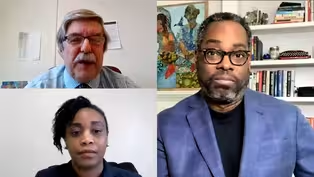
Video has Closed Captions
Clip: S49 Ep14 | 9m 42s | Cera Program | Episode 4914/Segment 1 (9m 42s)
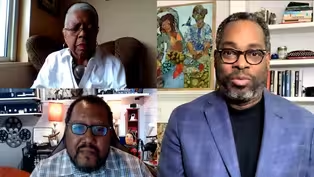
Video has Closed Captions
Clip: S49 Ep14 | 10m 30s | Eyes on the Prize | Episode 4914/Segment 2 (10m 30s)
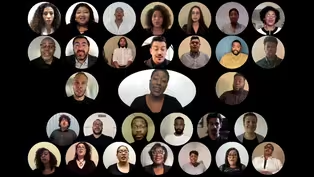
Video has Closed Captions
Clip: S49 Ep14 | 1m 44s | Lift Every Voice and Sing | Episode 4914/Segment 3 (1m 44s)
Providing Support for PBS.org
Learn Moreabout PBS online sponsorship
- News and Public Affairs

Top journalists deliver compelling original analysis of the hour's headlines.

- News and Public Affairs

FRONTLINE is investigative journalism that questions, explains and changes our world.












Support for PBS provided by:
American Black Journal is a local public television program presented by Detroit PBS