
Challenge Accepted
Season 4 Episode 4 | 26m 46sVideo has Closed Captions
Utah boasts a rich history of athletes who fearlessly face any obstacle.
Utah boasts a rich history of athletes who fearlessly face any obstacle, from amateurs, to professionals, and Olympians like the remarkable fencer Shelby Jensen. Despite a childhood stroke, she trained hard to represent the United States at the Paralympic Games. Then, discover three women who united to establish a welcoming and diverse community for climbers of color in Utah's bouldering world.
Problems playing video? | Closed Captioning Feedback
Problems playing video? | Closed Captioning Feedback
This Is Utah is a local public television program presented by PBS Utah
Funding for This Is Utah is provided by the Willard L. Eccles Foundation and the Lawrence T. & Janet T. Dee Foundation, and the contributing members of PBS Utah.
Support provided by:


Challenge Accepted
Season 4 Episode 4 | 26m 46sVideo has Closed Captions
Utah boasts a rich history of athletes who fearlessly face any obstacle, from amateurs, to professionals, and Olympians like the remarkable fencer Shelby Jensen. Despite a childhood stroke, she trained hard to represent the United States at the Paralympic Games. Then, discover three women who united to establish a welcoming and diverse community for climbers of color in Utah's bouldering world.
Problems playing video? | Closed Captioning Feedback
How to Watch This Is Utah
This Is Utah is available to stream on pbs.org and the free PBS App, available on iPhone, Apple TV, Android TV, Android smartphones, Amazon Fire TV, Amazon Fire Tablet, Roku, Samsung Smart TV, and Vizio.
This is Utah
Liz Adeola travels across the state discovering new and unique experiences, landmarks, cultures, and people. We are traveling around the state to tell YOUR stories. Who knows, we might be in your community next!Providing Support for PBS.org
Learn Moreabout PBS online sponsorship(Gentle Music) Welcome to the show.
We are so happy that you've joined us for another edition of This is Utah.
I'm your host, Liz Adeola.
Utah is home to many impressive athletes who shine season after season.
Coming up, meet a local Paralympian athlete on a journey to go for the gold.
Plus, find out how these climbers are drafting a new route to inclusive bouldering.
This is Utah is made possible in part by the Willard L. Eccles Foundation, the Lawrence T and Janet T. Dee Foundation, and by the contributions to PBS Utah from viewers like you.
Thank you.
(Upbeat Music) - It's often described as a physical game of chess, but with a weapon.
Welcome to the world of fencing.
Where one woman shows us how the mind and body work together to beat the odds and win.
- [Referee] En garde.
Ready.
Fence.
(swords clanging against each other) - I joke with people and say I like to hit people with swords, but no, no, that's not, that's not the real reason.
(swords slicing against each other) I guess it's the mental game I really like.
Challenging your opponents subconsciously with your actions that you do.
(slow, inspiring music) - I've spent more than half my life with this disability, so it's just normal to me.
I don't think I ever realized that something bad had happened.
I think there was moments when I felt like, is this gonna be okay?
Am I gonna be okay?
When I was about 15, 16 years old, I found fencing.
Fencing has given me a sense of purpose.
My parents are a huge part of why I do what I do.
They support me and they love me.
They're amazing and I can't thank 'em enough.
- Sheri and I were married for approximately eight years, seven years before she got pregnant.
Eight years wasn't?
- Seven.
- I thought it was somewhere in there.
Shelby came into our lives and you know, it was just a wonderful experience for us.
We had, you know, a little baby.
Taking care of her, seeing her grow up.
- [Sheri] One night she was doing her homework and she couldn't write the number four.
Then she told me her memory was fuzzy and that her thoughts were gone.
- [Jed] One thing led to another and you know, then she had a stroke when she was seven years old.
- And they brought up the x-rays, the pictures and said, this is the aneurysm and this is what we have to do.
We have to go in there and operate.
There's a chance she's not gonna make it But if we don't operate, she won't make it.
They didn't realize how big the aneurysm was.
So she was really kind of a, a miracle baby.
- Then we were just kind of wondering, what do we do now?
- [Sheri] Everything was starting over.
We had a seven year old toddler, basically.
She had to learn how to walk and talk and swallow.
Everything.
- And everybody came up to us and sensed at that time, and told us is, you're gonna be surprised.
She's gonna surprise you.
Seriously, a lot of people said that to us and we had no idea.
(small crowd cheering) - [Male Referee] Fence.
Halt.
- I was volunteering for a wheelchair sports camp and I came across wheelchair fencing.
- [Male Referee] Halt.
- [Shelby] I went to my first competition about three and a half years ago.
- [Male Referee] Halt.
- [Shelby] I absolutely loved it and I decided then, that I would go internationally.
(Shelby yelling in frustration) - I put in a lot of time and effort to get where I am.
- [Brandon] Is that too tight or you good?
- [Shelby] Tighter.
- Once I got introduced the sport, it's like, oh, this is a whole different level of fencing where you can't run away, you're forced to fight and this is like a knife fight up close.
So this is close quarters combat.
(swords tapping against each other) - There's three different weapons.
Each have their own style and way to go about it.
They have different areas of points, where to target.
One's really a mental game, one's mental, physical and the other one's mental and speed.
Shelby, she's definitely accelerated her skill level and it's been really exciting to watch.
'Cause when she started it was like, oh this is awesome.
She's excited about it, she has passion for it.
Cool.
And then all of a sudden she just started building and had just started this momentum and it's been an amazing experience.
I'm just like, super stoked to be a part of it.
- I was at work, I started getting calls from my coach, my mom, my manager, and everybody's just like, look at the email.
I looked out the email and said I had made it to the Paralympics and I started sobbing with joy.
I'm like, I actually did it.
- [Crowd] USA.
U.S.A. USA.
- Just chanting, USA, USA.
That moment, it clicked.
I'm at the Paralympics, I'm representing the USA.
It just gave me chills.
It honestly is the highest achievement I've accomplished in my life so far.
In Paris, I hope to win a medal, but if I don't that's okay.
I still have at least one or two more chances after that.
(swords tapping against each other) - [Brandon] There you go, good.
I've watched every single bout frame by frame, touch by touch and just trying to get everything dialed in with body technique, tip control, everything.
There it is.
Yeah, let that come down.
Every time I watch her fence I'm like, I'm like, come on.
Right there.
It's just.
(bell ringing) - Yeah, it's nothing at all.
You just can relax.
It's really like the time and the effort and the work you put into it to get to that, that point to, to really step up.
To compete against like, the best in the world at that level is, is really a dream that I think every athlete has had.
And most never get to get there.
She's there.
- We're so, so happy and so thankful that she's still here with us.
'Cause that brain aneurysm could have taken her the other way so fast.
But we have a Paralympian in our arms, under our roof and we're so proud of her.
- I just think she's grown into the, such a beautiful person and I can't wait to see where she goes from here.
- I understand the stereotype with people with disabilities.
Perceptions and like, they need extra help but that's just not who I am.
I don't see myself as my disability.
I see myself as part of everybody else.
An independent, passionate, driven woman.
(Vibrant Asian Music) - Now it's time to meet inspiring leaders who are taking Utahns to new heights.
They're working together to make sure all climbers feel a sense of belonging in the sport and culture of bouldering.
- [Diana] My name is Diana Miron-Valadez.
- [Child] Mama, be careful.
- I'm a member of Latino Outdoors here in Salt Lake City, Utah.
As a founding chapter member, we saw a need to bring our communities together in the outdoors to enjoy it in a state that is so rich with outdoor beauty but equally unaccessible.
As an immigrant child, my outdoor enjoyment was limited to my neighborhood, to the parks and to the streets.
And I've always felt a deep rooted connection to the land, almost like a calling to my cultura, which was ignored until my son was born.
(car beeping) Through him, I saw the world differently.
I wanted him to learn about our culture and to continue our story and enjoy the outdoors.
So as a mother, I looked for activities that would engage him because he has a lot of energy and there was a place that opened up nearby called Bouldering Project.
Now, rock climbing never crossed my mind.
I never saw people like me doing this activity and I've been to places that I felt unwelcomed, but you almost become fearless as a mom.
You want your child to experience everything that the world has to offer.
So I took a chance, a leap of faith, and I came in and from the moment that I stepped into this place, I felt welcomed.
(lighthearted music) It's been nice to see my child be scared of climbing to now going to the top of this boulder behind me.
(lighthearted music) You know, I see him and he reaches a point where he gets stuck and I talk him through it, like that fear, 'cause in his mind he thinks he's gonna fall, right?
But we talked through it and I told him "when you feel in your mind, like that voice that you're gonna fall, just push through it."
And as soon as he did that, there was like that change, and he did it.
And after he comes down, you can see that sense of pride in himself.
- I already know how to do that.
- And I've seen that change in the way that he interacts with people, school, like it has deep, like a deep impact in other aspects of his life.
(lighthearted music) I've gone to places where I didn't feel welcomed because it is predominantly white.
And sometimes there's barriers in making those connections or feeling like, you know, do I belong here?
I avoid those places.
Especially when you're a single mother, you don't want to take your child into a space that you don't feel safe.
And sometimes it's tiring.
You know, it's tiring to keep showing up into spaces where they don't want you.
But at the same time, I wanna show my son that he's gonna have to go through things like this and he has to, you know, push through and not feel scared to show up.
(lighthearted music) - You know, when you enter a space and it's something that's new to you and you don't see someone that looks like you or maybe you don't see a friendly face, it's really intimidating.
It's hard to get into any sport.
Climbing is inherently dangerous and it's maybe not intuitive to run up a wall.
Then if you compound that with people around you who aren't friendly, or aren't willing to show you how to get into the sport, it makes up all that more intimidating.
So it's really amazing when you can walk in here and you know that you're gonna have friendly faces and people who really want you to be here.
- That was cool.
I wanna try it one more time.
- Yeah, yeah, yeah.
- Can you spot one more time?
- [Rebecca] When I met Diana, that was such a special night for me and she let me know that she and her son had never been able to come to a climbing gym before and feel included and feel like this was a space for them.
You got it!
It's a big reach.
That is exactly what I'm trying to do here.
And as somebody who is also Mexican American, it brings me so much joy that it's working.
It's really just all up here.
Like you did all of that work, I just kept you in position.
- I'll fall a bunch of times and then that one day.
I don't know if my body just gives more and then I can do it.
Love it.
(upbeat music) - My name is Rebecca Bowman and I'm the operations manager here at Bouldering Project.
Bouldering Project is really special because we are intentional about making our space inclusive and accessible and safe.
Part of that is why we don't have ropes, why we're a bouldering gym.
Because when you eliminate gear and you provide walls to climb and a pair of shoes, you're opening up this space to a lot more people.
You'll notice that our walls are inclusive for every climber.
From the very beginner all the way to the pro.
You know, there's this standard set that you have to be strong to be in this sport and I really want to dismantle that idea.
I want you to be in this sport if you want to be in this sport.
And so it's really important that we have a space like this in Utah because there are a lot of pro athletes here.
There's a lot of strong people here and climbing was created by white people for white people.
Regardless of the intention behind that, you are excluding a huge percentage of the population.
We want to make this sport more accessible for everyone.
(upbeat music) I grew up surrounded by a huge Mexican culture.
It was amazing.
But even then we didn't go to climbing gyms, we didn't go trail running, we didn't, you know, have access to these outdoor sports.
And I think that's really what shaped what I wanted to do with my life and what I wanted to do with movement, which is make it more accessible.
We're very intentional about partnering with community groups and that includes those who maybe have never climbed, but really want to get into this sport.
Also, we love partnering with other groups who are in the outdoors industry.
(upbeat techno music) We partner with RAR, Radical Adventure Riders.
They focus on mountain and road riding.
We have SLAQK, Salt Lake Area Queer Climbers here every month.
The Dirt Bags Run are a team of black, indigenous, and people of color trail runners.
We work with groups like Color the Wasatch, which is a black indigenous people of color climbing group.
(upbeat music) - Everybody should be having a joyous experience with climbing, right?
Like people's value as human beings does not come from you know, what they look like, what grade they can climb, how long they've been climbing.
Their value is intrinsic within them.
And like we try to be just extremely supportive of all types of diversity, even within our Color the Wasatch group.
(gentle music) My name is Priyam Patel.
When I moved to Salt Lake City, I would see people of color around and just be like, "wow, I like really wanna be climbing with these people.
I wanna know them.
I wanna like know their life stories."
And in the summer of 2020, right after George Floyd was murdered, there were many days in the academic community of reflection, you know, thinking about what kind of change we wanted to make in the world.
And I just felt like the time was right and the response that we got initially was just immense, right?
It was, from the get-go, just something so clearly needed in our community.
(gentle music) Climbing transformed the way I feel about myself and what I'm capable of.
You just become so much more confident.
It's also a huge endorphin high for me.
Like I love problem solving.
The feeling of struggling on something and then pushing and pushing, trying until you just get it.
It's very similar to why I love math.
Proving a math theorem can feel like that a lot of days, where you're just hitting your head against the wall over and over and over, and then all of a sudden there is that moment where things just sort of unfold for you, and all of a sudden you see what the end of the problem should be like.
- I wonder if you can like go all the way around.
- You know, one of our biggest goals is actually breaking down that socioeconomic barrier to a fairly expensive sport right?
Like, yes, you can go bouldering and if you have a crash pad, for instance, and you have knowledge of the local mountains, and a car, and gas, and friends who know the area, and you know, you just start racking it up and it's so expensive.
Let alone rope climbing, which you need tons of gear for safety, right?
And then on top of that, just always having a certain type of person thrown into your face as a climber.
What is a quintessential climber?
And there's that constant questioning of like do I really belong in this space?
Like, is this a safe space for me?
Is this a place where I can feel happy?
Those pieces of questioning is a big part of what we're trying to deconstruct in Color the Wasatch.
I'm very aware that my struggles as an Asian-American woman are very different than those of like black women and indigenous women and so on.
And the thing that I feel like has been the hardest is the constant signaling I get, that like climbing is not made for me and that like I couldn't possibly know what I'm doing.
And I feel that, you know, through conversations with other people of color, that's very similar for them, this feeling of just being the only one like yourself in a room is such a strong burden to bear, that having the community I have, there are days where I walk into the gym by myself and I walk right out and it's sad, right?
That I don't feel comfortable in a space where, I mean, at Salt Lake Boulder Project, I know half of the staff or most of the staff, they've made me feel so welcome.
But it's the culture, right?
It can't just be changed by a few people in charge.
It has to be something that we all embody as a climbing community.
And I am really thankful that I am starting to see that change.
But it has to be behavioral, every day.
Don't stare if somebody doesn't look like you.
Don't make assumptions about somebody based off of height, body shape, body weight, culture, skin color, sex, everything.
I think it really comes from within each person.
Like that change is gonna start having to happen individually if things are gonna get better.
- I think what's really special about SLAQC, Salt Lake Area Queer Climbers, RAR, Radical Adventure Riders, Color the Wasatch, Dirt Bags Run, we're all passionate about different forms of movement, but we're all working to do the same thing.
And that is create more accessible and safe and diverse spaces - Between like summer versus winter, are there any roads or areas that you're just like- - We have a lot of strong females, you know, who are leading these community groups and talk about the challenges that we're facing or what's working, what's not working.
I feel like I'm constantly learning from them.
They're my role models.
And it's really beautiful to have us all come together and be in the same spaces and build something that's not really been here in Utah.
(gentle music) - You know, there's people that live in these communities that have never gone to Cottonwood, they've never been to a hike, they've never snowboard.
It's unbelievable.
I have friends like that, you know, their parents were busy working.
They were focused on surviving.
(heartfelt music) But, Utah is so beautiful.
It's rich in outdoor activities for the kids to explore.
And that's what we want.
Latino Outdoors, we wanna show up.
We want people to see us in these spaces.
So if you see other people like you, you feel more motivated to also share that with your family and your friends.
My message to my community and to the rest of Utah is to care, to be stewards of the land, to care about creating a safe space for this generation to grow up and feel like they belong, to create accessibility for all of us to enjoy this beautiful state because we all love it here.
(gentle music) (Peaceful Piano Music) I think the overall theme in those stories is to never give up.
And with that being said, I'm never going to give up plugging.
This is Utah's YouTube, Facebook and Instagram pages.
Please head on over and hit the like button and share a story or two.
Until next time, I'm Liz Adeola and This is Utah.
This is Utah is made possible in part by the Willard L. Eccles Foundation, the Lawrence T and Janet T. Dee Foundation, and by the contributions to PBS Utah from viewers like you.
Thank you.
(Upbeat Music)
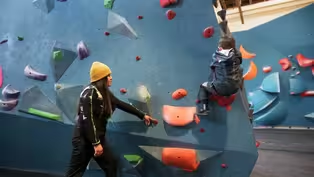
Video has Closed Captions
Clip: S4 Ep4 | 14m 5s | Meet the three leaders inspiring diversity and inclusion in the sport of bouldering. (14m 5s)
Preview: S4 Ep4 | 30s | The power of cultural traditions can unite people and spark transformative change. (30s)
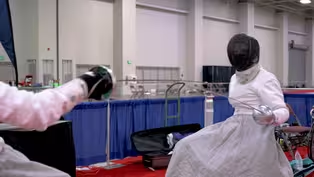
Video has Closed Captions
Clip: S4 Ep4 | 7m 20s | Shelby Jensen overcame her personal hardships and joined Team USA as a Paralympic fencer. (7m 20s)
Providing Support for PBS.org
Learn Moreabout PBS online sponsorship













Support for PBS provided by:
This Is Utah is a local public television program presented by PBS Utah
Funding for This Is Utah is provided by the Willard L. Eccles Foundation and the Lawrence T. & Janet T. Dee Foundation, and the contributing members of PBS Utah.