State of Affairs with Steve Adubato
Chancellor of Rutgers Newark explores AI in higher ed
Clip: Season 9 Episode 35 | 9m 18sVideo has Closed Captions
Chancellor of Rutgers University – Newark explores artificial intelligence in higher ed
Steve Adubato is joined by Dr. Tonya Smith-Jackson, Chancellor of Rutgers University – Newark, to explore the impact of innovation, research, and artificial intelligence in higher education.
Problems playing video? | Closed Captioning Feedback
Problems playing video? | Closed Captioning Feedback
State of Affairs with Steve Adubato is a local public television program presented by NJ PBS
State of Affairs with Steve Adubato
Chancellor of Rutgers Newark explores AI in higher ed
Clip: Season 9 Episode 35 | 9m 18sVideo has Closed Captions
Steve Adubato is joined by Dr. Tonya Smith-Jackson, Chancellor of Rutgers University – Newark, to explore the impact of innovation, research, and artificial intelligence in higher education.
Problems playing video? | Closed Captioning Feedback
How to Watch State of Affairs with Steve Adubato
State of Affairs with Steve Adubato is available to stream on pbs.org and the free PBS App, available on iPhone, Apple TV, Android TV, Android smartphones, Amazon Fire TV, Amazon Fire Tablet, Roku, Samsung Smart TV, and Vizio.
Providing Support for PBS.org
Learn Moreabout PBS online sponsorship[INSPRATIONAL MUSIC STING] - Hi everyone.
Steve Adubato.
We kick off the program with one of the leaders in higher education that you're gonna wanna meet.
She is Dr.
Tonya Smith-Jackson, chancellor of Rutgers University-Newark.
Chancellor, great to have you with us.
- And it's a great pleasure to be here, Steve.
Thank you for inviting me.
- Let me disclose that we have a long-time relationship with Rutgers-Newark.
One of our higher ed partners.
Talk to, describe the campus and describe the university, the Newark campus that I was saying to you I know well, but most may not.
And they say, "Well, it's all Rutgers... Camden, New Brunswick, Newark.
What's the difference?"
There is a difference, please, Chancellor.
- There is indeed, and I know you recognize that as an alumnus of Rutgers University-Newark, Steve, but certainly Rutgers University-Newark really stands very strongly and uniquely as a strong anchor institution.
It's an institution that has proven itself in terms of conducting research and partnerships and education that's community engaged, that's also community responsive, and we're recognized in that way across the nation.
Rutgers University-Newark is also number five in the nation by "U.S.
News & World Report" for Social Mobility.
So we're a university who serves students who are primarily first-generation, low-income students, students who haven't always had an inherited access and privileges that others have.
And we actually have turned it into... we've created a system that works for all students, and we're very proud of that.
We are part of all of Rutgers University, but at the same time, each of us has a personality as a member of the Rutgers University family.
- Along those lines, Doctor, let me ask you this.
There's been a lot of talk about... I'm gonna ask you about AI in a second in higher education, but how the heck... and I've asked every college president, chancellors like yourself, leaders in higher ed, this question... how the heck in these very polarized difficult times do we protect the rights?
Do we protect academic freedom, free speech on a campus, but maintain a degree of safety for all students on a campus and faculty members?
Easier said than done.
- It has become quite complicated, I think.
You know, it is up to every institution to make sure that they are protecting academic freedom, which is the cornerstone of higher education, ways in which faculty can use their expertise in order to prepare our students for the future.
Free speech, obviously, constitutionally is the right of every U.S.
citizen.
We've come upon times, however, where some of those aspects are challenged, and the nuances of how academic freedom works on and across campuses and how free speech works on and across campuses have been challenged in ways that were unprecedented.
I will say that no matter what, we are here to make sure our students get the best education.
We're making sure that they are learning or coming out with a recognition that their college degree has value going forward.
So in essence, in spite of the challenges that have occurred, we're gonna work within those boundaries that do exist because there are boundaries certainly on both free speech and on also academic freedom.
But at the same time, we know that we need to have an environment where every student feels like they belong.
Where every student has a place here at this institution or any other institution and feels heard, but at the same time, they receive a very high-quality academic experience.
- Along those lines, Doctor, I'm not sure when you got into higher education that you envisioned AI, artificial intelligence.
It's here, it's engaged, it's part of our lives.
For you as a leader of the Newark campus who's been involved in higher ed for a while and understands the challenges and the issues of ethics and integrity as it relates to students, how the heck can AI be used as a positive force in higher ed and not be seen as a way of short-circuiting thinking?
Because I can get the answer.
- I understand, that's a good question.
I understand the concerns that people have.
I've had the privilege of serving on various AI working groups over the past few years... over the past five years in fact, and also being able to study AI in various ways.
And I do understand where people are coming from.
We're in an age, though, where technology has already taken off, and it took off without regulations and without ethics built around it so that we could make more informed decisions as we apply the technology.
But first and foremost, AI has benefits and it has downsides.
And if we understand the benefits that can be offered in higher education for artificial intelligence, then I think we can utilize it well while understanding what the downsides are.
We have faculty who for years have been practicing certain principles around the use of artificial intelligence at Rutgers University and at other institutions.
And what they've done is broken down the challenge in several ways as it relates to student success.
There are options for students to completely rely on artificial intelligence.
There are options for students to combine AI and their own human capabilities.
And then there are options for students to use only their human capabilities.
What we have asked our faculty and staff and others who are involved in educating our students to do is to first make sure that any use of AI is made clear to students from the very beginning, clear on their syllabi, clear in classroom discussions with each assignment.
They need to know to what extent they can or cannot use AI.
But then also, we've asked our educators to make sure that if they're incorporating AI, it is something that is helping to advance the student outcomes, which might include things like critical thinking, the ability to problem solve.
So we don't ever want AI to think for our students, we want them to think for themselves, but sometimes they might use AI to facilitate so that they can make more informed or, you know, think about it in a more informed way.
- Got a minute left before I let you go, Doctor.
Your academic area of concentration has been?
- Oh, Human Factors is my area.
Engineering Psychology or Industrial and Systems Engineering.
It has multiple names.
- Hold on.
People, I'm sure, are tired of me.
I bring this book up all the time with Dr.
Daniel Goleman, "Emotional Intelligence."
- Yes.
- What you just described is tied to EQ, emotional intelligence, is it not?
- Oh, indeed it is.
When we're looking at... so my particular area, I examine how humans interact with anything, systems, machines, et cetera.
And so EQ or human intelligence or human... I'm sorry, emotional quotient... or emotional intelligence has a lot to do with how humans build the use of partnerships with other things in order to operate in their own context.
EQ then helps to facilitate their interpersonal relations.
- Doctor, let's do this next time you join us, we're gonna go deeper into a subject I never should have brought up with a minute left because it is a deep, intense, and complex topic.
And Dr.
Tonya Smith-Jackson, the chancellor at Rutgers-Newark, a great institution, a terrific campus.
My first teaching job out of graduate school, out of Rutgers, was at the Rutgers-Newark campus, and I'm very fond of the family there, and it is a family.
Thank you, Doctor, I appreciate it.
- Thank you, Steve.
Thank you for all you've done for us as well.
We appreciate it.
- Very kind.
Stay with us, we'll be right back.
- [Narrator] State of Affairs with Steve Adubato is a production of the Caucus Educational Corporation.
Funding has been provided by The Turrell Fund, a foundation serving children.
United Airlines.
RWJBarnabas Health.
Let’s be healthy together.
NJ Best, New Jersey’s five-two-nine college savings plan.
PSEG Foundation.
Community FoodBank of New Jersey.
The Fidelco Group.
Valley Bank.
And by The Russell Berrie Foundation.
Promotional support provided by NJ.Com.
And by Insider NJ.
- (Narrator) Public service.
It's what we do, at the PSEG Foundation Through volunteer hours, partnerships and our other contributions.
We're committed to empowering communities.
We work hand in hand with you, our neighbors, to educate young people, support research, environmental sustainability and equitable opportunities, provide training and other services all over New Jersey and Long Island.
Uplifting communities.
That's what drives us.
The PSEG Foundation.

Carlos Medina shares ideas to uplift the hispanic community
Video has Closed Captions
Clip: S9 Ep35 | 9m 25s | Carlos Medina discusses how the new NJ administration can uplift the hispanic community (9m 25s)
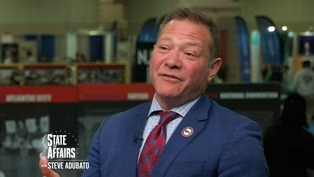
Steve Beatty examines how policies are impacting teachers
Video has Closed Captions
Clip: S9 Ep35 | 9m 33s | President of NJEA examines how local, state, and federal policies are impacting teachers (9m 33s)
Providing Support for PBS.org
Learn Moreabout PBS online sponsorship
- News and Public Affairs

Top journalists deliver compelling original analysis of the hour's headlines.

- News and Public Affairs

FRONTLINE is investigative journalism that questions, explains and changes our world.












Support for PBS provided by:
State of Affairs with Steve Adubato is a local public television program presented by NJ PBS