
Here and Now
Charles Franklin on Polling Wisconsin's Budget Surplus Deal
Clip: Season 2400 Episode 2446 | 6m 14sVideo has Closed Captions
Charles Franklin on voter support for a bipartisan spending bill was defeated.
Marquette Law School Poll Director Charles Franklin discusses polling that found widespread voter support for a bipartisan budget surplus spending bill that was defeated in the Wisconsin Legislature.
Problems playing video? | Closed Captioning Feedback
Problems playing video? | Closed Captioning Feedback
Here and Now is a local public television program presented by PBS Wisconsin
Here and Now
Charles Franklin on Polling Wisconsin's Budget Surplus Deal
Clip: Season 2400 Episode 2446 | 6m 14sVideo has Closed Captions
Marquette Law School Poll Director Charles Franklin discusses polling that found widespread voter support for a bipartisan budget surplus spending bill that was defeated in the Wisconsin Legislature.
Problems playing video? | Closed Captioning Feedback
Where to Watch Here and Now
Here and Now is available to stream on pbs.org and the PBS app.
Providing Support for PBS.org
Learn Moreabout PBS online sponsorship>> The deal between Republican legislative leaders and Governor Tony Evers to use surplus dollars to reduce property taxes, increase school funding and give out tax rebates, failed in colossal fashion when most Democrats voted against it, and Republican candidate for governor, Tom Tiffany, blasted the bill ahead of the vote.
But when asked, most people across the state said they were for it.
A new Marquette Law School poll found 80% of Wisconsin adults say the legislature should have passed the measure.
Poll director Charles Franklin is here with more.
And thanks very much for being here.
>> Thanks for having me.
>> So have you ever conducted a poll with across the board bipartisan results on any issue like this?
>> There are a few, but they're really rare.
And on this one, with the 80% in favor, that was 77% of Republicans, 81% of independents, 82% of Democrats.
That is really an incredibly narrow range across party.
And it's also the same across ideology.
78% of liberals, 78% of conservatives and statewide, in every media market in the state, it's in the high 70s or 80s in support of the bill.
most resonant about why people wanted this?
>> Well, I think the fundamental thing is that it gives something that everybody wants at least a piece of.
In our other polling this year, we've seen concern about reducing property taxes is high with funding for special education is a 70% in favor of that.
And who doesn't want a check for 300 or $600 to a couple?
So there are popular elements there.
I think the other thing that's less obvious is that this is a kind of old fashioned compromise where everybody got something, and it's all about the good things you're getting rather than the bad things.
The conflict in politics and in the capital may have made it hard for that compromise to carry over in the actual votes, where you saw both some Republicans and all Democrats in the Senate voting no.
That that inability to reach a compromise and stick to it is much easier for the public to see this as a reasonable outcome, maybe harder for legislators.
>> So in your polling, you referenced the potential fiscal impact, but you surveyed people before the Legislative Fiscal Bureau actually put a specific $2.9 billion number on a potential projected deficit as a result of this.
Do you think if you had that specific number, it would have changed the results?
>> It might have changed it a little bit.
That report came out after we were already in the field, so it was too late to incorporate it.
But we did ask a separate question that said, some opponents have said this is fiscally irresponsible.
Do you think it would be better to wait until we have a better picture of next year's budget, or pass it now, even if that means a potential future budget deficit?
It was still 69% saying it should be passed.
Now just 21% say wait until later.
So having that information, those real doubts about the fiscal situation did lower support by 11 points, but it still left more than two thirds in favor.
And again, across the board, Republican, independent and Democrats still wanted it to happen.
Now.
>> Back to your results.
How surprising is it that usual party politics kind of don't apply here?
>> Yeah, it's very surprising because so little that we see in state politics is bipartisan this way.
I think part of what's going on is you had an odd combination of bipartisan support for the bill.
Governor Evers and Republican leadership.
But you also had bipartisan opposition, Tom, Tiffany's opposition.
Most of the Democratic candidates either were outright opposed or were very lukewarm about the bill.
And as we saw in the vote split, there were three Republicans in the Senate, enough to sink the bill without Democratic support, and all Democrats opposed.
So you had both bipartisan support and bipartisan opposition.
So what's a partizan to do when they're sent such conflicting messages?
And the result was just almost no difference in how the parties felt about the bill.
>> Now there is the piece about Governor Evers not working with his Democratic caucus on this, and then they mostly vote against it.
What do you make of Evers play in this legislation?
>> I think that's a politically stunning result, not one that most voters pay that much attention to day in and day out, but it surfaces the fact that for seven and a half years, Evers has really had to deal with the Republican majorities in the legislature.
The Democratic minority could do very little to help him, though it was vital for passing the most recent budget, for example.
But he just hasn't been forced politically to work with the Democrats in the legislature.
But this was really surprising that his party would desert him so completely on, you know, the sort of capstone bill of his term as governor.
>> You asked the question in your poll whether positions on this bill will affect the November elections.
Will it?
>> 25% said it would be very important for their fall vote.
I take that with a grain of salt.
Fall is still a good ways away, but what I think we can be certain of is that the issues of property tax funding for schools, those things are going to be at the center of our fall campaigns.
Even if voters have completely forgotten about this bill, and I'm not sure that they will forget about the bill.
But how do you sell that?
You're for property tax relief.
You're for school funding.
If both parties took such ambiguous stands took such ambiguous stands
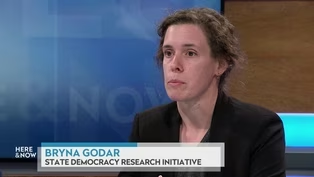
Bryna Godar on a Lawsuit Over Immigration Holds in Wisconsin
Video has Closed Captions
Clip: S2400 Ep2446 | 5m 33s | Bryna Godar on a lawsuit against county sheriffs over the status of 48-hour ICE detainers. (5m 33s)
Here & Now opening for May 29, 2026
Video has Closed Captions
Clip: S2400 Ep2446 | 1m 6s | The introduction to the May 29, 2026 episode of Here & Now. (1m 6s)
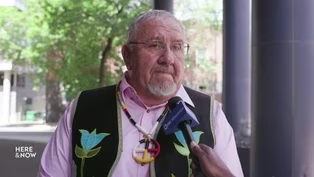
Lac Du Flambeau Tribe Fights State Lawsuit On Fishing Access
Video has Closed Captions
Clip: S2400 Ep2446 | 1m 22s | A federal court heard a state of Wisconsin lawsuit over tribal fishing limits on 19 lakes. (1m 22s)
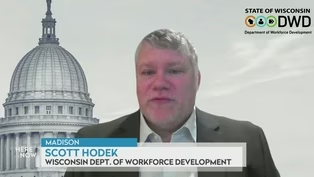
Scott Hodek on Wisconsin's Job Market, Layoffs and AI's Role
Video has Closed Captions
Clip: S2400 Ep2446 | 7m 22s | Scott Hodek on shifts in the job market and impacts of artificial intelligence. (7m 22s)
Wisconsin's 2026 Governor Race and Local Government Funding
Video has Closed Captions
Clip: S2400 Ep2446 | 6m 12s | Candidates in the 2026 race for governor on shared revenue to local government. (6m 12s)
Providing Support for PBS.org
Learn Moreabout PBS online sponsorship New Episode
- News and Public Affairs

Top journalists deliver compelling original analysis of the hour's headlines.
 New Episode
- News and Public Affairs

FRONTLINE is investigative journalism that questions, explains and changes our world.
 New Episode
 New Episode
 New Episode
 New Episode
 New Episode
 New Episode
 New Episode
 New Episode

Support for PBS provided by:
Here and Now is a local public television program presented by PBS Wisconsin