
Chasing the Moon, Part 3
Season 31 Episode 5 | 1h 52m 43sVideo has Closed Captions
Chasing the Moon, Part 3
Chasing the Moon, Part 3
Problems playing video? | Closed Captioning Feedback
Problems playing video? | Closed Captioning Feedback
Corporate sponsorship for American Experience is provided by Liberty Mutual Insurance and Carlisle Companies. Major funding by the Alfred P. Sloan Foundation.
Support provided by:


Chasing the Moon, Part 3
Season 31 Episode 5 | 1h 52m 43sVideo has Closed Captions
Chasing the Moon, Part 3
Problems playing video? | Closed Captioning Feedback
Where to Watch American Experience
American Experience is available to stream on pbs.org and the PBS app.
Buy Now
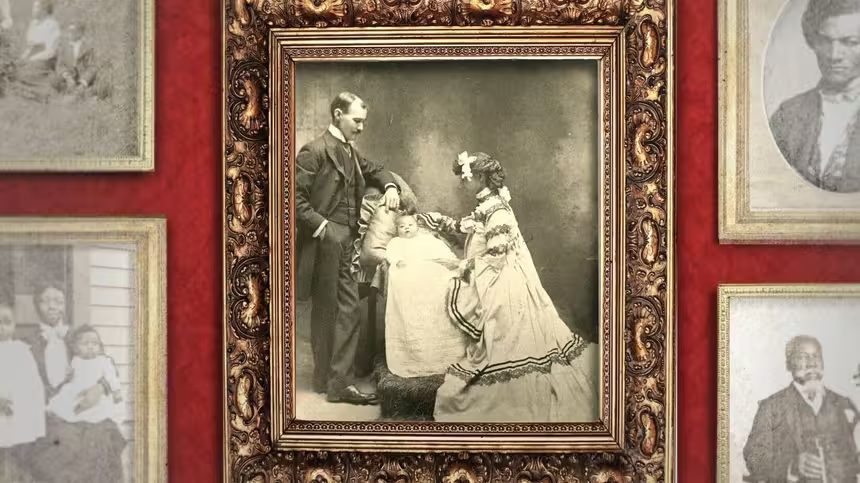
When is a photo an act of resistance?
For families that just decades earlier were torn apart by chattel slavery, being photographed together was proof of their resilience.Providing Support for PBS.org
Learn Moreabout PBS online sponsorship(Tom Lehrer playing "Wernher von Braun" on piano) ♪ Gather round while I sing you of Wernher von Braun ♪ ♪ A man whose allegiance is ruled by expedience ♪ ♪ Call him a Nazi, he won't even frown ♪ ♪ "Nazi-shmazi," says Wernher von Braun ♪ (piano continues) ♪ Don't say that he's hypocritical ♪ (plays flourish on piano) ♪ Say, rather, that he's apolitical ♪ (in German accent): ♪ "Once the rockets are up ♪ ♪ "Who cares where they come down?
♪ (audience laughs) ♪ That's not my department," says Wernher von Braun ♪ (audience laughs) (in regular accent): ♪ Some have harsh words for this man of renown ♪ ♪ But some think our attitude should be one of gratitude ♪ ♪ Like the widows and cripples in old London Town ♪ ♪ Who owe their large pensions to Wernher von Braun ♪ ♪ You, too, may be a big hero ♪ ♪ Once you've learned to count backwards to zero ♪ (in German accent): ♪ "In German oder Englisch, I know how to count down ♪ ♪ And I'm learning Chinese," says Wernher von Braun ♪ (plays final chord, audience applauds) ♪ ♪ NEIL ARMSTRONG: That's one small step for man, one giant leap for mankind.
♪ ♪ ♪ ♪ ♪ ♪ ♪ ♪ (speaking German) (speaking German) ED BUCKBEE: All those years, we had very, very few inquiries about von Braun's past.
We never really had any questions about what, what are all these Germans doing, you know, involved in this program?
That never came up.
He was kind of untouchable.
He was the rocket man, and he was taking us to the moon.
Then when things began to change, he handled it quite well.
(audience applauding, "Up, Up, and Away" playing) I believe you were forced to join the Nazi party, as I understand it.
No, this isn't quite right.
Oh.
Um... (audience laughs) I was trying to make it sound... I got a letter one fine day which said, "We understand you would like to join the party, and here is a form, an application form."
But the circumstances were such that... the message would have been very loud and clear, you know, had you not sent it in.
GEORGE ALEXANDER: He disavowed any loyalty to Hitler or to the German cause.
He acknowledged the regime's crimes.
He tried to avoid discussing the politics of World War II.
♪ ♪ Do you have a statement... Dr.
von Braun, were you-- were you aware that there was a slave camp near the plant you worked in Germany?
Well, you are misinformed.
The slave camp was about 400 miles from where I worked, because I was in charge of the development of the V-2 rocket, which took place in Peenemünde on the Baltic, and this slave camp was in Central Germany in the Harz Mountains... Were you aware that there were any atrocities taking place there?
I learned later on that there were atrocities taking place there, but I was not involved in this whole operation.
ALEXANDER: He had to have known that all those people he saw pushing heavy equipment were horribly abused.
He would have had to have been blind, deaf, and mute not to have known that.
Do you feel that it will hinder your reputation at all?
Well, that remains to be seen.
As I say, I think this record is for inspection.
And... I have nothing to hide, I had nothing to hide, and... I told the court what I knew.
I was here as a witness; I'm not implicated.
Remember that.
(crowd applauding) RICHARD NIXON: Only a few short weeks ago, we shared the glory of man's first sight of the world as God sees it, as a single sphere reflecting light in the darkness.
As the Apollo astronauts flew over the moon's gray surface on Christmas Eve... (protesters' chants grow louder) NIXON: They spoke to us of the beauty of Earth.
(rockets firing, exploding) (protesters clamoring) Get lost!
(clamoring continues) ROGER LAUNIUS: In the time that they were focused on going to the moon, the world had changed.
Society had changed in pretty fundamental ways.
FRANK BORMAN: After Apollo 8, President Nixon sent me around to make talks on the different college campuses.
(crowd talking indistinctly) Everywhere I went, I met with antagonism and even hatred.
I think I represented, to these people, the establishment.
At one of the places, I had to go in by helicopter because they'd barricaded the entrance to the college.
(siren blaring) And at Columbia, I was run off the stage by a guy in a gorilla suit.
They threw marshmallows at me.
It was unbelievable.
(crowd clamoring) When we went to Cornell, it was like going into an enemy camp.
I couldn't believe I was in America.
And I must say, when you continually point your finger at the establishment and big business, I'd like to just shoot it back at you a little bit.
Many of us think one of the greatest problems we have in the environment of the future is the current crop of irresponsible college radicals.
(audience groans) BORMAN: The difference between the reaction on the American campuses and overseas was like night and day.
REPORTER: To the people of this planet, what is the meaning of this stupendous venture?
(crowd applauding) BORMAN: They were excited, they were happy, they were very congratulatory, they were wonderful.
Everywhere.
(chuckling): Except on the American campus.
Even in Russia, they were very, very friendly.
I was there in 1969, my family and I. This was before the lunar landing.
We spent two weeks over there, going all over the country.
They couldn't have been more nice to us.
REPORTER: Another warm welcome for the traveling American astronaut who came far out of his way, all the way to central Siberia, to pay tribute to Soviet science.
Colonel Borman, you've seen something of the world of Soviet science-- how does it impress you?
Oh, very much.
They certainly have a fine institute here.
(speaking Russian) BORMAN: The intellectuals there understood their system was corrupt and couldn't last, but they were afraid to talk about it unless you got them off by themselves.
It was that kind of a society.
And I like to think that the Apollo program had a lot to do with the subsequent dismantling of the Soviet Union.
Have you had any feeling from the cosmonauts of their view toward the pending moon landing and Apollo 11?
Well, I think they feel the same way about that as we do about theirs-- they wish us all success, as we've done on every one of their flights.
MARK BLOOM: I remember trying to write as much as I could about what the Russians were doing.
We knew very little.
Occasionally, they'd show us spy photography from Baikonur, from the Soviet launching site.
But there was a lot of guess work.
♪ ♪ JACK KING: Korolyov.
He was the von Braun, if you will, of the Russian space program.
He died.
And, in my mind, that's when things started to change, as far as the Russians were concerned.
They tried to put together a giant rocket.
But I always felt that once they lost Korolyov, they really lost the genius of the Russian program.
SERGEI KHRUSHCHEV: The Korolyov lunar program to send the man to the moon, it have a very sad history.
The Soviet Union have the same ideas as the Americans, but our design of the lunar vehicle failed from the very beginning because Korolyov technically made it in the wrong way.
The N1 program, it was very complicated project, with 30 engines that have to work together, and if you did not test it by stages, you have too many new things.
Korolyov's people, after Korolyov's death, they say, "Let's assemble everything together "without testing.
Maybe you will have a good luck."
(man speaking on radio) (rocket engines igniting) (explosion roaring) (men shouting, sirens blaring) KHRUSHCHEV: Korolyov died, but this project was doomed from very beginning.
Resuming our interview on "Meet the Press" from Cape Kennedy, Florida, our guests today are the three astronauts who commanded Apollo missions 8, 9, and 10.
JOHN NOBLE WILFORD: Colonel Borman, during your trip to Russia, did you get any indication in your talks with the Russians when they might be sending cosmonauts to land on the moon?
Do you think that they still want to land men on the moon?
There's no question about it.
They... he told... everywhere, the indication was, "Not only will we land on the moon, "will we go to the moon, we'll go to the planets and eventually, man will leave the solar system."
And I believe that.
♪ ♪ BLOOM: NASA called a press conference to introduce the Apollo 11 crew, and I went to that.
They were introduced, the three guys.
PAUL HANEY: Ladies and gentlemen, it's my considerable pleasure to introduce to you our Apollo 11 crew.
BLOOM: Neil and Buzz and Mike Collins-- this was the crew that, if all went well, Apollo 11, with Neil Armstrong and Buzz Aldrin, was going to be the crew that landed, and Neil was the commander.
REPORTER: Which one of you gentlemen will be the first man to step onto the lunar surface, and what do you think your reaction will be?
The current plan involves one man on the lunar surface for approximately three-quarters of an hour prior to the second man's emergence.
Now, which person is which has not been decided at this point.
BUZZ ALDRIN: Neil was going to be the commander, but there was two schools of thought as to what we should do after landing.
The first man would exit the spacecraft, most probably taking down with him what we call a lunar equipment conveyor.
This is a pulley-type system which enables us to transfer various pieces of equipment.
And the first priority on the surface is to take photographs from the LEM itself at the landing site.
And the second priority is a contingency sample... (voiceover): Obviously, Neil and I might have differences.
He said that he understood the significance and he wasn't going to rule himself out of being first... ... priority is an E.V.A.
evaluation... (voiceover): And so there was a standoff.
(archival): So it's at this point that the second person would exit the spacecraft.
BLOOM: Buzz, his father was a retired general, and he went on a press campaign, came to my office in New York, to campaign for Buzz to be the first man on the moon, not Neil.
The controversy was inspired by Buzz's father.
HANEY: Hey, Buzz, as I recall, isn't your middle name "Moon"?
My mother's middle name is Moon.
Your mother's family name?
That was my grandfather's name.
ALDRIN: By coincidence or good fortune, my mother was named Marion Moon.
That was her maiden name.
So she was Marion Moon Aldrin.
My grandmother was known as Mama Moon.
I had two older sisters.
They didn't know what to call me, but I was their baby brother, so it was "Buzzer," and it got shortened to Buzz.
(crowd cheering) We had a taste of the publicity from Gemini 12.
ANNOUNCER: This celebration in Montclair is for hometown boy Lieutenant Colonel Edwin "Buzz" Aldrin, the record-setting space walker, who, along with... ALDRIN: She just looked like she was uncomfortable about being in the press.
Before we were announced as the crew to Apollo 11, my mother died.
Committed suicide.
I felt that she didn't want to look forward to that sort of thing again.
She didn't want to be a part of it.
REPORTER: I wondered if each of the three could tell us very briefly how your families have reacted to the fact that you're taking this historic mission.
ARMSTRONG: Well, who wants to take a crack at it?
ALDRIN: Well, I think in my particular case, my family has had five years now to become accustomed to this eventuality, and over six months to face it quite closely.
♪ ♪ PETER HACKES: Colonel Collins, you'll be the only one of the three making this first moon flight who will not have an opportunity to walk on the moon's surface.
How do you feel about that?
MICHAEL COLLINS: Well, I think that the way we've put Apollo together, it's a three-man job.
All three men are required to do the total mission, and of course, I'll be the only one on board the command and service module.
(voiceover): I honestly felt really privileged to be on Apollo 11, to have one of those three seats.
Did I have the best of the three?
No.
But was I pleased with the one I had?
Yes!
I do have one complaint, however.
I'd like to point out to those of you, particularly in the television business, that I have no TV set on board, and therefore I'm going to be one of the few Americans who's not going to be able to see the E.V.A.... (audience laughs) So I'd like you to save the tapes for me, please.
I'd like to look at them after the flight.
ALEXANDER: They were three distinct personalities.
Armstrong was the gold standard for the calm, committed, professional pilot that he was.
BILL ANDERS: I probably knew Neil better than most people, because we were in Gemini together as a crew.
Then he and I became the two who were selected to fly the lunar module training vehicle.
It really was an exceptional simulation of the lunar module in one-sixth lunar gravity.
The day of the accident, I went out in the morning.
There was a bit of a wind.
That afternoon, Neil went over to fly this thing.
♪ ♪ Unbeknownst to us on that day, the sensor for the hydrogen peroxide fuel had failed.
(machinery hissing) So when the red light came on and they said, "Okay, Neil, you've got 30 seconds to go, head on down," he didn't know, nor did the ground know, that he really only had about 15 seconds of fuel.
(ejection seat pops) (explosion echoes) (flames crackling) ♪ ♪ Neil was the consummate test pilot.
He packed up, went to his office.
You know?
He said, "Oh, yeah, I ejected."
That's Neil Armstrong for you.
(machinery hissing) Six months later, another test pilot crashed.
(ejection seat pops) (explosion roars) I never flew it after that.
It's easy to see that the lunar landings might have well had crashes on the moon.
♪ ♪ KHRUSHCHEV: The Soviets had another secret lunar project, an automatic lunar system called Luna 15.
We wanted to land it on the moon the same way as Apollo.
It was possible that this will just drill the moon, extract some soil, and then fly back to the Earth before the Americans, because it was more efficient.
And we have scheduled this launch more or less at the same time, on the summer 1969.
(blowing whistle) FRANK REYNOLDS: Moscow's morning newspapers today ignored the impending Apollo 11 flight to the moon.
The Russians are not saying very much about Luna 15, either.
That's their own unmanned spaceship that is expected to reach the moon either today or tomorrow.
JULES BERGMAN: I don't think anything in history has ever happened like this, Frank, with any group so large.
We think there must be at least a million people.
And to us, it's a terribly moving scene.
REPORTER: There are a million people who made their way down to the Cape to see this rocket go off.
One million people in the immediate environment of Cape Kennedy to watch it go off from that launch complex 39A.
(crowd cheering) MAN (on loudspeaker): Now may I have your attention?
I'd like to take this opportunity to discuss the Apollo 11 profile, which will begin tomorrow morning.
They will climb through an airlock into the lunar module.
The third astronaut-- these astronauts being Armstrong, Aldrin, and Collins-- Collins will remain on board the Command and Service Module serving as a communication link between the surface of the Earth and the surface of the moon.
(people talking in background) (protesters singing) MAN: They're against the spacecraft.
(singing continues) LAUNIUS: At the time of the Apollo 11 launch, Ralph Abernathy led a group of protesters to the Kennedy Space Center to protest the priorities of the federal government.
Ladies and gentlemen of the press, on the eve of one of man's noblest ventures, I am profoundly moved by our nation's scientific achievements in space and by the heroism of the three men who are embarking for the moon.
I have not come to Cape Kennedy merely to experience the thrill of this historic launching.
I'm here to demonstrate in a symbolic way the tragic and inexcusable gulf between America's technological abilities and our social injustice.
♪ We shall overcome ♪ LAUNIUS: Tom Paine went out to Ralph Abernathy's group and met with them.
He's the new head of NASA, and they talked.
Ladies and gentlemen, I'm here because you invited me to be here and because I want to be here.
If it were possible for us tomorrow morning to not push the button and to solve the problems for which you are concerned, believe me, we would not push the button, but the problem is that... LAUNIUS: He said, you know, this is something that we as a nation have decided that we need to do, and we think that these results are going to be positive for everybody.
We would like to see you hitch your wagons to our rockets, and to tell the American people that the NASA program is an indication of what this country can do... LAUNIUS: And then he invited a select group of the people who were in the protest to attend the launch, among them Ralph Abernathy.
...to encourage this country to tackle many of its other problems.
(applauding) ABERNATHY: As our brave, courageous heroes make their way to the moon tomorrow, may they never forget their suffering brothers and sisters down here on the Earth.
May they think about us tomorrow and pray for us as we will be praying for them.
♪ ♪ ♪ ♪ ALEXANDER: The urge to explore was so deeply ingrained in the human psyche.
That goes back to our earliest days as Homo sapiens, this curiosity.
What was this large, shiny, white globe?
What was it?
Was it God?
We attributed so many explanations to the moon.
And now, at last, we had the opportunity to go and see for ourselves-- to satisfy that curiosity.
It was something that you couldn't just turn off.
Tomorrow, we the crew of Apollo 11 are... privileged to represent the United States in our first attempt to take man to another heavenly body.
We feel very honored that we can participate in this voyage, represent our nation.
We think the country has provided us with the finest equipment, the finest training, the finest preparation that anyone can receive.
We look forward to going.
We thank all of you for your help and your prayers.
♪ ♪ REYNOLDS: Good morning, ladies and gentlemen, I'm Frank Reynolds at ABC space headquarters in New York.
It is July 16, 1969, and we are all about to witness the fulfillment of that promise that President Kennedy made at Rice University Stadium in Texas on September 12, 1962.
♪ ♪ (people talking in background) REPORTER: They take with them this morning the good wishes and the admiration of a world of people, as man, a species born and who's lived all his life on Earth, moves with this journey out into the solar system, and so presumably begins, with this journey, his dispersal in other places out in the universe.
KING: Astronauts Neil Armstrong, Buzz Aldrin, and then, finally, Mike Collins, with their suit technicians and director of flight crew operations Deke Slayton now boarding the transfer van.
The transfer van now departing from the manned spacecraft operations building at the Kennedy Space Center on the start of its eight-mile trip to Launch Pad A here at Complex 39.
Right now, our count at three hours, three minutes, and counting, aiming toward the planned liftoff time of 9:32 a.m.
Eastern Daylight Time.
This is launch control.
♪ ♪ (seagull squawking) THEO KAMECKE: It was still twilight, and I could hear the faint siren and some blinking lights, and looked off to my right, and there was the convoy of half a dozen vehicles bringing the astronauts to the launch pad.
And it was just the most beautiful thing you ever saw.
♪ ♪ BORMAN: The riskiest part of most missions at that time, to my mind, were the launch.
You're sitting on a small atom bomb.
Of course, the landing had never been done before; that's very risky.
This was the culmination of a lot of lives that were lost and a lot of lives that were tragically broken.
So I was quite concerned about the mission.
♪ ♪ JOHN LOGSDON: It was clear, first of all, to the NASA people that success was not guaranteed and that there was a chance of a catastrophic occurrence with the worst possible-- astronauts being stranded on the moon alive, but unable to get back.
Nixon had brought Apollo 8 commander Frank Borman into the White House to advise he and his associates.
And it was Borman that said, "Prepare for what you say to the widows."
REPORTER: So, up there this morning, let's all think of those three men-- three superb pilots.
Armstrong, the commander; Aldrin, the man who will share the journey, the unknown part of this lunar journey to the moon; and Collins, the man who's going to fly them round.
And here they are at breakfast a couple of hours ago, and the traditional steak and eggs, and how they can eat it with this journey before them, Lord alone knows.
REPORTER: At this moment, millions of Frenchmen are glued to their television sets to watch the launching of Apollo 11.
Britain is not a participant in the space race, but she is an avid spectator.
They're going to land on the moon.
And then what are they going to do?
They're going to walk around.
And then what are they going to do?
Go back up.
Well, in my opinion, it's a very, very marvelous achievement.
I only hope it's successful.
I think it's disgusting.
It's a pity they haven't got something else to do.
(crowd talking in background) WILLIAM LAWRENCE: It has to be over 100 degrees here in the broiling Florida sun where the V.I.Ps., the very important persons, and indeed, the V.V.I.Ps.-- the very, very important persons-- are gathered to watch this launch just downrange.
Among them here are former President Johnson, who helped to shape the space program as Senate majority leader, the new vice president, Mr.
Agnew, who has already stirred a controversy by suggesting that this administration commit itself to sending a man to Mars by the end of the century.
KING: We're now coming up on... Ten minutes away from our Apollo liftoff.
Mark, T minus ten minutes and counting, we're aiming for our planned liftoff of... (voiceover): I was doing the countdown commentary from the back row of the launch control center.
Launch control center is about three-and-a-half miles from the launch pads, which is considered to be the safe distance as far as sound and blast is concerned.
My God, we had 3,000 press people in there for Apollo 11.
They did all kinds of tests, acoustics tests.
They equated the sound to sitting in the first row of a hard rock heavy metal band.
It was just... Wow.
(archival): ...that Eagle was sold.
The swing arm now coming back to its fully retracted position as our countdown continues.
T minus four minutes, 50 seconds, and counting.
Skip Schulman informing the astronauts that the swing arm's now coming back... KAMECKE: I think there were 500 people in that launch control center.
Just rows and rows of consoles and technicians sitting looking at their own particular gauge that they were monitoring.
I was the only civilian in there, because that's where I was supervising the filming of the launch.
That's the first time I understood what it meant to smell fear.
I've heard that expression ever since I was a kid, and it was a distinctive smell.
It wasn't body odor, it was the smell of fear.
Every single one of those 500 people was afraid that it would be their little gauge, their little valve, that would go wrong.
KING: All indications coming into the control center at this time indicate we are go, one minute, 25 seconds in the counting... We're getting close, we're getting close.
KING: All the second-stage tanks now pressurized, 35 seconds and counting, we are still go with Apollo 11.
30 seconds and counting.
Astronauts report it feels good.
T minus 25 seconds.
20 seconds and counting.
T minus 15 seconds, guidance is internal.
12, 11, ten, nine, ignition sequence starts, six, five, four, three, two, one, zero, all engine running.
Liftoff, we have a liftoff, 32 minutes past the hour.
Liftoff on Apollo 11.
(engine roaring) WALTER CRONKITE: She's passing the tower, she's lifting up.
KING: Tower clear.
CRONKITE: We have tower clear, we have tower clear.
We're beginning to feel the first thunderous roar.
(rocket roaring) Oh, boy, it looks good.
♪ ♪ The building's shaking.
What a moment, man on the way to the moon.
(equipment beeping) (Armstrong communicating indistinctly) (rocket roaring) (people talking on radio) ALEXANDER: You could feel the vibrations in the ground.
The sound was deafening, making your shirt and your slacks flap.
(announcer talking indistinctly) It was a big-dog experience, flat out, it was... it just took your breath away.
♪ ♪ BERGMAN: Burning hot, straight, and true all the way toward a moon 218,000 miles distant.
A moment many Americans, many people never believed could happen or would happen.
MAN: We're through the region of maximum dynamic pressure now.
(rocket roaring) COLLINS: No Saturn 5 rocket ever blew up.
Saturn 1, the 1B, and the Saturn 5, I thought surely one of those suckers was going to blow up.
(applauding) It's a real tribute to the engineering of von Braun's people, primarily.
(applause continues) BUCKBEE: 33 Saturns were flown in the time that they were built-- never failed.
They completed their mission, and they never carried a weapon in space.
And it was done by a bunch of government guys, you know.
There's really nothing to say about it-- what can you say about a sight like that?
(boosters firing) ♪ ♪ ♪ ♪ ♪ ♪ ♪ ♪ (CBS News theme playing) MAN: This is CBS News color coverage of "Man on the Moon: The Epic Journey of Apollo 11."
JOEL BANOW: As a director, I had to make this very, very exciting, and make it more like a movie.
We alone spent almost a million dollars on the production, which for a news event in those days, in '69, was astronomical.
Remembering all the great science fiction B-films I saw as a boy, I got a sense of things that I would like to try and do, like creating a full-sized mock-up on a lunar landscape and using models to explain things.
The time is next Sunday, the place is the lunar surface.
BANOW: We would say, "CBS News simulation," "CBS News animation," telling the audience this is not from the moon at this moment in time or in space.
Doug Trumbull, the great special effects creator for "2001," I called him and hired him to work for me.
(computer beeping) I needed Doug to create a system for putting alpha-numeric graphics on the screen.
We named it HAL, in honor of HAL from "2001."
HAL has characteristics unlike most of the sophisticated machines you've ever seen, so... BANOW: We had Walter talk to HAL.
CRONKITE: Welcome to CBS, HAL.
Are your memory banks keyed up for today's events?
(computer beeping) BANOW: We didn't have a voice, we didn't go that far.
CRONKITE: Might show us, for instance, how Columbia, the Command Module, acquires tracking stations... BANOW: We stayed on-- I mean, we were on the air for 36 straight hours.
We knew that the whole world was seeing this.
HOUSTON: 11, Houston, that's a beautiful picture now we've got.
We're looking at a 12-second delay.
And to us, you're just bringing it down by the optics now.
(beeps) CRONKITE: So, things are going well, they went into Earth orbit exactly as planned.
They have gone into their trans-lunar trajectory, their course to the moon, exactly as planned.
They have docked with the lunar module still in the third stage of their Saturn rocket.
They will be ejecting that, and then, with the lunar module attached to their nose, they'll be on the way to the moon.
ARMSTRONG (archival): Yeah, we're about to open the hatch now.
MAN: Right.
(device beeping) ALDRIN (voiceover): We'd been training for six months on doing something and getting closer and closer, and now it's approaching the time, and you've finished your training.
(archival): The vehicle is surprisingly free of any debris moving around, it's very clean.
CHARLIE DUKE: 11, Houston, it's pretty hard to describe this view, it's really, really great.
(device beeps) ALDRIN: Now you know how we feel.
DUKE: Hey, that's a great shot right there.
We see you in there.
Guess that's Neil and Mike.
Better be, anyway.
♪ ♪ REPORTER: But how is the Apollo spaceship doing?
Latest reports from Houston say the craft is in its tenth orbit of the moon, while the Soviet spacecraft Luna 15 is also still in orbit, but in an elongated path.
Bob, what's the scene at Houston now?
REPORTER 2: Well, it's a bit early in the morning, but they're beginning to gather.
I think probably you could sum up the situation here, the feeling in most people's mind is that it's a tremendous sense of history, an awareness that this is the most important thing historically that's happened for a long time, possibly the greatest physical event that has ever taken place.
REPORTER 1: What's the speculation about the first words Neil Armstrong will utter as he steps off the ship?
REPORTER 2: Well, everyone's noticed that they're a pretty taciturn group, the crew of Apollo 11, and no one really knows, and he's been very careful not to say anything.
He's avoided it.
But there's one curious little rumor going around.
He comes from a place in Ohio called Wapakoneta.
Wapakoneta is known for a cheese factory, a small cheese factory, run and owned by a man called Freddie Fisher.
And for months now, Armstrong has been playing a little game with Freddie Fisher, because that company's been trying to capitalize on the publicity by referring to the moon as being made of their cheese.
So it's possible that he may make some reference to cheese and it may well be Freddie Fisher's cheese that he talks about.
REPORTER 1: You really think he might be that corny?
REPORTER 2: Well, yes.
(device beeps) DUKE: 11, you got a pretty big audience.
It's live in the U.S., it's going live to Japan, Western Europe, and much of South America.
Everybody reports very good color.
Appreciate the great show.
(device beeps) Looks like it's going to be impossible to get away from the fact that you guys are dominating all the news back here on Earth.
Even "Pravda" in Russia is headlining the mission and calls Neil the tsar of the ship.
ALDRIN (voiceover): Neil wasn't particularly outgoing.
He was hard to get to know.
I'm not much of a cocktail discussion person, either.
Yeah, hello there, sports fans, you got a little bit of me, but Neil is in the center couch and Buzz is doing the camera work this time.
DUKE: Roger, it's a little dark there... ALDRIN: Mike was the one that probably had the better sense of humor of seeing the lighter side of life.
I would have put on a coat and tie if I'd known about this ahead of time.
We are very comfortable up here though, we do have a happy home.
There's plenty of room for the three of us, and I think... ALDRIN: Mike asked him, at one time when we were in the command module, approaching the moon, he said, "Well, Neil, have you thought about what you're going to say?"
Because of course the newspapers were posing the question, "What will the first man say when he puts his foot on the ground?"
Mike said, "Did you think about what you're going to say?"
And Neil said, "No, no, I'll wait till I get there and think about it," and I don't think Mike believed him, and I didn't, either.
(radio static crackling) Columbia, Houston-- we'll have L.O.S.
at one-zero-one-two-eight, AOS for you... One-zero-two-one-five, over.
REYNOLDS: Houston has just told Apollo 11, "We'll see you on the other side."
They told them that a few minutes ago.
They are not, as everybody knows by now, a very talkative crew.
They said, "We'll see you on the other side," and the response from Apollo 11 was, "Okay."
♪ ♪ CRONKITE: We're approaching one of the critical moments of this flight.
At 1:46 p.m.
Eastern Daylight Time, the command module and the lunar module will begin undocking, the lunar module cutting itself free from the command module, beginning the maneuvers, which, in two hours and 32 minutes from now, should place it on the surface of the moon.
♪ ♪ COLLINS: Hear you loud and clear, Houston.
HOUSTON: Roger, same now.
Could you repeat your burn status report?
We copied the residuals and burn time and that was about it.
Send the whole thing again, please.
COLLINS: It was right perfect.
Altitude zero, burn time 557... MAN: Zero, one, eight-eight, niner.
CRONKITE: As they're circling the moon now, at this altitude, the Luna 15 is in an orbit similar to the one that the lunar module will assume after that descent orbit insertion burn.
MAN: Showed... 60.9 by 169.9.
CRONKITE: It does increase the speculation as to what the Soviet unmanned spacecraft is doing up there.
MAN: Okay, Charlie, we're in the lab.
GENE KRANZ: Okay, it's a go there, CapCom, on the hot and fire.
Okay, all flight controllers, going around the horn, go-no go for undocking.
KRANZ: Okay, retro?
MAN: Go.
KRANZ: Fido?
MAN: Go.
KRANZ: Guidance?
MEN: Go.
KRANZ: Control?
MAN: Go.
KRANZ: Telcom?
MAN: Go.
KRANZ: GNC?
MAN: Go.
KRANZ: E-Com?
MAN: Go.
KRANZ: Surgeon?
MAN: Go.
KRANZ: CapCom, we're go for undocking.
♪ ♪ KAMECKE: When it was time to descend from lunar orbit and land on the moon, I was there watching.
The descent to the lunar surface happened pretty quickly.
It was tense.
DUKE: Hello, Eagle, Houston.
We're standing by, over.
(device beeps) ♪ ♪ Eagle, Houston-- Houston, we see you on the steerable, over.
ARMSTRONG: Roger, Eagle is undocked.
DUKE: Roger, how does it look?
ARMSTRONG: The Eagle has wings.
DUKE: Rog.
♪ ♪ Eagle, Houston, we recommend you yaw ten right.
It will help us on the high-gain signal strength.
Over.
(device beeps) ♪ ♪ KRANZ: Okay, all flight controllers, go-no go for powered descent.
Retro?
MAN: Go.
KRANZ: Fido?
MAN: Go.
KRANZ: Guidance?
MAN: Go.
KRANZ: Control?
MAN: Go.
KRANZ: TelCom?
MAN: Go.
KRANZ: GNC?
MAN: Go.
KRANZ: E-Com?
MAN: Go.
KRANZ: Surgeon?
MAN: Go.
KRANZ: CapCom, we're go for powered descent.
(ticking) BERGMAN: Gene Kranz getting a go-no go for descent.
BUCKBEE: I did not think we'd land Apollo 11.
I don't think anybody thought we would actually land the first time.
We figured that something would happen, we'd get a wave-off, you know, something-- it just wouldn't go right.
MAN: Moments now.
Roger.
CRONKITE: They are face down, windows down.
You're go to continue powered descent, you're a go to continue powered descent.
MAN: Okay, everybody, let's hang tight and look for landing radar.
CRONKITE: Ten minutes to the touch down.
(people talking on radio) CRONKITE: Oh, boy.
Ten minutes to a landing on the moon.
KAMECKE: Bear in mind that for everyone all over the world who was watching this, during the descent to the moon, it was an audio experience.
The camera that shows the descent right to the surface is a film camera, so as it was happening, it's not readily viewable.
CRONKITE: You're seeing here our CBS simulation of what should be taking place at this moment, according to the flight plan.
ARMSTRONG: Our position is just down range.
It appears to be a little long.
DUKE: Roger, copy.
BERGMAN: That was Armstrong saying that they're a little long, down range on position.
They'll have to correct slightly.
They should be through 45,000 feet... BLOOM: I kept thinking, as the lunar module went down from the command module in lunar orbit, and got closer and closer and closer, I kept thinking they were going to abort.
I mean, they're not going to make it on the first try.
Inconceivable in my eyes.
MAN: Houston, you're looking at our Delta H. MAN: That's affirmative.
MAN: Program alarm.
(alarm beeping) DUKE: Looking good to us, over.
ARMSTRONG: It's a 1202.
ALDRIN: 1202.
BUCKBEE: Of course the computer was, you know, overloading.
ARMSTRONG: Houston, give us a reading on the 1202 program alarm.
KAMECKE: They had a computer on the spacecraft that would make your iPhone look like the most powerful thing in the world.
It was, it was primitive.
MAN: We're still go, altitude 27,000 feet... ALDRIN: Same alarm, and it appears to come up when have a 1668 up.
DUKE: Roger, copy.
MAN: Okay, we'll monitor... CRONKITE: What's this alarm, Wally?
WALTER SCHIRRA: It's a go case that just apparently some... ...function that's coming up on the computers.
MAN: Delta H looks good now.
DUKE: Roger, Delta H is looking good to us.
KRANZ: Okay, all flight controllers, hang tight.
ALEXANDER: There were all these problems.
MAN: Descent two, fuel crit.
DUKE: Descent two, fuel critical.
He didn't want to say critical.
Eagle, Houston, it's descent two.
Fuel to monitor, over.
ALEXANDER: They were running low on propellant and they had overshot the landing site.
CRONKITE: Oh, boy.
MAN: Down to two.
MAN: Altitude 13,005.
CRONKITE: They're just a little under five miles from the landing site.
And that high gate... MAN: We're now in the approach phase, everything looking good.
REPORTER: They have 70 seconds in which to redesignate the landing site, to take a good look at it now if they want to change it.
MAN: ...Says we're go.
Altitude 9,200 feet.
DUKE: ...you're looking great.
REPORTER: In that high gate now, slowing down below 300 miles an hour... MAN: 129 feet per second... REPORTER: Just a little more than 100-mile-an-hour descent rate.
They're getting a look now such as no man has ever had at the surface of the moon.
They should be getting a good look at it now.
They should decide very soon if they like it.
DUKE: Eagle, you're looking great, coming up nine minutes.
(device beeps) HOUSTON: We're now in the approach phase.
Everything looking good.
KRANZ: Okay, all flight controllers, go-no go for landing.
Retro?
MAN: Go.
KRANZ: Fido?
MAN: Go.
KRANZ: Guidance?
MAN: Go.
KRANZ: Control?
MAN: Go.
KRANZ: TelCom?
MAN: Go.
KRANZ: GNC?
MAN: Go.
KRANZ: E-Com?
MAN: Go.
KRANZ: Surgeon?
MAN: Go.
CapCom, we're go for landing.
DUKE: Eagle, Houston, you're a go for landing, over.
(TV playing in background) ALDRIN: Roger, understand.
Go for landing, 3,000 feet.
Program alarm.
1201.
ARMSTRONG: 1201.
DUKE: Roger, 1201 alarm.
(alarm beeping) MAN: Good heavens.
ALEXANDER: Gene Kranz, who was the mission director, he had to make a decision to let the landing proceed or whether to abort it.
KRANZ: Roger, 1201 alarm.
MAN: Same type.
We're go, flight.
MAN 2: Okay, we're go.
KRANZ: We're go.
Same type.
We're go.
MAN: Flight fighter right on, real good.
MAN: 2,000 feet, 2,000 feet, into the AGS, 47 degrees.
MAN: Roger.
How's our margin looking, Bob?
MAN: It looks okay, we're about four and a half.
KRANZ: Okay, rog.
ALEXANDER: He stayed cool and calm and he kept everybody focused.
No panic.
He had confidence in Armstrong, that Armstrong would manage the fuel consumption and the altitude.
But it was touch-and-go.
CRONKITE: They got a momentary alarm on their system there, but decided that... MAN: Eagle looking great, you're go.
CRONKITE: ...it was nothing.
MAN: ...now, to our right, now... BUCKBEE: The other thing that happened-- the landing site that he was supposed to land was a big crater, and Neil, he saw this giant crater about 60 feet deep, 100 yards wide, and he put that thing in a hover position with 30 seconds of fuel left in the tank.
CRONKITE: They've got a good look at their site now.
This is the point in time they're going to hover, they've got to make a decision.
MAN: ... down three and a half.
MAN: I think we'd better be quiet now.
MAN: Rog.
Okay, the only call-outs from now on will be fuel.
ALEXANDER: All we knew was that Armstrong was manually steering the lunar module looking for a safe place to land, and the fuel kept running lower, and lower, and lower.
ALDRIN: Okay, 75 feet.
Guys, we're looking good, down a half-- six forward.
MAN: Low level.
MAN: Low level.
ALDRIN: 60 seconds, lights on.
Down two and a half.
Forward, forward.
40 feet down, two and a half, picking up some dust.
Big shadow.
Four forward, four forward, drifting to the right a little.
Down a half.
DUKE: 30, 30 seconds.
ALDRIN: Contact light.
Okay, engines stopped.
A.C.A.
out of descent.
MAN: Copy.
ALDRIN: Mode control, both auto.
Descent engine command override off.
Engine arm off.
MAN: We've had shut down.
ALDRIN: 413 is in.
BLOOM: Holy (no audio).
They made it, on the first try.
DUKE: We copy you down, Eagle.
(cheering) ARMSTRONG: Tranquility Base here, the Eagle has landed.
DUKE: Roger, 20, Tranquility, we copy you on the ground.
You got a bunch of guys about to turn blue, we're breathing again-- thanks a lot.
CRONKITE: Man on the moon.
REPORTER: "Houston, Tranquility Base."
ARMSTRONG: We're looking good here.
REPORTER: "The Eagle has landed."
DUKE: Eagle has landed, Tranquility Base.
Phew, oh, boy.
KRANZ: Okay, keep the chatter down in this room.
ALDRIN: It looks like we're venting the oxidizer now.
HOUSTON: Roger, Eagle, and you are stay for T1.
ARMSTRONG: Houston, the autotargeting was taking us right into a football field-sized crater... BUCKBEE: Neil landed with 17 seconds of fuel left.
DUKE: Rog, Tranquility, be advised, there are lots of smiling faces in this room and all over the world, over.
(crowd cheering and applauding) (cheering continues) MAN: That's what the cheers and applause are for.
They're on the moon right now.
(crowd cheering) And it's a standing ovation.
Very inspiring.
("America" playing) BLOOM: You ripped the copy out of a typewriter.
(chuckling): And you've got your Western Union guy, grab the copy, run over, teletype to New York.
And there was a guy in New York who was assigned to ripping my copy off the teletype machine, rushing it over to the national desk, and he told me that was the most exciting day of his life.
It was a good day, I mean, it was a giddy day, I think, for a lot of us.
CRONKITE: Another morning newspaper... BLOOM: Nothing quite matched that day.
Yes, Jim, I don't want to interrupt you, but we have just had a bulletin from U.P.I, United Press International, from Jodrell Bank in England.
The Jodrell Bank tracking station said today indications were Russia's Luna 15 satellite has landed on the moon.
They say now that Luna 15 has landed on the moon in the Sea of Crises, about 500 miles away from the landing site of Apollo 11.
If we look at the moon's surface, Luna 15 came over Eagle's landing area.
This is roughly site two here, and somewhere in this area is where Jodrell Bank claims Luna 15 landed.
One of the scientists at Jodrell Bank is now quoted as saying, "It is now possible that the Russian probe will be back faster than the Americans."
There may be savings in time with an unmanned craft with no docking procedure.
(people talking in background) REYNOLDS: So, recapping: all is well at Tranquility Base aboard Eagle, the moon walk due to begin about 20 minutes from now.
JAMES BURKE: The moonwalk now beginning just about an hour later than originally planned.
That screen, blank at the moment there in Mission Control as we look at it direct via satellite from Houston.
ARMSTRONG: Houston, this is Tranquility.
We're standing by for a go for cabin depress, over.
DUKE: Tranquility Base, this is Houston, you are go for cabin depressurization.
Go for cabin depressurization.
ARMSTRONG: Roger, thank you.
BURKE: Armstrong beginning that very cumbersome and difficult act of getting down on his stomach... ARMSTRONG: How am I doing?
MAN: You're doing fine.
BURKE: ...to go out feet first.
They're obviously going extra-careful.
At most-- unless he really takes his time-- it should be no more than a minute and a half to two minutes from now.
ARMSTRONG: Okay, Houston, I'm on the porch.
BURKE: Armstrong is out on the porch, outside.
ARMSTRONG: Okay.
MAN: Hand rails there.
Then from the front porch down to the first rung of the ladder.
BURKE: Any minute now, he should release the controls that turns on the television.
Any minute now we should see pictures.
(people talking on radio) MAN: Houston, roger, we copy, and we're standing by for your TV.
MAN: Can we verify TV circuit breaker in?
ALDRIN: Roger, TV circuit breaker's in.
♪ ♪ And read you five square.
MAN: Roger.
(static crackles) MAN: And we're getting a picture on the TV.
(cheers and applause) There's a great deal of contrast in it, and currently it's upside down on our monitor, but we can make out a fair amount of detail.
Man, that's... MAN: Okay, can you verify the position, the opening eye you have on the camera?
MAN: Stand by.
CRONKITE: There he is, there's a foot coming down the step.
DUKE: Okay, Neil, we can see you coming down the ladder now.
BURKE: There is Armstrong.
ARMSTRONG: Okay, I just checked getting back up to that first step, it's... The ladder didn't collapse too far, but it's adequate to get back up.
MAN: Roger, we copy.
ARMSTRONG: It's a pretty good little jump.
(children talking in background) ARMSTRONG: I'm at the foot of the ladder, the LEM foot pads are only depressed in the surface about one or two inches, although the surface appears to be very finely grained as you get close to it, it's almost like a powder.
Going to step off the LEM now.
That's one small step for man, one giant leap for mankind.
(cheering and applauding) SCHIRRA: That was Neil's quote, I didn't understand.
CRONKITE: One small step for man, but I didn't get the second phrase.
If some one of our monitors here, at space headquarters, was able to hear that, we'd like to know what it was.
ARMSTRONG: Surface is fine and powdery.
I can pick it up loosely with my toe.
It does adhere in fine layers like powdered charcoal to the sole and insides of my boot.
CRONKITE: His quote was, "That's one small step for man, one giant leap for mankind."
ARMSTRONG: ...the footprints of my boots, and the treads, in the fine, sandy particles.
HOUSTON: Neil, this is Houston, we're copying.
(static buzzes) KAMECKE: There was a video camera that was recording them coming down the ladder, and then there was another portable camera which they took and moved out away from the lunar module.
And that was the only vision that humans around the world had of what was happening on the moon.
HOUSTON: Here you come into our field of view.
(inaudible) ARMSTRONG: Oh, let me move that over the edge for you.
KAMECKE: There was a ghostly quality about it because you can see through people.
Well, that's a very clever way they had of limiting the amount of signal that they had to broadcast.
You couldn't transmit high-definition television from the equipment that they had on the moon.
It couldn't be done.
So you're going to have to pare down your expectations of the quality of the image that you're going to see.
ALDRIN: Okay, ready for me to come out?
ARMSTRONG: All set.
Okay, you saw what difficulties I was having.
I'll try to watch your PLSS from underneath here.
CRONKITE: Aldrin about to emerge, apparently, from the spacecraft.
ARMSTRONG: Okay, your foot looks like it's clear and okay.
Your toes are about to come over the sill.
Okay, now drop your PLSS down.
There you go, you're clear.
ALDRIN: Now I want to back up and partially close the hatch, making sure not to lock it on my way out.
(Armstrong laughs) ARMSTRONG: Definitely a good thought!
ALDRIN: It's a very simple matter to hop down from one step to the next.
ARMSTRONG: You're on- you've got three more steps and then a long one.
ALDRIN: Okay, I'm going to leave that one foot up there and both hands down to about the fourth rung up.
ARMSTRONG: There you go.
That's a good step.
Yep.
About a three-footer.
CRONKITE: And now we have two Americans on the moon.
(cheers and applause) ALDRIN: Beautiful view.
ARMSTRONG: Isn't that something?
Magnificent sight out here.
ALDRIN: Magnificent desolation.
(Beethoven's "Moonlight Sonata" playing) ALDRIN (voiceover): There's no way that words can really describe the enormity or the timelessness, the magnificence.
It was so desolate.
But I could have thought and thought beforehand and I probably wouldn't have come up with that.
(sonata continues) It's this, yet it's that.
(sonata continues) KAMECKE: We had gotten ourselves onto another world and put our foot there.
It was not just "we the Americans."
It was "we the humans."
"We the people of Earth."
It was one of us.
(news reports playing in multiple languages) (people talking in background) ALDRIN (archival): Neil is now unveiling the plaque... ARMSTRONG: For those who haven't read the plaque, we will read the plaque that's on the front landing gear of this LEM.
There's two hemispheres, one showing each of the two hemispheres of Earth.
Underneath, it says, "Here men from the planet Earth "first set foot upon the moon.
"July 1969, A.D.
We came in peace for all mankind."
It has the crew members' signatures and the signature of the president of the United States.
COLLINS: Before the flight, we knew there was going to be some kind of plaque.
And they were kicking around what it should say.
NASA had to clear it with the White House.
And they said, "Well," you know, "I don't see anything in there about God."
And, you know, "The president's big on God."
LOGSDON: The person in the White House that was responsible for signing off on the design of the plaque said, "We put in A.D.-- 1969, A.D."
as a sneaky way of noting that we were using a Christian calendar.
COLLINS: Houston, Columbia on the high gate, over.
MAN: Columbia, this is Houston reading you loud and clear, over.
I guess you're about the only person around that doesn't have TV coverage of the feed.
COLLINS: That's all right, I don't mind a bit.
How is the quality of the TV?
HOUSTON: Oh, it's beautiful, Mike, it really is.
COLLINS: Oh, gee, that's great.
Is the lighting halfway decent?
HOUSTON: Yes, indeed, they've got the flag up now.
You can see the stars and stripes on the lunar surface.
COLLINS: Beautiful, just beautiful.
BLOOM: The flag was an act of Congress.
Congress passed a resolution requiring it.
A lot of people felt there shouldn't be a flag.
They said, "Who are we to put our American flag up?"
(people talking on radio) KAMECKE: Oh, so they planted a flag on the moon.
But... they do that on mountaintops.
In fact, people would consider it strange if they didn't plant a flag.
ARMSTRONG: Say again, Houston?
HOUSTON: Roger, we'd like to get both of you in the field of view of the camera... BORMAN: President Nixon, he wanted NASA to even play "The Star-Spangled Banner."
At least we got that canned.
MAN: I just talked to the president... BORMAN (laughing): People knew it was an American on the moon.
You didn't have to play the "Star-Spangled Banner" to tell them that.
MAN: Neil and Buzz, the president of the United States is in his office now and would like to say a few words to you, over.
BORMAN: Let's face it, he had nothing to do with Apollo 11, and I told him that.
ARMSTRONG: That would be an honor.
BORMAN: I said you ought to be very, very concise, short, and humble about it, or at least not grandstanding.
HOUSTON: Go ahead, Mr.
President, this is Houston, out.
NIXON: Hello, Neil and Buzz, I'm talking to you by telephone from the oval room at the White House, and this certainly has to be the most historic telephone call ever made.
I just can't tell you how proud we all are of what you've (audio cuts out).
For every American, this has to be the proudest day of our lives, and for people all over the world, I am sure they too join with Americans in recognizing what an immense feat this is.
Because of what you have done, the heavens have become a part of man's world, and as you talk to us from the Sea of Tranquility, it inspires us to redouble our efforts to bring peace and tranquility to Earth.
For one priceless moment in the whole history of man, all the people on this Earth are truly one.
One in their pride in what you have done, and one in our prayers that you will return safely to Earth.
♪ ♪ (news reports playing in multiple languages) LOGSDON: For a brief period of time, people just sort of paused and watched this thing take place.
And there was a sort of momentary sense of community all around the world.
(French news report playing) ALDRIN (archival): I believe I'm out of your field of view, is that right, now, Houston?
HOUSTON: That's affirmative, Buzz.
ALDRIN (voiceover): Now, once the two of us put the flag up... HOUSTON: You're in our field of view now.
ALDRIN: ...I knew where the TV was, so I got in front of it and demonstrated different ways of moving around.
The TV was looking at the scenery.
We happened to be passing through.
(archival): In about two or three, or maybe four, easy paces, can bring you some fairly smooth... (voiceover): There was the being in the suit and the lightness of the gravity, but you know you're on camera.
You're going to have cameras on you all the time.
(cheering) ALDRIN (voiceover): What can I do?
Well, I can hop like this.
(archival): So-called kangaroo hop does work, but it seems that your forward mobility is not quite as good.
(voiceover): I got a big backpack and you have to acknowledge that you're carrying that when you make a turn.
(archival): You do have to be rather careful to keep track of where your center of mass is.
(voiceover): It really wasn't what you'd call a challenge other than to look nonchalant in front of people.
(archival): ...this may be a function of this suit, as well as lack of gravity forces.
(voiceover): Early in our being outside, I heard Neil say something about it-- "Beautiful, isn't it?"
And I thought, "That's not beautiful."
CRONKITE: The date's now indelible.
It's going to be remembered as long as man survives.
July 20, 1969, the day man reached and walked on the moon.
HOUSTON: We heard on the news today, 11, that "The New York Times" came out with a, headlines, the largest headlines they've ever used in the history of the newspaper.
REYNOLDS: Yes, well, landing and walking on the moon, of course, is only the halfway point in Apollo 11's mission.
Now Armstrong and Aldrin must safely return to the command module and begin the long and very welcome journey home.
MISSION CONTROL: Crew of Eagle going through their pre-ignition checklist.
MAN: Standing by for two minutes... BLOOM: The only thing NASA had on the mission that did not have redundancy was the ascent engine on the lunar module.
They had one shot to light that thing and go back up into lunar orbit.
And if it didn't work on the first try, the likelihood of it working on the second try was pretty slim.
Or zero.
And they knew that.
We did at one point have a "Marooned!"
headline in type, with big typeface.
If the ascent engine on the moon didn't light up, they were marooned.
So that was the headline we had, ready to go.
BERGMAN: This engine burns seven minutes and 18 seconds, Frank, to get them into a 9.9-mile orbit.
And it has to work.
ALDRIN (archival): Yep.
Nine, eight, seven, six, five, fourth stage, engine-armed ascent, proceed.
(boosters firing) Beautiful.
26, 36 feet per second up... (radio static crackles) REYNOLDS: That ascent engine that had never been fired before in similar circumstances has fired.
ALDRIN: Very quiet ride.
REYNOLDS: Armstrong and Aldrin are off the lunar surface after a stay of 21 hours and 36 minutes, and all continues to go exactly as planned.
MAN: ...per second vertical rise... (static crackles) Here we go, Houston, they request manual start override.
♪ ♪ ♪ ♪ ALEXANDER: All the steps involved in Apollo, all that hard work, all that detective work, all that head-scratching and eureka moments-- getting out to the moon, getting down on the moon, getting up from the moon and getting back to the mothership-- sort of a winnowing of problems.
They all came together pretty much perfectly.
♪ ♪ CRONKITE: The big news this morning, Jodrell Bank has just come through and said that now they're tracking data.
As they analyze, it indicates that Luna 15 may have plunged to the surface of the moon at around 300 miles an hour... BERGMAN: Lovell said if Luna 15 hit the surface at that speed, nothing could be likely to survive such a landing.
CHET HUNTLEY: ...hit the moon's surface at a speed of 300 miles an hour, indicating it may have crash-landed.
♪ ♪ ♪ ♪ (thrumming loudly) (clangs loudly) (people talking in background, birds chirping) KHRUSHCHEV: I was not with my father when the Apollo 11 landed.
I was on my vacation with my friends.
And we were-- you won't believe it-- in Chernobyl.
It was this river, Pripyat, with the forest filled with mushroom, and we have one of our friend, he was officer from the KGB intelligence, and he had the telescope.
So we have this telescope and look there.
(crickets chirping) It was no broadcast on the Soviet television.
It was just small several lines somewhere in the middle of the newspaper that American reported that they landed on the moon.
♪ ♪ But then, later, I brought this film to my father, it was 16 millimeters.
Of course, Soviets did not show anybody except the professionals, but we watched this movie together.
He say he cannot understand why Soviets failed to send man to the moon.
We just sadly said, "Yes, they did it."
The stars and stripes flies proudly now over the Sea of Tranquility.
A new chapter in human history has opened.
The race for the moon is over.
Man's probe into the universe has begun.
MISSION CONTROL: Roger, the Hornet is on the station, just far enough off the target point to keep from getting hit.
REPORTER: Yes, we see it, we see it.
Here it is.
Apollo 11 coming right down toward the primary... (helicopter blades whirring) (people talking in background) (helicopter blades whirring) (applauding) (cheering) KHRUSHCHEV: I was proud for the human beings.
You know, we compete with each other, but at the same time, we have respect.
(talking in background, laughing) POPPY NORTHCUTT: Oh, I think everybody felt that they had a piece of it.
Everybody felt they had a piece of it, and they did.
I thought at the time, it was the beginning of something.
I thought it was the beginning of moving out to other planets.
(people talking in background) REPORTER: Of course, that question still remains, the question of contamination, whether enough precautions have been taken to protect the Earth from anything that they might bring back in the way of rudimentary forms of life.
REPORTER: The opinion seems to be generally among the scientists who are represented here, at least, that the possibility of some sort of contamination is very, very remote, and that adequate steps have been taken to prevent it, at least adequate as far as anyone can possibly figure out.
REPORTER: The door opens and out come America's Apollo 11 astronauts, waving, albeit their faces completely covered by these B.I.G.
suits.
COLLINS: On the one hand, you got rooms full of scientists saying, "We don't think there are any germs up there, "but should there be, "we ain't gonna expose the population of the Earth to these germs."
So they had all these procedures.
But then, look at it this way.
Suppose there were germs on the moon.
There are germs on the moon, we come back, the command module is full of lunar germs.
Command module lands in the Pacific Ocean, and what do they do?
They open the hatch-- you gotta open the hatch-- all the damn germs come out!
(helicopter blades whirring) ALDRIN: You have to laugh a little bit, because when you get in the life boat out of the spacecraft, you have this biological isolation garment, the BIG garment.
They've got disinfectant, and they've got a rag, and they sponge you down.
When they get through, they have a weight and they tie it around the rag and they throw it overboard, and it takes all those germs down to the bottom of the ocean.
(chuckling): Oh, I wonder if they're going to survive down there.
COLLINS: I mean, it doesn't make any sense.
There was a huge flaw in the planning.
("Hail to the Chief" playing) REPORTER: President Nixon waving to the astronauts.
The curtains have been drawn, and there they are in the rear window.
Have you been able to follow some of the things that have happened when you were gone?
Did you know about the all-star game?
ALL: Yes, sir.
The capsule communicators have been giving us daily news reports.
They keep you posted.
Yeah, were you American League or National League?
I'm a National League man... I'm non-partisan, sir.
That's right.
There's the politician in the group, right.
(chuckling) COLLINS: We had to be in isolation, I believe, 21 days from the time we left the moon.
It wasn't as if some horrible injustice had been done to us, it was... It was fine.
I was glad to be back.
(cheering and applauding) CRONKITE: Do you suppose Neil Armstrong and Buzz Aldrin have any concept of what's in store for them?
The first men to have set foot on the moon, of meeting this dream of two billion years-- their lives can never be the same.
(crowd cheering and applauding) (motorcycle engines humming) (cheering) REPORTER: You're now national heroes.
What are your initial feelings about being heroes?
How do you believe it will change your lives?
And do you think that maybe you'll get another chance to go to the moon, or are you going to be too busy being heroes?
(audience laughing) COLLINS: The trip around the world was very, very interesting.
They put a whole big airplane at our disposal, you know, the backup Air Force One.
It had a whole crew, the three of us and our three wives, some people from NASA headquarters.
28 cities in 33 days, or something like that.
(crowd cheering and applauding) BUCKBEE: These guys, they'd never really been out, exposed to anything like this.
A tantos amigos... (crowd cheering) BUCKBEE: That stuff just went totally beyond any of our belief what would have happened.
And I think the astronauts were just totally overcome.
REPORTER: The presidential jet has arrived at Heathrow, bringing America's man on the moon team to Britain.
(applauding) REPORTER: It's the only communist country of their tour, so for this reason, Yugoslavia regards the visit of the three American astronauts as a special and significant honor.
BUCKBEE: These astronauts were famous.
It was unbelievable how much people came out to see them.
(cheering) I think Kennedy would have loved that, to have seen the effect that his boys, you might say, had around the world.
That was a wonderful chance for America to touch all these other countries.
Once they saw what the rest of the world thought about NASA and what they had accomplished, then they realized, "Hey, we made an impact."
(crowd clamoring) ALDRIN: We saw many, many signs that said, "We did it."
Not us-- "we," they, the whole world.
COLLINS (archival): They all had that identical feeling of, "By golly, we-- mankind-- did this thing, and we're all brothers together."
And it'd certainly be nice if we could use the space program to... to further that feeling.
How to do it is a more complicated question.
MAN: Ladies and gentlemen, welcome to the Apollo 11 press conference.
ALDRIN: You know, the most frequently asked question is, "What did it feel like?"
REPORTER: When you first stepped on the moon, did it strike you as you were stepping that you were stepping on a piece of the Earth?
Or sort of what your inner feelings were, whether you felt you were standing in a desert, or this was really another world, or how you felt at that point?
Well, there was no question in our minds where we were.
We'd been orbiting around the moon for quite a while.
(all laughing) BUCKBEE: I don't think we did a good job of preparing them for what was expected of them, especially after they flew and came back.
Does it have a philosophical dimension of any kind?
Mr.
Aldrin?
ALDRIN (voiceover): They somehow want to know what's in your inner thoughts.
If we were that kind of people, we probably wouldn't have been given the opportunity.
Poets, philosophers?
No, you want people who are technically equipped to make decisions.
(man speaking Spanish) I felt very small and very lucky.
And as we looked up on the surface... from the surface of the moon, we could see above us, up here, the planet Earth.
And it was very small, but it was very beautiful.
And it looked like... a oasis in the heavens.
And we thought it was very important at that point, for us, and men everywhere, to save that planet as a beautiful oasis that we together can enjoy for all the future.
♪ ♪ Today, as astronauts speed again to the threshold of the moon, and as we prepare for the final achievement of this national goal, we have the obligation to look ahead to the role of the space program will play in the future.
LOGSDON: There was a recognition that decisions on what to do after Apollo were urgently needed.
The idea was that just looking out to the end of the century in justifying NASA's missions wasn't a long enough view.
And one of von Braun's assignments was organizing a view of NASA over the next hundred years or so, not just the 30 years remaining in the 20th century.
REPORTER: Where do you think we ought to go from here?
VON BRAUN: I think the next ten years will undoubtedly be a little more versatile.
We will have a number of activities in several areas rather than one big thrust in one direction.
BUCKBEE: He was looking at the big picture.
Von Braun had a nuclear stage plan for Saturn 5 to go to Mars, and he met Kennedy at Los Alamos.
They watched a nuclear test firing of an engine of what was called a NERVA-- a nuclear engine test vehicle.
With that nuclear stage on the top of the Saturn 5, he was confident that we could send a crew out there.
REPORTER: If you had to estimate, when would you see a man on Mars?
Well, if you'll foot the bill, in 1985, but at the moment, there's no national commitment to do that, and it would probably require a national commitment of a similar magnitude as the Apollo program to land a man on the moon.
But the technology is there to do it, and we could land a man on Mars in a little over ten years if we really wanted to do it.
BUCKBEE: And von Braun presented that project to Nixon's vice president, Agnew, two weeks after Neil walked on the moon.
Nobody was listening, nobody cared.
REPORTER: This is a live special report from ABC Radio News-- the flight of Apollo 12.
I'm Mark Graham with Merrill Mueller... BLOOM: It was never going to be the same again.
The quest was fulfilled.
And coverage of the second mission, you had to sell it a little bit to your editors.
Like that doing something for the first time is so much better than doing something for the second time.
I mean, who remembers the second team that climbed Everest?
If you can do it once, you can do it again.
REPORTER: The Apollo program, short of money and no longer as fashionably popular as it once was, is ending.
But it will end on a spectacular note, with a nighttime launch, perhaps one of the most exciting sights a visitor to Cape Kennedy can see.
(gulls crying) CRONKITE: What is it in our makeup that it is possible for us to get excited about an Apollo 11, man's first step on the moon, and within two short years of that time, be as blasé as the public seems to be today about, about this particular launch and the space program generally?
Well, I think it's the excitement of the new.
I mean, it's like getting married, you know, and being married.
The love is still there, the excitement is still there, but it's no longer the honeymoon.
FREEMAN DYSON: I was all in favor of people going into space.
(rockets firing) It was the particular way of doing it which didn't make sense.
Right from the beginning, Kennedy thought of it as a ten-year project.
And you went to the moon, you waved your flags, and you came home, and that was it.
Apollo would have made sense if it had been a 100-year program.
The Apollo mission, it was wonderful that they managed to do as much as they did.
NORTHCUTT: It was amazing how quickly the money dried up in our space program.
At the Cape, they started handing out pink slips right after the launch.
♪ ♪ LAUNIUS: There is such a thing as spinoffs, and in the early 1960s, NASA brought together hundreds of the best minds it could find to build an Apollo guidance computer capable enough to get these guys to the moon and back and small enough to fit in the command module.
At the end of the effort to build that guidance computer, the people working on it dispersed.
And they went everywhere you can imagine.
And these become the individuals who sort of build the computing industry in the 1970s.
NORTHCUTT: The thing about technology is that every little advance really multiplies in a lot of unexpected areas.
And, in that sense, I think that the space program did a whole lot for technology.
I think they accelerated miniaturization in the area of computers and everything else.
I mean, all kinds of things were made smaller because you needed to make them smaller in order to fly.
BLOOM: The Apollo project was a great achievement.
National pride, a dose of national pride was a good thing for the country.
It showed that this country could do what it wanted to do technologically if it devoted enough time and effort and resources to it.
I think we could do lots of things today technologically if there were the political will, and there was political will to go to the moon.
COLLINS: I think the really interesting thing in the future is Mars.
ANDERS: Mars is a long way off.
I don't get all philosophical about, "We need a place to escape when the sun expands."
You know, the sun isn't going to expand before we've wiped ourselves out ten times over with global warming or some other thing.
Sure, humans ought to go to Mars, but only after it's been thoroughly worked over for decades by unmanned vehicles.
(whooshing) ♪ ♪ ALEXANDER: And irony of ironies, as time has gone by, the robotic program now of course has taken over space exploration.
Mars now has something like 15 or 16 American-made machines either flying over or making their way across the Martian surface.
DYSON: I think that the manned program only begins, really, to make sense when it becomes sort of like the Mayflower going across the Atlantic.
People go because they want to go, and they want to go and live there.
So, to my mind, these are the adventurers who will take risks and go out there and try and make a go of it.
(rocket firing) I don't know whether Mars is such an interesting place to go, that remains to be seen.
Life expands, and life always takes chances.
Taking risks is in fact what makes life interesting.
(rocket firing) ♪ ♪ ♪ ♪ ("Outro" by M83 playing) ♪ I'm the king of my own land ♪ ♪ Facing tempests of dust, I'll fight until the end ♪ ♪ Creatures of my dreams ♪ ♪ Raise up and dance with me ♪ ♪ ♪ I believe we should go to the moon.
MAN: Three, two, one... zero, liftoff.
♪ Now and forever ♪ ♪ I'm your king ♪ ♪ ♪ ("Outro" continues) But it will be done.
And it will be done before the end of this decade.
("Outro" continues) ("Outro" continues) ("Outro" continues) (song ends) ♪ ♪ ♪ ♪ ♪ ♪ ANNOUNCER: This program is available with PBS Passport and on Amazon Prime Video.
♪ ♪
Chapter 1 | Chasing the Moon, Part 3
Video has Closed Captions
Clip: S31 Ep5 | 9m 16s | Watch Chapter 1 of Chasing the Moon, Part 3. (9m 16s)
Official Trailer |Chasing the Moon, Part 3 | PBS
Preview: S31 Ep5 | 30s | Preview Chasing the Moon Part 3. Airs July 10 at 9/8c on PBS. (30s)
Providing Support for PBS.org
Learn Moreabout PBS online sponsorship















Support for PBS provided by:
Corporate sponsorship for American Experience is provided by Liberty Mutual Insurance and Carlisle Companies. Major funding by the Alfred P. Sloan Foundation.