Chatsworth Through Time
Chatsworth Through Time
Special | 57m 27sVideo has Closed Captions
Explore the history, architecture and artwork of Chatsworth House.
Chatsworth Through Time explores the history, architecture, landscape and artworks of Chatsworth House, an English estate and home of one of Europe's most significant collections of fine art. The program begins in the Tudor Period, progresses through five hundred years of history all the way to the 21st century.
Problems playing video? | Closed Captioning Feedback
Problems playing video? | Closed Captioning Feedback
Chatsworth Through Time is a local public television program presented by CPTV
Chatsworth Through Time
Chatsworth Through Time
Special | 57m 27sVideo has Closed Captions
Chatsworth Through Time explores the history, architecture, landscape and artworks of Chatsworth House, an English estate and home of one of Europe's most significant collections of fine art. The program begins in the Tudor Period, progresses through five hundred years of history all the way to the 21st century.
Problems playing video? | Closed Captioning Feedback
Where to Watch Chatsworth Through Time
Chatsworth Through Time is available to stream on pbs.org and the PBS app.
(upbeat music) - Hello, and a warm welcome to Chatsworth.
There's been a house on this site for well over 500 years, and over the centuries about 16 generations of our family have lived here.
- In 1981, the house, garden, and park passed from our family into the hands of the Chatsworth House Trust, which exists for the long-term benefit of the public, preserving the history while supporting learning and conservation of the site.
- Over the years, many of our predecessors have made considerable changes, some more than others.
Change is part of Chatsworth, as it is part of all historic monuments, but we really, really embrace it and we relish it.
We love new things, and it's always worth remembering that practically everything here was brand new once.
The paint was wet on most of the pictures when they first arrived.
- We're now going to hand you ov to Alice Martin and Alex Hodby, two expert curators here, who'll introduce you to the house, significant events in its past, and how it's been transformed over time, as well as some of the most interesting stories associated with Chatsworth.
- Hello, I'm Alice Martin.
I'm the Head of the Devonshire Collection.
- And I'm Alex Hodby.
I'm Senior Curator of Programme.
- And together, we're gonna take you through over 500 years of history of the building of this amazing house that is Chatsworth.
- [Alice] So any story of Chatsworth and the Cavendish family really begins with Elizabeth Hardwick, born into a family of respectable but very cash-strapped Derbyshire landowners, she eventually married, and would outlive four husbands and have six surviving children.
- [Alex] And it was her second husband, who was William Cavendish, that Bess persuaded to settle in Derbyshire, and they bought this area of land.
And it was their children, so Bess and William's children, who would become the Earls and later the Dukes of Devonshire.
So the line of the Cavendish family continues from them until now.
- [Alice] Bess's significance really cannot be underestimated.
Her fourth husband, George Talbot, Earl of Shrewsbury, was actually the jailer of Mary, Queen of Scots, in this country, something that literally would have bankrupted all but the wealthiest of people.
And the breakdown of their marriage, which is actually linked to that, leads to some of the most fascinating objects in our collection.
So I think this is one of my sort of favorite pieces relating to the Tudor period.
So this was found on the West Terrace, wasn't it?
- That's right.
It was found in the West Terrace in archeological investigations.
And it's a piece of terracotta, and it has on it the cipher of William and Elizabeth Cavendish.
So it's got a W, an E, and a C intertwined, showing the kind of the unification of those houses.
We know that they bought this area of land in 15... - 49.
- 1549.
And not long afterwards, we know that they started to build here.
- We know there was sort of several iterations of the house, so we don't know exactly which one it's from.
So William Cavendish died in 1557, so it's quite a short window unless they actually brought it from a previous house.
So quite intriguing, but lovely to see their two names together like that.
- So this shows us the Tudor Chatsworth.
It was made right at the end of the 1500s, possibly by Bess of Hardwick herself or one of the members of her household.
And it's needlework on linen.
And what's remarkable about this is that it shows us this very fortified-looking house.
It looks very strong and robust.
And then around the house, we've got lots of things which tell us about the family and the environment.
So at the top and bottom of the border, we've got the Hardwick coat of arms.
On the house itself, in the center, we have the Cavendish coat of arms.
The chimneys, which have these curls of smoke coming from them.
A really lovely sun beaming out right in the center.
And then hints of nature and the natural world around the property.
So we've got bees and butterflies, and then hints of the landscape and flowers beyond the house at either side.
And then the border is intertwined snakes, another symbol of the Cavendish family.
- I think it is just extraordinary and so lovely to be this close to it because you really get to see that detail.
I think incredible that in all these sort of 57 kind of lattice windows, whoever has done it has actually used sort of blue silk to create that idea of windows.
To think that actually someone who possibly lived in this house created this gives you that sense that you're really looking at something that would've had the feel of the house at that period.
- [Alex] This is the Hunting Tower.
It functions really as an anchor point for us in the landscape.
It has spectacular views down the valley, the River Derwent, the parkland, and the house beneath, and it appears time and again in paintings, and engravings, and drawings, and we can often orientate ourselves against it.
- [Alice] The interesting thing is it's that sort of survival from the Tudor landscape.
So created in 1582, we think for Bess of Hardwick, most likely designed and built by Robert Smythson.
The fact that it's still in the landscape is so interesting.
- [Alex] Yes, it's so interesting.
And I think that's because not only does it function as a hunting tower, so that would've been its purpose when it was built, but in centuries after, it also functions as a folly and as a viewpoint.
- So one of the most fascinating aspects of Tudor history that we have in the archive here at Chatsworth is Bess of Hardwick's will.
And this really is an extraordinary piece of archival evidence of the period.
So she died in 1608, and we have here a two-page large will of all of the contents of her many, many properties.
And they show, you know, the fact that this was such a wealthy and far-ranging family.
And really fascinatingly, attached to this is a 1601 inventory, which includes really detailed information of Chatsworth.
So it gives us room names, some of the contents.
So really gives us sort of a glimpse into Tudor Chatsworth.
- We get enshrined in this document, not only that very helpful list, but also we have lots of changes as well.
So we've got these amendments that happen through the will.
- Yeah, and they show, you know, the fact that this was such a wealthy and far-ranging family.
Bess was very well known for arranging very advantageous marriages for her many children that you sort of see their changing fortunes as well.
So people are written out, we see who's the favorite, and the fact that it is on vellum obviously has meant it's survived so well.
- And I love this huge seal at the bottom with her stamp, which we think is the coat of arms of Hardwick.
So it just is the most incredibly still quite alive document.
- Yes, and so important because, obviously, we have so little from that period.
- What we're looking at here is a really interesting volume which records the properties of the family.
And this particular page, made in 1617, records the land at Chatsworth.
- [Alice] So it gives us an idea of just the sort of scale of the sort of the land, the gardens, and the house around Chatsworth.
- And, of course, the Hunting Tower, there very prominently in this survey, even bigger than the house actually appears in this map.
- Yes, perspective may not have been all it should be, yes.
- We've got the ponds here, we've got the River Derwent running all the way through along the valley.
The house and its immediate buildings around it, so the service buildings, the stables, and so on.
The sense that there's more of a garden here and then the kind of landscape beyond that.
- [Alice] And it's just so beautiful.
Obviously on vellum, highly colored.
Absolutely sort of stunning.
There's 65 actual maps of different land areas in here.
- But also, of course, as you said, it's a very important document recording ownership.
- [Alice] It's a legal document, - [Alex] It's a legal document.
It's kind of indicating to us, ownership.
- So what we have here is a view of the west front of Chatsworth.
And this is by the artist Richard Wilson.
And although it's painted in the mid-18th century, it's actually depicting a far earlier period of the house's development.
And it was actually made from a draft of a much earlier painting by Jan Siberechts showing a period of the house when it was in real transition between the Tudor and the modern Chatsworth.
- Yes, and we know that that date must be between 1676 and '86 because it's in that moment, the third earl changes the windows of Tudor Chatsworth to be more contemporary sash windows.
So it's part of this beginning to change the Tudor house.
And you can see all the changes taking place as well in the garden and the wider landscape.
- We are now in the Great Chamber, and it's a big room, the first room in a suite of rooms that flow along from this on the South Front of the house.
And this was part of the 4th Earl who became the 1st Duke.
His rebuilding of this entire front of the house, it was his first endeavor in moving from the Elizabethan property into this new English Baroque home.
It's not hugely furnished, in fact, it's quite empty.
And that's how it probably would've been because it was intended as a reception room.
So if your monarch was visiting, this would've been where they would've held court.
And it's decorated with carved lime wood by Samuel Watson and then the ceiling by Verrio, which has this incredible array of mythological characters on the ceiling.
- And I think, as you say, this suite of rooms very much within a secular house, the place where the visiting monarch would reside, it's a suite of rooms that gets more and more intimate as you get towards the bed chamber and the closet and the furnishings become ever-more rich as you go through And in fact, the bedroom, we know that the 1st Duke actually spent more combined on that room than almost any other room in the house.
So these suite of rooms were completed by 1694, when he was ennobled and went from being a 4th Earl to the 1st Duke.
Unfortunately, William and Mary, the new Protestant monarchs never actually visited.
But, again, there's so much meaning in the works that are here, so Verrio, again, riffs on the idea of the coming of peace, prosperity, goodness.
So we have Cybele representing Mary, you know, an earth goddess, bringing those sort of that sense of triumph and rebirth for the nation.
So, Alex, now we find ourselves in the state closet, which is the last room on the enfilade along the South elevation.
And this is a very intimate space, isn't it?
This is where only the sort of the closest to the monarch would reach, and we find ourselves with this extraordinary object here.
- This is a silver, an English silver chandelier from the 1690s.
What's interesting about this object is that it has both the emblems of the Earl and the Duke of Devonshire.
So it marks that real moment of transition in his status.
It's also a portable object, so it has its own carrying case and it would've moved from house to house.
And it's great to find it here in this most intimate of spaces.
And, of course, when the 1st Duke built this enfilade of rooms, the way to get to this space was only by going through the rooms that we've been through.
- So not much privacy.
- So not much privacy.
There were no interconnecting corridors.
So in a way, to get to this space, you would've had to have kind of sought various permissions and be of a certain status.
- And it must have been incredibly difficult then when the Duke was, well, subsequent Dukes were obviously, adapting this house to the sort of the growing sense of private space, that would've caused all sorts of issues, which I'm sure we'll touch upon when we go further into the house.
- Yes.
I mean, and there we revisit again the making and remaking of this house.
So we're talking at the moment of the transition from the Tudor property to this English Baroque house.
But there are more changes to come.
So here we are in the Painted Hall.
It's one of 12 major painted spaces at Chatsworth, and it's a reception hall.
It's where people would be welcomed and it's huge and painted in amazing colors and gold.
And it is really an impressive space.
- So this is also where I think the real statement of sort of Whig supremacy is writ large for those people who are arriving at Chatsworth.
'cause this is a place where all the messages you want to make about yourself are being made.
And I think for the 1st Duke, when Legare is painting this in 1692 to 1694, that is very much about what the new King William means to the country.
And that's about the bringing of the new dawn.
Here's the new Caesar.
So there's, you know, Caesar is writ large all across this space and there are images here and stories that can be got from that imagery.
So we've got Caesar crossing the Rubicon on one side, obviously, that would spark the Civil War.
And then on the other side, you've got crossing the English Channel, which is what William did obviously, to come over.
So there's so much going on here There's celebration, there's reaffirmation of Protestant faith.
But there's also a subtle warning here.
This is about, you know, the growth of the political power, landed power.
So we've also got the warning of the assassination of Caesar.
So it's almost saying, remember who helped you here and remember not to overstep the bounds of your legitimate power.
- So this whole space is a really fabulous metaphor for power at that time.
So, Alice, we find ourselves in the chapel, which is one of the most remarkable rooms at Chatsworth, not least, because the decoration and the architecture is pretty much as the first you made it.
And we're talking here around 1688 to 1693.
So we have the amazing altarpiece, the painted walls and ceiling, and then wooden paneling with carving as well.
And what's incredible about this is that it all works together in concert.
And this is really, we think typical of the English baroque.
- Absolutely, and I think what's so interesting is there's so much meaning that is threaded into almost every aspect of this space.
This is very much as you say, a baroque space, which I think most people would very much associate with the Catholic faith.
But, of course, this is a Protestant chapel and this was very much built on the footprint of what would've been the Elizabethan chapel that had come before.
And I think having things like, on this amazing altar, these two figures were carved by Cibber and they're Justice and Prudence.
And that's much more this idea of a growing sort of political class who would have a lot more power underneath the king.
And I think, you know, having Doubting Thomas in this beautiful work by Verrio really sort of starts to bring in that idea about evidence-based sort of faith and society.
- Yes, there's a lot to think about.
And we must remember this room, of course, was a functioning chapel, so there would've been prayers in here every day.
So imagining the whole house called gathering here and being together and experiencing this space as a place of prayer.
And you know, there's just an incredible amount to look at in here.
I think your eye can travel along the carvings in the wooden paneling, the carvings on the altarpiece.
These are both by Samuel Watson who was this kind of extraordinary carver.
He worked in all different kinds of material at Chatsworth.
The other thing that I think is really great here is that the painting and the sculpture, there are these trompe l'oeil moments.
So there's moments where the sculpture kind of transforms almost into the painting.
And when the architecture of the room also is mirrored in the wall painting.
So your eye is constantly shifting between the reality and then this painted or sculpted vision around us as well.
So it's such an interesting and intricate environment.
- [Alice] So here we see the South Front of the house and this is the very first sort of front of the house that was remodeled by the 4th Earl, 1st Duke.
And he chose a relatively unknown architect to work with him on this.
- [Alex] Yeah, so it's William Talman.
So William Talman then went on to great things.
He was surveyor of the king's works at Hampton Court, but at this stage, yes, relatively little work behind him.
But here we've got the South Front and, of course, this is the front that contains the state apartment on the second floor and also the chapel, which is where all the work began.
So that's what's just behind this magnificent facade.
- [Alice] And he had only initially thought to do the South, hasn't he?
It was sort of like he was almost bitten by the building bug after that.
- [Alex] Now we're looking at the East front of the house and the 1st Duke has moved his building works from the South Front, which he completes to the East front.
And he's working on reconciling the corner of the house with the old Elizabethan wing, which he has to demolish and rebuild again, it's a very complex building project - So we've moved from the completion of the South Front of the house, we've looked at the East front of the house and then in 1700, the Duke turns his attention to the West Front of the house in his kind of rebuilding of the whole of the property.
And what we get with the West Front is something quite different I think.
- Yeah, I think it's a sort of shift in confidence.
He'd obviously employed William Talman as his first architect and I think they sort of parted ways.
I think the Duke was someone who liked to be part of a collaborative process and I think that was a struggle with Talman.
Whereas, I think, at this time, Thomas Archer comes on the scene.
And I think what's interesting is you are starting to see quite a sort of confidence in the architecture.
So you've got these incredible kind of plasters here on the front, which is on a sort of very classical facade, you know, so this is really confident building.
- And we've got what does survive from the idea in this drawing I think is this central, the strong central feature of the elevation with this triangular pediment, which is quite different than we've seen on the South and East fronts of the house.
- So, Alex, here we are in front of this monumental painting by the Flemish artist Jan Siberechts.
And I think what I take from this painting more than anything is the fact that we now have these classical facades to the house.
So we've got a completed South, East and West Front, we can just see over the top with its pediment sculpture.
And I think it's a snapshot 'cause this was taken in the last years of the 1st Duke's life.
- I think one of the garden features we must talk about in this painting is the Cascade House and the Cascade, because, of course, that is a change to this painting.
So when this painting was made, that wouldn't have been a feature, it wasn't yet built.
And we can see from the way that it's painted that it is a later edition to the painting.
And what's brilliant for people who come and see this painting at Chatsworth is that from the windows of this room, you can see that Cascade House still in situ.
It's one of the survivors of the garden over the centuries.
- [Alice] So as we approach the Cascade, I think it's really interesting to consider in what sort of context this arrived at Chatsworth, this idea of having a cascade, I think very much inspired by the 4th Earl, 1st Duke's time at the French Court of Louis XIV and some of the amazing work that was going on there.
- [Alex] So what we are looking at now, is this kind of run of water that comes down the hillside towards the house.
And what we see today isn't the first Cascade that appeared at Chatsworth.
There was a much smaller one that was designed by the Frenchman Grillet and then this was built not long afterwards an extended and enlarged cascade.
And then, eventually, we get the Cascade House at the top of the hill from which the water emerges through various fountains and spouts and so on.
It's quite a complex structure that's kind of filled and surrounded by water.
And the water for that is gravity-fed from the hilltop above and there was a lake dug there by the 1st Duke in order to supply the water that then runs down and feeds all the fountains and the cascade that flows from it.
- [Alice] And this is all part of that sort of lovely 18th century idea of the sort of fun and the exuberance of having these water features within your gardens, you know, to delight the visitor as they wandered around.
And what I think is really interesting is what we've ended up here with this Cascade House, which is designed by Thomas Archer, is very much a much more simplified version.
We've moved from this sort of quite ornate, over the top maybe idea of the French design to a much more restrained classical concept, maybe closer to a sort of Dutch model.
I think what's extraordinary here as well is we're just seeing all of that virtuoso work that we see so much of on, you know, the interior and exterior of the house.
So again, we have the hand of Nadauld and Watson and Gerson who had succeeded Cibber.
And it really is quite wonderful I mean, not only the monumental sculpture, also the frostwork, which is, is so, so extraordinary.
- [Alex] Yes, and I think, for me, sometimes the Cascade House is a little bit like a microcosm all the things that were happening in the house during that time.
The architecture, the sculpture, the sensory sound of water, it's all coming together in this garden feature.
- [Alice] Yeah, and something that seems so almost permanent has been so moved.
You know, it's been lengthened.
It's had the Cascade House added, it's had various bits of its water features sort of simplified and taken away.
So we end up with this really serene space and which gives you such beautiful views across the landscape as it developed.
(soft music) - [Alex] We're going to explore some of the architectural treasures in the library and archive at Chatsworth.
- [Alice] And we shall see what has inspired and informed the family over the 500 years that they have been collecting in this area.
- So here we are on the West Sketch at Chatsworth, looking at an assemblage of objects which tell us quite a particular story that connects to the architectural treasures here.
- Yes.
So this portrait of the 3rd Earl of Burlington by Knapton really brings together a lot of the elements of the story that we've been talking about.
So it's painted in 1743 and it really shows some of the sort of the key things that the Earl was sort of, I suppose, proud of one of which is his holding the 1727 copy that he had promoted of Inigo Jones' work, which Kent had carried out.
He's also wearing his insignia of the Knight of the Garter.
So this is a man who is pleased with what he has achieved.
- Yes.
And over his shoulder here, we can see in the painting a sculpture of Inigo Jones.
And so very interesting that he's decided to include that in this portrait of himself.
And then with this painting, what we have here on the right is indeed that sculpture which Burlington had commissioned for Chiswick House alongside a second portrait bust of Palladio.
So here, what we're able to tell is that complete story of the influence on Richard Boyle, the 3rd Earl of Burlington, of Palladio, Inigo Jones, and then how he brings that together in his time.
- And it is only through the marriage of Burlington's daughter and heiress, Charlotte Boyle.
It almost doubled the size of the collection and the significance and quality of that collection.
So it's a coming together of an incredible inheritance.
So, Alex, what's particularly special about this 1567 edition of Vitruvius?
- This particular edition has a commentary by a Venetian architect, Daniele Barbaro.
And then at the end of this volume, we have this inscription that's written by the 3rd Earl of Burlington, which describes that this book belonged to Inigo Jones and was annotated by him.
So here, encapsulated, really, we have the architecture of ancient Rome, Inigo Jones' thoughts on that and his re-translation I suppose of those ideas, and then passing into the hands of the 3rd Earl of Burlington.
So it's that perpetuation of classical ancient architecture into the Earl Burlington's world where he's then creating new buildings which draw on that long history.
- That's what's incredible, that there are so many great minds at work in this one book.
So, Alex, we talk a lot about Burlington when we are considering architecture both in the collection, but also in the structures that are part of our collections.
And I think what I always find so interesting is obviously he was an individual.
He didn't just appear suddenly as an architectural great.
He obviously had a backstory as such, and this book from one of his travels later in life would show that interest.
But from some of the earlier material we've got, we know that architecture wasn't a particular passion of his in earlier trips.
He doesn't really mention it.
He mentions art and music much more than we would think architecture.
- Yeah.
So I think we can describe the moment where he becomes more interested in architecture with the rebuilding of Burlington House in London in Piccadilly.
And it was after that date.
So then he took a second trip to Italy in 1719 and he took with him a book that had become really a bible for his thinking about architecture after that experience of building himself.
And it's Palladio's Four Books on Architecture.
What's interesting about this particular volume is that Lord Burlington has had it interleaved with blank pages.
So they become a space for him to make notes on the buildings of Palladio and Palladio's ideas in amongst that original text.
- Yeah.
And some of them are incredibly technical.
He's even taking precise measurements and sort of making calculations of degrees and things.
But on the other hand, there's also his sheer exuberance in finding these places.
You know, he's saying this is one of the most beautiful buildings in the world, you know, and this is an actual kind of diary of that discovery.
So although both the hand and the location have been disputed at various points, this is believed to be the work of Palladio.
- Yeah.
So this was in the Burlington collection and I imagine a prized item because it records absolutely Palladio's vision for architecture, which is this complete geometric pattern of harmony really that's realized in architecture.
So actually, the overall effect is one of calm symmetry and real cleanliness and sharpness of line.
- I mean, just extraordinary that something of this scale to have survived and come down through the ages.
- [Alice] This repository of material is a source of continuing inspiration for those who work on this house and its interiors.
- So, Alex, what I've always been really struck with when I look at this painting by Thomas Smith is that we have no sort of designs from this period.
So this is our only glimpse into this sort of early 18th century landscape.
And my understanding before I really looked into it was that nothing really changed from the formal gardens of the 1st Duke until the 4th Duke brought Capability Brown in.
But actually there's a lot of change happening here in the time of the 3rd Duke, and has obviously happened in the time of the 2nd Duke because it's a lot less formal.
There's a simplification coming, and although I know some of the structures are still there, there is a real sense of this idea of more of a landscape.
- So this painting dates to the early 1740s, it's in the time of the 3rd Duke, and already here we can see that there's a lot less of those highly-patterned parterre gardens here.
We can see a lot more of these open lawns in the landscape.
There's still some of areas where there are these walled gardens, and still the old stable block here, quite close to the west front of the house.
And it would be 20 years until these elements were swept away, including the bridge, and, indeed, the course of the river changing.
But at this moment, halfway as you say, between the formal and then the Capability Brown landscape, we've got this much more united garden and landscape vista.
So you've got the sense of the house, not just within its own garden, but within this much bigger, more expansive view.
- [Alice] The landscape architect, Lancelot “Capability” Brown's work at Chatsworth came early in his career, but his approach and style were already by then clearly defined.
At Chatsworth, Brown did not make the huge transformations he is often credited with at other estates.
Rather, he was part of an almost 100-year evolution away from the French and Dutch-inspired formal gardens of the late 17th century, to the less formal and natural designs of the 18th.
This involved the dissolving of the boundaries between garden and park, including the diverting of roads, planting of trees, and the widening of the river to create a more picturesque and visible watercourse.
In tandem with this, were new buildings, bridges, stables, a mill and all-in-all the landscape setting became a more considered and deliberate backdrop for the house.
So, Alex, we're looking at some of the work of James Paine, who was brought in in 1759, as part of a sort of naturalization of the estate.
Very much sort of the coming of the picturesque.
So, some of these drawings, what are we looking at here?
- We're looking at drawings of work made by James Paine.
And you're right, this is completely a change in the kind of philosophy, really, of how your house sits within the landscape, and it is that connection between the house and not just a garden, but the landscape beyond.
So, Paine was designing for the 4th Duke a series of buildings and functional architecture in the landscape.
But as much as functional, it was also very much about seeing the house from these structures and the way in which these things related to the house in the landscape.
- [Alice] So framing views, as such?
- Framing views, but also paying more attention to the views from the house, as well.
So this three-arched bridge, which was designed by Paine, and has in this drawing sculptures on it that were relocated from the garden from the 1st Duke's time.
These are sculptures by Cibber.
So creating this quite beautiful structure to cross the river in a new way, and the bridge itself is angled, so that when you're on the bridge you get this fantastic view of Chatsworth sitting within the landscape and also from the house when you look at the river and this bridge crossing it, it's also at the kind of optimum angle for this kind of picturesque view of the landscape beyond the house.
And he's also designing quite a significant building which is just kind of up the hill from the house.
- Yeah, the stables.
So, here are two pictures of the stables at Chatsworth, which, again, is a building that's still here, still very much part of the Chatsworth experience.
They're Palladian in style, and that's a really good point to mention because, of course, the 4th Duke's father-in-law was 3rd Earl Burlington, and he was responsible for bringing Palladianism to that period of time.
And the stables were built for 80 horses, carriages.
There was a grain store, accommodation for the people who were looking after the horses.
And they were built on a quadrangle so that the horses could be exercised within that space, within its walls.
(soft music) - Chatsworth, and the land surrounding it, were changed and adapted over the years to reflect new political and social realities, as well as changing fashion.
The 6th Duke was a significant figure in the history of the building.
He collaborated with figures such as the architect, Sir Jeffry Wyatville and the engineer gardener and designer, Sir Joseph Paxton.
The 6th Duke was also a brilliant documenter of his work, and even now we refer to his records to understand the usage, design, and some of the history of the house.
He was active in the first half of the 1800s, so he's also closer to us in time and therefore it is not surprising that we know more about him and the activity that he commissioned.
So, Alex, we're going to be looking at the 19th century at Chatsworth, and this is the period when the 6th Duke comes to the fore.
In 1811, at the age of 21, he takes over the Dukedom and shortly after that he actually commissions a set of Royal Derby porcelain depicting the main seats that make up his inheritance.
And that's what we're looking at here.
- Yeah, so we've got Hardwick Hall, Chiswick House, Chatsworth in the middle.
This is Lismore in County Waterford in Ireland, and Bolton Abbey in Yorkshire.
- And done very much in the sort of Paul Sandby estate painter style.
It really does show the sort of the immense sort of collections that were circulating around this inheritance at this time.
And very much what would become during the 6th Duke's time, a new way of displaying these and a new way of enjoying these properties and collections.
- Yes, with the 6th Duke, he's someone that we refer to very often, because it is in his lifetime that he creates major changes to many of these properties.
But he records them really well and he creates great documents that we can look back to and really find out the detail of lots of the things that he was doing to these properties.
- So, Alex, these sets of architectural drawings by Jeffrey Wyatville are from 1818.
And this is a really interesting moment for Chatsworth.
So we've got here a Duke who has a huge accumulation of objects that he has inherited, but he's also someone who, like many of his predecessors, likes to buy, likes to commission on a grand scale.
He's also living in a time when the great house party is really coming into its own.
House parties required a huge setup, and luckily the Duke of Devonshire had this large estate where he could provide shooting, fishing, hunting, entertainments, balls, theater productions.
But what he needed was actually to create those spaces.
In 1817, he'd been introduced to Sir Jeffry Wyatville by the Duke of Bedford, for whom at Woburn Abbey he had just completed a sculpture gallery.
And this really set him off on this journey of what was to become the North Wing.
- Yeah.
And these designs are fascinating, I think, 'cause they show various iterations of how the existing buildings that were to the north of the quadrangle of Chatsworth as we knew it, were being reimagined and remodeled in order to satisfy those needs.
So here we have various ideas about how that could be realized.
And I think it's fascinating, because what we're seeing here is a development of the ideas and how that's gonna work.
- [Alice] So it's beginning to look a lot more like how we know the house today, but there are some things that obviously didn't make it through to the final cut.
So, for example, at the end there where we see those bushes and the sort of covered walkway, that's actually where the orangery now sits.
So, obviously, this design didn't make it entirely through.
- [Alex] And, of course, we're seeing, also, the East front of the kind of original quadrangle of the house here.
And what happens in the 6th Duke's time with Wyatville is a remodeling of that East front.
So it integrates with this new North Wing.
- And what's great, as well, is that we know that none of these were realized in exactly the way that we're seeing, but it shows that thought process.
It shows the things that they're trying to achieve and the spaces that they hope to get in this new extension.
- Here in this album of designs by Jeffry Wyatville, we've got this plan for the North Wing.
And what's interesting about this plan is it shows us how he proposes to integrate some of the previous building into his new design.
So, the black lines, and this dotted black line here show the three kind of main pavilion-type buildings of the James Paine North Wing.
And then his additions are in this kind of ruddy-brown ink.
So he's proposing kind of incorporating some of this, but then adding quite a lot of rooms here to the east of the North Wing.
- And a lot of these are obviously service wings, as we can see, 'cause obviously there's very helpful kind of, you know, things like the lobby and the pantry and all those sort of things.
And what I find particularly interesting about this entire album is, is how many ideas are coming through.
You know, it this is an album of what could have been, what is and what was never realized.
So as we move through these series of rooms on the North Wing, we're going to see some of the spaces that was created by the 6th Duke, both to host the lavish entertainment that he undertook, but also the areas that he stored, displayed and enjoyed his vast collections.
- [Alex] So, the library is still within the quadrangle of the house that we've talked about a lot.
We then move into the dome room, before we get to the great dining room.
- [Alice] And the great dining room is a really special place at Chatsworth.
It's still used to this day.
One of the earliest uses, which is heavily documented is Princess Victoria, later Queen Victoria's visit in 1832, where she actually had one of her first, sort of public dinners as a grownup.
- [Alex] But the architecture itself is very much of its time and the 6th Duke's vision for this space.
Then we move into the sculpture gallery, which is a whole different kind of space, again.
It's a stone space, and it was purpose-built for the 6th Duke's collection of contemporary sculpture.
- Yes.
And I think that really speaks to the sort of amalgamation of things, which is reaching its zenith during the 6th Duke's time.
He's not only the sort of looking after a collection which he has inherited, he's adding to it.
This gallery, which contains many amazing works by Canova, was actually purpose-built to house this collection.
(soft music) So Alex, when the 6th Duke inherited his estates, we've already mentioned Chiswick, that was actually the sort of the place that he met another great figure, which was to have a huge impact on Chatsworth right up to this day.
- Yes.
And that figure was Joseph Paxton.
So Paxton was working on land near to Chiswick.
He was working for the Royal Horticultural Society.
And I think the 6th Duke must have recognized his talent and got in there quickly, because Paxton was about to embark for America to kind of further himself and learn more.
He was obviously quite an extraordinary person.
But the 6th Duke brings him to Chatsworth and he becomes Head Gardener.
And it's in his time as Head Gardener at Chatsworth, that Paxton really begins what would be an amazing career in terms of garden design, building, plant collecting, engineering.
We have evidence of the work that he did at Chatsworth that survives.
So the Emperor Fountain, which is enormous gravity-fed fountain, the rock garden, significantly.
Those are still major parts of seeing the garden at Chatsworth.
And then there are things that don't survive any more.
So these photographs are of the Great Conservatory.
- And Paxton would go on to actually create Crystal Palace for the Great Exhibition.
And that's obviously how a lot of people still remember him.
But at Chatsworth, he's really interwoven into so many parts of our story.
- Yes, so here we've got an exterior shot of the Great Conservatory, an interior shot, which is great 'cause it shows us the extent of the plant collection within there.
And then another photograph, which is from much later in the 20th century, the early 20th century when the greenhouse had fallen into disrepair.
So in the First World War, there wasn't the coal or the manpower to keep this building going.
And so eventually it's demolished.
- Yes, during the time of the 9th Duke.
But I think what's so wonderful is this was magical.
You know, Queen Victoria actually rode through this in a carriage when she visited Chatsworth.
It was all illuminated.
It was, it really... This cemented Chatsworth as the Palace in the Peak.
(soft music) In the company of the Duke and Duchess of Devonshire, we are going to look at the major works that have been carried out at Chatsworth in the 20th and 21st centuries.
I grew up in Edensor with my parents and my sister.
And then in about, sort of when I was 10 or 11 in the mid-'50s, I used to come here more and more in the holidays, school holidays, with my mother because my parents had decided to move in because they've got to keep the house going.
And although they were paying a lot of death duty tax, they wanted to let Edensor House where we were living.
So my mother had a tiny little budget, and she had to it more or less all herself, all the decorating and all the reorganizing furniture, which had been in store really since before the war.
And she did an amazing job.
And so 50 years later when we came, all the services and everything that my parents had put in in the '50s, had done over 50 years, and they'd done really well, but they did need to be completely redone.
And that was great 'cause it meant, 'cause we had to dig them all out and make a mess.
We then had to put it back new.
- Yes, and also the water tanks were in the attics and the water, if there was a leak.
- Or a fire.
- There was a real problem.
And sometimes, and when we saw water pouring down the silk walls, we thought, no, come on.
It's time to do something- - Yeah, quite right.
- About it.
And it snowballed.
And we realized that then we needed to do the electrics.
And so the plumbing and the electrics was the thing that really got us started.
And the redecorating of the private side of the house.
- And a lot of the visitors, I had to improve the visitor route, the creation of the North Sketch Gallery before we decided to make it a ceramic gallery to make the route easier, so they didn't go down the very steep west stairs, which visitors had had to do before.
So a lot of improvements to our part of the house and to the visitor part of the house and clean all the stone and mend a lot of the stone.
And to reopen a quarry, which had been the quarry for the 1st Duke's house and the quarry for the 6th Duke's wing.
And we had to reopen it.
That took two years to get planning permission.
So it wasn't a quick thing, but I'm really glad we did because all the stone matches absolutely perfectly.
- Yes, I think overall it took 10 years to redo.
- And this is what we call the master plan, isn't it?
- The master plan.
- Yeah, which was probably the largest building work that's been done here since the 6th Duke's time in terms of, you know.
- [Duchess] Yes.
- You want to see those photographs of all white sheets over the scaffolding.
- Yes.
- And it was, do you remember a little school boy?
- [Duchess] Yes, he said, "What's it like living in a sugar cube?"
(laughs) - [Duke] And the answer was extremely dark.
- [Duchess] The whole of the main part of the house was surrounded by scaffolding, white.
- [Duke] And that was about two years, wasn't it?
- [Duchess] Yes.
- [Duke] That we lived in the dark, and we moved to different bits of the house.
We lived in the attics for quite a long time, which was great because we got to know the house even better.
- [Duchess] Yes, yes.
- [Duke] And we could see what it was like.
And I don't regret any of it.
- We'd already taken out the lift, which was perhaps a mistake.
So it was 101 steps to get to the attic.
- So you didn't want to leave these behind.
- No.
And working with the design team was such an eye-opener.
Peter Inskip was the architect.
David Mlinaric was the interior decorator.
Jonathan Bourne was the furniture expert who, his knowledge was unbelievable.
- So as part of the master plan process, it sounds like you both found a lot about the history and reconstruction, as well as making this place into your own home.
- Yeah.
- One of the things that we decided early on was to put back the state rooms to as near as we could to what they were when the 1st Duke built them and decorated them.
My mother had taken a different, perfectly reasonable view was that historic houses, like any house, is a sort of archeological history of generations.
So there's something from everybody's generation put down and left there for years and then, oh well we can't move that 'cause that was Duchess Evie's book.
So, and my mother strongly supported that philosophy.
And so there's, the state rooms had things of all different dates and they could easily be put back 'cause we photographed everything before and afterwards And so that if we were going to change something, at least we knew why it was there before.
And I think that was incredibly important.
One of the things we had to do in the house and in the garden and in the park was to find out the actual history.
There was a tremendous lot of myth.
We didn't really understand about the state rooms.
We therefore, we assumed that a lot of visitors didn't understand about them.
And so we did it in a way to make it a bit easier to understand.
- And when we first came, we had exhibitions each year sponsored by Sotheby's and they were modern sculpture.
- [Duke] Out of doors.
- [Duchess] Out of doors, in the yes, in the garden.
And that was a very strange feeling for people who came regularly.
They didn't like it.
And we had quite a few grumbles about what we were doing but then we found, we had a different audience.
We had younger people came to look and were interested and excited about the exhibitions.
- And the first year, like you said, people were horrified.
I think we had hardly moved in.
We were unknown really, an unknown quantity.
And I think a lot of people thought it was permanent.
There was a great big Robert Indiana love sculpture on the middle of the cascade which was fantastic.
But people thought it was gonna be there forever.
And I think that would've been disappointing.
And they were right to complain.
But once people got the hang of the fact that there was such a temporary thing, you have Robert Indiana for two or three months, and then away back to the old cascade, then people got behind it a bit more.
And so we learnt a little bit, you know, change is quite a tense thing.
If it's your idea, it's bound to be brilliant, but other people's ideas are not always quite so good.
And so we need to persuade people to have confidence, and to say, you know, we're listening.
- So it's always a balance.
- It is a balance.
- To be struck, yeah.
- That hasn't happened for a year or two now, but I hope one day we'll do something similar or bigger or better or, you know, or the next generation will.
- So as well as the artworks that were placed in the garden, you've also instigated some major changes in terms of the plants that we find there as well.
- Yes, very much so.
- Could you tell us a little bit about how you've approached the garden and the work that you've undertaken there?
- When we first arrived, we started fiddling around ourselves and... - Moving a primrose at a time.
- Yes.
And we didn't get anywhere very far.
So we suddenly realized we needed a garden designer and we approached different people, and then we decided on Tom Stuart-Smith.
- And Dan Pearson.
- And Dan Pearson as well, who's done some of the garden.
Between them, they've done different bits.
There was a whole area of 15 acres that was like a wilderness.
I mean, nothing had been done.
And there were a lots of wartime seedlings, what we called, because of having had two World Wars, nothing had happened.
And so we decided that we wanted to open it all up.
And so we asked Tom Stuart-Smith for a plan of what he thought was what he could do.
And we wanted to have views through down to the park so that we could see the park through the trees.
So we, I mean we took down quite a few trees, but we planted a lot of trees.
- I mean hundreds.
- And plants.
We planted over 150 trees.
- [Duke] And we haven't finished yet either.
- (laughs) No, you are quite right.
But he divided it up into three glades, and that's the glades you can see.
From the top looking down, you can see the view through.
And two of them looked down onto the maze, which is very attractive 'cause you look at the maze from above.
And we planted thousands and thousands of plants.
And even through lockdown, we were still trying to plant, and we only had five gardeners working during the lockdown.
And so as a family, we were all set to work on planting.
It's a very satisfying project because these three glades are all different and they're different coloring and all throughout the whole year, they look different.
And then at the far end there's a meadow which has been planted as a... - [Duke] It was sown actually, wasn't it?
- [Duchess] Yes, it was sown by hand.
- [Duke] It was broadcast, yeah.
- Yes, Professor James Hitchmough.
And he did all the wild flowers at the Olympics when they were in London.
And so as he lived in Sheffield, we thought, let's ask a local person to help.
- He's also probably the best.
- Yes, yes.
- Just saying.
- Just saying.
And so he's come and as you say, he planted them by hand like this.
It was great fun to watch him do.
- He mixed all the seed, the seed came and cost a fortune, seed came in a shoebox.
And we thought, you know, that's really not very much seed, but of course, a lot of them are absolutely tiny.
And he'd worked out exactly what percentage would germinate and to how many you needed of each of the many, many different, mostly wildflowers.
And then he mixed it with sawdust.
- With sawdust, yes.
- In a great big wheelbarrow.
So a little bit of the shoe box was emptied in masses of sawdust all mixed up like making bread and then put into bags and broadcast on the.. And it looked terrible until about a month ago, didn't it?
- Yes.
- A lot of empty spaces and all.
And he's been coming every week or every fortnight with Steve Porter, our head gardener, and the team and I must say now it's beginning to look wonderful.
- So we know that you are moving out of the house in the next few years.
What will be your feelings as you leave Chatsworth?
- Well, I think most of all, that we are going to leave Chatsworth in the best condition that we possibly could have done.
Over the 16 years that we've lived here, I mean, the first 10 years was the master plan, and during that time, we found the best craftsmen, that for each job that needed doing.
And the masons particularly were very skilled.
- [Duke] Incredible.
- And watching them working was amazing.
And they used a scalpel to use to do the pointing.
And to me, I couldn't believe anything, that they were taking so much trouble to get everything particularly right.
And the drain pipes are stone heads of lion heads and I mean, there's no outside drain pipe down to the ground.
So the water from the roof used to come through these, or still does come through these lion heads.
And one of the masons was cleaning the teeth of the lion.
And so he was nicknamed the dentist, and you know, and they were really friendly and they were thrilled to be working on a beautiful house like Chatsworth.
We now feel that we have done our very best to make Chatsworth secure for the next 100 or 200 years.
- But there's always a long list a pipeline of more work to be do My parents did a lot, and we've done a bit more, and there's still work to do.
But it's enjoyed by hundreds of thousands of people every year from all over the world.
And we're increasing the amount of attention to interpretation and education.
So I think there were 22,000 children came for organized visits before the pandemic.
There's so many exciting things to look forward to and we've had a lot of fun.
And they'll have a lot of fun to (upbeat music)
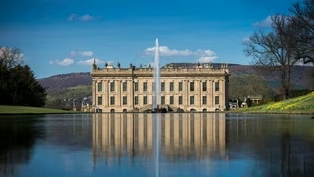
Chatsworth Through Time | Preview
Explore the history, architecture, landscape and artworks of Chatsworth House. (30s)
Providing Support for PBS.org
Learn Moreabout PBS online sponsorship New Episode
 New Episode
- Arts and Music

Innovative musicians from every genre perform live in the longest-running music series.


 New Episode






 New Episode
 New Episode

Support for PBS provided by:
Chatsworth Through Time is a local public television program presented by CPTV